
- Education
- Diamond 4Cs & Grading
- Best Colour and Clarity for Each Diamond Shape
Diamond 4Cs & Grading
Best Colour and Clarity for Each Diamond Shape
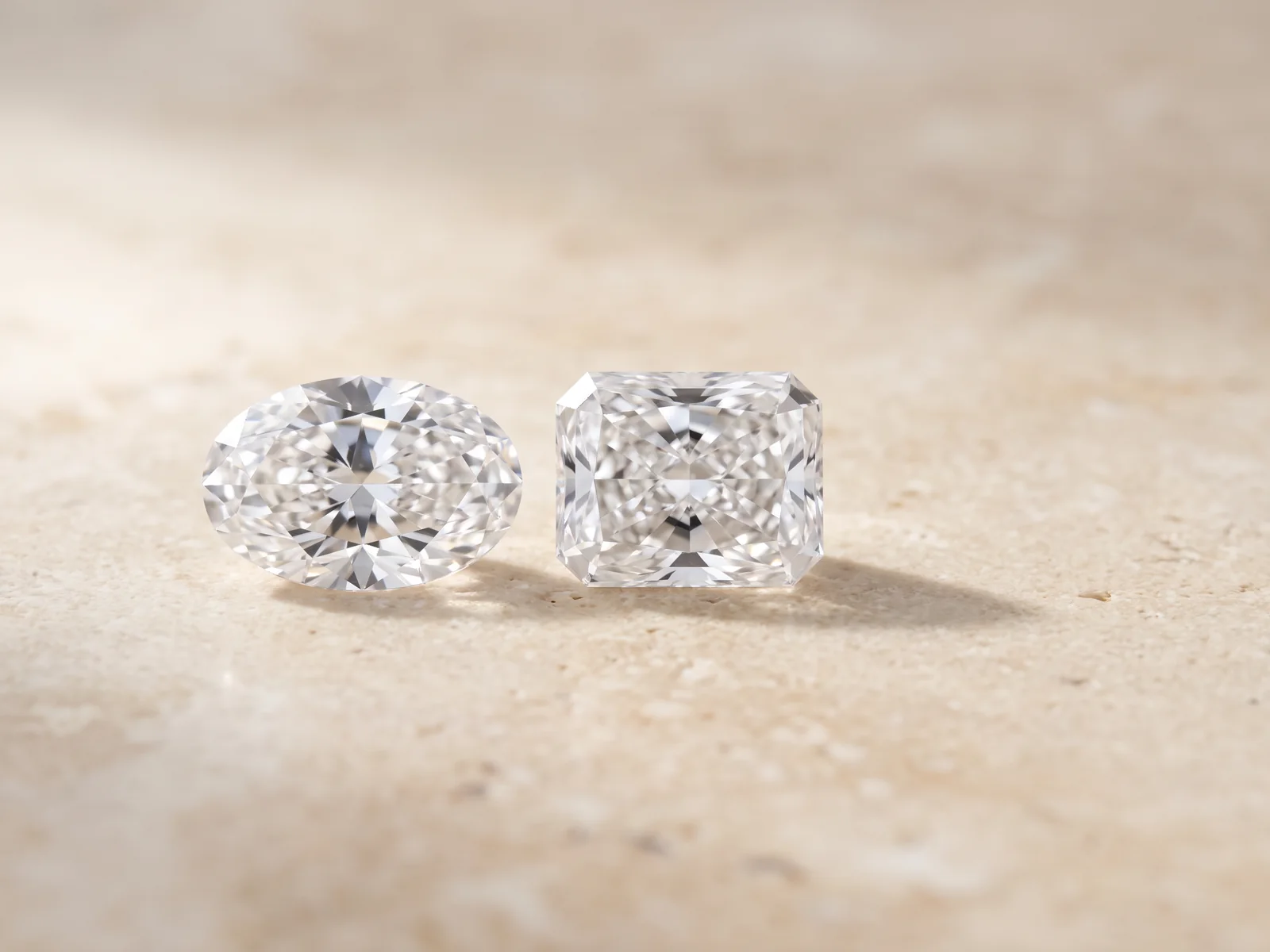
The best colour and clarity for each diamond shape is not the same, because the cut changes how much tint and how many inclusions you can actually see. Matching the grade to the shape keeps the diamond looking white and clean without paying for differences your eye will never pick up.
 Reviewed by Raj Sood, Graduate Gemologist (GIA), AJP (GIA)Master jeweller and Graduate Gemologist (GIA) · reviewed 4 November 2026
Quick answer
There is no single best combination: it depends on shape. Brilliant rounds hide colour and inclusions best, so H colour and SI1–VS2 clarity usually look white and eye-clean. Ovals, pears, cushions and princess cuts need about G–H and VS2. Step cuts such as emerald and Asscher show more, so aim for F–G and VS1 or better.
What is the best colour and clarity for each diamond shape?
Colour and clarity are two of the four Cs of diamond grading. Colour describes how free a white diamond is from a yellow or brown tint. Clarity describes how free it is from inclusions (internal features such as tiny crystals, feathers and clouds) and blemishes (marks on the surface). The grading scales are the same for every shape, but the shape changes how much of each you can see. A round brilliant and an emerald cut with identical reports can look quite different on the hand.
| Shape | Facet style | Colour (white metal) | Clarity for eye-clean | Why |
|---|---|---|---|---|
| Round brilliant | Brilliant | H–I | SI1–VS2 | Strongest light return; masks tint and small inclusions |
| Princess | Brilliant | G–H | VS2–SI1 | Colour gathers in the four corners |
| Cushion | Brilliant or 'crushed ice' | G–H | VS2 | Deeper pavilion and softer facets show warmth |
| Radiant | Modified brilliant | G–H | SI1–VS2 | Hides inclusions well, but corners hold colour |
| Oval | Brilliant | G–H | VS2–SI1 | Colour shows at the two ends |
| Pear and marquise | Brilliant | G–H | VS2–SI1 | Points collect colour; inclusions there are easy to see |
| Heart | Brilliant | G–H | VS2 | Lobes and point collect warmth |
| Emerald | Step | F–G | VS1 or better | Large open table shows almost everything |
| Asscher | Step | F–G | VS1 or better | Deep step facets leave little to hide behind |
These are starting points for stones of about 1 carat set in white gold or platinum. Smaller stones can usually drop a grade, larger ones may need to go up one, and yellow or rose gold changes the colour advice considerably. Each of those adjustments is covered below. If you are still deciding whether to spend on colour or clarity first, that guide sets out the trade-off in general terms; this page applies it shape by shape.
What does the lab check for colour and clarity?
A grading lab such as GIA or IGI assesses colour with the diamond face-down on a white tray, under controlled daylight-balanced light, comparing it with a set of master stones of known grade. Looking through the side of the stone removes the sparkle, so the grader sees body colour on its own. The scale runs from D (colourless) to Z (light yellow or brown), and our explainer on how the D-to-Z colour scale works covers each band in detail.
- D–F: colourless. Differences between them are very hard to see even for trained graders.
- G–J: near colourless. Most engagement diamonds sit here.
- K–M: faint colour, visible face-up in larger stones.
- N–Z: very light to light colour.
Clarity is graded face-up at 10× magnification. The grader weighs five things: the size of each inclusion, how many there are, where they sit, what type they are, and their relief (how much they contrast with the diamond around them). The eleven grades are FL, IF, VVS1, VVS2, VS1, VS2, SI1, SI2, I1, I2 and I3. The full clarity scale from FL to I3 explains each one; at the extremes are flawless and internally flawless diamonds, which are rare and priced accordingly, and the included I1 to I3 grades, where inclusions are usually visible without magnification.
The key point: neither grade takes shape into account. A report tells you how much colour and how many inclusions the stone has. It does not tell you how much you will see once the stone is cut into a particular shape and sitting face-up in a ring. That is the gap this guide fills.
One more line on the report matters here: fluorescence, a glow some diamonds give off under ultraviolet light. Medium to strong blue fluorescence can make an I or J stone look slightly whiter in daylight. In rare cases very strong fluorescence makes a stone look faintly hazy, so if the report says Strong or Very Strong, ask to see it in daylight.
Why does diamond shape change how colour shows?
Face-up, you are looking at light that has bounced around inside the diamond before coming back to your eye. The longer that light path, and the more it passes through thick parts of the stone, the more body colour it picks up. Brilliant facets also break light into many small flashes, which distracts the eye from tint.
- Rounds return the most light evenly across the face, so they mask colour best. That is why an I colour diamond often looks white in a well-cut round.
- Points and corners (pear, marquise, heart, princess, radiant) are where light paths are longest and facets are crowded, so warmth collects there. You often see a slightly warmer tip even when the centre looks white.
- Elongated shapes such as ovals show colour at the ends, more so in long ratios above about 1.45.
- Step cuts have broad, flat facets and fewer flashes of light, so body colour is less disguised.
- Deep stones of any shape show more colour than shallower ones, because light travels further through the diamond.
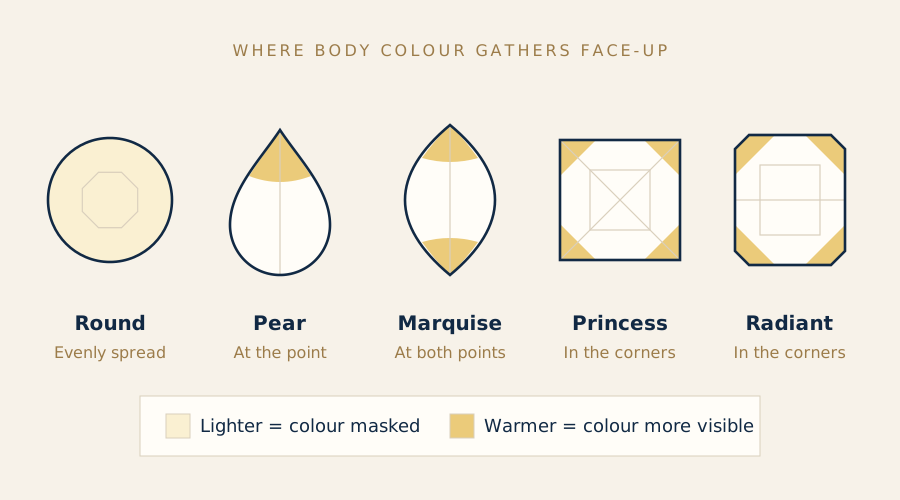
In practice, that means most fancy shapes in white metal need about one colour grade higher than a round to look equally white. H colour is the usual dividing line: in a round it looks white to almost everyone, while in a pear or radiant some people start to notice warmth in the tips and prefer G colour stones instead.
Why do step cuts show inclusions more than brilliant cuts?
Brilliant cuts (round, oval, pear, cushion, princess, radiant, heart, marquise) have dozens of small triangular and kite-shaped facets. They scatter light into a busy pattern of bright and dark flashes, and small inclusions get lost in it. Step cuts (emerald and Asscher) have long, parallel facets running like stairs around a large flat table. That produces broad flashes of light and dark, sometimes called the hall-of-mirrors effect, with a clear window into the stone. An inclusion in that window has nothing to hide behind.
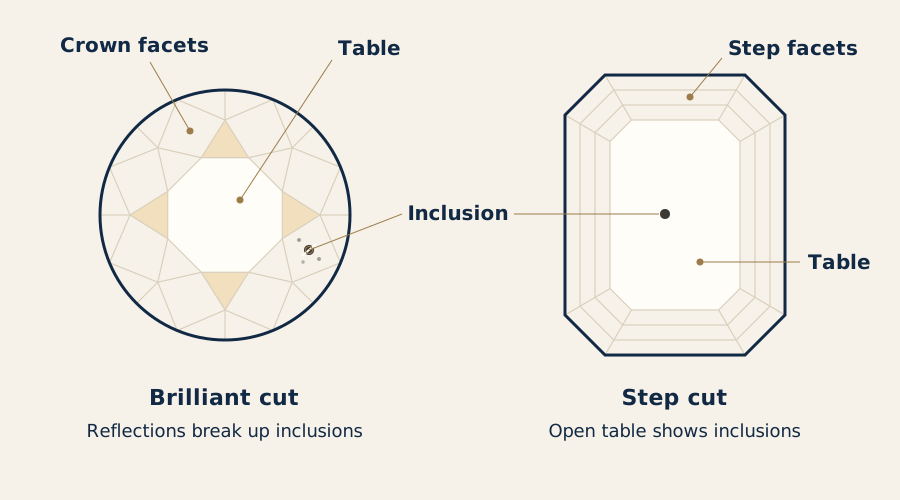
This is why the eye-clean line moves by shape. In a round or radiant, a carefully chosen SI1 is often eye-clean, and in some well-cut rounds even a stone near the point where SI2 can still look clean passes at normal viewing distance. In an emerald or Asscher cut, most people find VS1 is the safe floor. Our guide to what VS1 clarity looks like shows typical inclusions at that grade.
Position matters in brilliant shapes too. Inclusions near the girdle (the thin outer edge) are often hidden by claws. Inclusions under the table are the most visible. A feather (a small internal crack) at the point of a pear, marquise or heart, or at the corner of a princess, is worth avoiding, because those are the thinnest parts of the stone.
Not sure which one is right?
Send us the stones you are looking at and our gemologist will tell you which to choose and why.
What colour and clarity suits round, princess, cushion and radiant diamonds?
Round brilliant. The most forgiving shape on both counts. In white metal, H or I colour looks white to most people, and SI1 or VS2 is usually eye-clean. Going higher than G colour or VS2 clarity buys rarity and peace of mind more than a visible difference. VS2 clarity diamonds are a common sweet spot for rounds of 1 to 2 carats.
Princess cut. A square brilliant with sharp corners. Colour collects in the corners, so G–H is the usual range in white metal. Clarity of VS2 or a well-placed SI1 is generally eye-clean, but check the corners carefully: an inclusion there is both visible and a weak point.
Cushion. Cushions come in two broad styles. Older-style cushions with larger facets show colour and inclusions more; modern 'crushed ice' cushions, with many small facets, hide inclusions well but can look slightly warmer. G–H colour and VS2 clarity suit most cushions. If you are sensitive to warmth, G is the safer choice.
Radiant. A rectangular or square shape with trimmed corners and brilliant faceting. It hides inclusions almost as well as a round, so SI1 is often eye-clean, but its depth and corners hold colour, so G–H is a sensible target in white metal.
What is the best colour and clarity for oval, pear, marquise and heart diamonds?
These four shapes share brilliant faceting and at least one end where colour gathers. The advice is similar for all of them: G–H colour and VS2–SI1 clarity in white metal, with the inclusions kept away from the points.
- Oval: colour shows at both ends, more noticeably in long ovals. G–H is the usual range. VS2 or a clean SI1 is generally eye-clean, because the faceting is lively.
- Pear: the point shows warmth first. Choose G–H and avoid any inclusion at or near the tip.
- Marquise: two points, so two places for colour to gather. G–H colour; inclusions at either point are both visible and a risk.
- Heart: warmth collects in the lobes and the point. G–H and VS2 are the usual choices, keeping the cleft and point free of feathers.
A dark bow-tie (a band across the middle of an oval, pear or marquise) is a cut issue, not a colour or clarity issue, so a higher grade will not fix it. Terms like bow-tie, relief and girdle are defined in our jewellery glossary if you meet them on a listing.
Related guideColour vs Clarity: Which to PrioritiseWhat is the best clarity for emerald cut and Asscher diamonds?
Emerald cut. A rectangle with cut corners and step facets. With its open table, clarity is the first grade to protect: VS1 is the usual minimum for a stone that looks clean, and many buyers choose the VVS2 grade in larger stones so that nothing at all shows through the window. Colour matters too, because there is little sparkle to disguise it. F–G is the usual range in white metal; some people are happy with H in a smaller stone.
Asscher. A square step cut with deep corners and a characteristic 'windmill' pattern when viewed from above. It is deeper than an emerald cut, so it can show colour slightly more. F–G colour and VS1 or better clarity are typical. Stepping up to VVS1 diamonds is a personal choice; most people cannot tell VVS1 from VS1 without a loupe.
Step cuts reward a good look at the actual stone. Two VS1 emerald cuts can look different, one with a faint crystal hidden near the corner, the other with a feather visible through the table. Ask for a clear face-up video before deciding.
Does metal colour or carat size change the colour and clarity you need?
Metal colour. Metal reflects into the diamond. White gold and platinum make any warmth easier to see, which is why the table above is for white metal. Yellow and rose gold warm the stone anyway, so colour for yellow gold can drop by two or three grades: I–J in a round, H–J in most fancy shapes and about H in an emerald cut usually look right. Paying for D–F in yellow gold buys little you can see. A popular option is a white metal head (the claws holding the stone) on a yellow gold band, which keeps a higher colour looking crisp.
Carat size. Bigger stones have longer light paths and a larger table, so both colour and inclusions become easier to see. As a rough guide:
| Carat weight | Colour adjustment | Clarity adjustment |
|---|---|---|
| Under 0.50 ct | Can drop about one grade | SI1–SI2 often eye-clean in brilliants |
| 0.50–1.50 ct | Use the shape table as is | Use the shape table as is |
| 1.50–2.50 ct | Consider one grade higher | VS2 or better in most shapes |
| Above 2.50 ct | One grade higher, especially in step cuts | VS1 or better in most shapes |
Setting style also plays a part. A bezel (a rim of metal around the stone) or a halo of small diamonds hides inclusions near the edge and, in white metal, can make a stone look slightly whiter by contrast. Claws cover very little, so they leave more of the stone on show.
How much do colour and clarity change the price, natural or lab-grown?
For natural diamonds, colour and clarity have a big effect on price, and the jumps are not even. Moving from H to G, or from SI1 to VS2, typically costs less than moving from E to D or from VVS1 to IF, where rarity pushes prices up steeply. That is why matching the grade to the shape matters: buying an F VVS2 round when an H VS2 looks the same face-up spends money on something only a loupe can see.
| 1 ct round, good cut | Approximate price range (AUD) |
|---|---|
| Natural, H SI1 | about $5,000–$8,000 |
| Natural, G VS2 | about $6,500–$11,000 |
| Natural, E VVS2 | about $10,000–$18,000 |
| Lab-grown, G VS2 | about $800–$2,000 |
| Lab-grown, E VVS2 | about $1,000–$2,500 |
These are broad ranges only; prices move with the market and with cut quality, and fancy shapes usually cost somewhat less per carat than rounds. Lab-grown diamonds are real diamond grown in a laboratory rather than mined. They have the same hardness (10 on the Mohs scale) and refractive index (about 2.42) as natural diamond, and they cost much less. Because the price gap between grades is much smaller in lab-grown stones, many buyers simply choose higher colour and clarity. Lab-grown diamonds are graded by labs such as IGI on the same D–Z and FL–I3 scales; GIA now describes lab-grown stones more broadly, so check which lab and which format a report uses. Some lab-grown diamonds are treated after growth to improve colour, and the report should say so.
If you are comparing a diamond with moissanite (silicon carbide, 9.25 on the Mohs scale), note that its grades are not the same thing; see how moissanite is graded for colour and clarity before comparing reports side by side.
Browse diamonds by shape: natural and lab-grown
How do you choose the best colour and clarity for each diamond shape? Step by step
- Pick the shape first. Shape sets the starting grades: rounds can go lower, fancy brilliants need about one colour grade more, step cuts need more again on clarity.
- Decide the metal. White gold or platinum: use the shape table. Yellow or rose gold: drop colour two or three grades.
- Adjust for size. Under 0.50 ct, relax a grade; above about 1.50 ct, tighten one.
- Read the report. Confirm the lab, whether the stone is natural or lab-grown, any treatment, and the fluorescence.
- Check the plot. Look at where the inclusions sit. Avoid feathers at points and corners, and anything under the table of a step cut.
- Look face-up. Watch a video or view the stone in daylight at arm's length. If it looks white and clean, the grades are doing their job.
- Spend the rest on cut. Money saved on grades you cannot see is usually better spent on a well-cut stone or a little more carat weight.
Free consultation
Talk to a gemologist
Compare stones in person or online with Raj Sood, Graduate Gemologist (GIA), AJP (GIA).
Book a consultationShop this shape
FAQ
Common questions
What colour and clarity is best for a round diamond?
In white gold or platinum, H or I colour with SI1 or VS2 clarity usually looks white and eye-clean in a well-cut round. Rounds hide tint and small inclusions better than any other shape.
What is the best clarity for an emerald cut diamond?
VS1 is the usual minimum, because the large open table shows inclusions clearly. In stones above about 2 carats, many buyers move to VVS2 so nothing is visible through the window.
What colour and clarity should I choose for an oval diamond?
G–H colour and VS2 or a clean SI1 clarity suit most ovals in white metal. Colour tends to show at the ends, so long ovals benefit from the higher end of that range.
Can I choose a lower colour grade in yellow gold?
Yes. Yellow and rose gold warm the diamond anyway, so I–J in a round and around H–J in most fancy shapes usually look right. Very high colours such as D–F show little visible benefit in yellow gold.
Is VS2 good enough for a princess cut?
Usually, yes. VS2 is generally eye-clean in a princess cut, but check that no inclusion sits in a corner, where it is easier to see and the stone is thinnest.
Do lab-grown diamonds need the same colour and clarity?
The visual rules are the same, because lab-grown diamonds are real diamond with the same optics. The difference is price: higher grades cost much less in lab-grown, so many people choose G or better and VS or better.

Ask a gemologist
Not sure which diamond to choose?
Raj Sood is a Graduate Gemologist (GIA) and master jeweller. Bring the stones you are considering, or send the reports, and he will tell you honestly which one is better and why.
Keep learning
Related guides
 Diamond 4Cs & GradingColour vs Clarity: Which to Prioritise
 Diamond 4Cs & GradingUnderstanding Diamond Clarity Grades: FL to I3 Explained
 Diamond 4Cs & GradingDiamond Colour Grading
 Diamond 4Cs & GradingVS2 Clarity Diamonds
 Diamond 4Cs & GradingVS1 Clarity DiamondsDiamond 4Cs & GradingVVS2 Clarity DiamondsDiamond 4Cs & GradingVVS1 Clarity Diamonds
Explore more
More guides on this topic
Education