
Gemstones
Peridot Jewellery: What Makes Its Green Different?
Peridot jewellery has a green you can pick from across the room: brighter and more yellow than emerald, warmer than green sapphire. Here is why that colour happens, how tough the stone really is, and how to choose, set and care for it.
 Reviewed by Raj Sood, Graduate Gemologist (GIA), AJP (GIA)Master jeweller and Graduate Gemologist (GIA) · reviewed 4 November 2026
Quick answer
Peridot jewellery is set with gem-quality olivine, a magnesium iron silicate. Its green is different because iron is part of the crystal itself, so peridot only ever comes in yellowish to olive green, never blue or red. It rates 6.5–7 on the Mohs scale, so it suits earrings and pendants easily and rings with a protective setting.
What is peridot jewellery made from?
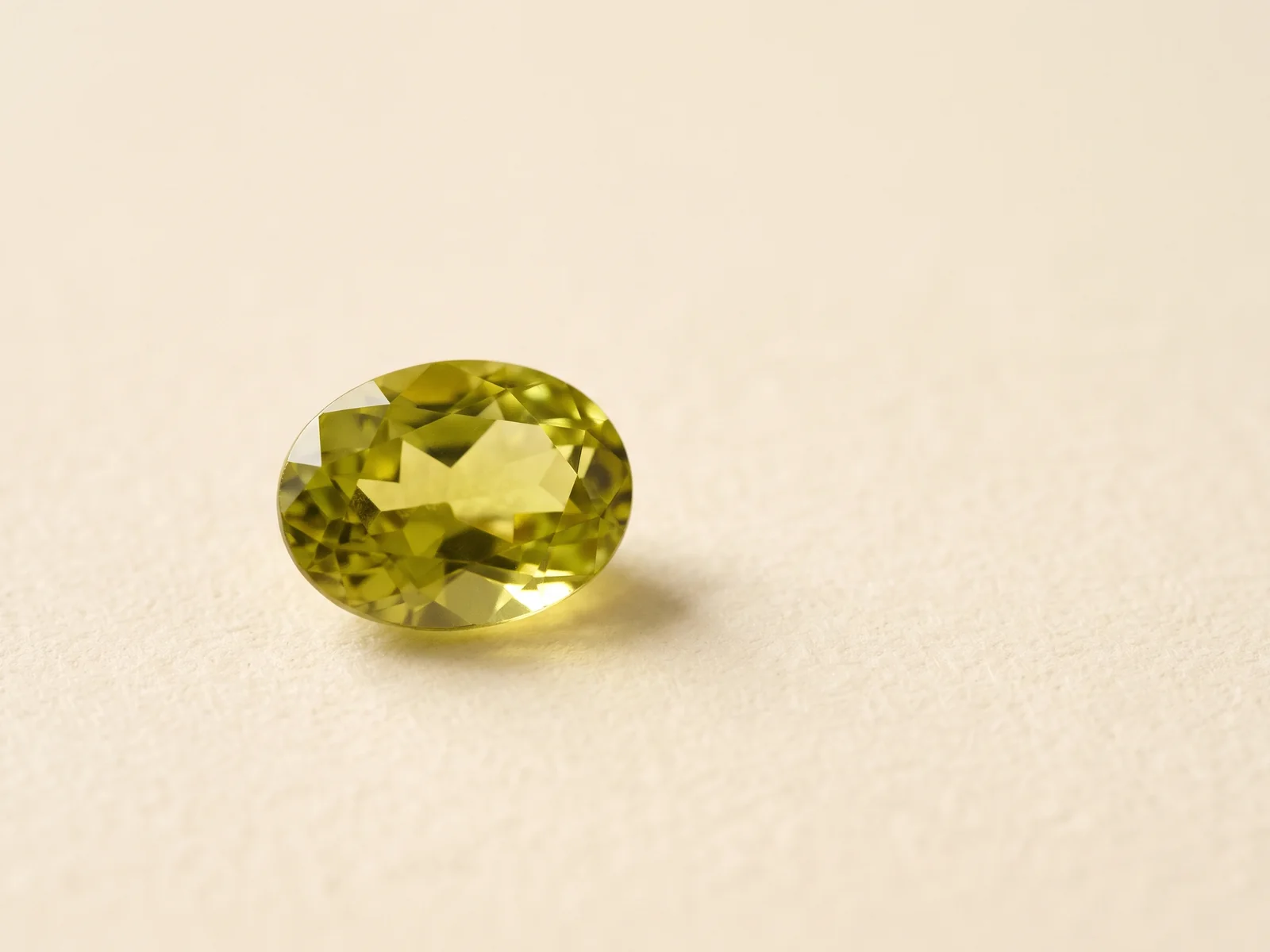
Peridot (said PAIR-ih-doh or PAIR-ih-dot; you will hear both in Australia) is the gem variety of olivine, a mineral that makes up much of the Earth's upper mantle. Chemically it is a magnesium iron silicate, (Mg,Fe)2SiO4. Gem peridot sits close to the magnesium-rich end of the olivine series, called forsterite, with a small share of iron standing in for some of the magnesium. That iron is the whole story of its colour. For sizes, shapes and sources at a glance, see our peridot gemstone profile.
Peridot forms deep underground and is carried to the surface by volcanic activity, often as green grains inside basalt or in lumps of mantle rock called xenoliths. It is one of the few gems also found in meteorites: a rare stony-iron type called a pallasite contains olivine crystals, although meteoritic peridot is a collector's curiosity rather than a jewellery staple.
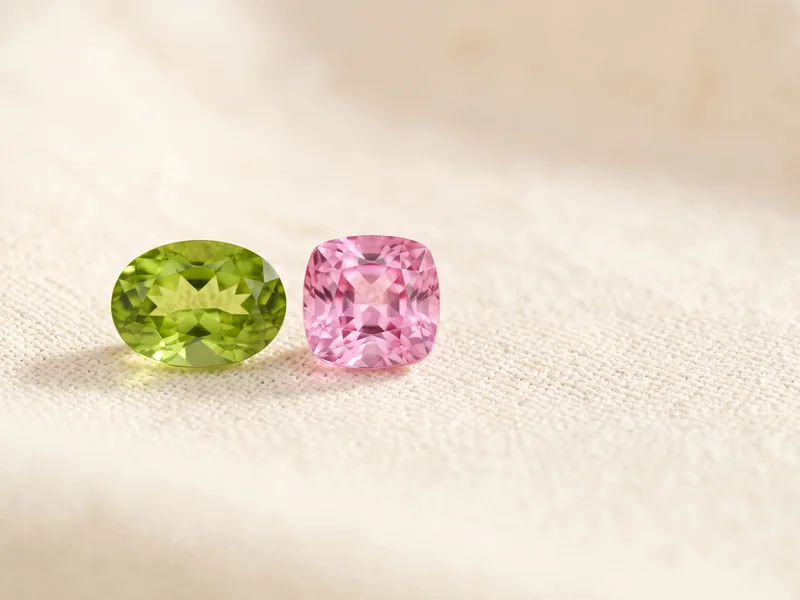
In jewellery you will meet peridot in rings, studs, drop earrings, pendants and bracelets, very often in yellow gold. It is one of the birthstones for August, which we cover alongside its partner stone in August's two birthstones, peridot and spinel. Peridot sits within our wider guide to coloured gemstones, and any term on this page you have not met before is explained in our plain-English jewellery glossary.
What makes peridot's green different?
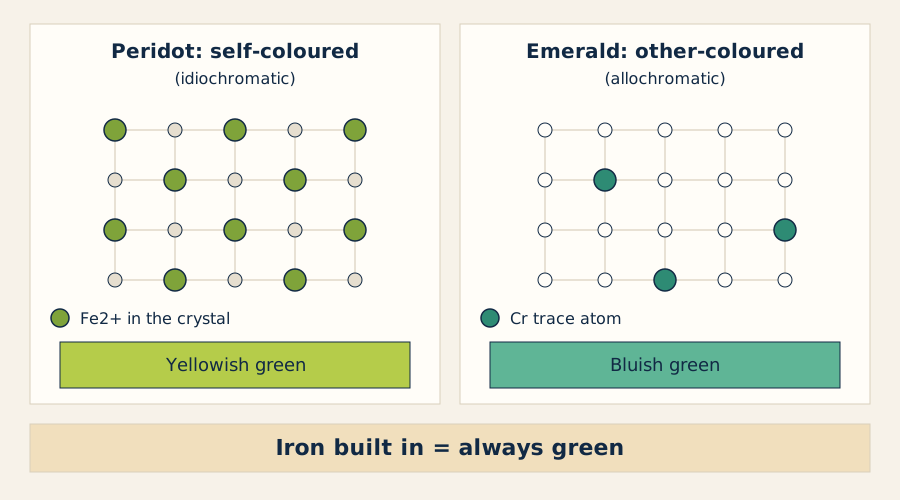
Most coloured gems are allochromatic, meaning 'other-coloured'. The pure mineral is colourless, and a trace impurity adds the colour. Emerald is colourless beryl with a touch of chromium or vanadium; sapphire is colourless corundum with traces of iron and titanium. Peridot is idiochromatic, meaning 'self-coloured'. Iron, in its ferrous (Fe2+) form, is part of the crystal's own chemistry, not a stray guest. So every peridot is green, and peridot never comes in blue, pink or red.
The amount of iron sets the shade. Less iron gives a lighter, yellowish lime green; more pushes the colour towards olive and then brownish green. Iron absorbs light at the red end of the spectrum and some of the blue, so what reaches your eye is a green with a warm yellow undertone. That is why peridot looks unlike the cooler, bluish green of emerald or tsavorite garnet, even when the two sit side by side.
- Green with a hint of yellow: the most sought-after peridot colour looks clearly green with only a touch of yellow and no brown.
- Stable under any light: peridot looks much the same in daylight, LED and warm indoor light. It does not change colour the way alexandrite does.
- Rarely treated: unlike emerald, which is usually filled with oil or resin, or sapphire, which is usually heated, peridot is almost always untreated. The colour you see is the colour it grew with.
- Soft, slightly oily lustre: peridot's surface shine is described as vitreous to oily, giving a gentler glow than the hard, glassy flash of sapphire.
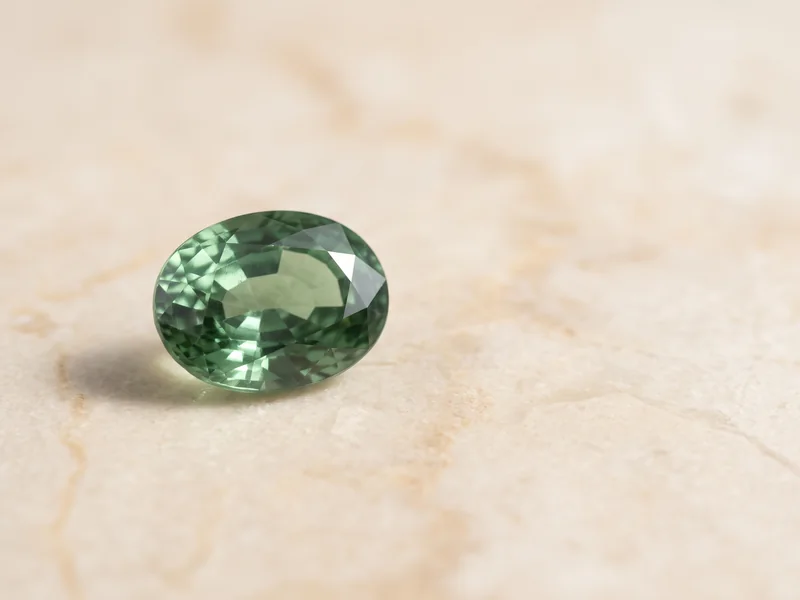
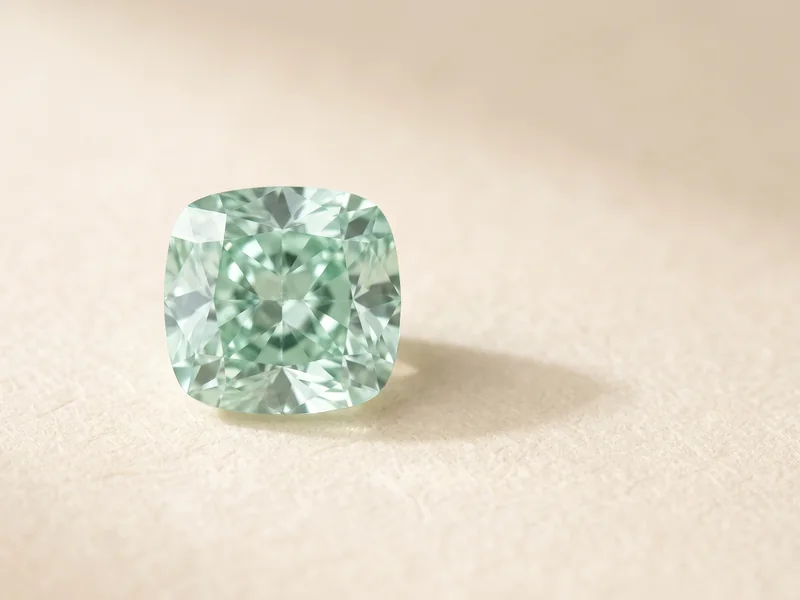
Green diamonds are a useful contrast. Their colour usually comes from natural radiation over very long periods, and many green diamonds on the market are treated; our page on how natural green diamonds get their colour explains the difference. In green sapphire, coloured by iron too, iron is only a trace impurity rather than a building block, which tends to give a cooler teal, mint or olive green rather than peridot's bright lime.
How does peridot compare with emerald, green sapphire and other green gems?
Peridot vs emerald is the comparison people ask about most, but there are several green stones worth knowing. The table sets out what causes each green, how it looks and the numbers a gemmologist would check.
| Gem | Cause of green | Typical shade | Mohs | Refractive index | Light behaviour |
|---|---|---|---|---|---|
| Peridot | Iron, built into the crystal | Yellowish to olive green | 6.5–7 | 1.65–1.69 | Double refraction, strong |
| Emerald | Chromium and/or vanadium | Bluish to pure green | 7.5–8 | 1.57–1.58 | Double refraction, weak |
| Tsavorite garnet | Vanadium and/or chromium | Vivid pure to bluish green | 7–7.5 | about 1.74 | Single refraction |
| Green sapphire | Iron (trace) | Teal, olive or mint | 9 | 1.76–1.77 | Double refraction, weak |
| Green tourmaline | Mostly iron | Mid to dark green, often olive | 7–7.5 | 1.62–1.64 | Double refraction, moderate |
| Green diamond | Natural radiation, or laboratory treatment | Pale to deep green | 10 | about 2.42 | Single refraction |
| Green glass (imitation) | Added colourants | Any green | about 5–6 | about 1.50–1.70 | Single refraction |
In short: peridot is the brightest yellow-green of the group and usually the most affordable for its size. Emerald is bluer and more saturated but nearly always included and treated. Green sapphire is far harder and the natural choice if your ring will take daily knocks. Diamond stands apart on hardness and brilliance; what sets diamond apart from other gems explains why.
Is peridot jewellery durable enough for everyday wear?
Two different properties decide how a gem wears. Hardness is resistance to scratching, measured on the Mohs scale from 1 to 10. Toughness is resistance to chipping and breaking. Peridot rates 6.5–7 for hardness. Ordinary household and outdoor dust contains quartz, which is 7, so over months and years a peridot ring worn daily will pick up fine scratches and rounded facet edges, especially on the table (the large top facet).
Peridot's toughness is rated fair. It has no easy cleavage plane (a direction along which a crystal splits cleanly), but it breaks with a shell-like fracture and can chip if a thin edge takes a hard knock. It is also sensitive to sudden temperature changes and to acids, which matters for cleaning and repairs. Here is how it compares for ring wear:
| Gem | Mohs hardness | Toughness | Ring suitability |
|---|---|---|---|
| Peridot | 6.5–7 | Fair | Occasional wear, or daily with a protective setting and care |
| Emerald | 7.5–8 | Poor to fair (fractures common) | Careful wear, protective setting |
| Green tourmaline | 7–7.5 | Fair | Occasional to regular wear |
| Tsavorite garnet | 7–7.5 | Good | Regular wear |
| Spinel | 8 | Good | Daily wear |
| Green sapphire | 9 | Excellent | Daily wear |
| Diamond | 10 | Good (can cleave) | Daily wear |
Earrings and pendants face far less wear, so peridot is an easy choice there. If hardness matters more to you than the exact shade, look at green sapphire for a harder-wearing ring. For August birthdays, choosing between peridot and spinel for August is worth reading, because spinel, at 8 on the Mohs scale and with good toughness, is noticeably harder-wearing on the hand.
Not sure which one is right?
Send us the stones you are looking at and our gemologist will tell you which to choose and why.
How do gemmologists identify peridot?
Peridot has a distinctive set of properties, so a trained gemmologist can usually confirm it in a few minutes at the bench. These are the checks we run:
- Refractive index: on a refractometer, peridot reads about 1.65–1.69. Refractive index measures how much a gem bends light.
- Birefringence: the gap between its two refractive index readings is about 0.035–0.038, which is high for a gem. Birefringence is the strength of double refraction.
- Doubling: because of that high birefringence, looking through the table with a 10× loupe you can often see the back facet edges doubled, like a slightly blurred double image. Glass, garnet and diamond show no doubling, and emerald and sapphire show very little.
- Lily pad inclusions: flat, disc-shaped stress fractures around tiny crystals, often chromite, that look like lily pads on a pond. They are close to a fingerprint for peridot. Small dark crystals and flakes of biotite mica also occur.
- Specific gravity: about 3.3–3.4, meaning it is roughly a quarter heavier than the same volume of quartz.
- Spectroscope: iron produces dark absorption bands in the blue part of the spectrum, roughly at 453, 473 and 493 nm.
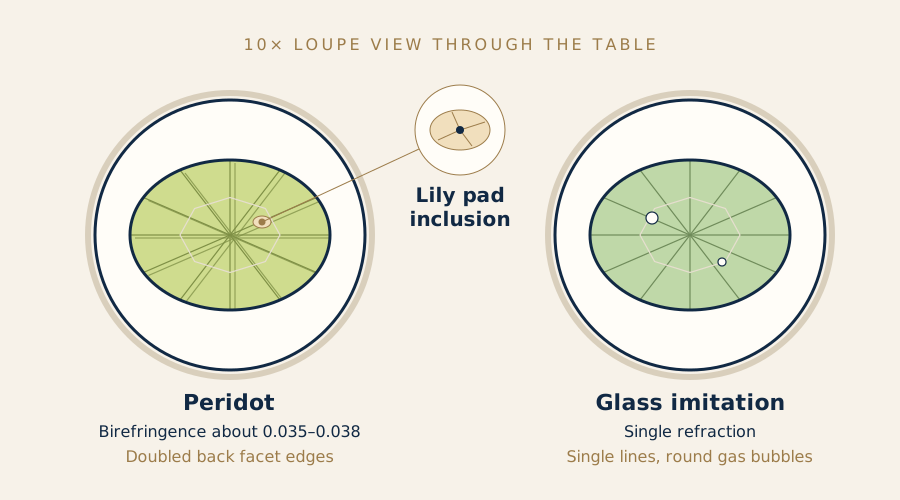
The usual imitation is green glass, which shows single refraction, round gas bubbles and sometimes swirl marks. Lab-created green spinel and synthetic corundum are occasionally used too, along with doublets (two pieces glued together). Synthetic forsterite exists, but it is uncommon in jewellery. If you want to follow the terms in a lab report, our definitions of refractive index and birefringence keep them simple.
Where does peridot come from, and is there Australian peridot?
Gem peridot is mined on several continents, and each source tends to produce a recognisable range of sizes and shades:
- Arizona, USA: the San Carlos Apache Reservation supplies much of the world's commercial peridot, mostly in small sizes that suit studs, accents and pendants.
- Pakistan: deposits high in the mountains of the Kohistan region, found in the 1990s, produce large, clean stones in a fine pure green. Many of the big peridots in today's market come from here.
- Myanmar: a historic source of large, well-coloured peridot.
- Egypt: Zabargad (St John's Island) in the Red Sea is the oldest recorded source, worked for thousands of years and the origin of many peridots in old European collections.
- China, Vietnam and Tanzania: active sources of commercial and some fine material.
Australian peridot does exist, but mostly as a geological rather than a jewellery story. Olivine is common in the younger volcanic rocks of eastern Australia, including the basalt plains of western Victoria, where green olivine nodules can be found in volcanic deposits such as those around Mount Noorat. Similar material occurs in parts of New South Wales and Queensland. Almost all of it is small, fractured or too dark to facet into anything larger than a tiny stone, so nearly all peridot in Australian jewellery is imported.
Origin rarely changes the price of everyday peridot. The exception is large, fine stones, where a Pakistani or Burmese origin may be noted by the seller. Our profile of peridot colour, sizes and sources in detail goes further into each deposit.
How is peridot graded, and what does peridot jewellery cost in Australia?
There is no universal grading report for peridot like the ones used for diamonds, so peridot is judged by eye on the same four factors used for most coloured stones:
- Colour: the most important factor. A saturated green with only a hint of yellow commands the highest prices; lighter, yellower or brownish stones cost less.
- Clarity: good peridot is expected to be eye-clean, meaning no inclusions visible without magnification. Visible lily pads or dark crystals lower the value.
- Cut: ovals, cushions, rounds, pears and emerald cuts are common, the same outlines set out in our overview of gem and diamond shapes. Paler rough is often cut a little deeper to intensify the colour; look for even brightness without a dark or washed-out centre.
- Carat: stones under about 3 carats are common. Clean peridot over 10 carats is much rarer and costs more per carat.
| Quality | Typical size | Approximate price per carat (AUD) |
|---|---|---|
| Commercial: lighter, yellowish or slightly brownish | Under 1 ct | about $30–$100 |
| Good: mid green, eye-clean | 1–3 ct | about $80–$250 |
| Fine: saturated green, eye-clean, well cut | 3–10 ct | about $200–$500 |
| Exceptional: large, clean, fine colour | 10 ct and above | about $400–$1,000 or more |
These are broad ranges for loose natural stones only; prices move with the market and with each stone's exact colour and clarity. In finished peridot jewellery, the metal, setting style and labour often cost more than the stone itself, especially for smaller sizes. For comparison, green diamonds at the very top of the price scale can cost many times more per carat, and the range of natural and lab-created coloured stones we cover shows where peridot sits among the alternatives.
Browse natural gemstones, including peridot
Which settings suit a peridot ring, earrings and pendants?
Because peridot is softer than sapphire or diamond, the setting's job is to protect the edges and girdle (the stone's outer rim) while letting light in. Shape matters too: pears and other pointed outlines need a V-claw or bezel at the tip, and you can compare outlines in our catalogue of 34 cut styles. The common choices:
- Bezel or half-bezel: a rim of metal around the edge. The most protective option for a peridot ring worn often.
- Four or six claws: show more of the stone and let in more light. Fine for pendants and earrings; on a ring, choose sturdy claws and have them checked regularly.
- Halo: a ring of small diamonds around the peridot frames its green, makes the centre look larger and shields its edges from knocks. The same principles appear in our guide to halo and setting tricks that add visual size.
- Low profile: a peridot set closer to the finger catches less on clothing and surfaces than a tall cathedral setting.
- Metal colour: yellow gold warms peridot towards lime, white gold or platinum makes it look cooler and greener, and rose gold gives a softer contrast.
Peridot also works as a quiet personal touch rather than the centre stone: a small peridot set inside a band or under the head of a ring for an August birthday. Ideas like this are collected in hidden details for a personal custom ring.
Related guidePeridotHow do you clean and care for peridot jewellery?
Warm soapy water is always safe for peridot. Ultrasonic and steam cleaners are not recommended, because vibration and heat can enlarge existing fractures, and peridot can be damaged by sudden temperature changes. It is also attacked by acids, so keep it away from strong household cleaners and pool chemicals. If a peridot ring needs re-tipping, resizing or other heat work, the jeweller should remove the stone first.
- Soak. Leave the piece in lukewarm water with a few drops of mild dishwashing liquid for a few minutes.
- Brush gently. Use a soft toothbrush, paying attention to the back of the stone where soap and skin oils build up.
- Rinse at the same temperature. Use lukewarm running water, never hot or cold, with the plug in so nothing goes down the drain.
- Dry. Pat dry with a soft, lint-free cloth.
- Store it separately. Keep peridot in its own soft pouch or compartment, away from diamonds and sapphires, which can scratch it.
- Check the setting. Have claws or bezels checked every 6–12 months, and take peridot rings off for gardening, the gym and cleaning.
Storage matters more for peridot than for harder gems; our guide to storing pieces so harder gems cannot scratch them covers trays, pouches and humidity. If you are taking peridot jewellery on holiday, our tips for travelling with fine jewellery help keep it safe in transit.
Free consultation
Talk to a gemologist
Compare stones in person or online with Raj Sood, Graduate Gemologist (GIA), AJP (GIA).
Book a consultationShop this shape
FAQ
Common questions
Can you wear a peridot ring every day?
You can, but at 6.5–7 on the Mohs scale it will gradually scratch and its facet edges can wear. A bezel or halo setting, taking it off for rough tasks and an occasional re-polish keep it looking bright.
Is peridot more valuable than emerald?
Usually not. Fine emerald generally costs considerably more per carat than fine peridot, although an exceptional large peridot can cost more than a low-quality emerald.
Does peridot fade in sunlight?
No. Peridot's colour comes from iron in its crystal structure and is stable to light. It is more vulnerable to heat, sudden temperature changes and acids than to sunlight.
Why does my peridot look dull?
Usually it is a film of soap, lotion and skin oil on the back of the stone, which warm soapy water and a soft brush will remove. If it still looks hazy, the surface may be scratched and a jeweller can re-polish it.
Is there lab-created peridot?
Synthetic forsterite can be grown in a laboratory, but it is uncommon in jewellery. Green imitations you are more likely to meet are glass, lab-created spinel or synthetic corundum, which a gemmologist can separate from natural peridot.
Is peridot found in Australia?
Olivine occurs in volcanic rock in western Victoria and parts of New South Wales and Queensland, but it is mostly too small or fractured to facet. Almost all peridot in Australian jewellery is imported, mainly from Arizona, Pakistan, Myanmar and China.

Ask a gemologist
Not sure which diamond to choose?
Raj Sood is a Graduate Gemologist (GIA) and master jeweller. Bring the stones you are considering, or send the reports, and he will tell you honestly which one is better and why.
Keep learning
Related guides
 GemstonesPeridot
 GemstonesAugust Birthstone: Peridot and Spinel
 GemstonesGreen Sapphire
 Care, Repairs & RemodellingHow to Store JewelleryGemstonesGemstones | Coloured Gemstones, Birthstones and Custom Jewellery
 Fancy Colour DiamondsGreen Diamonds
 Engagement Rings & SettingsSettings That Make a Diamond Look Bigger
 Engagement Rings & SettingsHidden Details That Make a Custom Engagement Ring Personal
Explore more
More guides on this topic
Education