
Gemstones
Peridot Guide: Colour, Hardness, Origins and Value
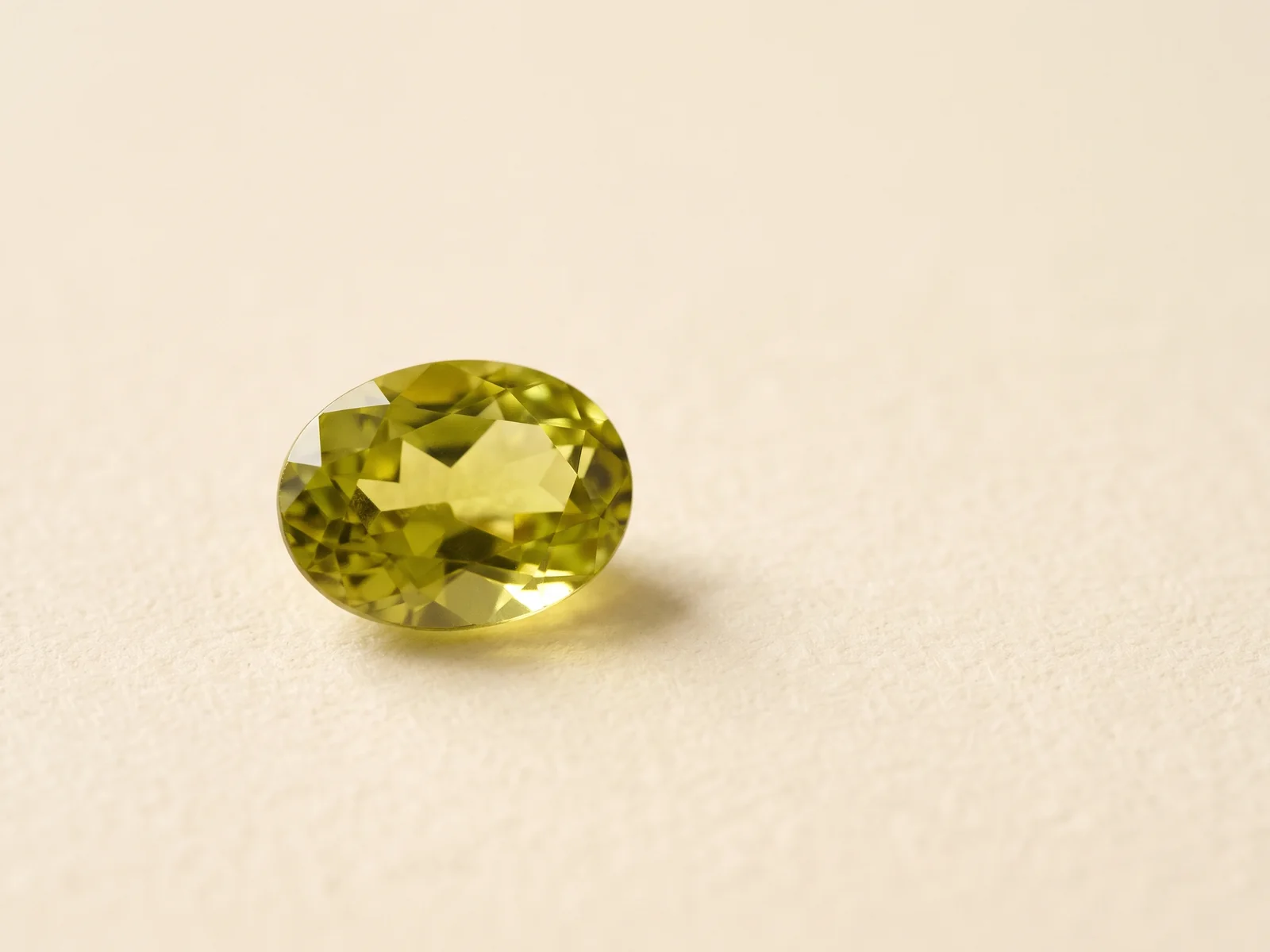
Peridot is one of the few gems that only ever comes in one colour family, and one of the few that is almost never treated. Here is what decides its colour, how well it wears in a ring, where it comes from and what makes one stone worth more than another.
 Reviewed by Raj Sood, Graduate Gemologist (GIA), AJP (GIA)Master jeweller and Graduate Gemologist (GIA) · reviewed 4 November 2026
Quick answer
Peridot is the gem variety of olivine, a magnesium-iron silicate whose iron gives it a green colour from yellowish lime to olive. It rates 6.5–7 on the Mohs scale with fair to good toughness, so it suits pendants and earrings and, with a protective setting and care, rings. It is rarely treated; colour, clarity and size drive value.
What is peridot?
Peridot is the gem-quality form of olivine, one of the most common minerals in the Earth's upper mantle. Chemically it is a magnesium-iron silicate, written (Mg,Fe)2SiO4. Most gem peridot sits close to the magnesium-rich end of the olivine series, a mineral called forsterite, with a small amount of iron swapped in. That iron is what makes it green.
Because the colour comes from the gem's own chemistry rather than from a trace impurity, peridot is called idiochromatic (self-coloured). This is unusual. Corundum (sapphire), beryl (emerald) and tourmaline owe their colours to small traces of other elements, which is why they come in many colours. Peridot only comes in green, from a pale yellowish lime to a deep olive, with no blue, red or pink varieties.
Peridot forms deep underground, at roughly 30–80 kilometres down, and reaches the surface in two main ways: carried up as chunks (called xenoliths) inside basalt lava, or exposed in slices of mantle rock pushed up during mountain building. A small amount even arrives from space, in a rare type of stony-iron meteorite called a pallasite. If you are comparing it with other coloured stones, our overview of coloured gemstones and birthstones puts peridot in context, and any unfamiliar term here is explained in our plain-English jewellery glossary.
The key physical numbers: a refractive index (how strongly the stone bends light) of about 1.65–1.69, a specific gravity (density compared with water) of about 3.32–3.37, and a hardness of 6.5–7 on the Mohs scale. Peridot has no strong cleavage, meaning it does not tend to split along flat planes, but it breaks with a curved, shell-like (conchoidal) fracture if struck hard.
What colour is peridot, and why is it always green?
Peridot colour is set by how much iron the crystal contains. Less iron gives a lighter, brighter yellowish green; more iron pushes the colour deeper and towards olive, and too much adds a brownish tone. The colours most people prefer sit in the middle: a lively, saturated green with only a slight yellow tint and no brown.
- Pale lime or yellowish green: bright and cheerful, common in small stones, usually priced lower.
- Pure grass green with a slight yellow tint: the most valued peridot colour, especially in larger sizes.
- Deep olive green: rich, but can look dark in smaller or deep-cut stones.
- Brownish green: higher iron content; generally the least valued.
Peridot looks noticeably different under different light. In daylight it tends to look greener; under warm indoor lighting the yellow component comes forward. It is worth viewing any stone in both before deciding. Unlike some green gems, peridot's colour is stable: it does not fade in sunlight and is not changed by heat treatment.
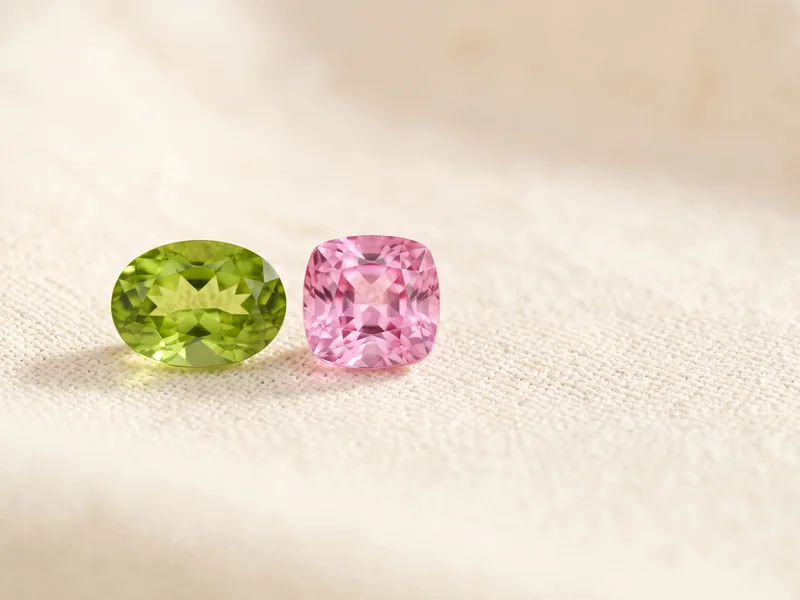
That yellow-leaning, slightly oily green is what separates peridot from emerald and tourmaline at a glance. Our article on why peridot's green looks different from other green gems goes deeper into the colour science. Peridot is also one of the two modern birthstones for August; see the August birthstones, peridot and spinel if you are choosing a birthday piece.
Related guidePeridot Jewellery: What Makes Its Green Different?How hard is peridot, and is it tough enough for a ring?
Two different properties decide how a gem wears. Hardness (the Mohs scale) is resistance to scratching. Toughness is resistance to chipping and breaking when knocked. Peridot is 6.5–7 for hardness and rated fair to good for toughness.
The hardness number matters more than it looks. Everyday dust contains quartz, which is 7 on the Mohs scale. Anything at or below 7 will slowly be scuffed by that dust, so a peridot worn daily in a ring will gradually lose the crispness of its facet edges and its polish. Peridot is also sensitive to sudden temperature changes and to acids, which a hardness number does not tell you.
| Gem | Mohs hardness | Toughness | Ring wear |
|---|---|---|---|
| Peridot | 6.5–7 | Fair to good | Occasional, or daily with a protective setting and care |
| Moonstone | 6–6.5 | Poor (cleavage) | Occasional; bezel recommended |
| Labradorite | 6–6.5 | Fair (cleavage) | Occasional |
| Sunstone | 6–6.5 | Fair | Occasional |
| Kunzite | 6.5–7 | Poor (perfect cleavage) | Pendants and earrings preferred |
| Iolite | 7–7.5 | Fair | Daily with care |
| Jadeite and nephrite | 6–7 | Exceptional | Daily |
| Chrysoberyl | 8.5 | Excellent | Daily |
| Sapphire | 9 | Excellent | Daily |
| Diamond | 10 | Good (has cleavage) | Daily |
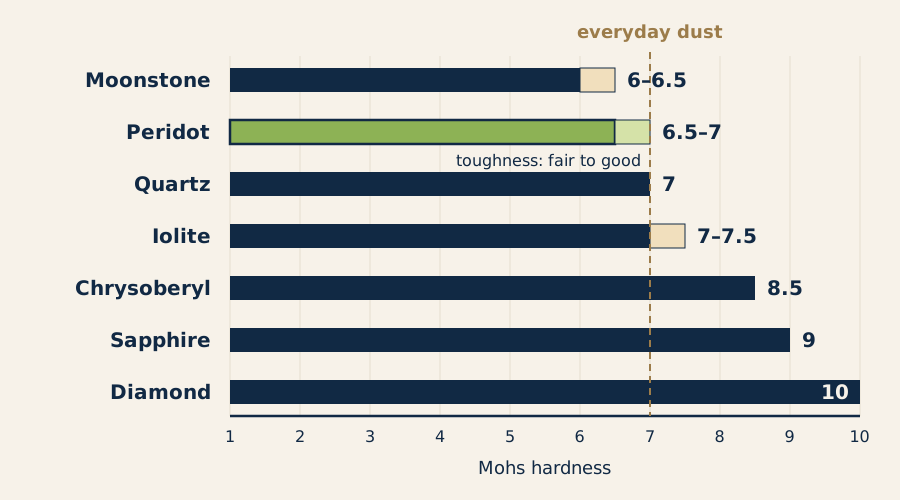
Peridot is a little more robust than the feldspar gems: moonstone's softer, cleavage-prone feldspar, labradorite with its flashes of colour and glittering sunstone all sit around 6–6.5. It is similar in hardness to kunzite, which splits easily along its cleavage, but tougher. For a green-to-yellow stone that can take hard daily wear, chrysoberyl at 8.5 on the Mohs scale is much more durable, while the exceptional toughness of jadeite and nephrite comes from their interlocking fibres, not their hardness. Violet-blue iolite is a close match to peridot in hardness and sensitivity.
So is a peridot engagement ring a good idea? It can be, if you go in with clear expectations. Choose a setting that protects the edges, take the ring off for gardening, gym work and cleaning, and expect to have it repolished every several years if it is worn daily. If you want a ring that shrugs off decades of rough wear, a harder stone is the more practical choice.
Is peridot treated?
Usually not. Heating, the most common gem treatment, does not improve peridot's colour because that colour is fixed by its iron content. The great majority of peridot on the market is untreated. Occasionally, stones with surface-reaching fractures are filled with oil or resin to make the cracks less visible. This is uncommon, but a reputable seller should disclose it, and a lab report will note it.
Lab-created (synthetic) peridot has been grown, but it is rarely seen in jewellery because natural peridot is plentiful and affordable. Far more common are simulants, materials that only imitate peridot: green glass, green cubic zirconia and green synthetic spinel. None of these is peridot, and all can be separated with basic gemmological testing. Our A to Z of gemstone treatments explains how treatments and imitations are disclosed across all the common gems.
| Peridot | Emerald | Green tourmaline | Tsavorite garnet | Chrysoberyl | |
|---|---|---|---|---|---|
| Mineral | Olivine | Beryl | Tourmaline | Grossular garnet | Chrysoberyl |
| Cause of colour | Iron | Chromium, vanadium | Iron and other elements | Vanadium, chromium | Iron |
| Mohs hardness | 6.5–7 | 7.5–8 | 7–7.5 | 7–7.5 | 8.5 |
| Refractive index | 1.65–1.69 | 1.57–1.59 | 1.62–1.64 | about 1.74 | 1.74–1.76 |
| Birefringence | 0.035–0.038, strong | 0.005–0.009 | 0.014–0.021 | None | 0.008–0.010 |
| Typical treatment | Usually none | Oil or resin filling common | Sometimes heated | Usually none | Usually none |
The table shows why peridot vs emerald is an easy separation for a gemmologist: peridot's refractive index is higher, its doubling far stronger, and its green leans yellow where emerald leans blue.
Not sure which one is right?
Send us the stones you are looking at and our gemologist will tell you which to choose and why.
How do gemmologists identify peridot?
Peridot has one of the strongest identifying features of any common gem: birefringence of about 0.035–0.038. Birefringence means each ray of light entering the stone is split into two rays travelling at different speeds. In peridot the split is large enough that, looking through the table with a 10× loupe, the back facet edges appear doubled, like a slightly out-of-focus photograph. This effect is called doubling.
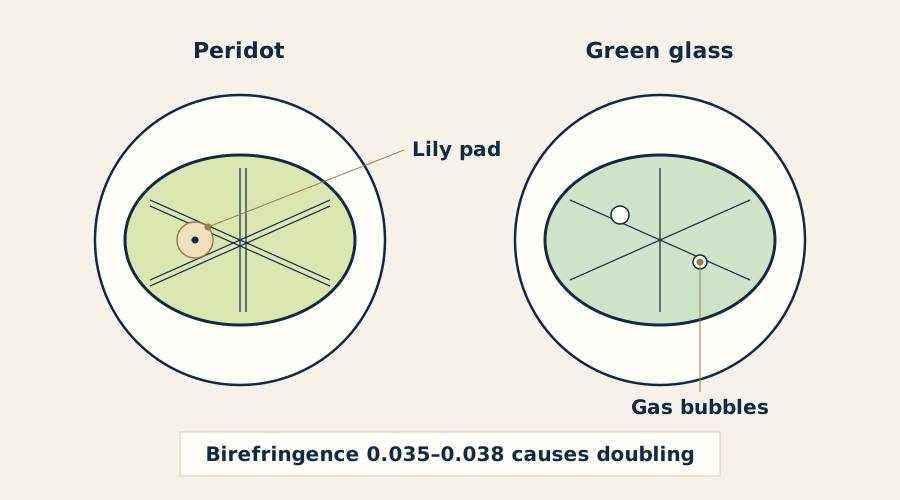
Inside, many peridots show lily pad inclusions: flat, round disc-shaped fractures, often with a tiny dark crystal (usually chromite) or a small cavity at the centre. They form when the trapped crystal or fluid expands and cracks the surrounding peridot. Lily pads are a classic sign of natural peridot. Small flakes of brown mica (biotite) and tiny black chromite crystals are also common.
- Refractometer: readings of about 1.65–1.69 with a large spread between them confirm peridot.
- Specific gravity: about 3.34, heavier than glass of similar size.
- Loupe: strong doubling plus lily pads or mica points to natural peridot.
- Glass: no doubling, a single refractive index, gas bubbles and swirl marks.
Where does peridot come from, and is there peridot in Australia?
Peridot is mined on several continents, and where it comes from often hints at the size and quality you can expect. For more on how origin is discussed for coloured stones generally, see our guide to how origin shapes the value of coloured gemstones.
| Source | What it is known for |
|---|---|
| Arizona, USA (San Carlos) | A major commercial source; mostly smaller stones, often under about 5 ct, from basalt |
| Pakistan (Kohistan region) | Large, clean, well-coloured stones found from the 1990s; many fine stones above 10 ct |
| Myanmar (Mogok area) | A historic source of large, fine peridot |
| Zabargad Island, Egypt (Red Sea) | The ancient source, worked since ancient Egyptian times; now largely historic |
| China, Vietnam, Ethiopia, Tanzania | Commercial production in various sizes and tones |
| Hawaii, USA | Small olivine grains in volcanic rock and beach sand; rarely cut |
| Pallasite meteorites | Extraterrestrial peridot; very rare and small as cut gems |
Peridot in Australia: olivine is common in Australia's younger volcanic fields, including the basalt plains of western Victoria within a few hours of Melbourne, and volcanic areas of New South Wales and Queensland. Crystals are usually small and fractured, though, and only occasional pieces are clean enough to cut. Most peridot sold in Australia is imported, mainly from the sources above. An Australian-found olivine is a lovely story, but expect a small stone.
What affects peridot value and price in Australia?
Peridot is one of the more affordable coloured gems, but prices climb steeply with size and quality. In order of importance, the factors are:
- Colour: a saturated, pure green with only slight yellow and no brown is worth the most. Lighter and browner stones cost less.
- Size: small stones are plentiful. Clean stones above about 10 ct are much rarer, so the price per carat rises with size.
- Clarity: peridot is expected to be eye-clean (no inclusions visible without magnification). Visible lily pads or dark crystals lower value.
- Cut: good proportions give even brightness; shallow stones show a washed-out window in the centre, and deep stones look dark.
- Origin: may add interest for some buyers, but quality matters more than country.
| Quality and size | Approximate price per carat (AUD) |
|---|---|
| Commercial, under 2 ct, lighter or slightly brownish | about $40–$150 |
| Good colour, eye-clean, 2–5 ct | about $100–$350 |
| Fine colour, eye-clean, 5–10 ct | about $250–$600 |
| Exceptional colour and clarity, 10 ct and above | about $500–$1,200 or more |
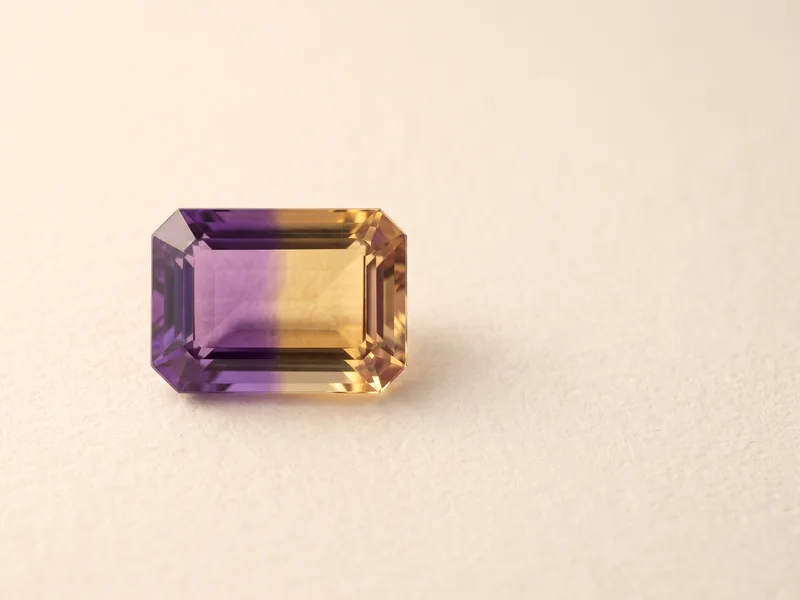
These are broad ranges only and vary with the market and the individual stone. A 2 ct peridot of good colour typically costs a fraction of an emerald or sapphire of similar size, which is part of its appeal for larger pendants and cocktail rings. Bicoloured ametrine, a two-tone quartz sits in a similar price band if you are comparing affordable coloured stones.
Browse natural gemstones
Which settings suit a peridot ring or pendant?
Because peridot can chip if knocked and slowly scuffs, the setting should protect its edges, especially in a ring.
- Bezel: a rim of metal around the whole girdle (the outer edge). The most protective choice for a peridot ring worn often.
- Four or six claws: show more of the stone and let in more light; choose sturdy claws and have them checked regularly.
- Halo: small diamonds around the peridot add brightness and shield its edge.
- Lower profile: a stone sitting closer to the finger is knocked less often.
- Pendants and earrings: take much less wear, so any setting style works.
Yellow gold deepens peridot's warm green and is the traditional pairing; white gold and platinum make the green look cooler and crisper. Peridot also works well in multi-gem pieces, alongside the sky blue of turquoise, a softer opaque gem or the deep blue of lapis lazuli with its golden pyrite flecks, although both of those are softer still and need protective settings.
How do you clean and care for peridot?
Peridot is easy to keep bright if you avoid a few specific risks.
- Clean with warm water, a little mild dishwashing liquid and a soft toothbrush, then rinse and pat dry.
- Avoid ultrasonic and steam cleaners: vibration and heat can enlarge existing fractures.
- Avoid acids and harsh chemicals: peridot can be etched by acids, including some household cleaners.
- Avoid sudden temperature changes: do not go from hot water to cold, or near a flame or jeweller's torch without removing the stone.
- Store separately: harder gems and diamonds will scratch peridot if they rub together in a box.
- Take it off for gardening, the gym, cleaning and swimming in chlorinated pools.
If a peridot ring needs resizing or repair, the stone is usually removed first, because the heat of soldering can crack it.
How do you choose a peridot? Step by step
- Confirm what it is. Ask for natural peridot and whether any fracture filling has been used; for larger stones, a lab report gives certainty.
- Judge the colour in two lights. View it in daylight and under warm indoor light, and look for a saturated green without brown.
- Check clarity with a loupe. Aim for eye-clean; note any lily pads or dark crystals, especially near the edge where they could weaken the stone.
- Look at the cut. Tilt the stone; even brightness across the face is good, a pale centre window or dark patches are not.
- Compare measurements, not just carats. Peridot is fairly dense, so check the millimetre size face-up.
- Match the setting to the wear. A bezel or halo for a daily ring; lighter settings for pendants and earrings.
- Plan the care. Gentle cleaning, no ultrasonic, and a polish check every few years if worn daily.
Free consultation
Talk to a gemologist
Compare stones in person or online with Raj Sood, Graduate Gemologist (GIA), AJP (GIA).
Book a consultationShop this shape
FAQ
Common questions
Is peridot a precious or semi-precious stone?
The old precious and semi-precious split is a trade habit rather than a scientific category. Peridot is a natural gemstone valued on its colour, clarity and size, and fine large peridots can be quite valuable.
Can peridot be worn every day in a ring?
It can, with a protective setting such as a bezel and some care, but at 6.5–7 on the Mohs scale it will slowly scuff and may need repolishing every several years. Harder gems like sapphire or chrysoberyl wear better for hard daily use.
Does peridot fade in the sun?
No. Peridot's colour comes from iron in its structure and is stable in light. It is more sensitive to sudden temperature changes and acids than to sunlight.
How can you tell peridot from emerald?
Peridot is yellowish green, emerald bluish green. A gemmologist will also see strong doubling of the back facets in peridot, which emerald does not show, and a higher refractive index.
Is peridot found in Australia?
Yes, olivine occurs in Australian volcanic fields, including western Victoria, but gem-quality pieces are usually small. Most peridot sold in Australia is imported.
Is peridot usually treated?
Rarely. Heat does not improve its colour, so most peridot is untreated; occasionally fractures are filled with oil or resin, which should be disclosed.

Ask a gemologist
Not sure which diamond to choose?
Raj Sood is a Graduate Gemologist (GIA) and master jeweller. Bring the stones you are considering, or send the reports, and he will tell you honestly which one is better and why.
Keep learning
Related guides
 GemstonesPeridot Jewellery: What Makes Its Green Different?
 GemstonesAugust Birthstone: Peridot and Spinel
 GemstonesGemstone Treatments A to Z
 GemstonesGemstone Origins: Ceylon, Burma, Kashmir, Madagascar, MozambiqueGemstonesGemstones | Coloured Gemstones, Birthstones and Custom Jewellery
 GemstonesAmetrine
 GemstonesMoonstone
 GemstonesLabradorite
Explore more
More guides on this topic
Education