
Gemstones
August Birthstone: Peridot and Spinel, Their History, Colours and Durability
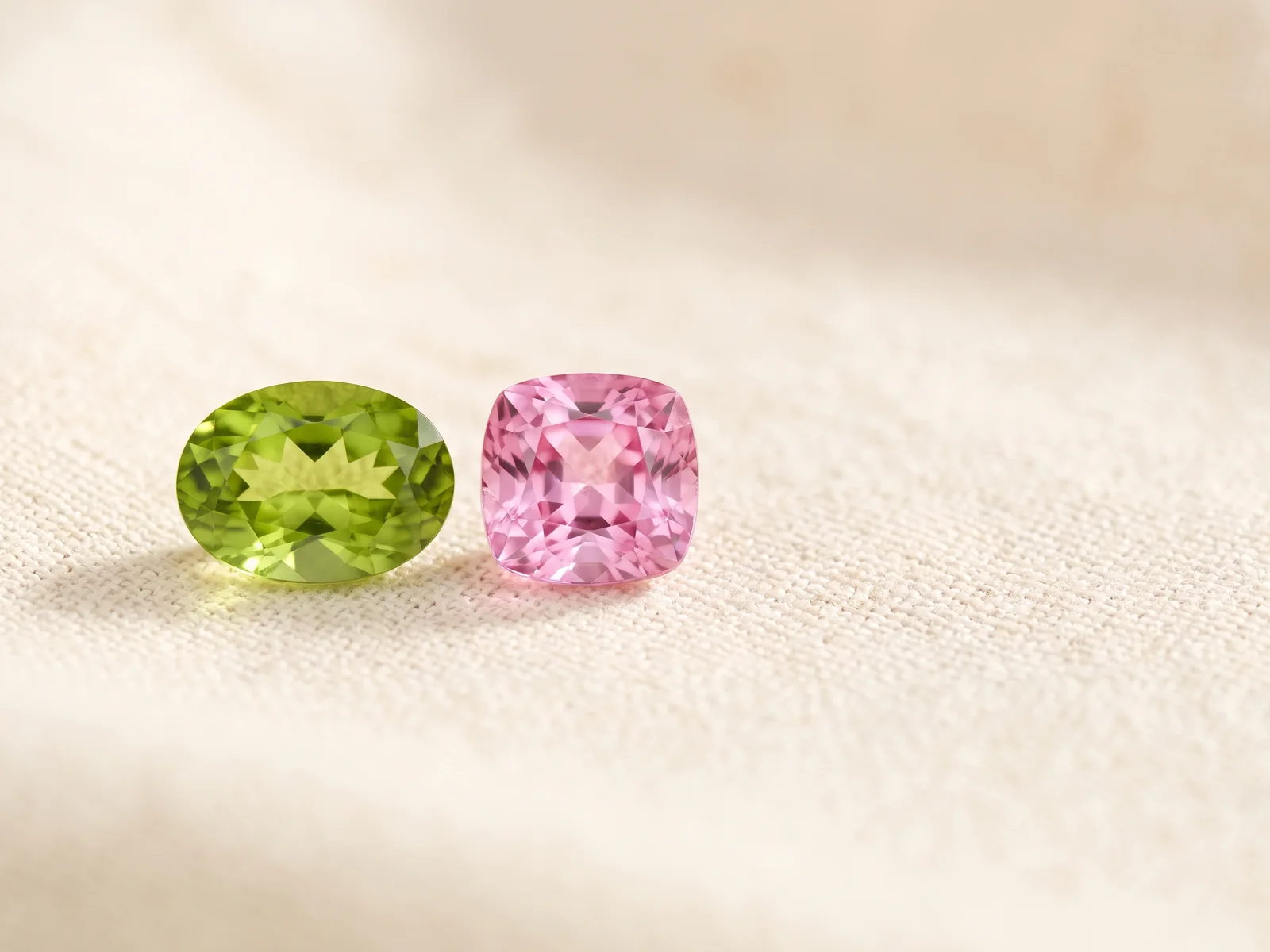
The August birthstone gives you a real choice: the bright green of peridot or the wide colour range of spinel, added to the list in 2016. Knowing how each one wears, and how to set it, matters before it goes into a ring you will wear every day.
 Reviewed by Raj Sood, Graduate Gemologist (GIA), AJP (GIA)Master jeweller and Graduate Gemologist (GIA) · reviewed 4 November 2026
Quick answer
The August birthstone is peridot, a yellowish-green to olive gem of 6.5–7 on the Mohs scale, with spinel added as a second August stone in 2016 and sardonyx as the older traditional choice. Spinel, at Mohs 8, comes in red, pink, blue and grey and is more durable for everyday rings; peridot suits pendants, earrings and protective bezel settings.
What is the August birthstone?
The modern August birthstone is peridot, the gem variety of the mineral olivine, known for its fresh yellowish-green to olive colour. In 2016 two American trade bodies, the American Gem Trade Association (AGTA) and Jewelers of America, added spinel as a second August stone. Older lists also name sardonyx, a banded red-brown and white form of chalcedony (a fine-grained quartz) long used for cameos and signet rings. Our overview of coloured gemstones and birthstones shows where all three sit among the other gem families.
So if you were born in August, you can choose a green stone that is a little soft for rings, a harder stone that comes in almost every colour, or a patterned stone with an ancient history. Australian jewellers generally follow the American modern list, so peridot and spinel are the two people ask for most. For gift ideas across all twelve months, see our page on birthstone jewellery in Melbourne, and if a technical word below is new to you, our glossary of jewellery terms explains it.
| Peridot | Spinel | Sardonyx | |
|---|---|---|---|
| Mineral | Olivine (magnesium-rich forsterite) | Spinel | Chalcedony (quartz family) |
| Chemistry | (Mg,Fe)2SiO4 | MgAl2O4 | SiO2 |
| Colours | Yellowish green to olive and brownish green | Red, pink, orange, purple, lavender, blue, grey, black | Bands of red-brown and white |
| Mohs hardness | 6.5–7 | 8 | 6.5–7 |
| Toughness | Fair to good | Good | Good |
| Refractive index | about 1.65–1.69 | about 1.71–1.72 | about 1.53–1.54 |
| Optics | Doubly refractive, strong doubling | Singly refractive | Aggregate (many tiny crystals) |
| Usual treatments | Rarely treated | Usually untreated; heat occasionally | Often dyed |
| Lab-created version | Exists, rarely seen | Widely made and used | Imitations common |
Why does August have three birthstones?
Birthstone lists have changed over centuries. Sardonyx appears on older traditional lists, which trace loosely back to the gems of ancient breastplates and to Roman and medieval seals, because its layers could be carved so wax would not stick. In 1912 the US National Association of Jewelers published the modern list that most of the English-speaking world still uses, naming sardonyx and peridot for August (peridot became the main August stone in later revisions). Spinel was added in 2016, giving August buyers a harder stone and more colour choice.
Peridot's history goes back thousands of years. The island of Zabargad (St John's Island) in the Red Sea was an important ancient source, and historians believe many 'emeralds' in old collections were actually peridot. The large green gems on the medieval Shrine of the Three Kings in Cologne Cathedral were long thought to be emeralds before being identified as peridot. Peridot is also one of very few gems found in meteorites: pallasite meteorites contain olivine crystals that formed in space.
Spinel's history is a story of mistaken identity. For centuries, red spinels were called 'balas rubies' and treated as rubies. The famous Black Prince's Ruby set in Britain's Imperial State Crown is in fact a red spinel, as is the Timur Ruby. Spinel was only recognised as a separate mineral in the late 1700s, once scientists could measure the difference. Today a gemmologist separates them quickly: ruby is doubly refractive and harder, while spinel is singly refractive. Our guide to July's ruby birthstone covers the ruby side of that comparison.
What colour is peridot, and how do you judge its quality?
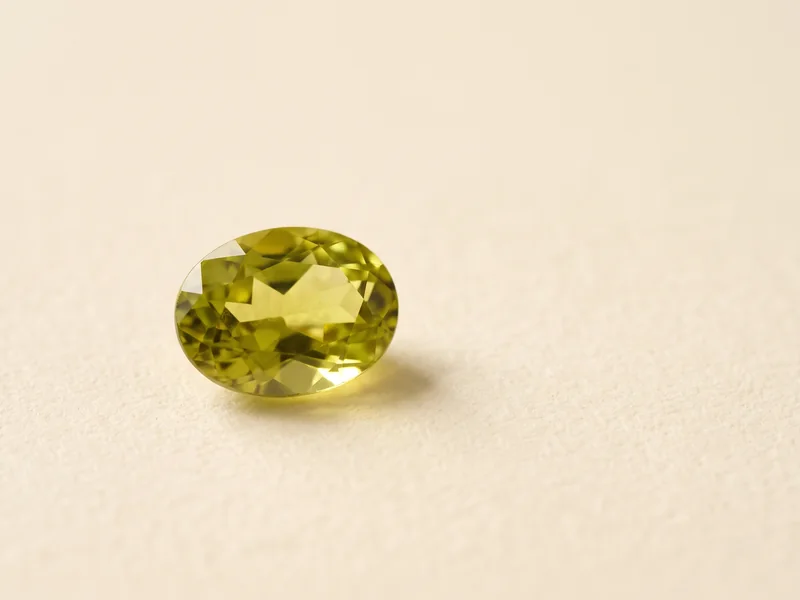
Peridot is idiochromatic, meaning its colour comes from its own chemistry rather than from a trace impurity. That colour comes from iron, so peridot only ever comes in shades of green. The less iron, the purer and brighter the green; more iron pushes it towards olive and brown. Most buyers prefer a vivid grass green with only a slight yellow tint, and stones with a strong brown cast cost noticeably less.
- Colour: pure, medium green is the most valued; light yellowish green is common and affordable; olive and brownish green sit at the lower end.
- Clarity: good peridot should be eye-clean (no inclusions visible without magnification). Look out for 'lily pad' inclusions, tiny disc-shaped stress fractures around a small crystal, which can weaken the stone if they reach the surface.
- Cut: ovals, cushions, rounds and emerald cuts are common. A good cut returns light evenly without a dull, glassy centre.
- Size: commercial peridot is mostly under 5 carats. Larger clean stones, over about 10 carats, are much scarcer and come mainly from Pakistan and Myanmar.
One gemmologist's check: peridot has strong double refraction (birefringence of about 0.036), so when you look through the table of a larger stone with a loupe, the back facet edges appear doubled. Green glass does not do this, which makes doubling a quick first test against a common imitation. Our full peridot gem guide goes into origins, inclusions and grading in more depth.
Peridot is often compared with emerald, but they look different side by side. Peridot is brighter, more yellow and usually far cleaner, while emerald has a bluer green and typically visible inclusions. If a deep bluish green is what you love, see May's emerald birthstone.
What colours does spinel come in?
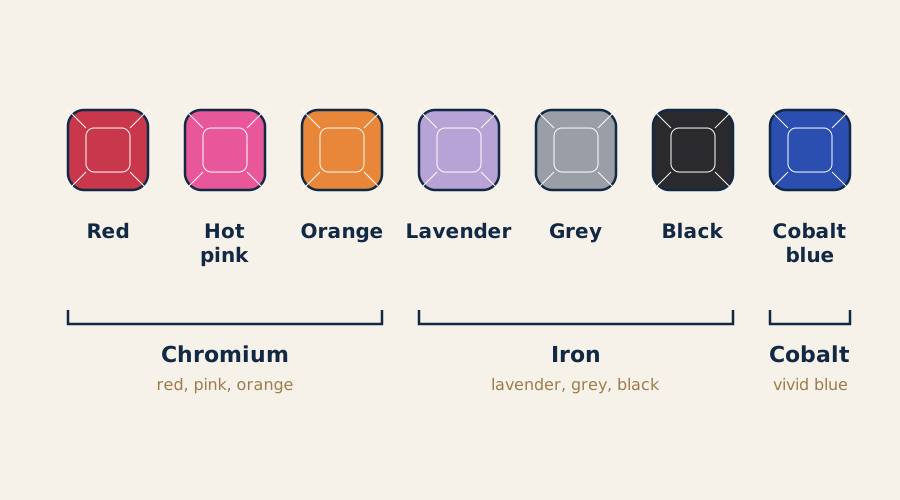
Spinel is allochromatic: pure spinel is colourless, and its colours come from small amounts of other elements. Chromium gives red and pink, iron gives blue, grey and lavender, and cobalt gives the rare, saturated cobalt blue. Because spinel is singly refractive, its colour looks the same from every angle, and it has a bright, crisp lustre. Our dedicated spinel gem guide covers each colour in more detail.
- Red: the classic colour, historically confused with ruby. Fine Burmese red spinel is among the most sought after.
- Pink and hot pink: from soft pastel to neon. Tanzania (Mahenge) and Myanmar (Mogok) are known sources.
- Orange and 'flame': reddish orange, less common.
- Purple and lavender: soft, muted tones that are popular for engagement rings and comparatively affordable.
- Grey and steel blue: cool, modern colours that suit white gold and platinum.
- Cobalt blue: very rare and expensive; a natural cobalt spinel is a collector's stone.
- Black: opaque and inexpensive, often used in men's rings and pendants.
Natural spinel is usually sold untreated, which many buyers appreciate; occasional heat treatment does occur and should be disclosed. A blue or grey spinel can look similar to sapphire, though sapphire is harder at Mohs 9. If blue is your colour, compare it with September's sapphire birthstone.
Not sure which one is right?
Send us the stones you are looking at and our gemologist will tell you which to choose and why.
Is the August birthstone durable enough for an everyday ring?
Two properties decide how a gem wears. Hardness (the Mohs scale, 1 to 10) measures resistance to scratching. Toughness measures resistance to chipping and breaking. Everyday dust contains quartz, which is Mohs 7, so any gem softer than about 7 will slowly lose its polish and pick up fine scratches on a ring that is worn daily.
Peridot sits right at that line, at 6.5–7, with only fair to good toughness. It is also sensitive to sudden temperature changes and to acids. In a ring worn every day it will show wear on the facet edges within a few years, so it is better in pendants and earrings, or in a ring worn occasionally and protected by a bezel. Spinel, at 8 with good toughness and no cleavage (no natural plane of weakness), is a genuinely practical everyday stone. That is why many people now choose it; our guide to spinel as an underrated engagement stone looks at this choice in detail.
| Birthstone | Gem | Mohs hardness | Everyday ring? |
|---|---|---|---|
| January | Garnet | 6.5–7.5 | With care; protective setting |
| February | Amethyst | 7 | With care |
| March | Aquamarine | 7.5–8 | Yes, with good claws |
| April | Diamond | 10 | Yes |
| July | Ruby | 9 | Yes |
| August | Peridot | 6.5–7 | Occasional wear; bezel recommended |
| August | Spinel | 8 | Yes |
| September | Sapphire | 9 | Yes |
| October | Opal | 5.5–6.5 | Occasional wear only |
| November | Topaz | 8 | Yes, but has cleavage |
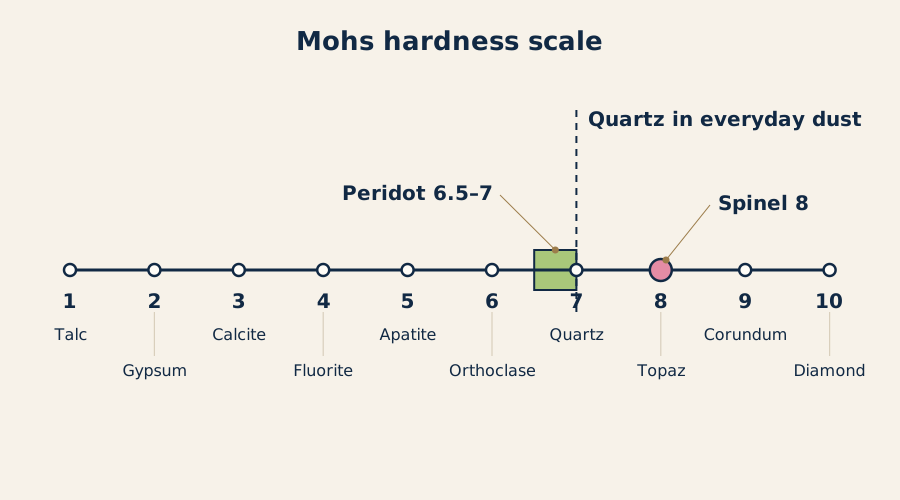
For context, the hardest birthstone is April's diamond at 10, while February's amethyst shares peridot's hardness of about 7. Aquamarine for March babies is a little harder at 7.5–8. At the soft end, October's opal and tourmaline shows how a delicate stone and a durable one can share a month, much like August. November's topaz and citrine are a similar pairing, and January's garnet is a red alternative with hardness close to peridot's.
Related guideBirthstone Engagement Rings: Choosing for DurabilityWhere do peridot and spinel come from, and are any found in Australia?
Most gem peridot comes from volcanic rock. The San Carlos area of Arizona supplies much of the world's commercial peridot, mostly in smaller sizes, while northern Pakistan has produced large, clean stones since the 1990s. Myanmar, China, Vietnam and Tanzania are also sources. Australia has plenty of olivine: it is common in the young volcanic basalts of western Victoria, often as green grains in rock nodules. Clean crystals large enough to facet are rare, though, so Australian peridot is mainly a collector's and fossicker's find rather than a jewellery supply.
Fine spinel comes mainly from Myanmar (Mogok), Sri Lanka, Tanzania, Vietnam and Tajikistan. In Australia, black spinel turns up alongside sapphire in the gemfields of New England in New South Wales and central Queensland, and small coloured spinels are found occasionally, but almost all spinel in Australian jewellery is imported.
Origin is rarely certified for peridot or spinel the way it can be for high-value sapphire or ruby. A reputable dealer can often tell you the likely country of origin; if a particular source, including Australian material, matters to you, ask before the stone is chosen rather than after.
What are the best settings for peridot and spinel?
The setting should match the stone's durability. Peridot needs protection; spinel gives you more freedom. Useful options for an August birthstone ring or piece:
- Bezel: a thin rim of metal around the whole stone. The most protective choice for peridot, guarding the girdle (the outer edge) from knocks.
- Halo: a ring of small diamonds around the centre stone. It frames the colour and shields the edge; a green peridot or pink spinel with a diamond halo is a popular look.
- Six claws: secure for spinel solitaires, with a little more light reaching the stone than a bezel allows.
- Low profile: a centre stone set closer to the finger is less likely to take hits, which suits peridot.
- Pendants and earrings: the safest home for peridot, since they rarely touch hard surfaces.
- Three-stone and mixed rings: peridot and spinel together, or with diamonds, are a way to include both August stones.
Metal colour changes how the stones look. Peridot reads warmer and richer in yellow gold and cooler and brighter in white gold or platinum. Pink and red spinel sit naturally in rose and yellow gold, while grey, lavender and blue spinel suit white metals.
How much do peridot and spinel cost in Australia?
Peridot is one of the more affordable birthstones, while fine spinel can cost as much as good sapphire. Colour is the main price driver for both, followed by size, clarity and cut. These are broad ranges per carat for loose natural stones; prices vary with quality and the market.
| Stone | Approximate price range (AUD per carat) |
|---|---|
| Peridot, commercial yellowish green, 1–3 ct | about $60–$300 |
| Peridot, fine pure green, 5 ct and over | about $300–$900 |
| Spinel, grey, lavender or purple, around 1 ct | about $300–$1,500 |
| Spinel, fine pink or red, around 1 ct | about $1,500–$6,000 |
| Spinel, natural cobalt blue | from about $5,000, often much more |
| Lab-created spinel, any colour | usually under $150 per stone |
Natural vs lab-created: lab-created spinel has been grown since the early 1900s and is widely used, not only as spinel but as a stand-in for other birthstones in inexpensive jewellery. Lab-created spinel has the same hardness as natural spinel, so it is a practical, low-cost option, but it must always be described as lab-created or synthetic. Lab-created peridot exists but is rarely seen. A gemmologist can separate natural and lab-created stones by their inclusions and, if needed, laboratory testing; for a high-value spinel, ask for an independent report.
Browse natural gemstones
How do you choose and care for an August birthstone ring? Step by step
- Decide how often you will wear it. Daily wear points to spinel; occasional wear, pendants and earrings suit peridot well.
- Choose the colour first. Green means peridot; for red, pink, lavender, grey or blue, look at spinel.
- Check it is natural or lab-created. The invoice or report should state which, plus any treatment.
- Look at clarity in person or on video. Aim for eye-clean, with no inclusions reaching the surface near the edges.
- Match the setting to the stone. A bezel or halo for peridot; six claws or a bezel for spinel. Our guide to choosing a birthstone ring that lasts compares options for every month.
- Plan the care. Clean gently, take the ring off for gardening, gym and cleaning, and have the setting checked about once a year.
For cleaning, warm soapy water and a soft toothbrush are safe for both stones. Avoid ultrasonic and steam cleaners for peridot, and keep it away from acids, including some household and jewellery cleaners, and from sudden heat. Untreated spinel can usually go in an ultrasonic cleaner, but check first if the stone has any visible fractures. Store each piece separately so harder gems, including diamonds and sapphires, cannot scratch your peridot.
Free consultation
Talk to a gemologist
Compare stones in person or online with Raj Sood, Graduate Gemologist (GIA), AJP (GIA).
Book a consultationShop this shape
FAQ
Common questions
What is the August birthstone?
Peridot is the main modern August birthstone, and spinel was added as a second option in 2016. Sardonyx, a banded chalcedony, is the older traditional August stone.
Is peridot good for an engagement ring?
Peridot can work for an engagement ring, but at 6.5–7 on the Mohs scale it will scratch and wear with daily use. A bezel setting helps, and many people choose spinel or keep peridot for pendants and earrings instead.
What is the difference between peridot and spinel?
Peridot is always green and sits at 6.5–7 on the Mohs scale, while spinel comes in many colours and is harder at 8. Spinel is also singly refractive, whereas peridot shows strong doubling of the back facets.
Is spinel a real gemstone or a fake ruby?
Spinel is a real, natural gemstone in its own right. It was historically mistaken for ruby, and lab-created spinel also exists, which must always be disclosed as lab-created.
Is peridot found in Australia?
Olivine, the mineral peridot belongs to, is common in western Victoria's volcanic basalts, but gem-quality crystals are rare. Most peridot in Australian jewellery is imported from Arizona, Pakistan, Myanmar and other sources.
How do you clean a peridot ring?
Use warm soapy water and a soft brush, then rinse and dry. Avoid ultrasonic and steam cleaners, acids and sudden temperature changes.

Ask a gemologist
Not sure which diamond to choose?
Raj Sood is a Graduate Gemologist (GIA) and master jeweller. Bring the stones you are considering, or send the reports, and he will tell you honestly which one is better and why.
Keep learning
Related guides
 GemstonesPeridot
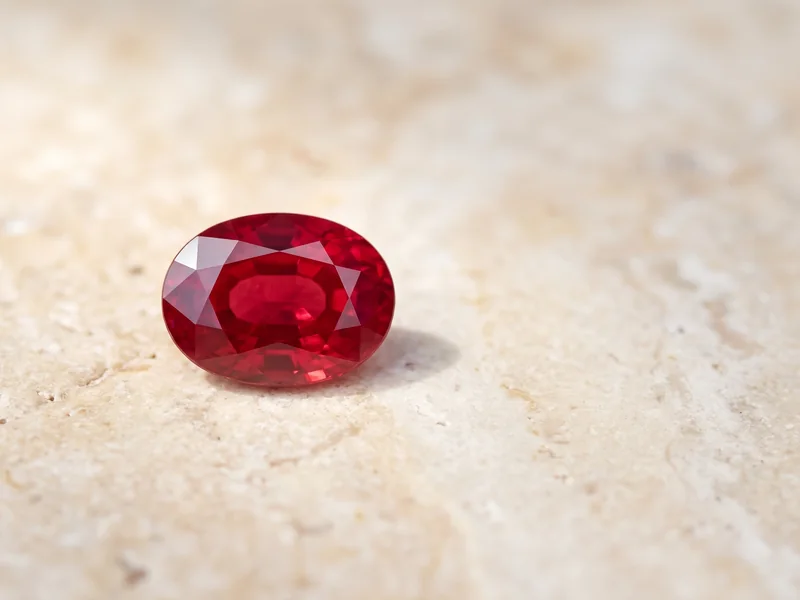 GemstonesSpinel
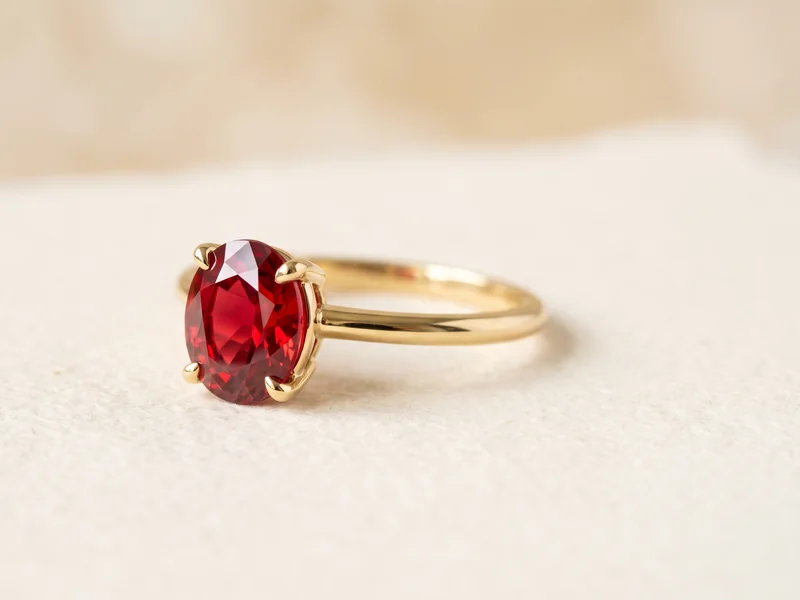 GemstonesSpinel Engagement Rings: An Underrated Gemstone
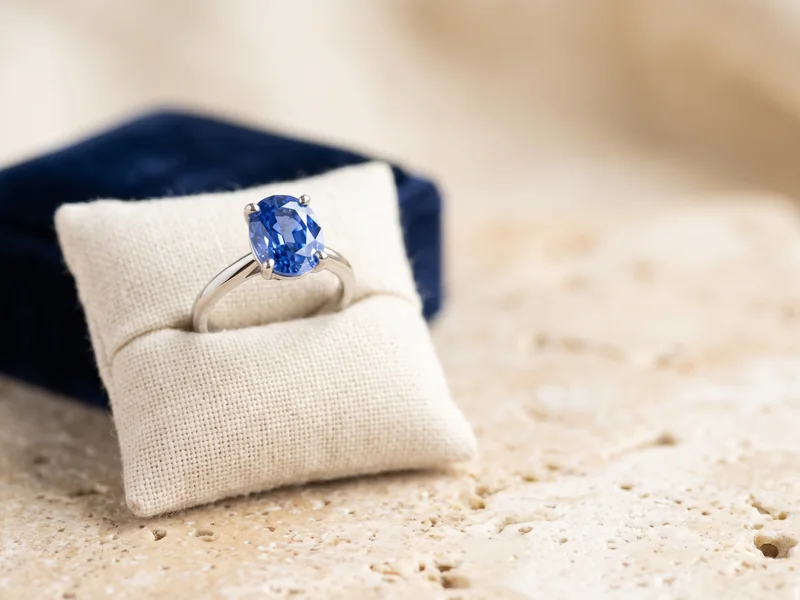 GemstonesBirthstone Engagement Rings: Choosing for DurabilityGemstonesGemstones | Coloured Gemstones, Birthstones and Custom Jewellery
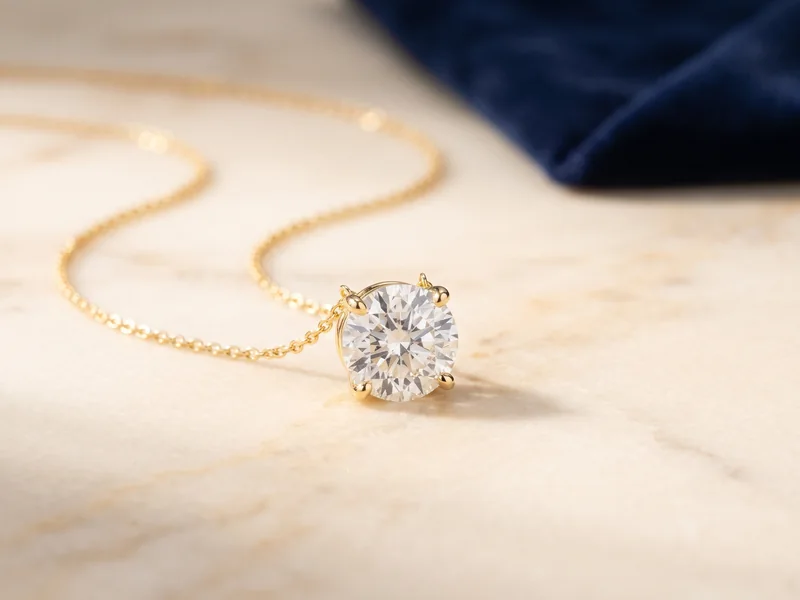 GemstonesBirthstone Jewellery Melbourne
 GemstonesApril Birthstone: Diamond
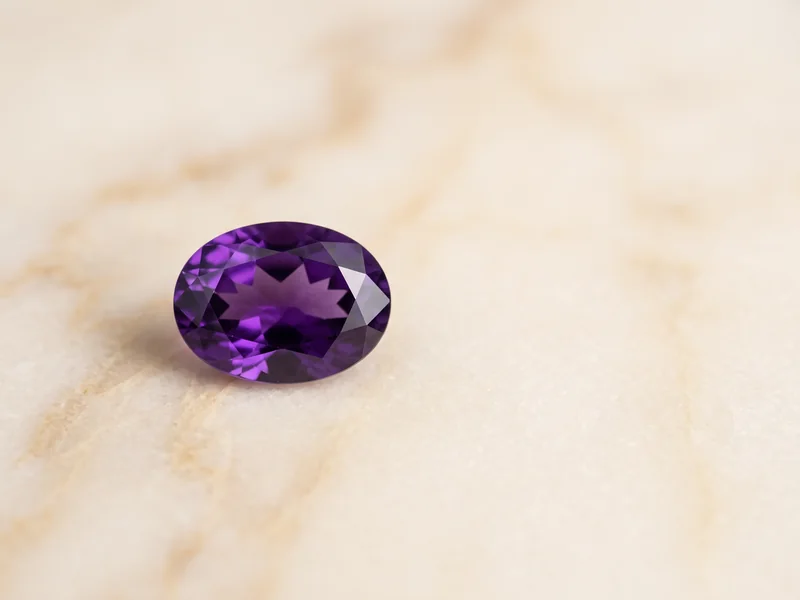 GemstonesFebruary Birthstone: Amethyst
Explore more
More guides on this topic
Education