
Gemstones
Rose Gold Engagement Rings: How to Pair Diamonds and Gemstones
Rose gold engagement rings change how every stone looks: they warm up a diamond, deepen a pink gem and make a blue one look cooler. Choosing the right pairing can save you money on diamond colour and keep a softer gemstone safe for decades.
 Reviewed by Raj Sood, Graduate Gemologist (GIA), AJP (GIA)Master jeweller and Graduate Gemologist (GIA) · reviewed 4 November 2026
Quick answer
Rose gold engagement rings suit near-colourless and slightly warm diamonds: G–J colour looks white against the pink metal, so you can save on colour grade. For coloured stones, morganite, pink and peach sapphire, blue sapphire and champagne diamonds pair well. For daily wear, choose Mohs 9–10 stones, or protect softer gems with a bezel.
What is a rose gold engagement ring made of?
A rose gold engagement ring is made from gold mixed with copper and a little silver. Pure gold is yellow; copper pulls the colour towards pink, and the more copper in the mix, the pinker the metal. Our page on what gives rose gold its pink colour explains the metallurgy in more detail. A mix of metals like this is called an alloy.
In Australia you will mostly see two purities. Here carat (written ct) measures gold purity out of 24 parts, which has nothing to do with the carat weight of a diamond.
- 18ct rose gold: 75% gold, usually around 20–22% copper and the rest silver. A soft, warm pink with a rich colour.
- 9ct rose gold: 37.5% gold with a higher share of copper and silver. Often pinker and a little harder, and it costs less, but it contains half the gold of 18ct.
- Red gold: a name some makers use for alloys with an unusually high copper content and a deeper colour.
Copper is harder than gold, so rose gold is generally a touch harder than yellow gold of the same carat. Very high purities are another matter: why 22K and 24K gold is too soft for everyday rings covers the problem. An engagement ring should also be solid gold rather than a coating. Our guides to the difference between plated, filled and solid gold and how gold vermeil layers gold over silver show why a thin pink layer wears through on a ring worn every day.
If you are still deciding on a metal at all, our comparison of how rose gold compares with yellow and white gold sets out colour, hardness, upkeep and price for all three.
What diamond colour looks best in rose gold engagement rings?
Diamonds are graded for colour on a scale from D (completely colourless) to Z (noticeable yellow or brown). A diamond acts a little like a mirror for the metal around it: claws and a setting in rose gold reflect a faint pink warmth into the stone. That has a useful side effect. A slight warmth that would show in platinum or white gold is masked by rose gold, so you can often drop a colour grade or two without seeing a difference face-up (looking down on the ring as it is worn).
| Diamond colour | How it looks in rose gold | Who chooses it |
|---|---|---|
| D–F (colourless) | Icy white, with strong contrast against the pink metal | People who want the stone to stand apart from the metal; often set in white claws |
| G–H (near colourless) | Looks white, with a gentle harmony with the metal | The most common balance of colour and price |
| I–J (near colourless) | Faces up white; any warmth blends into the rose tone | Good value; the warmth is masked by the setting |
| K–M (faint) | Visibly warm, soft peachy glow | Vintage-style rings where warmth is wanted |
| Fancy champagne, pink or peach | Colour is deliberate and matches the metal | Coloured diamond lovers; see the next section |
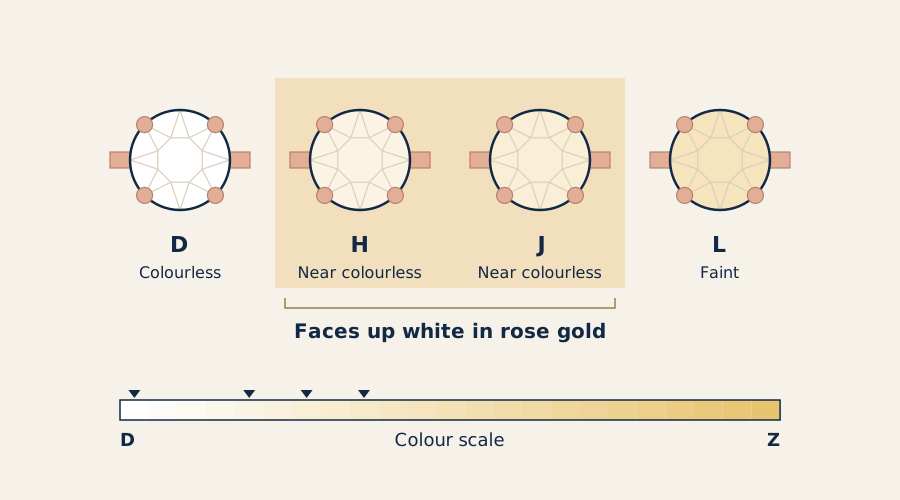
Shape plays a part too. Elongated shapes such as an oval diamond show body colour a little more at the ends than a round does, so if you choose a fancy shape, stay towards the whiter end of that G–J range. The numbers matter less than your own eye, so compare stones in the same light. Daylight near a window is the fairest test. If you love a very white D–F diamond, consider white gold or platinum claws on a rose gold band; we explain that option in the settings section. Our overview of choosing between the three gold colours shows how the same diamond grade reads in each metal.
Which coloured diamonds go with rose gold?
Rose gold is the natural partner for diamonds with a warm body colour. These are graded differently from white diamonds: they are judged on hue, tone and saturation rather than on how little colour they show.
- Champagne and cognac diamonds: light to deep brown diamonds with a warm, honeyed colour. They sit beautifully in rose gold and cost far less than white diamonds of the same size. Australia's Argyle mine produced a large share of the world's brown diamonds.
- Pink diamonds: natural pinks are very rare. Argyle, in the Kimberley region of Western Australia, supplied most of the world's pinks until it closed in 2020. Lab-grown pink diamonds are widely available; their colour is usually created or enhanced after growth, and the grading report should say so.
- Peach and orange-pink diamonds: uncommon, but rose gold brings out the warmth.
- Salt and pepper diamonds: natural diamonds with visible black and white inclusions (internal features), giving a grey, speckled look. The cool grey contrasts well with pink metal.
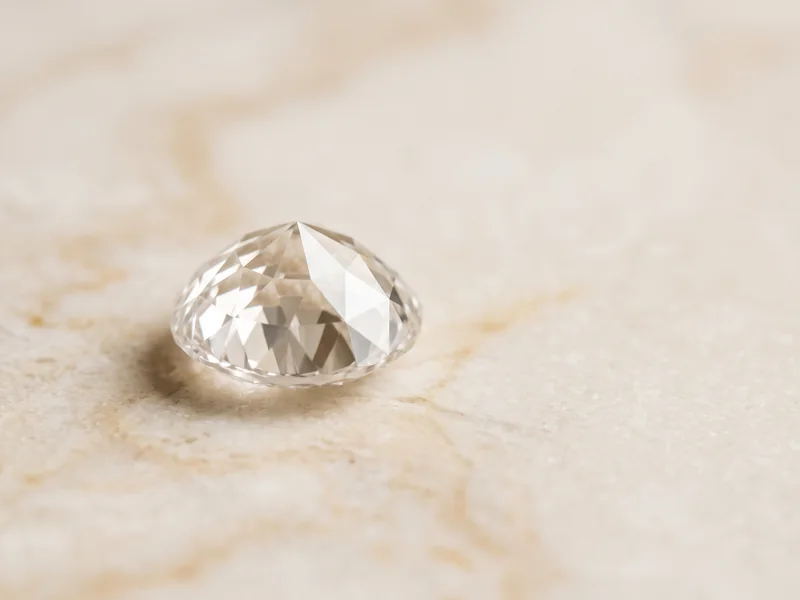
Pink diamonds are often cut in fancy shapes, including hearts, to concentrate their colour; our guide to heart shaped diamonds, including pink hearts explains what to check. Vintage cuts are also popular in rose gold, which has a long history in antique jewellery. A flat-backed rose cut diamond has a domed top of triangular facets and no pointed base, giving a soft glow rather than sharp sparkle. If any term here is new, our jewellery terms glossary explains it.
Which gemstones suit rose gold engagement rings?
Coloured stones work with rose gold in two ways. A pink or peach stone matches the metal for a soft, tonal look. A blue, green or grey stone contrasts with it, so both the stone and the metal stand out. Here are the pairings we see most often.
- Morganite: the pink to peach variety of beryl (the same mineral family as emerald and aquamarine). It is the classic rose gold pairing, and often heat-treated to remove a yellow tint.
- Pink, peach and padparadscha sapphire: sapphire is corundum, Mohs 9 with excellent toughness, so it suits any everyday ring. Padparadscha is the trade name for a rare pinkish-orange sapphire.
- Blue and teal sapphire: a strong contrast with rose gold. Australian sapphires from Queensland and New South Wales are known for deep blues, greens and teal colours, including parti sapphires that show two colours in one stone.
- Spinel: pink, red, lavender and grey spinels sit well in rose gold and are reasonably hard at Mohs 8.
- Green stones: emerald, tsavorite garnet and green tourmaline contrast well with the warm metal, but most are softer or more brittle than sapphire.
- Opal: Australia's national gemstone. Its play of colour suits rose gold, but it needs a protective setting and gentle wear.
- Moissanite: a near-colourless diamond alternative. In jewellery it is always lab-created, and it shows strong rainbow flashes.
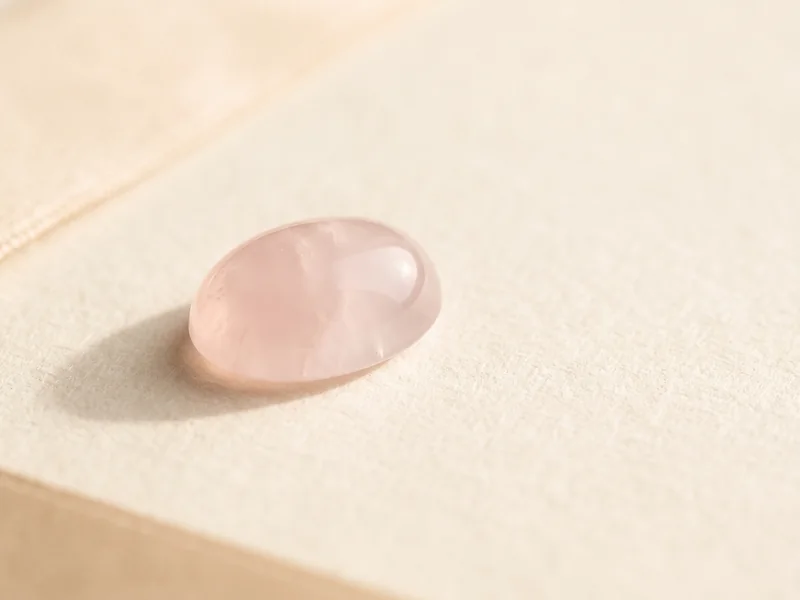
Our coloured gemstone guides cover each of these stones in depth. Pale pink quartz is often suggested too, but at Mohs 7 with only fair toughness, rose quartz suits pendants and earrings better than daily rings.
Not sure which one is right?
Send us the stones you are looking at and our gemologist will tell you which to choose and why.
Which gemstones are hard enough for an everyday engagement ring?
An engagement ring is knocked against benches, car doors and kitchen sinks for decades, so the stone matters more than the metal. Two properties decide how well it lasts. Hardness, measured on the Mohs scale from 1 to 10, is resistance to scratching. Household dust contains quartz at Mohs 7, so anything softer than 7 slowly loses its polish. Toughness is resistance to chipping and breaking, and it depends on cleavage (planes where a crystal splits easily) and internal features.
| Gemstone | Mohs hardness | Toughness | Everyday ring? | Australian source |
|---|---|---|---|---|
| Diamond | 10 | Good (has cleavage) | Yes | Argyle, WA (closed 2020); Ellendale, WA (closed 2015) |
| Sapphire and ruby (corundum) | 9 | Excellent | Yes | Sapphire: Anakie fields, Qld; New England, NSW |
| Moissanite (lab-created) | 9.25 | Good | Yes | Lab-created only |
| Spinel | 8 | Good | Yes | Minor finds only |
| Morganite (beryl) | 7.5–8 | Fair to good | Yes, with a protective setting | Not a commercial source |
| Aquamarine (beryl) | 7.5–8 | Fair to good | Yes, with a protective setting | Minor finds only |
| Emerald (beryl) | 7.5–8 | Poor to fair (inclusions) | With care; a bezel helps | Historic small mines in NSW and WA |
| Tourmaline | 7–7.5 | Fair | With care | Minor finds, WA |
| Garnet | 6.5–7.5 | Fair to good | With care | Harts Range, NT |
| Rose quartz | 7 | Fair | Better for pendants | Minor finds only |
| Tanzanite | 6–7 | Fair (has cleavage) | Occasional wear | Not found in Australia |
| Opal | 5.5–6.5 | Poor | Occasional wear, bezel set | Lightning Ridge, NSW; Coober Pedy, SA; Qld boulder opal |
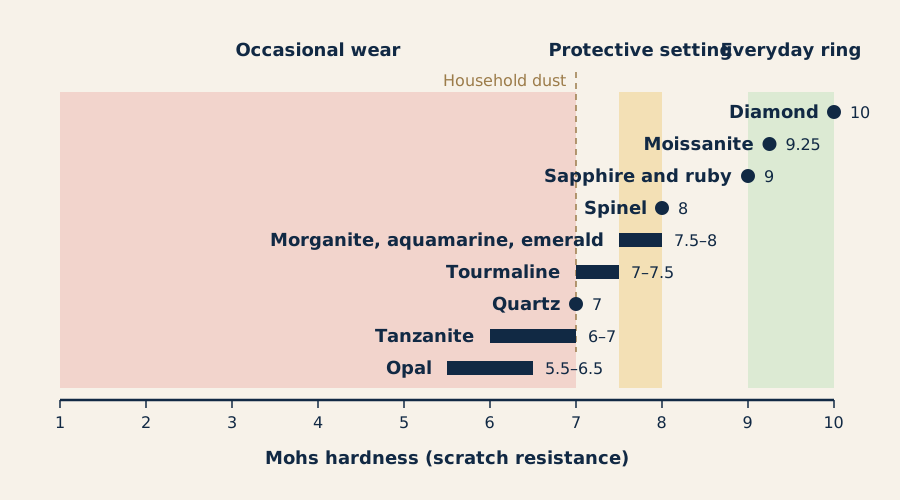
Morganite is the stone most people ask about with rose gold. It is perfectly wearable, but at 7.5–8 it will pick up fine scratches and lose some lustre over years of daily wear, and it attracts skin oils that make it look cloudy until cleaned. A re-polish every so often brings it back. If you want a pink stone that shrugs off daily life, pink sapphire is the harder choice. You can explore natural coloured gemstones and birthstones by hardness before you decide.
How can you tell morganite from pink sapphire or rose quartz?
Pale pink stones look much alike in a shop window, and the price gap between them is large. A gemmologist separates them with a refractometer, which measures the refractive index (RI): how strongly a stone bends light. Each mineral has its own range.
- Rose quartz: RI about 1.54–1.55. Usually slightly milky or hazy rather than fully transparent. More on this stone in our guide to how rose quartz differs from other pink gems.
- Morganite (beryl): RI about 1.57–1.59. Clean, soft pink to peach, often in larger sizes.
- Kunzite (spodumene): RI about 1.66–1.68. Pink to lilac, strong cleavage, and the colour can fade in strong sunlight.
- Pink spinel: RI about 1.71–1.72, and singly refractive (it does not split light in two).
- Pink sapphire: RI about 1.76–1.77. Usually heat-treated, which is standard and should be disclosed.
- Pink diamond: RI about 2.42, beyond the range of a standard refractometer, so other tests are used.
Lab-created pink sapphire has the same RI as natural sapphire, so separating them needs a microscope, looking for curved growth lines or gas bubbles, or a laboratory report. The same applies to lab-grown and natural diamond, which need specialist testing equipment.
What setting styles work best for a rose gold engagement ring?
The setting holds the stone, protects it and decides how much metal colour shows. Some choices work especially well with rose gold:
- Claw solitaire: four or six claws let the most light into the stone. Fine for diamond, sapphire and moissanite.
- White claws on a rose band: platinum or white gold claws keep a D–H diamond looking icy white while the band stays pink.
- Bezel: a thin rim of metal around the stone. The most protective option for opal, emerald and morganite.
- Halo: a ring of small diamonds around the centre stone makes it look larger and shields its edge. A diamond halo around a morganite is a common rose gold design.
- Vintage and milgrain: milgrain is a fine beaded edge on the metal. It suits rose gold's antique roots and pairs well with antique-style rose cut diamonds.
Rose gold suits every centre-stone shape, from rounds and ovals to pears and emerald cuts. To compare outlines before you choose a setting, see our overview of every diamond shape or browse all 34 diamond cuts side by side.
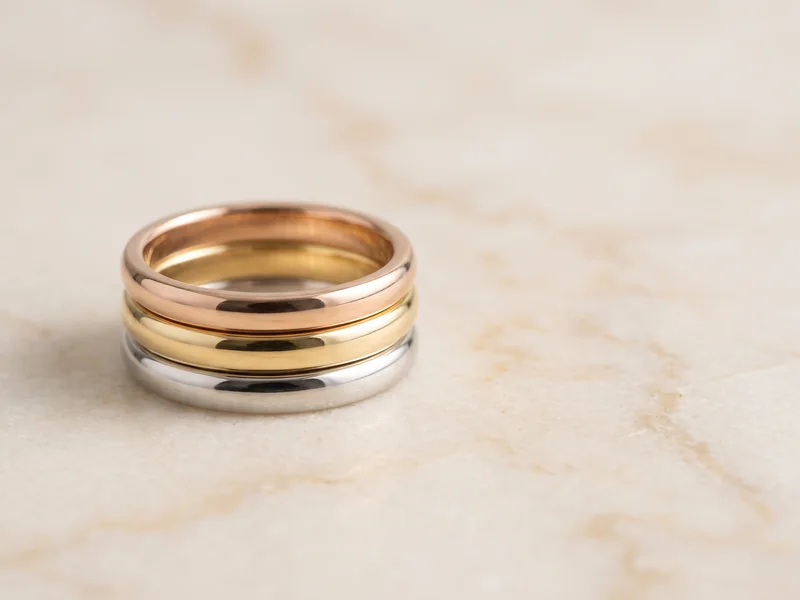
Many people wear rose gold beside white or yellow gold, either in the wedding band or in a two-tone engagement ring. Our guide to mixing rose, white and yellow gold in a bridal set covers which combinations sit comfortably together.
Related guideMixing White, Yellow and Rose Gold in a Bridal SetIs rose gold durable for engagement rings, and does it fade?
Solid rose gold is a durable choice. The colour runs right through the metal, so it does not fade or wear off, and unlike white gold it never needs rhodium plating (a thin white metal coating that wears away and is renewed every year or two). Over many years the surface can deepen slightly in colour as the copper near the surface reacts with air and skin, a gentle patina that a polish removes. Our page on how copper content changes the shade explains why different alloys age a little differently.
- Allergies: rose gold usually contains no nickel, the most common metal allergy. A copper sensitivity is uncommon but possible; 18ct contains less copper than 9ct.
- Chlorine: take the ring off in pools and spas, as chlorine can attack gold alloys over time.
- Cleaning: warm water, a drop of mild dish soap and a soft toothbrush, especially behind the stone where oils collect.
- Checks: have claws checked about once a year, as daily knocks slowly wear claw tips in any gold.
How much does a rose gold engagement ring cost in Australia?
The price is the setting plus the centre stone. Rose gold costs about the same as yellow gold of the same carat, because the gold content is the same; 18ct costs more than 9ct because it holds twice the gold. As a rough guide, a simple 18ct rose gold solitaire setting is about AUD $1,500–$3,500 and a 9ct one about $700–$1,800, depending on weight and design. The centre stone usually makes the bigger difference.
| Centre stone (about 1 ct or 7 × 5 mm) | Approximate price range (AUD) |
|---|---|
| Lab-grown diamond, G–H, VS | about $800–$3,000 |
| Natural diamond, G–H, VS | about $6,000–$15,000 |
| Natural diamond, I–J, VS–SI (faces up white in rose gold) | about $4,000–$9,000 |
| Natural champagne diamond | about $1,500–$5,000 |
| Morganite, 8 × 6 mm oval | about $200–$900 |
| Natural pink sapphire | about $1,000–$4,000 |
| Natural blue sapphire | about $1,500–$6,000 |
| Lab-created sapphire | about $100–$500 |
| Moissanite (lab-created), 6.5 mm | about $400–$1,200 |
These ranges are broad and move with the market and exact grades. Lab-grown diamonds are real diamond, grown in a laboratory rather than mined, and cost much less than natural diamonds of the same grades. Natural stones are rarer, and their origin and treatment history are part of what you pay for. Either way, ask for an independent grading or identification report and check it states natural or lab-grown, plus any treatment.
Browse natural gemstones for rose gold
How do you choose a stone for a rose gold engagement ring? Step by step
- Decide on matching or contrast. Pink and peach stones blend with the metal; blue, green, grey and white stones stand apart from it.
- Check daily-wear hardness. For everyday rings, favour Mohs 9–10 (diamond, sapphire, moissanite). Choose a bezel or halo for morganite, emerald or opal.
- Pick the gold purity. 18ct for a richer colour and more gold; 9ct for a pinker, harder and lower-cost band.
- Set your diamond colour. In rose gold, G–J usually faces up white. Go D–F only if you also want white claws.
- Read the report. Confirm the stone's identity, whether it is natural, lab-grown or lab-created, and any treatment such as heating.
- See it in daylight. Compare stones in the actual rose gold setting, near a window, not under bright shop spotlights alone.
- Plan the wedding band. Make sure a band in your chosen metal sits comfortably beside the engagement ring before you finalise the design.
Free consultation
Talk to a gemologist
Compare stones in person or online with Raj Sood, Graduate Gemologist (GIA), AJP (GIA).
Book a consultationShop this shape
FAQ
Common questions
What colour diamond looks best in rose gold?
G to J colour diamonds usually look white in rose gold, because the warm metal masks a faint tint. Choose D–F only if you want strong contrast, ideally with white gold or platinum claws.
Is morganite a good stone for a rose gold engagement ring?
Yes, if you accept some upkeep. At Mohs 7.5–8 it can scratch and lose lustre over years of daily wear, so a protective setting, regular cleaning and an occasional re-polish help keep it bright.
Does rose gold tarnish or fade?
Solid rose gold does not fade, because the colour runs right through the alloy. It can deepen slightly over many years, which a polish removes; plated rose gold, by contrast, wears through.
Is 9ct or 18ct rose gold better for an engagement ring?
Both are durable. 9ct is usually pinker, slightly harder and costs less, while 18ct has a richer colour and twice the gold content.
What gemstones go with rose gold besides pink?
Blue and teal sapphires, salt and pepper diamonds, grey spinel, emerald and opal all contrast well with rose gold. For everyday wear, sapphire is the hardest coloured gemstone after diamond.
Can you put a lab-grown diamond in a rose gold ring?
Yes. Lab-grown diamonds are real diamond, set exactly like natural diamonds, and cost much less; the report should state that the stone is laboratory-grown.

Ask a gemologist
Not sure which diamond to choose?
Raj Sood is a Graduate Gemologist (GIA) and master jeweller. Bring the stones you are considering, or send the reports, and he will tell you honestly which one is better and why.
Keep learning
Related guides
 MetalsWhat Gives Rose Gold Its Colour?MetalsYellow Gold vs White Gold vs Rose GoldMetalsMixing White, Yellow and Rose Gold in a Bridal Set
 Diamond ShapesRose Cut DiamondsGemstonesGemstones | Coloured Gemstones, Birthstones and Custom Jewellery
 GemstonesRose Quartz
 MetalsGold Plated vs Gold Filled vs Solid Gold
 MetalsGold Vermeil Explained
Explore more
More guides on this topic
Education