
- Education
- Diamond Shapes
- Round vs Cushion Cut Diamond: Which Shape Should You Choose?
Diamond shapes
Round vs Cushion Cut Diamond: Which Shape Should You Choose?
The round vs cushion cut diamond decision changes how big your stone looks, how it sparkles and what it costs. Here is a straight comparison of two of the most popular engagement ring shapes.
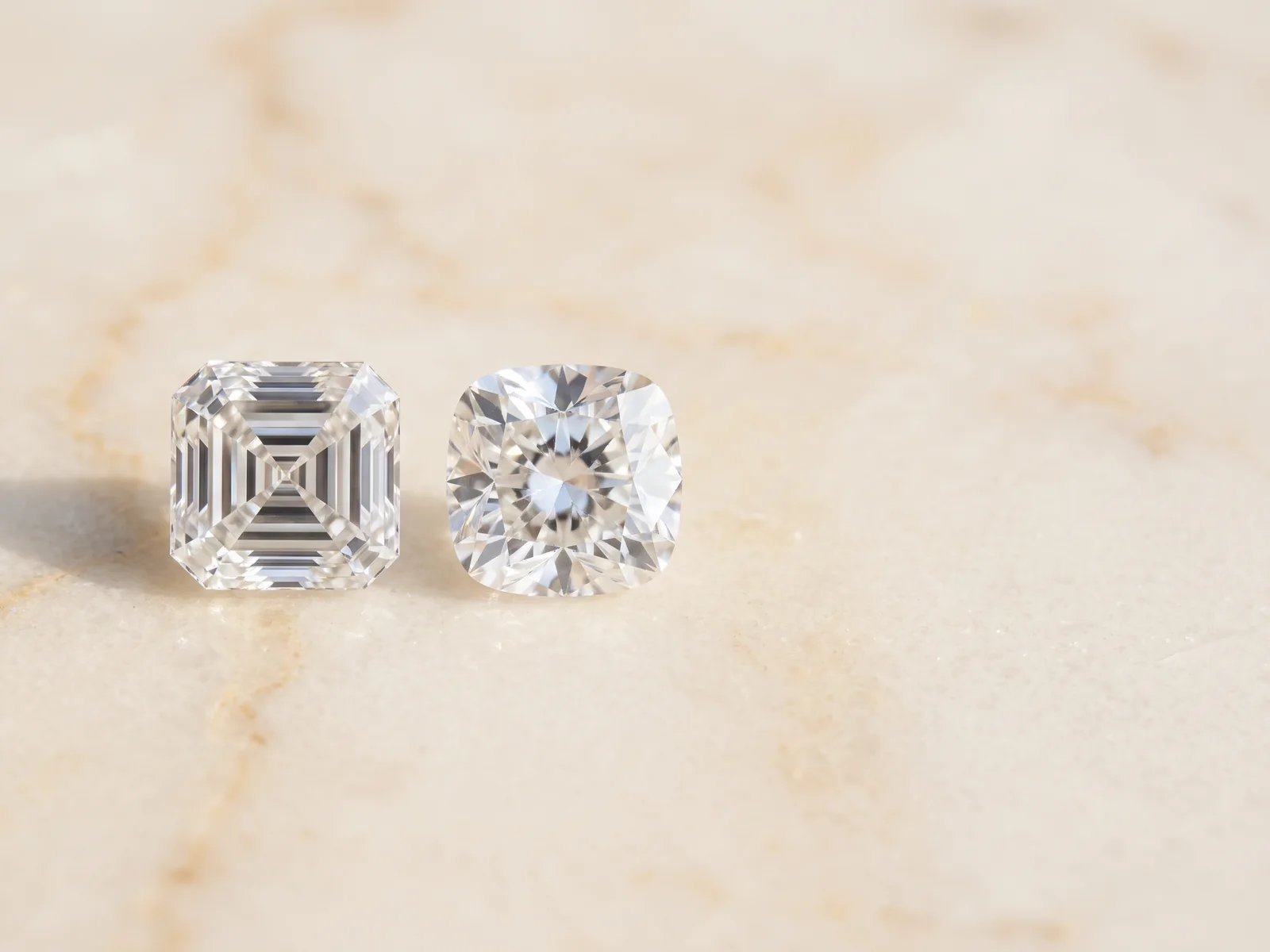
 Reviewed by Raj Sood, Graduate Gemologist (GIA), AJP (GIA)Master jeweller and Graduate Gemologist (GIA) · reviewed 4 November 2026
Quick answer
In the round vs cushion cut diamond choice, a round gives the most sparkle, a clear GIA cut grade and about 6.4 mm across at 1 carat. A cushion is a soft square with rounded corners and a vintage look. It usually costs noticeably less per carat, but faces up smaller and can show more body colour.
What is the difference between round and cushion cut diamonds?
A round brilliant is a circular diamond with 57 or 58 facets (58 if it has a culet, a tiny flat facet at the very bottom). Its proportions have been refined for more than a century to send as much light as possible back to your eye, which is why it remains the most popular shape for engagement rings. Our guide to round brilliant diamonds in depth covers its history and grading.
A cushion cut is a square or slightly rectangular diamond with rounded corners and gently curved sides, a bit like a pillow. It grew out of the Old Mine cut of the 1700s and 1800s and today comes in two main faceting styles: the cushion brilliant, with larger, bolder facets, and the cushion modified, with an extra row of facets underneath that creates a finely broken sparkle. Our complete cushion cut buying guide explains both styles.
| Round brilliant | Cushion | |
|---|---|---|
| Outline | Circle | Square or rectangle with rounded corners |
| Facets | 57–58 | Usually about 58–64, varies by cutter |
| Typical ratio | 1.00 | 1.00–1.05 square; about 1.10–1.30 elongated |
| Sparkle | Bright, even, many small flashes | Bolder flashes or a crushed-ice look; often strong fire |
| GIA cut grade | Yes, Excellent to Poor | No; judged by polish, symmetry and eye |
| Face-up size at 1 ct | About 6.4–6.5 mm across | About 5.5–5.8 mm square |
| Shows body colour | Least of any shape | More, especially in the corners |
| Corners | None | Rounded, fairly well protected |
| Price per carat | Highest of the main shapes | Usually noticeably lower |
Both are real diamond with identical physical properties: 10 on the Mohs hardness scale, a refractive index of about 2.42 and dispersion (the splitting of white light into spectral colours, often called fire) of about 0.044. Every difference comes from the outline and the facet pattern. For the wider picture, start with our introduction to how diamond shapes differ, and look up any unfamiliar word in the GemTrove jewellery glossary.
Round vs cushion cut diamond: how do they look on the hand?
On the hand, a round reads as a bright, concentrated point of light. Because it is circular, it looks the same from every angle, suits any finger shape and works in almost any setting. A cushion looks softer and more architectural: a square with pillowed edges that many people link with vintage and Art Deco jewellery. It sits squarer on the finger and shows its outline more clearly, especially in a halo.
A square cushion (ratio 1.00–1.05) looks broad and compact, much like a round in footprint. If you like the cushion look but want it to lengthen the finger, an elongated cushion at around 1.10–1.30 is the option, and it starts to overlap with the oval. If you are weighing a round against a longer shape in general, our oval vs round comparison covers that decision.
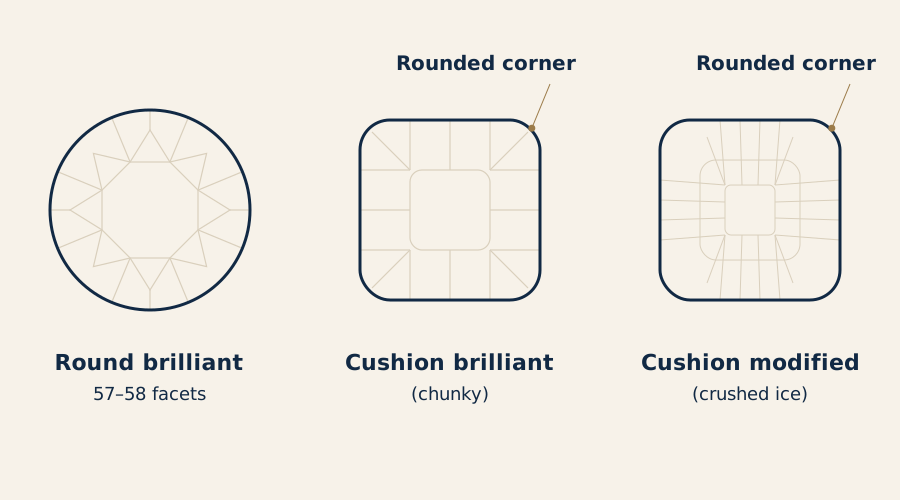
Cushions also vary far more than rounds. Two 1 carat rounds with Excellent cut grades look almost identical. Two 1 carat cushions can differ in outline (from nearly square to clearly rectangular, from crisp shoulders to very rounded corners), in facet style and in how deeply they are cut. That variety is part of the appeal, but it means you need to see each cushion, in a video or in person, rather than choose from a list of numbers.
Which looks bigger per carat, a round or a cushion?
Carat is weight, not size. What you see on the hand is the face-up size: the outline viewed from above. At the same weight, a well-cut round usually faces up larger than a cushion, because cushions are commonly cut deeper and carry more of their weight in the pavilion (the lower, pointed part) where you cannot see it.
| Carat weight | Round (diameter) | Square cushion (width) |
|---|---|---|
| 0.50 ct | about 5.1–5.2 mm | about 4.5–4.7 mm |
| 0.75 ct | about 5.8–5.9 mm | about 5.0–5.3 mm |
| 1.00 ct | about 6.4–6.5 mm | about 5.5–5.8 mm |
| 1.50 ct | about 7.3–7.4 mm | about 6.3–6.6 mm |
| 2.00 ct | about 8.0–8.2 mm | about 7.0–7.3 mm |
| 3.00 ct | about 9.1–9.3 mm | about 8.0–8.4 mm |
Measured by area, a 6.5 mm round covers about 33 mm². A 5.7 mm square cushion, once you allow for its rounded corners, covers about 29–30 mm². So the round shows roughly 10–15% more face-up area at 1 carat. Put another way, a 1 carat round tends to look about the same size as a 1.10–1.20 carat cushion. The cushion's corners do fill more of the finger's width than you might expect, which narrows the gap a little on the hand.
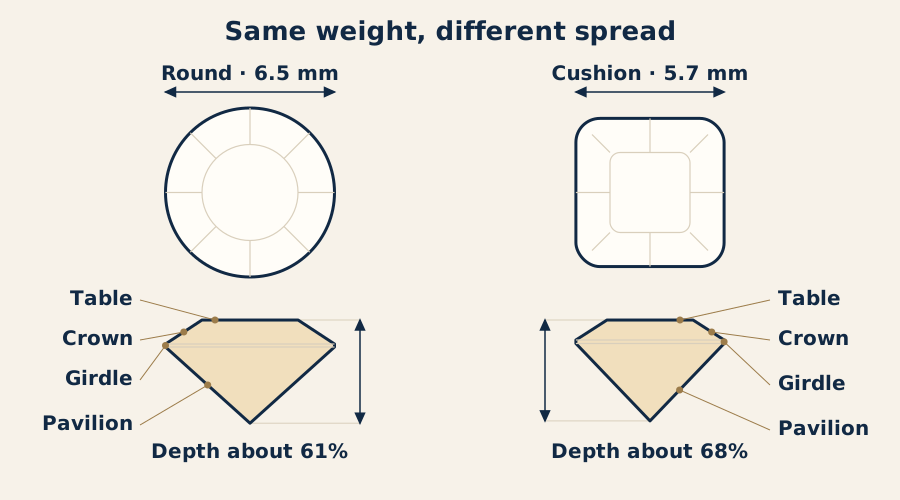
Depth is the main reason for the difference. Many cushions are cut at about 64–72% total depth, compared with about 59–62.5% for a well-cut round. Our article on how cushion depth hides carat weight shows how to spot a deep stone from the report, and our guide to round proportions beyond the cut grade explains why two Excellent rounds can still differ in spread (diameter relative to weight).
Does a round or cushion diamond sparkle more?
A round brilliant has the most consistent light return of any shape. Its facets are arranged symmetrically around a circle, so light entering from almost any direction is reflected back up through the top. A well-cut round balances brilliance (white light), fire (coloured flashes) and scintillation (the on-off sparkle as it moves), and it does so in almost every lighting condition.
Cushions sparkle differently, and the facet style decides how:
- Cushion brilliant (chunky): larger, bolder facets give broad flashes of white light and colour, a little like an Old Mine cut. Many people find the fire more noticeable than in a round, especially in candlelight or spotlights.
- Cushion modified (crushed ice): an extra row of pavilion facets breaks light into many tiny pinpoints, a busy glitter similar to a radiant cut. It hides inclusions well but can look less defined.
- Hybrids: many modern cushions sit between the two, so the label on the report does not always predict the look.
Our comparison of chunky cushion facets against crushed ice shows the two patterns side by side, and the guide to the cushion modified crushed ice style explains how to recognise it on a grading report.
Rounds have variations of their own. The round, star and Portuguese cut family shows how extra facets change the sparkle, and our page on 60/60 rounds against classic proportions looks at a popular proportion set that trades a little fire for extra brightness.
Not sure which one is right?
Send us the stones you are looking at and our gemologist will tell you which to choose and why.
How do you judge cut quality in a round and a cushion?
GIA gives an overall cut grade only to standard round brilliants. For a round, choosing Excellent cut, polish and symmetry (often called triple Excellent) does most of the work for you. For a cushion there is no such shortcut: the report lists polish and symmetry, but light performance, outline and facet style have to be judged by eye. These are typical ranges for well-cut stones:
| Measure | Round brilliant | Square cushion |
|---|---|---|
| Total depth | about 59–62.5% | about 61–68% |
| Table (top facet) width | about 53–58% | about 58–68% |
| Girdle (outer edge) | Thin to slightly thick | Thin to slightly thick; avoid very thick |
| Culet | None or very small | None or very small |
| Cut grade | GIA Excellent | None; aim for Excellent or Very Good polish and symmetry |
| What to check by eye | Little, if triple Excellent | Outline, facet style, dark areas, bow-tie |
A cushion can show a bow-tie, a dark band across the middle where light leaks out of the pavilion, especially in slightly elongated stones. A faint bow-tie that moves as the stone tilts is normal; one that stays dark in every position means the proportions are off. Rounds do not show a bow-tie.
Do cushion diamonds show more colour than rounds?
Yes, usually. A round brilliant masks body colour (the faint yellow or brown tint most white diamonds have) better than any other shape, because its facet pattern mixes light so thoroughly. Cushions tend to gather colour in the corners and are often cut deeper, giving light a longer path through the stone. Our article on why cushions can show more body colour explains the optics. As a practical rule, many people choose a cushion about one colour grade higher than they would for a round.
For clarity, both shapes hide inclusions (internal features) well because both use brilliant-style faceting. A round hides them best, a crushed-ice cushion nearly as well, and a chunky cushion slightly less, because its larger facets act like small windows. The goal for either is an eye-clean stone: no inclusions visible without magnification at normal viewing distance.
- Round in white gold or platinum: H–I colour often looks white; VS2–SI1 eye-clean.
- Cushion in white gold or platinum: G–H colour; VS2 or a carefully chosen SI1.
- Either in yellow or rose gold: I–J can look white, because the metal warms everything around it.
Which is more durable, a round or a cushion diamond?
Both are equally hard, but hardness is not toughness: diamond can chip along its cleavage planes if a thin edge takes a knock. A round has no corners at all, which makes it the most forgiving shape for everyday wear. A cushion's corners are rounded, so it is much less vulnerable than a princess cut, but the corners are still the parts most likely to catch, so they should sit under claws. Avoid any cushion with a very thin girdle at the corners.
- Round settings: four or six claws, bezel, halo, pavé band, three-stone. Six claws add security and make the outline look rounder; four show more of the stone.
- Cushion settings: four claws, one on each corner, or double claws for extra grip; halo, which suits the cushion's vintage roots; bezel, which fully protects the corners.
- Both: a low profile catches less on clothing and is easier to wear every day.
For detailed examples of claws, halos and bezels around a circular stone, see our guide to the most popular settings for round diamonds.
Related guideRadiant vs Cushion Cut DiamondsRound vs cushion cut diamond price: how much do they cost in Australia?
Rounds cost the most per carat of the main shapes. Two reasons: demand, since roughly half of all diamonds sold are rounds, and yield, because cutting a round from rough crystal usually loses more material than cutting a cushion. A cushion of the same weight, colour and clarity commonly costs noticeably less.
| 1 ct, G–H colour, VS clarity | Natural (approx. AUD) | Lab-grown (approx. AUD) |
|---|---|---|
| Round, Excellent cut | about $8,000–$15,000 | about $1,000–$2,500 |
| Cushion, well cut | about $5,500–$11,000 | about $900–$2,200 |
These are broad ranges only; prices move with the market and the exact grades. Lab-grown diamonds are real diamond, grown in a laboratory rather than mined, with the same hardness, refractive index and sparkle. They cost much less than natural diamonds and the price gap between round and cushion is smaller. Natural diamonds are rarer. Either way, ask for an independent grading report from a lab such as GIA or IGI, which states whether the stone is natural or laboratory-grown.
Because a round faces up larger, compare price per millimetre as well as price per carat. A 1 carat cushion may cost less than a 1 carat round, but a cushion that looks the same size as that round will weigh more, so the saving narrows.
Browse round and cushion diamonds: natural and lab-grown
Should you choose a round or a cushion diamond?
- Choose a round if: you want the most sparkle in every kind of light, the largest look for the weight, the simplest grading (a GIA cut grade does much of the work), or a shape with no corners for a hands-on job.
- Choose a cushion if: you like a softer, vintage or Art Deco look, want more carat weight for the budget, love broad flashes of fire, or plan a halo that frames a square outline.
- Either works if: you mainly care about a classic solitaire; both suit four-claw settings and straight wedding bands.
If vintage character is what draws you to the cushion, compare it with its ancestor in our Old Mine vs cushion comparison, and see the round's own antique forerunner in round against the Old European cut. If you like the square outline but want cleaner, step-cut lines, the Asscher vs cushion guide is the next comparison to read, and for a brighter square with cropped corners, try radiant set against cushion.
How do you choose between a round and a cushion? Step by step
- Set the size you want to see. Decide on a face-up size in millimetres, then use the size table to find the carat weight in each shape.
- Read the report. Confirm shape, measurements, depth, table, colour, clarity, polish and symmetry, and whether the diamond is natural or lab-grown.
- For a round, look for Excellent cut, polish and symmetry and a depth of about 59–62.5%.
- For a cushion, check the ratio (1.00–1.05 for square), a depth under about 68%, and watch a 360° video for the facet style and any fixed bow-tie.
- Adjust colour. Allow about one grade higher for a cushion than a round in white metal.
- Compare like with like. Line up a round and a cushion of similar face-up size, not just similar weight, and compare total price.
- Plan the setting. Make sure a cushion's corners sit under claws or a bezel, and choose claws or a halo that suit how you wear your hands.
Free consultation
Talk to a gemologist
Compare stones in person or online with Raj Sood, Graduate Gemologist (GIA), AJP (GIA).
Book a consultationFAQ
Common questions
Does a cushion cut look smaller than a round diamond?
Usually, yes. At 1 carat a round is about 6.4–6.5 mm across, while a square cushion is about 5.5–5.8 mm, because cushions are often cut deeper. The round shows roughly 10–15% more face-up area.
Which sparkles more, a round or a cushion?
A well-cut round has the brightest, most consistent sparkle of any shape. Cushions often show bigger flashes of coloured fire, and crushed-ice cushions give a finer glitter, so the difference is partly about taste.
Are cushion cut diamonds cheaper than round diamonds?
Typically, a cushion costs noticeably less per carat than a round of the same colour and clarity, because rounds are in higher demand and waste more rough when cut. Because the cushion faces up smaller, compare prices at the same face-up size too.
What colour grade should I choose for a cushion cut diamond?
Cushions tend to show more body colour, so in white gold or platinum most people choose G–H, about one grade higher than they would for a round. In yellow or rose gold, I–J often looks white.
Is a cushion cut diamond durable enough for an engagement ring?
Yes. Its corners are rounded, so it is much less prone to chipping than a princess cut, provided each corner sits under a claw or inside a bezel. A round, with no corners at all, is slightly more forgiving still.
Can I get lab-grown round and cushion diamonds?
Yes. Both shapes are widely available in lab-grown diamond, which is real diamond grown in a laboratory and costs much less than natural. The grading report will state that the stone is laboratory-grown.

Ask a gemologist
Not sure which diamond to choose?
Raj Sood is a Graduate Gemologist (GIA) and master jeweller. Bring the stones you are considering, or send the reports, and he will tell you honestly which one is better and why.
Keep learning
Related guides
 Diamond ShapesCushion Cut Diamonds: Brilliant, Modified & Buying Guide
 Diamond ShapesRound Brilliant DiamondsDiamond ShapesWhy Cushion Diamonds Can Show More Body ColourDiamond ShapesOval vs Round DiamondsDiamond ShapesUnderstanding Diamond ShapesDiamond ShapesRadiant vs Cushion Cut Diamonds
 Diamond ShapesAsscher vs Cushion Cut Diamonds
 Diamond ShapesCushion Modified (Crushed Ice) Cut Diamonds
Explore more
More guides on this topic
Education