
- Education
- Engagement Rings & Settings
- Best Settings for Princess Cut Diamonds: Claws, Halos and Bands
Engagement Rings & Settings
Best Settings for Princess Cut Diamonds: Claws, Halos and Bands
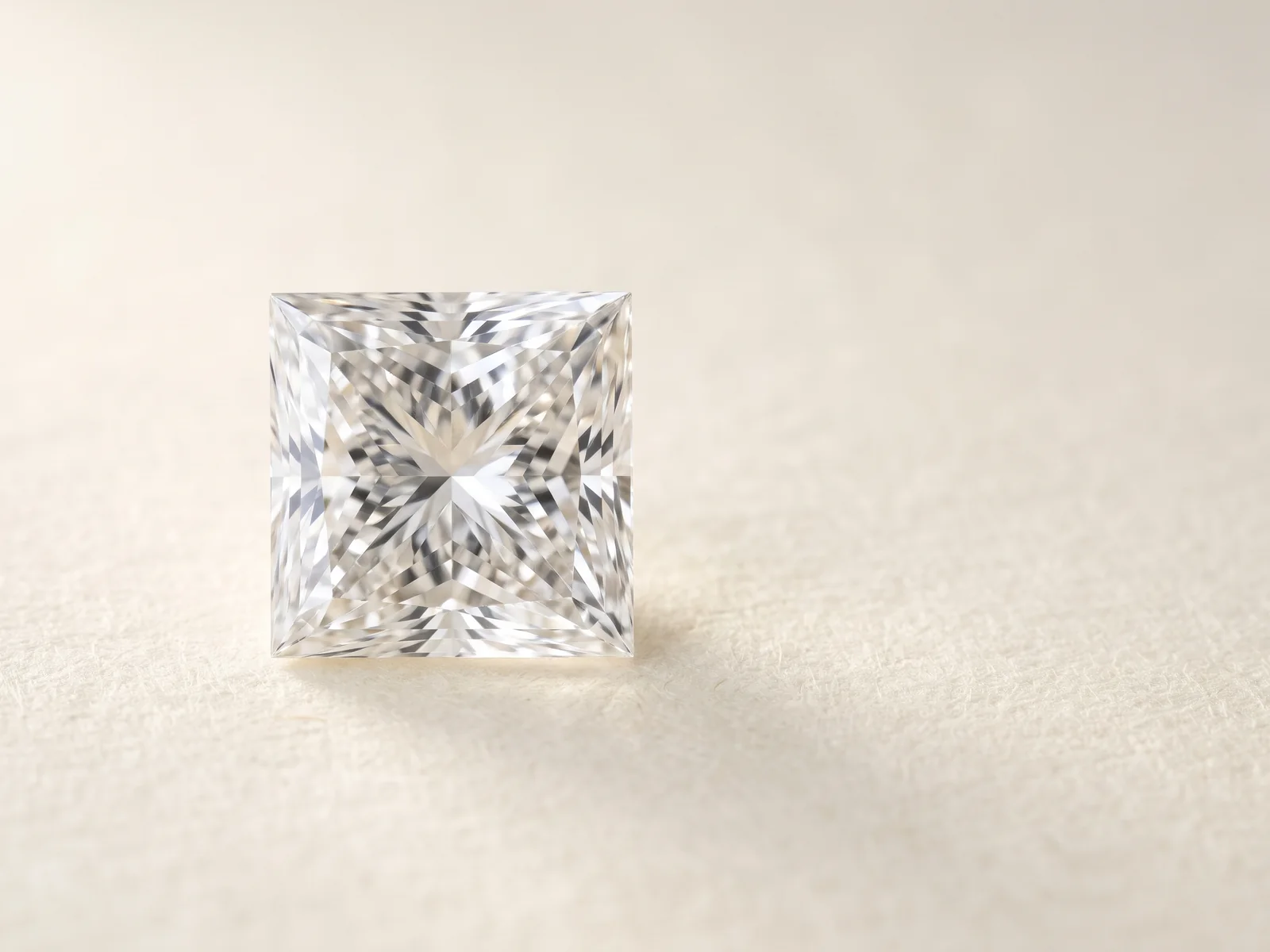
A princess cut has four sharp corners, and every one of them needs covering. The right princess cut settings keep those corners safe, show off the square outline and leave room for a wedding band.
 Reviewed by Raj Sood, Graduate Gemologist (GIA), AJP (GIA)Master jeweller and Graduate Gemologist (GIA) · reviewed 4 November 2026
Quick answer
The most secure princess cut settings protect all four sharp corners. A four V-claw solitaire (one V-shaped claw cupping each corner) is the classic choice; a bezel or half-bezel gives the most protection; a halo adds size and shields the edges. Set the stone low for active hands and pair it with a straight or flush-fitting band.
Why does a princess cut diamond need a special setting?
A princess cut is a square (or slightly rectangular) modified brilliant: it has the outline of a square but the sparkly, triangular faceting of a round brilliant. It usually has around 57–58 facets, and its pavilion (the pointed underside) is cut in rows of V-shaped facets called chevrons. Our full princess cut diamond guide covers its history and grading, and the page on how chevron patterns form under the table explains why two princesses of the same grade can sparkle quite differently.
What makes the setting so important is the corners. Each one meets at roughly 90°, and the girdle (the thin outer edge where the top and bottom halves meet) is at its thinnest right at those points. Diamond is 10 on the Mohs hardness scale, so it resists scratching better than any natural material, but hardness is not toughness. Diamond can split along its cleavage planes, and a sharp, unprotected corner that hits a doorframe or benchtop is exactly where a chip starts.
So the job of any princess setting is threefold: cover the four corners, hold the stone level so the square outline reads cleanly, and sit at a height that suits how you use your hands. If any term here is new, our plain-English jewellery glossary explains it.
- Check the girdle on the report: thin to slightly thick is fine; 'extremely thin' at the corners is a warning sign.
- Check the ratio: 1.00–1.05 looks square; above about 1.10 it reads as a rectangle and may suit different claw spacing.
- Check the corners under magnification: natural chips or 'extra facets' sometimes sit right at a point.
Where should the claws go on a princess cut diamond?
The short answer: directly over each corner. Claw placement is the single biggest decision in a princess setting, and it is where many off-the-shelf rings go wrong. There are four common approaches, and they do not protect the stone equally.
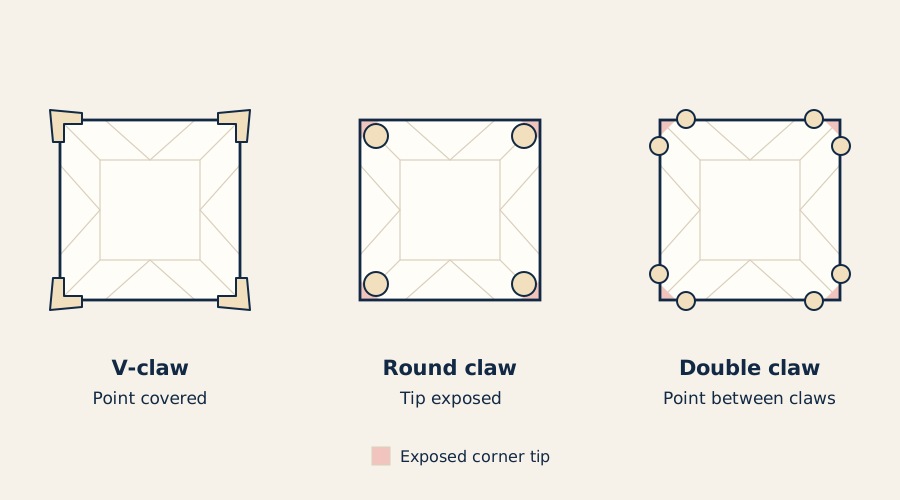
| Claw style | Where it sits | Corner protection | Look |
|---|---|---|---|
| Four V-claws | Folded over each corner, gripping both sides of the point | High: the point is fully covered | Clean, crisp, the classic princess look |
| Four round claws at the corners | A round bead over each corner | Moderate: the tip can still poke out beside the claw | Softer, more vintage; best on stones with slightly blunted corners |
| Double claws (eight) | Two claws either side of each corner | Moderate: the point sits between the pair, partly exposed | Finer, lacier look with more metal around the edge |
| Claws on the flat sides | Mid-way along each edge | Low: all four corners exposed | Not recommended for a princess cut |
A V-claw (sometimes called a V-prong or chevron claw) is a small V-shaped piece of metal that wraps the corner and covers roughly a millimetre along each adjoining edge. It hides very little of the diamond face-up, because the corner is the part you notice least, yet it takes the knocks before the stone does. Square stones with cut corners, like the Asscher, can get away with other claw shapes; compare our guide to square Asscher settings to see why.
For a broader look at how claws, bezels, channels and pavé actually grip a stone, read how each setting method holds a diamond.
What are the best princess cut settings?
There is no single winner. The right setting depends on how much protection you want, how much of the outline you want to see and how you wear your ring day to day. This comparison covers the princess cut engagement ring settings we are asked about most.
| Setting | Corner protection | How the princess looks | Maintenance | Suits |
|---|---|---|---|---|
| Four V-claw solitaire | High | Full square outline, maximum light | Check claws every 6–12 months | Most people; the classic choice |
| Full bezel | Highest | Framed by metal; slightly smaller face-up | Very low | Active hands, nurses, gym, gardening |
| Half-bezel | High on two sides, open on two | Modern, shows more of the diamond | Low | A bezel look with more sparkle |
| Square halo | High; the halo shields the edge | Looks noticeably larger | Small pavé stones need checking | A bigger look on a modest carat |
| Hidden halo | Medium (claws still do the work) | Clean solitaire from above, sparkle from the side | Moderate | A subtle detail |
| Three-stone | High with V-claws | Wider, more presence across the finger | Moderate | Larger hands, anniversary styles |
| Tension-style | Varies; corners take pressure | Stone appears to float | Ask about resizing limits | Design-led choices; discuss carefully |
A princess's straight sides are also its advantage: they sit neatly against bezels, square halos and channel-set bands in a way curved shapes cannot. Our overview of every engagement ring setting style explains each style in general terms. If you like the square look but want softer, rounded corners that need less protection, compare softer cushion settings.
On a full bezel, the metal rim has to be shaped with crisp inside corners to match the stone. A well-made bezel covers only about 0.3–0.5 mm of the edge, so the diamond loses little visible size, but it does let in less light from the sides than open claws.
Should a princess cut have a halo?
A halo is a ring of small diamonds set around the centre stone. On a princess it is usually a square halo that follows the outline, though some designs use a rounded or cushion-shaped halo to soften the corners. Both work; the square version keeps the geometric look, the rounded one changes the character of the ring.
The main reason people choose a halo is size. A single row of small diamonds, around 1.0–1.3 mm each, plus the metal between them, typically adds about 2.5–3.5 mm to the overall width of the head. A 1 carat princess of about 5.5 mm can then read closer to 8–9 mm across. The halo also acts as a bumper around the girdle, which is a genuine safety benefit for the corners.
| Princess carat | Typical face-up size | With a single halo (approx.) |
|---|---|---|
| 0.50 ct | about 4.4 × 4.4 mm | about 7.0–7.5 mm |
| 0.75 ct | about 5.0 × 5.0 mm | about 7.5–8.0 mm |
| 1.00 ct | about 5.5 × 5.5 mm | about 8.0–8.5 mm |
| 1.50 ct | about 6.3 × 6.3 mm | about 8.8–9.5 mm |
| 2.00 ct | about 6.9 × 6.9 mm | about 9.5–10.0 mm |
Princess cuts are cut deep, so they face up smaller for their weight than a round: a 1 carat round is about 6.4 mm across, against roughly 5.5 mm for a princess. A halo is one way to close that gap. To see how halos and solitaires compare on the shape that started it all, read about halo and solitaire options for round diamonds.
- Choose a halo if: you want more presence, extra edge protection or a vintage-inspired look with milgrain (tiny beaded metal edges).
- Skip the halo if: you prefer clean lines, want the lowest maintenance or plan to wear a wide stack of bands.
- Hidden halo: sits under the girdle, invisible from above, and adds sparkle from the side without changing the square outline.
Not sure which one is right?
Send us the stones you are looking at and our gemologist will tell you which to choose and why.
Can you set a princess cut sideways, or with side stones?
Yes. A kite setting (also called compass or diamond orientation) rotates the princess 45°, so the corners point north, south, east and west along the finger. A single V-claw sits on each point. Because the diagonal of a square is about 1.41 times its side, a 5.5 mm princess spans roughly 7.8 mm point to point in this position, so it reads larger lengthways and looks less traditional.
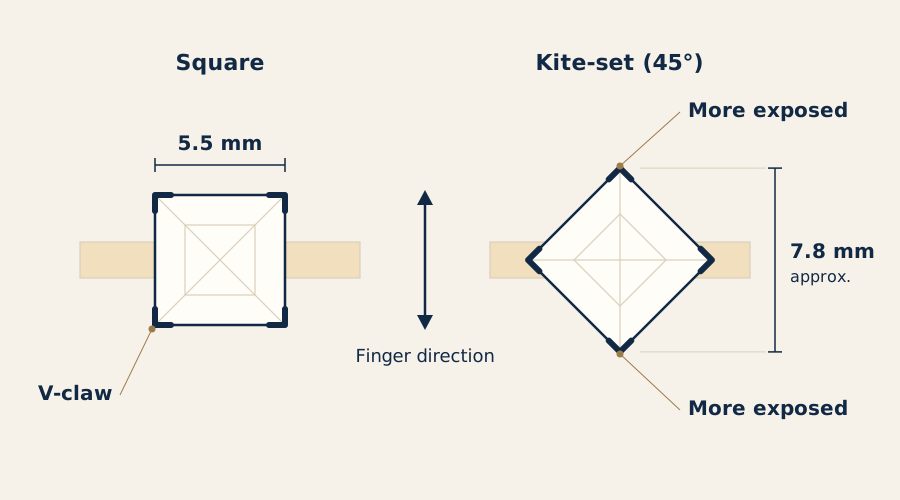
The trade-off is that the north and south points face the direction your hand moves most, so they take more knocks. A bezel or slightly heavier V-claws on those two points helps.
Princess cuts also pair naturally with side stones because of their straight edges. Common princess cut three stone ring combinations include:
- Trapezoids: step-cut side stones that taper outwards and sit flush against the princess's edges.
- Tapered baguettes: slim, rectangular step cuts that draw the eye to the centre.
- Smaller princesses: a matching trio, usually with the side stones at about a third to half the centre's carat weight each.
- Channel-set princess shoulders: small princesses set edge-to-edge between two metal walls, with no claws at all.
Step-cut side stones, with their long parallel facets, behave a lot like an emerald cut; see how step-cut emerald diamonds are set. If you are weighing a square stone against a longer one, our page on settings for elongated diamond shapes shows how proportions change the design.
Which princess cut settings suit active hands?
Height is the hidden variable. A princess is deep, often 65–75% of its width, so a 1 carat stone is roughly 3.6–4.1 mm from table to point. That depth has to fit inside the setting, which is why princess rings can sit taller than people expect. A high cathedral setting (where the shoulders sweep up to the head) might hold the table around 7–8 mm above the finger; a low-profile setting can bring that down to about 5–6 mm.
- Lowest risk: full bezel, set low, in platinum or 18ct gold.
- Good compromise: four V-claws on a low basket, so the corners sit close to the band.
- Higher risk: tall cathedral heads, fine double claws and kite settings with exposed north and south points.
- Habit that helps: take the ring off for weights, rock climbing, heavy gardening and anything involving chemicals.
Our guide to low-profile engagement rings for active hands compares heights and styles across every shape. The same thinking about protecting points applies to other shapes with sharp tips: see V-claw settings for pear diamonds, protecting both tips of a marquise and how to guard a heart's point and cleft.
Which metal works best for princess cut claws?
V-claws are small and take a lot of wear, so the metal matters more than it does on a round solitaire.
| Metal | How claws behave | Notes |
|---|---|---|
| Platinum (950) | Dense; metal moves rather than wearing away, so claws hold their mass longer | Heavier and usually costs more; develops a soft grey patina |
| 18ct white gold | Harder at first; wears gradually and may need retipping after several years | Usually rhodium-plated; replating every 1–3 years keeps it bright white |
| 18ct yellow or rose gold | Similar wear to white gold | Warm metal can disguise the tint of a lower colour grade; white-metal claws can be added for a whiter look around the diamond |
| 14ct or 9ct gold | Harder alloys but less gold content | Fine for budgets; check claw thickness |
Whatever the metal, have the claws checked every 6–12 months. A V-claw that has thinned or lifted at one corner is easy to rebuild early, and expensive to ignore.
What wedding band goes with a princess cut engagement ring?
This is where the princess shines. Its straight sides and squared head usually let a straight band sit flush alongside it with no gap, as long as the head is set high enough that the corners clear the band, or the basket is designed to let the band slide under.
- Plain straight band: the simplest match; same width as the engagement ring shank, often 1.8–2.5 mm.
- Channel-set princess band: small princesses edge-to-edge echo the centre stone.
- Pavé or claw-set band: adds sparkle, but check it doesn't catch on the V-claws.
- Contoured band: only needed if the head is very low, has a halo or sits on a wide bezel.
The usual gap problem comes from a halo or a low bezel, both of which are wider than the shank. If that is your design, plan the band at the same time. Our guide to wedding bands that sit flush beside a princess shows examples of each pairing.
Related guideBest Wedding Band for Princess Engagement RingsHow much do princess cut settings cost, natural or lab-grown?
The setting and the diamond are priced separately. A princess setting is a similar cost to a round of the same style; what changes the price is the metal, the number of small diamonds and the amount of hand finishing. These are broad AUD ranges for the setting only, without the centre stone:
| Setting style | 18ct gold (approx. AUD) | Platinum (approx. AUD) |
|---|---|---|
| Four V-claw solitaire | $1,500–$3,000 | $2,500–$4,500 |
| Bezel or half-bezel solitaire | $1,800–$3,500 | $2,800–$5,000 |
| Square halo | $2,500–$5,000 | $3,500–$6,500 |
| Three-stone (side stones included) | $2,500–$7,000 | $3,500–$8,500 |
Princess diamonds come in both natural and laboratory-grown forms, and they look identical to the eye. Lab-grown diamonds are real diamond, grown in a laboratory rather than mined, and cost much less, which lets many people choose a larger princess or put more budget into the setting. Natural princesses are rarer. Either way, ask for an independent grading report from a lab such as GIA or IGI, which states whether the stone is natural or lab-grown.
If you are reusing a family diamond, the same principles apply; older stones such as cushion-like antique cuts have their own needs, covered in remounting antique old mine diamonds.
Shop princess cut diamonds: natural and lab-grown
How do you choose a setting for a princess cut diamond? Step by step
- Read the report. Note the measurements, depth, girdle thickness and whether the stone is natural or lab-grown.
- Inspect the corners. Look for chips, extra facets or an extremely thin girdle at the points.
- Decide on protection. Four V-claws for the classic look, a bezel for maximum security, a halo for size and an edge bumper.
- Choose the orientation. Square (traditional) or kite-set (longer look, more exposed points).
- Set the height. Low for active hands; higher if you want a straight band to slide underneath.
- Pick the metal. Platinum or 18ct gold for the claws, matched to how white you want the diamond to look.
- Plan the wedding band now. Check it sits flush before the head is finalised.
- Book claw checks. Every 6–12 months, especially in the first year.
Already have a princess and a ring you love? Read about moving a loose princess into a ring you already own before you commit, because the existing head may need V-claws added.
Free consultation
Talk to a gemologist
Compare stones in person or online with Raj Sood, Graduate Gemologist (GIA), AJP (GIA).
Book a consultationFAQ
Common questions
What is the best setting for a princess cut diamond?
A four V-claw setting is the most popular because it covers all four corners while showing the full square outline. A bezel gives even more protection, and a square halo adds size.
Should a princess cut have four or six claws?
Four. A princess has four corners, and one V-claw on each is what protects them. Six claws suit round stones; on a princess, the extra claws would sit on the flat sides and do little.
Do princess cut diamonds chip easily?
The corners are the weak point because the girdle is thinnest there. In a setting that covers them, such as V-claws, a bezel or a halo, a princess is fine for everyday wear.
Does a straight wedding band fit a princess engagement ring?
Usually yes, because the princess has straight sides. Halos and low bezels are wider than the shank, so those designs may need a contoured band.
What is a kite set princess diamond?
It is a princess rotated 45° so its corners point along and across the finger. It looks larger lengthways, but the end points are more exposed.
Is a halo worth it on a princess cut?
It is if you want the stone to look bigger or want extra protection around the edge. A single halo typically adds about 2.5–3.5 mm to the width, but it means more small stones to maintain.

Ask a gemologist
Not sure which diamond to choose?
Raj Sood is a Graduate Gemologist (GIA) and master jeweller. Bring the stones you are considering, or send the reports, and he will tell you honestly which one is better and why.
Keep learning
Related guides
 Diamond ShapesPrincess Cut DiamondsWedding Bands & EternityBest Wedding Band for Princess Engagement RingsEngagement Rings & SettingsEngagement Ring Setting Styles Guide
 Engagement Rings & SettingsBest Engagement Ring Settings for Active Hands
 Engagement Rings & SettingsBest Settings for Round Diamonds
 Engagement Rings & SettingsBest Settings for Cushion DiamondsEngagement Rings & SettingsDiamond & Gemstone Setting Guide
 Engagement Rings & SettingsBest Settings for Pear Diamonds
Explore more
More guides on this topic
Education