
- Education
- Engagement Rings & Settings
- Flush Setting Guide: How Gypsy Settings Are Made, Wear and Fit
Engagement Rings & Settings
Flush Setting Guide: How Gypsy Settings Are Made, Wear and Fit
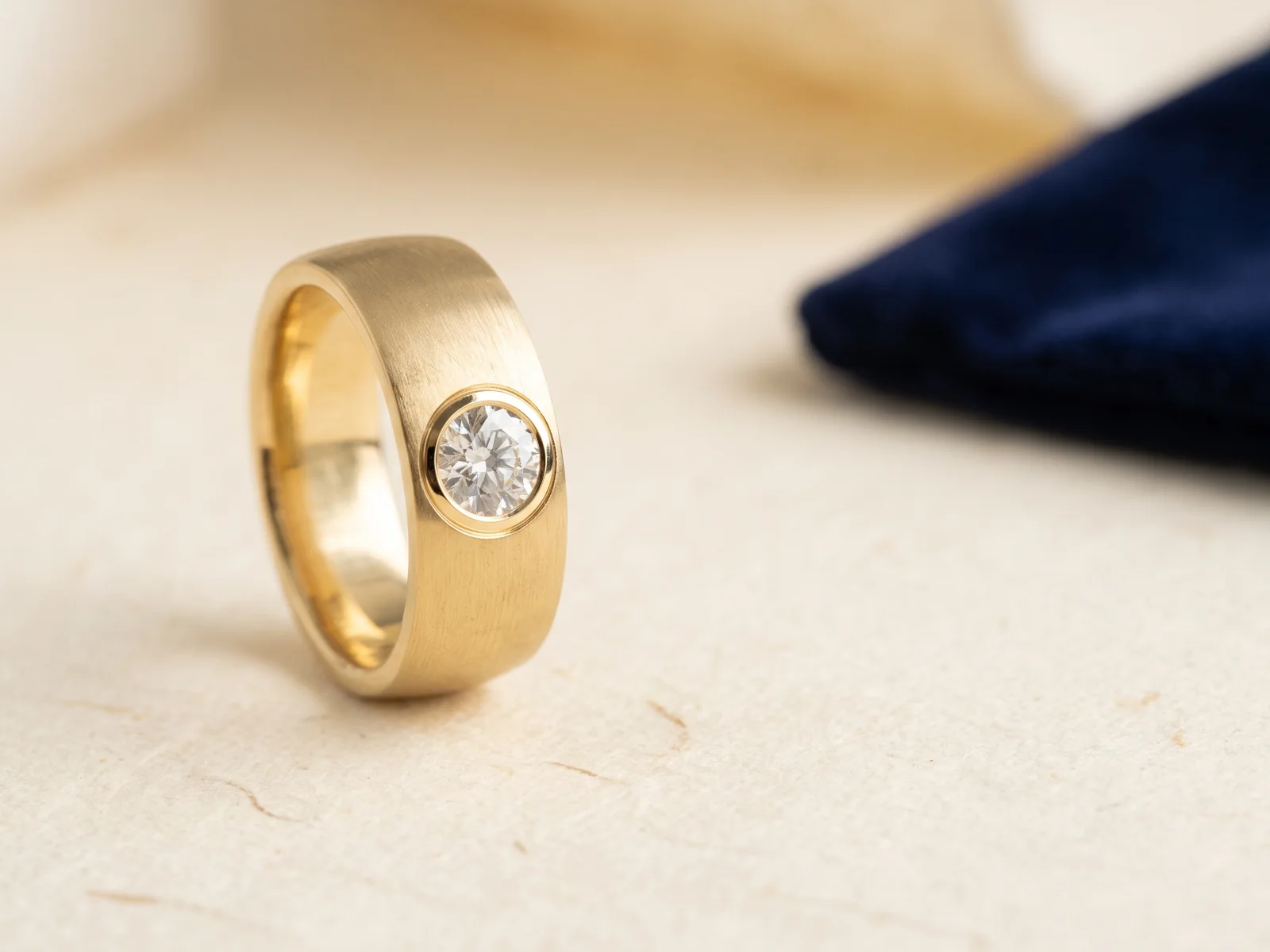
A flush setting sinks a stone into the metal so nothing sticks up. That makes it one of the most practical ways to wear a diamond, but it only works with the right stone, the right metal thickness and a skilled setter.
 Reviewed by Raj Sood, Graduate Gemologist (GIA), AJP (GIA)Master jeweller and Graduate Gemologist (GIA) · reviewed 4 November 2026
Quick answer
A flush setting, also called a gypsy setting, sets a gemstone into a drilled seat so its table sits level with the metal, held by a burnished lip around the girdle. It is very secure and snag-free, suits hard stones of about 1–4 mm such as diamond, sapphire and moissanite, and needs a thick, wide band.
What is a flush setting?
A flush setting sets a gemstone into a hole drilled in the metal, so the top of the stone sits level with, or very slightly below, the surface around it. There are no claws. Instead, a thin lip of metal is pushed over the stone's girdle (its widest outer edge) all the way round, and that continuous lip holds the stone in. You will also hear it called a gypsy setting, a burnish setting or, when fine lines are engraved out from the stone, a star setting.
The name gypsy comes from heavy Victorian-era men's rings, where stones were sunk into thick gold. Many jewellers now simply say flush setting, and that is the term we use here. It belongs to the same family as the bezel, because both surround the stone with metal, but a bezel raises the stone in a collar while a flush-set stone is recessed into the ring itself. Our overview of engagement ring setting styles shows where it sits alongside claws, bezels and halos, and the complete guide to how gemstones are set covers every technique a setter uses.
Flush settings are most common in wedding bands, men's rings, signet rings, and as small hidden stones on the shoulders or inside the band of an engagement ring. They are used less often for a large centre stone, for reasons covered below. If any term here is new, our plain-English jewellery glossary explains it.
How is a flush setting made by hand?
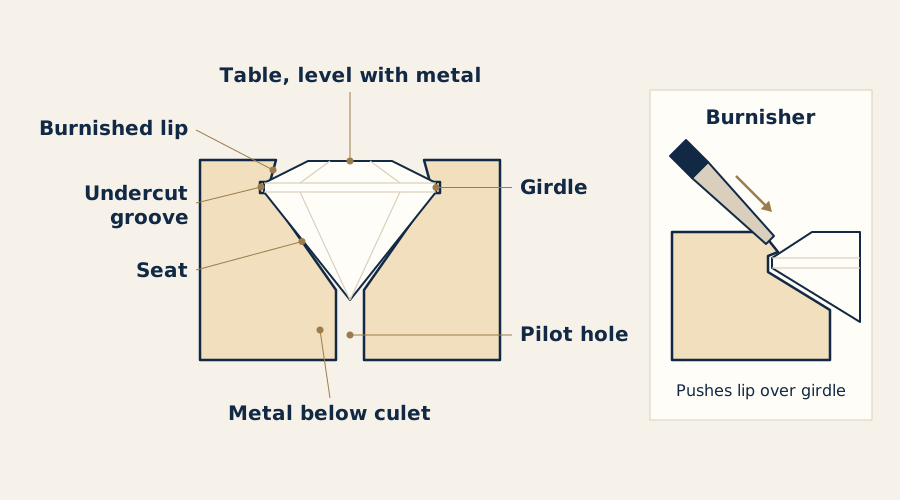
A flush setting looks simple, but it is one of the more exacting jobs at the bench. The setter works under magnification, usually 10× or more, and the stone has to sit perfectly level, because any tilt is obvious when the table is right at the surface. The usual stages are:
- Marking out: the position of each stone is marked so spacing is even and the stones sit on the centre line of the band.
- Pilot hole: a small hole is drilled right through the metal. This lets light reach the back of the stone and lets you clean behind it later.
- Cutting the seat: a setting bur the same diameter as the stone opens the hole to the right depth, with a small groove (the undercut) where the girdle will sit.
- Placing the stone: the stone drops into the seat with its table level and its girdle just below the metal surface.
- Burnishing: a polished steel burnisher, or a small pneumatic hammer handpiece, pushes the rim of metal inward over the girdle until it grips the stone evenly all the way round.
- Finishing: a fine bevel is often bright-cut (cut with a polished graver so it shines) around the rim, or lines are engraved for a star setting, before the ring is polished.
The depth is the critical number. A round brilliant is roughly 60% as deep as it is wide, so a 3 mm diamond is about 1.8 mm from table to culet (the bottom point). The metal must be deeper than that, with some left underneath, or the seat breaks through or the band is weakened. That is why flush settings need thicker bands than most other styles, and why they are much easier to plan before a ring is made than to add afterwards.
What does a flush set diamond look like?
A flush set diamond reads as a point of light sunk into smooth metal. The look is clean, modern and understated, and it suits brushed, matte and hammered finishes as well as high polish. Spacing several small stones around a band gives a scattered, starry effect, while a single stone in a wide band looks bold and architectural.
There are trade-offs. Because the lip covers the girdle, a sliver of the stone's outline is hidden, and no light enters through the sides of the stone. A flush-set diamond therefore looks a little smaller and slightly less lively than the same stone in claws. The bright-cut bevel helps, because it catches light right at the stone's edge. If face-up size matters most to you, our guide to settings that make a diamond look larger covers styles that work the other way, and for more sparkle across a band, compare micro-pavé, bead and bright-cut setting.
Colour and clarity choices shift slightly too. With little light entering from the side, a flush setting is forgiving of small inclusions near the girdle, which the lip often covers. In yellow or rose gold, the surrounding metal also warms the stone, so a slightly warmer colour grade can look white once set.
Is a flush setting secure for everyday wear?
Yes. For small, hard stones, a flush setting is among the most secure ways to set a gem. The whole girdle is gripped by metal, rather than four or six points, and the stone sits below the surface, so there is nothing to catch on knitwear, hair, gloves or tools. A knock to the side of the ring hits metal, not the edge of the stone.
That makes flush-set rings a common choice for people who work with their hands: nurses, tradies, chefs, gardeners, gym-goers and parents of small children. Our guide to ring settings for active hands compares it with other low-profile options.
Related guideBest Engagement Ring Settings for Active HandsThe limits are worth knowing. The burnished lip is thin, often only a few tenths of a millimetre, so softer metals can wear it down over many years. A hard blow to the face of the ring can still chip a stone that has a thin girdle. And the burnishing pressure itself can crack a brittle or included stone during setting, which is why stone choice matters so much.
Not sure which one is right?
Send us the stones you are looking at and our gemologist will tell you which to choose and why.
Which gemstones and shapes suit a flush setting?
Burnishing presses metal hard against the girdle, so the stone needs to be both hard (scratch-resistant, measured on the Mohs scale) and tough (resistant to chipping and cracking). Diamond, at Mohs 10, is the classic choice, and natural and lab-grown diamonds set the same way.
| Gemstone | Mohs hardness | Flush setting suitability |
|---|---|---|
| Diamond (natural or lab-grown) | 10 | Excellent; watch for very thin girdles |
| Moissanite | 9.25 | Excellent |
| Sapphire and ruby (natural or lab-created) | 9 | Excellent; a common coloured choice |
| Spinel | 8 | Good |
| Aquamarine, morganite | 7.5–8 | Possible with care; less tough |
| Garnet | 6.5–7.5 | Possible with care; scratches over time |
| Emerald | 7.5–8 | Not recommended; brittle and usually included |
| Tanzanite, opal | 6–7, 5.5–6.5 | Not recommended; soft or fragile |
Shapes matter as much as material. Round brilliants are the natural fit: the seat is cut with a round bur and the lip grips evenly. Our guide to setting options for round diamonds covers them in every style. Square and pointed shapes are possible but harder, because the seat has to be cut by hand and the points take the most pressure:
- Princess and square cuts: the sharp corners are vulnerable; many setters add tiny corner beads or choose a stone with slightly blunted corners. See how to protect princess cut corners.
- Pear and heart shapes: the fine tip is easy to chip under the burnisher. Our pages on settings that protect a pear diamond's point and safe settings for heart shaped diamonds explain the safer options.
- Cushions: the rounded corners flush set reasonably well, though the seat must follow the outline closely. Compare the alternatives in cushion diamond setting ideas.
- Old mine and antique cuts: these often have thick, uneven girdles and small tables, and recutting a seat to suit them takes skill. See how antique old mine stones are set before remodelling an heirloom.
Flush setting vs bezel, claw and pavé: how do they compare?
| Flush | Bezel | Claw (prong) | Pavé | Tension | |
|---|---|---|---|---|---|
| Stone height | Level with metal | Raised in a collar | Raised | Level with or just above metal | Raised between metal ends |
| Snag risk | Very low | Low | Higher | Low to medium | Low |
| Light into the stone | Face-up only | Mostly face-up | From all sides | Face-up, some sides | From most sides |
| Typical stone size | 1–4 mm | Any | Any | 0.8–2 mm | Usually 3 mm+ |
| Metal needed | Thick, wide band | Moderate | Least | Moderate | Precise, thick ends |
| Long-term upkeep | Check lip; re-burnish | Check rim | Check claw tips | Check beads; stones can loosen | Specialist work |
The closest relative is the bezel: both protect the girdle, but the bezel sits up off the band and shows more of the stone's outline. Claw settings let in the most light and show the most stone, at the cost of more snagging; the heads that hold them are explained in basket, trellis and peg head settings. A tension setting also looks minimal but works on a completely different principle, explained in how tension and suspended settings hold a stone. If you prefer softer, more decorative detail, floral engagement ring designs sit at the opposite end of the style range.
Which metals and band sizes work for a flush setting wedding band?
The lip has to move when burnished and then hold its shape for years, so the metal needs to be workable but not too soft. Platinum and 18ct gold are the most common choices. Platinum does not wear away the way gold does, it tends to push sideways, so a platinum lip keeps its bulk well. 18ct gold is easy to burnish and polishes back crisply. 9ct gold is harder and holds a lip well but is less forgiving to set. Very hard modern metals such as tungsten carbide cannot be burnished, so stones in them are usually held another way.
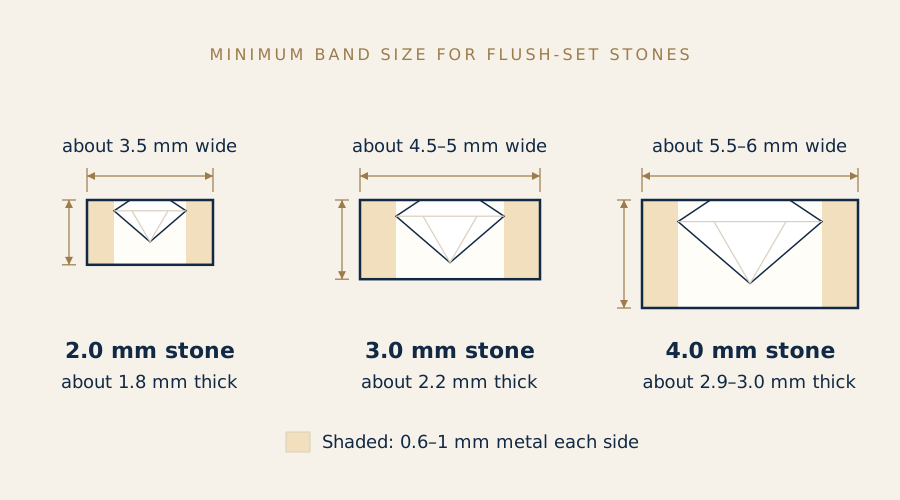
Band size is where many flush-set designs succeed or fail. As a rough guide, you want at least 0.6–1 mm of metal either side of the stone and enough depth to fully house it with metal underneath.
| Round stone diameter | Approx. diamond weight | Minimum band width | Minimum band thickness |
|---|---|---|---|
| 2.0 mm | 0.03 ct | about 3.5 mm | about 1.8 mm |
| 3.0 mm | 0.10 ct | about 4.5–5 mm | about 2.2 mm |
| 4.0 mm | 0.25 ct | about 5.5–6 mm | about 2.9–3.0 mm |
| 5.0 mm | 0.50 ct | about 6.5–7 mm | about 3.4–3.5 mm |
A flush-set wedding band is also one of the easiest bands to wear beside an engagement ring, because there are no claws or raised stones to rub against the centre setting. The flat face sits snugly, and many people choose one deliberately to sit under a claw or halo ring. How well any band sits depends on the height of the engagement ring's setting; our guide to setting height and how a wedding band sits explains the measurements to check.
How does a flush setting wear over the years?
From the repair bench, flush settings are some of the longest-lasting settings we see, but they do change with time. The things that wear them are predictable:
- Lip wear: daily contact slowly thins the metal over the girdle, especially on the palm side and in softer gold. Once it thins enough, the stone can start to move.
- Over-polishing: every machine polish removes a little metal. A ring polished hard every year can lose its lip faster than one that is simply worn.
- Resizing: stretching or cutting a band changes the shape of the seats. Small changes of one or two sizes are usually fine; bigger changes, or full flush-set eternity bands, may need stones removed and reset.
- Dents and distortion: a heavy knock to the face can open a seat slightly. A thicker band resists this much better.
- Dirt behind the stone: soap, lotion and skin oils collect in the pilot hole and dull the stone from behind. A soft brush and warm soapy water usually clears it.
The good news is that a worn flush setting can usually be tightened by re-burnishing the existing lip, and if too much metal has gone, the setter can reset the stone a fraction deeper or, in some cases, add metal by laser welding. A brushed finish can be refreshed without touching the lip at all.
How much does a flush setting cost in Australia?
The setting itself is labour, priced per stone, and flush setting usually costs a little more per stone than simple claw or pavé work, because each seat is cut individually and the stone must sit perfectly level. The stone is usually the larger cost. Natural and laboratory-grown diamonds flush set identically; lab-grown diamonds are real diamond grown in a laboratory and cost much less than natural diamonds of the same size and grade.
| Item | Approximate range (AUD) |
|---|---|
| Flush setting labour, per small stone | about $40–$120 |
| 0.10 ct round (3 mm), natural diamond, G–H, VS–SI | about $150–$400 |
| 0.10 ct round (3 mm), lab-grown diamond | about $40–$150 |
| 0.10 ct lab-created sapphire | about $30–$100 |
| Re-burnishing a loose flush-set stone | about $40–$100 |
These are broad guides only; metal prices, stone grades and design all move the total. A flush-set band also needs more metal than a slim claw-set band because of its extra width and depth, so the metal weight is often a bigger share of the price than people expect.
Design a flush-set ring or browse ring settings
How do you choose a flush set ring? Step by step
- Choose a suitable stone. Diamond, moissanite, sapphire or ruby, ideally Mohs 8 or higher, and confirm whether it is natural, lab-grown or lab-created.
- Pick a forgiving shape. Round is simplest; ask how corners or points will be protected on anything else.
- Match stone to band. Check the band width and thickness against the stone's diameter and depth so the seat is fully housed.
- Choose the metal. Platinum or 18ct gold for most designs; ask how the finish (polished, brushed or hammered) will age.
- Check the finished setting. Under a loupe, the table should sit level, the lip should be even all round and there should be a clean pilot hole behind the stone.
- Plan the upkeep. Have the lip checked about once a year and ask for gentle polishing rather than heavy buffing.
Free consultation
Talk to a gemologist
Compare stones in person or online with Raj Sood, Graduate Gemologist (GIA), AJP (GIA).
Book a consultationShop this shape
FAQ
Common questions
What is the difference between a flush setting and a gypsy setting?
There is no difference; they are two names for the same technique. Gypsy setting is the older name, while flush setting and burnish setting are the terms most jewellers use today.
Is a flush setting secure?
Yes. The whole girdle is held by a continuous lip of metal and the stone sits below the surface, so there is nothing to snag. The lip should still be checked about once a year, especially in gold.
Does a flush setting make a diamond look smaller?
Slightly. The lip covers the girdle and no light enters through the sides, so a flush-set diamond looks a little smaller and less lively than the same stone in claws.
Can you flush set an engagement ring centre stone?
It is possible for stones up to about half a carat in a wide, thick band, but it needs a lot of metal and suits a bold, modern design. Most flush-set engagement rings use smaller stones.
Can a flush-set ring be resized?
Usually by one or two sizes. Larger changes, or full flush-set eternity bands, can loosen the stones, which may then need to be removed and reset.
Which stones should not be flush set?
Soft or brittle stones such as emerald, opal, tanzanite and pearl are not recommended, because the burnishing pressure can crack them and daily wear scratches them.

Ask a gemologist
Not sure which diamond to choose?
Raj Sood is a Graduate Gemologist (GIA) and master jeweller. Bring the stones you are considering, or send the reports, and he will tell you honestly which one is better and why.
Keep learning
Related guides
 Engagement Rings & SettingsDiamond & Gemstone Setting GuideEngagement Rings & SettingsSetting Height and Wedding Band FitEngagement Rings & SettingsPavé Settings Explained: Micro-Pavé, Bead and Bright Cut
 Engagement Rings & SettingsFloral Engagement Ring Settings
 Engagement Rings & SettingsBest Settings for Princess Diamonds
 Engagement Rings & SettingsTension and Suspended Settings
 Engagement Rings & SettingsSettings That Make a Diamond Look Bigger
Explore more
More guides on this topic
Education