
- Education
- Engagement Rings & Settings
- Tension Setting Guide: True Tension, Tension-Style and Suspended Rings
Engagement Rings & Settings
Tension Setting Guide: True Tension, Tension-Style and Suspended Rings
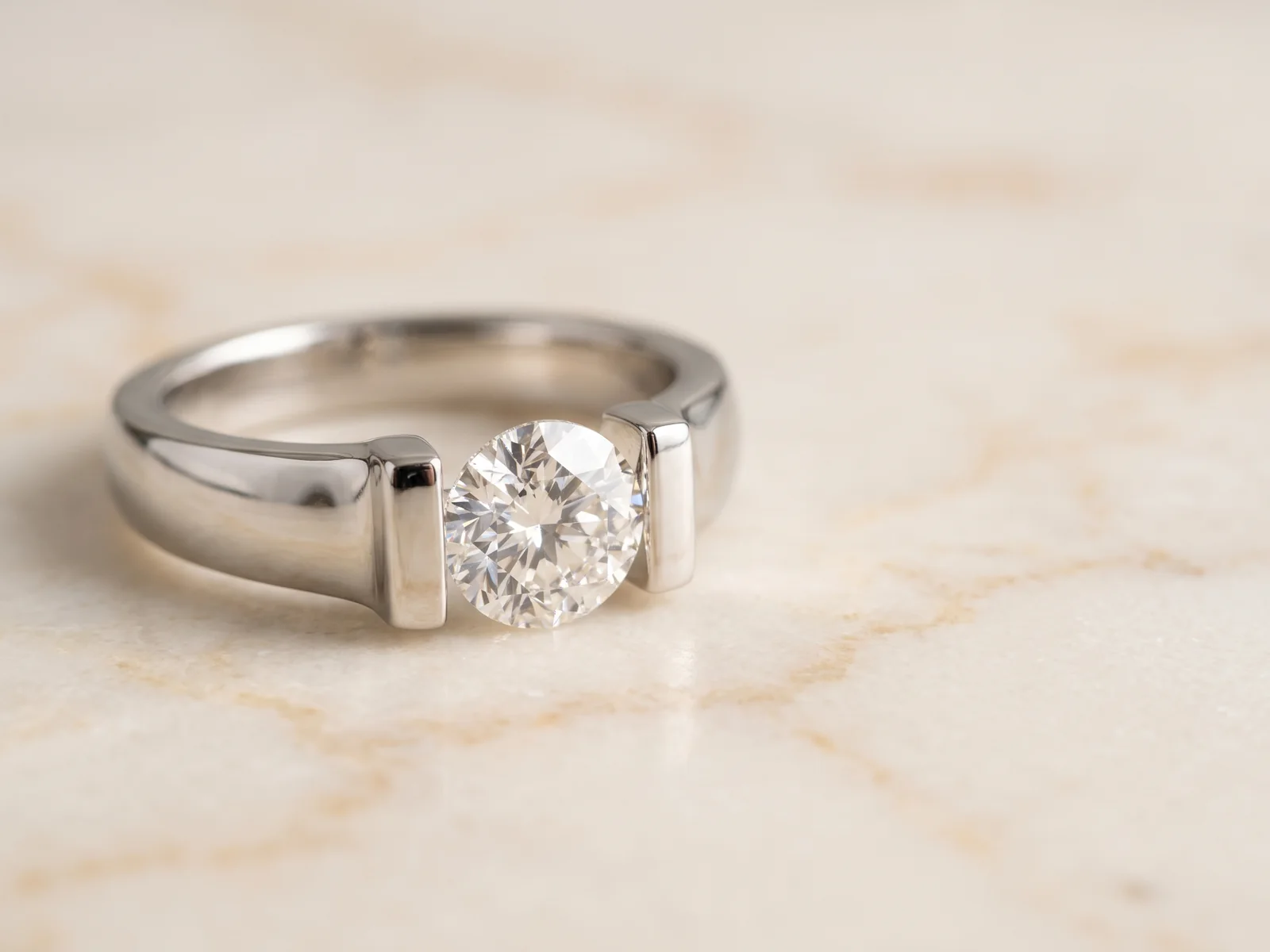
A tension setting makes a diamond look as if it is floating, with no claws in sight. That look depends on careful engineering, so here is how it works, how secure it really is and what it means for sizing and repairs.
 Reviewed by Raj Sood, Graduate Gemologist (GIA), AJP (GIA)Master jeweller and Graduate Gemologist (GIA) · reviewed 4 November 2026
Quick answer
A tension setting holds a diamond between the two ends of a band using the spring pressure of hardened metal, with the stone's girdle locked into tiny grooves rather than held by claws. It suits hard stones such as diamond, sapphire and lab-created moissanite in round, princess or cushion shapes, is secure when well made, but is difficult to resize.
What is a tension setting?
A tension setting holds a gemstone using pressure alone. The band is made as an almost complete circle with a small gap at the top. The stone sits in that gap, and the two ends of the band press inwards against it, like a spring that is always trying to close. There are no claws (the small metal prongs used in most rings) and no rim of metal around the stone, so it appears to hover between the band ends.
The stone is not simply squeezed between two flat surfaces. A setter cuts a tiny groove, called a seat, into each end of the band, and the stone's girdle (the thin outer edge where the top and bottom halves of a diamond meet) locks into those grooves. The pressure keeps it there; the grooves stop it sliding out.
Tension setting is one of the newer styles in our overview of engagement ring setting styles. It grew out of modern metallurgy and precision engineering from the late twentieth century, and it is still a specialist piece of work. If any term on this page is new to you, our plain-English jewellery glossary explains it.
The look is clean and architectural. Because almost nothing touches the stone, light enters from the sides and below, and the diamond reads as larger and brighter than it would deep in a basket. Setting a stone this way is one of the approaches in our guide to settings that help a diamond look larger, though the effect depends on how high the stone sits relative to the band.
How is a tension set diamond held in place?
The whole design depends on the metal behaving like a spring. Ordinary 950 platinum and standard 18ct gold are too soft: over time they would relax and let the stone go. True tension rings are made from hardened alloys, metal that has been strengthened by its recipe, by heat treatment or by work hardening (compressing and shaping the metal so its internal structure becomes stiffer). Titanium and stainless steel are also used, mainly in lower-priced tension rings.
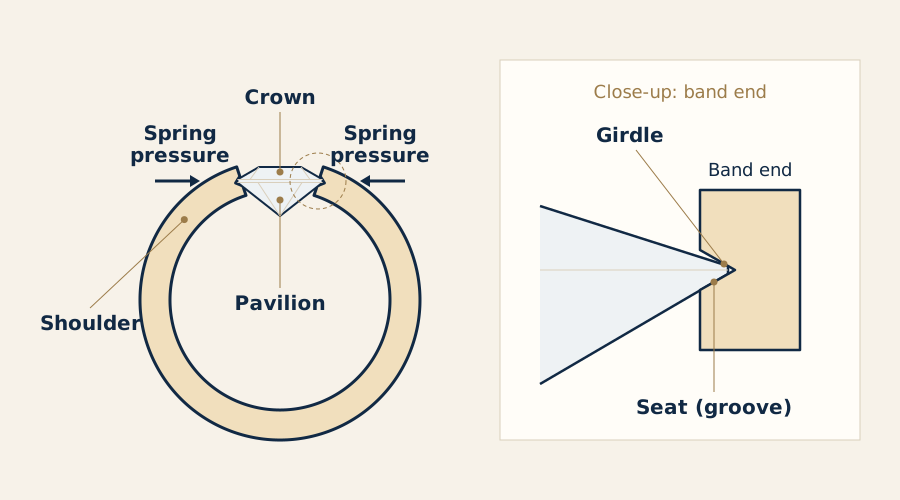
The usual way of building one runs like this. The band is formed thick and stiff, often 4–8 mm wide at the shoulders (the parts of the band either side of the stone). The maker opens the gap very slightly with a tool, slides the stone's girdle into the grooves, then releases the tool so the band springs back and grips it. The grooves are only a fraction of a millimetre deep, so they must be cut precisely to the stone's actual measurements, not the nominal size on a certificate.
That is why a true tension ring is normally made around one particular stone. Swapping in a different diamond later, even one of the same carat weight, usually means recutting the grooves or making a new band. Our guide to how diamonds and gemstones are set compares this with the way claws, bezels and channels hold a stone.
What is the difference between tension, tension-style and suspended settings?
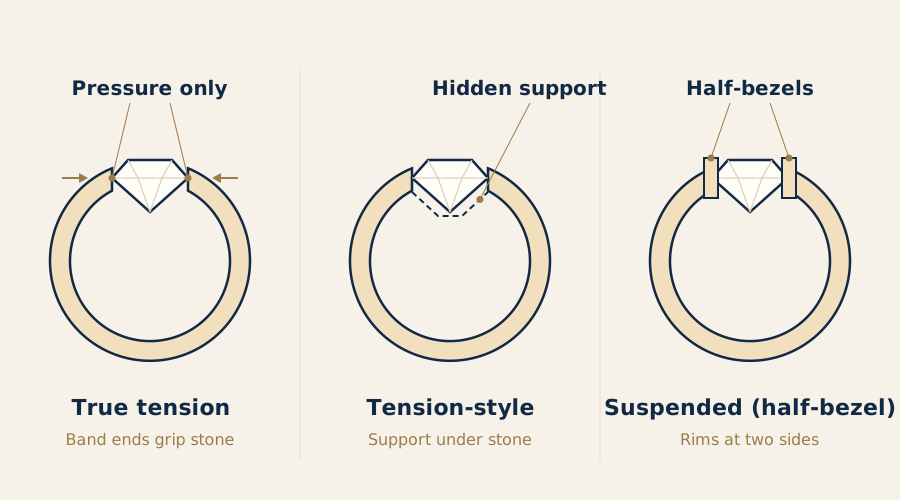
Jewellers use these names loosely, so it is worth asking exactly what holds the stone in any ring you look at. In general:
- True tension: the stone is held only by the spring pressure of the band ends pressing into grooves at two points.
- Tension-style (faux tension): looks the same from the top, but the stone is actually held by a hidden bezel, small claws or a bar underneath. The band does not need to be under pressure.
- Suspended setting: a broad term for designs where the stone seems to float, held at its edges by small partial bezels, fine claws or a bridge, with no visible basket below. Some suspended rings hold the stone between two band ends with a half-bezel on each side.
| True tension | Tension-style | Suspended (half-bezel) | Bezel | Claw | |
|---|---|---|---|---|---|
| What holds the stone | Spring pressure into two grooves | Hidden claws, bezel or bar | Two partial metal rims | Full metal rim | 4 or 6 prongs |
| Metal around the stone | Almost none | Very little | A little at two sides | All the way round | At 4–6 small points |
| Light into the stone | Very high | High | High | Lower | High |
| Resizing | Very limited or not possible | Usually possible | Usually possible | Possible | Possible |
| Stone swap later | Usually needs new grooves or band | Easier | Easier | Moderate | Easy |
| Edge protection | Sides exposed | Sides partly exposed | Good at two sides | Very good | Moderate |
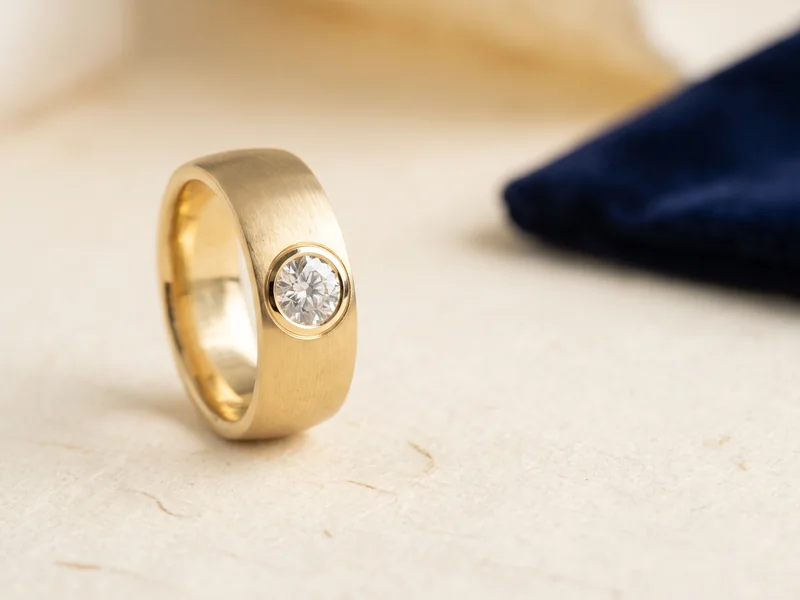
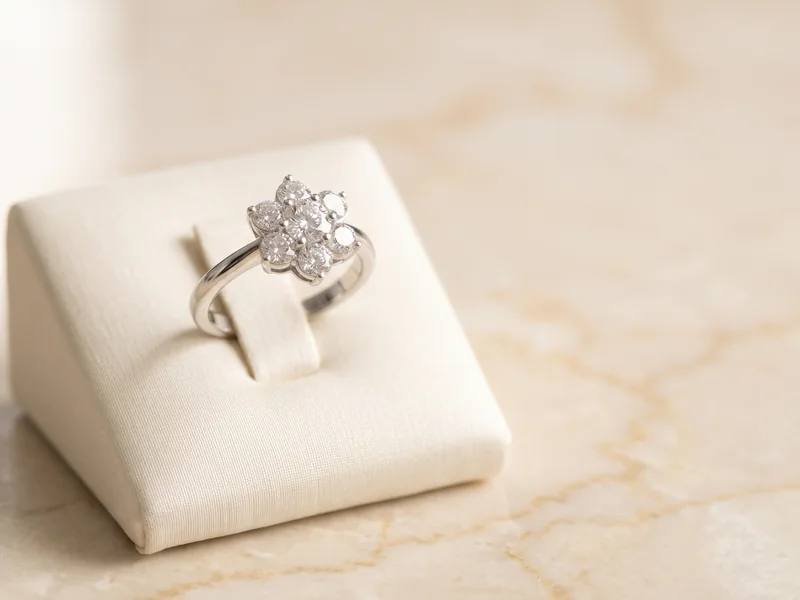
If you like the idea of metal hugging the stone but want everything sitting low, a flush or gypsy setting sunk into the band is the opposite approach: the stone is set level with the metal surface. And if you want something softer and more decorative than the minimal tension look, see our flower-inspired engagement ring settings.
Are tension settings safe for everyday wear?
A well-made true tension ring in a properly hardened alloy is secure for daily wear. The pressure on the stone is considerable, and it does not loosen gradually the way a worn claw can. Most problems come from three causes:
- Hard knocks to the shoulders. A sharp blow to the side of the band can flex it for a split second, enough to unseat the stone. Dropping the ring onto tiles or concrete is the classic case.
- Poor manufacture. Grooves that are too shallow, or metal that was never properly hardened, will not hold the stone for years.
- Changes to the band. Resizing, heating or bending a tension ring can destroy the spring in the metal.
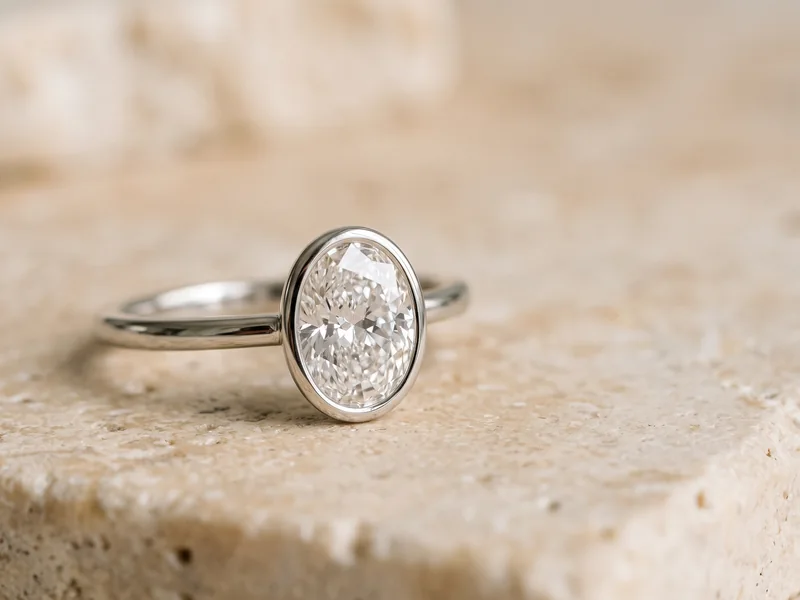
The other point is the stone itself. In a tension setting the girdle is exposed all the way round except where it sits in the grooves, so the edge of the diamond takes any knock directly. Diamond is 10 on the Mohs hardness scale, but hardness is not toughness: a hard blow on a thin girdle can still chip it. If you garden, lift weights, work with tools or play contact sport, our guide to ring settings for busy, active hands compares the safer options.
Related guideBest Engagement Ring Settings for Active HandsNot sure which one is right?
Send us the stones you are looking at and our gemologist will tell you which to choose and why.
Which gemstones suit a tension setting?
The stone in a tension ring is under constant pressure and has exposed edges, so it needs to be hard and tough. As a rule, choose a stone of 9 or higher on the Mohs scale with good toughness (resistance to chipping and breaking).
| Stone | Mohs hardness | Suits true tension? | Notes |
|---|---|---|---|
| Diamond (natural or lab-grown) | 10 | Yes | Natural and lab-grown diamond have the same hardness and refractive index (about 2.42) |
| Lab-created moissanite | about 9.25 | Yes | Very tough; strong fire from a refractive index of about 2.65 |
| Sapphire and ruby (natural or lab-created) | 9 | Yes | Tough; a popular coloured option |
| Spinel | 8 | With care | Softer; tension-style or suspended is safer |
| Emerald, tanzanite, opal, morganite | 5.5–8 | No | Too soft or brittle to take constant pressure |
Clarity matters more than usual. A diamond with a feather (a small internal crack) reaching the girdle near a groove can be weakened by the pressure. Ask to see the report's plotting diagram and check that the grooves will sit away from any girdle inclusion. Lab-grown diamonds are real diamond grown in a laboratory rather than mined, so they behave exactly like natural diamond in a tension ring; they simply cost much less for the same size.
For softer coloured gems, a tension-style or suspended ring with a hidden support gives a similar floating look without putting the stone under pressure.
Which diamond shapes work in a tension setting ring?
The shape decides where the grooves go and which parts of the stone are exposed. Shapes with straight, solid sides and no sharp points are the easiest to tension set.
- Round: the most common choice. The girdle is even all the way round, so the grooves can sit anywhere. See setting options for round brilliants.
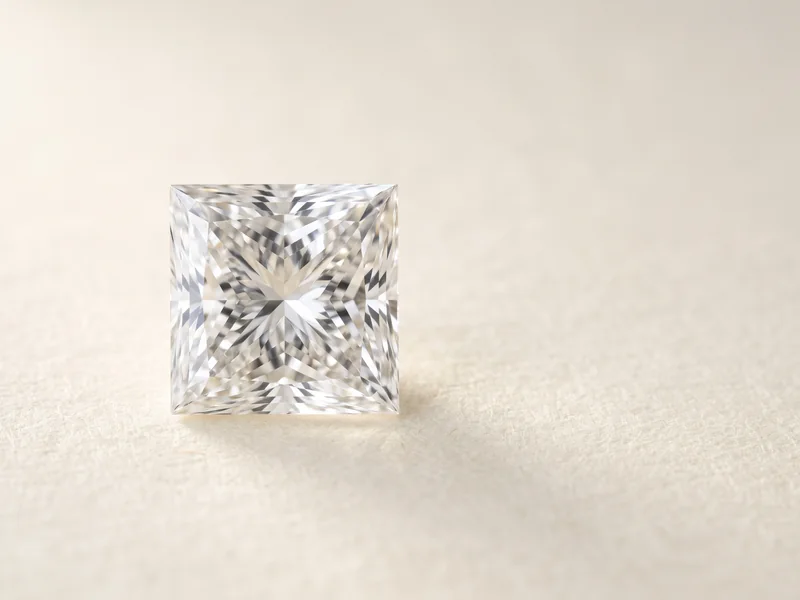
- Princess: works well when held across two flat sides, which leaves the four corners exposed; some designs add small corner guards. Our princess cut setting guide covers corner protection.
- Cushion: its rounded corners make it forgiving. Compare it in our cushion diamond settings page.
- Asscher and emerald cuts: their straight sides seat neatly, but step cuts show everything, including the grooves, so precise work matters. See how Asscher cuts are usually set and emerald cut setting choices.
- Pear, marquise and heart: their points are left unprotected in a true tension ring, so tension-style or suspended designs with a guard on each point are more practical. Read protecting a pear's point, marquise settings that guard both tips and heart diamond setting ideas.
Long shapes also raise a balance question: an oval or elongated stone held across its width sits east-west on the finger, which some people love and others find wide. Our settings for ovals and other elongated shapes explains the options.
Size has practical limits. Most tension rings hold stones from about 0.25 to 2 carats. Below that, the band can look heavy for the stone; above it, the band must be very thick and stiff to hold the extra weight, which changes the look and comfort of the ring.
Can a tension ring be resized or worn with a wedding band?
Tension ring resizing is the biggest practical drawback. Cutting and soldering a hardened band, or stretching it, removes the spring that holds the stone. Depending on the metal and the maker, a true tension ring may allow up to about half a size of adjustment, or none at all, and a bigger change usually means making a new band. Titanium and stainless steel tension rings generally cannot be resized. Tension-style and suspended rings, which do not rely on the band's pressure, can usually be resized like a normal ring.
For a wedding band, think about where the diamond sits. In many true tension rings the stone sits within the width of the band, with its girdle level with the band's sides. A straight wedding band worn alongside can then touch the diamond's edge directly, and because diamond is harder than any metal it will slowly wear a groove into the wedding band. Common solutions are:
- A matching band made to the same profile, with a slight curve or notch where the diamond sits.
- A stone mounted slightly higher or narrower than the band, leaving a small gap.
- Wearing the wedding band on the other hand or above the engagement ring, away from the stone's edge.
Tension bands are also usually thicker than a typical claw ring's band, so the pair can feel wide between the fingers. Try a combined width on before you decide.
How do tension and suspended settings wear over the years?
From the repair bench, these settings age differently from claw rings. There are no claw tips to wear thin, which is a real advantage. The open design is also easy to clean: warm water, a drop of mild detergent and a soft brush reach the back of the stone with nothing to trap soap or skin oils.
What we watch for instead:
- Groove wear: years of tiny movements can polish the grooves slightly, which is why a yearly check of the seat matters.
- Surface wear on the shoulders: the thick ends of the band take most of the knocks and show scratches first. Polishing must be gentle so metal is not removed from the area that holds the stone.
- Hidden supports in tension-style rings: the concealed claws or bar wear like any other claw and can be retipped (rebuilt with fresh metal).
- Half-bezels in suspended rings: these are robust, but a heavy knock can lift an edge, which a jeweller can usually push back and reshape.
If a true tension ring does lose its stone, the repair is rarely a quick fix. Heating with a torch is off limits near the hardened area, and many designs must be remade or re-tensioned by the original maker. Keep your purchase details and the maker's name with the ring's paperwork.
How much does a tension setting engagement ring cost?
The price depends mostly on the metal, the engineering and whether the design is true tension or tension-style. The figures below are broad ranges for the setting only, without the centre stone.
| Setting type (setting only) | Approximate price range (AUD) |
|---|---|
| Titanium or stainless steel true tension | about $300–$1,200 |
| 18ct gold tension-style or suspended | about $1,500–$4,000 |
| 18ct gold true tension (hardened alloy) | about $2,500–$6,000 |
| Platinum true tension (hardened alloy) | about $3,500–$8,000 |
Prices vary widely between makers and with band width, so treat these as a starting point. A centre diamond is priced separately: a lab-grown diamond costs much less than a natural diamond of the same size and grades, and both should come with an independent grading report from a lab such as GIA or IGI.
Explore ring settings or create your own ring
How do you choose a tension or suspended setting? Step by step
- Decide on true tension or tension-style. Ask exactly what holds the stone: pressure alone, hidden claws, a bar or half-bezels.
- Check the stone. Choose Mohs 9 or harder and confirm there are no feathers at the girdle where the grooves will sit.
- Match the shape. Rounds, cushions and princess cuts suit true tension; pointed shapes need guards or a suspended design.
- Confirm the metal. For true tension, ask for a hardened alloy rated for tension work, not standard 950 platinum or ordinary 18ct gold.
- Get your size right. Measure more than once and ask how much adjustment the design allows.
- Plan the wedding band. Make sure a second band will not rub the diamond's girdle.
- Ask about aftercare. Find out who can check, re-tension or repair the ring in years to come.
Free consultation
Talk to a gemologist
Compare stones in person or online with Raj Sood, Graduate Gemologist (GIA), AJP (GIA).
Book a consultationShop this shape
FAQ
Common questions
Are tension settings safe?
A well-made true tension ring in a hardened alloy is secure for everyday wear. The main risk is a hard knock to the sides of the band, which can unseat the stone or chip its exposed girdle.
Can a diamond fall out of a tension setting?
It can, but it is uncommon in a properly made ring. It usually follows a heavy impact, poor manufacture or a resize that weakened the metal's spring.
Can you resize a tension ring?
True tension rings usually allow little or no resizing, often up to about half a size at most, and larger changes generally mean a new band. Tension-style and suspended rings can usually be resized normally.
What is the difference between a tension setting and a tension-style setting?
A true tension setting holds the stone by the band's spring pressure alone. A tension-style setting looks similar but uses hidden claws, a bezel or a bar to hold the stone.
Can you put a sapphire in a tension setting?
Yes. Natural and lab-created sapphire is 9 on the Mohs scale and tough enough for true tension. Softer stones such as emerald, opal or morganite should not be tension set.
Can you wear a wedding band with a tension engagement ring?
Yes, but a straight band can rub against the diamond's edge and wear a groove in the metal. A matching shaped band or a small gap between the two solves this.

Ask a gemologist
Not sure which diamond to choose?
Raj Sood is a Graduate Gemologist (GIA) and master jeweller. Bring the stones you are considering, or send the reports, and he will tell you honestly which one is better and why.
Keep learning
Related guides
 Engagement Rings & SettingsDiamond & Gemstone Setting Guide
 Engagement Rings & SettingsBest Engagement Ring Settings for Active Hands
 Engagement Rings & SettingsFlush (Gypsy) Settings
 Engagement Rings & SettingsFloral Engagement Ring Settings
 Engagement Rings & SettingsBest Settings for Princess Diamonds
 Engagement Rings & SettingsSettings That Make a Diamond Look BiggerEngagement Rings & SettingsBest Settings for Cushion Diamonds
Explore more
More guides on this topic
Education