
- Education
- Diamond 4Cs & Grading
- Bigger Diamond or Better Quality? How to Decide
Diamond 4Cs & Grading
Bigger Diamond or Better Quality? How to Decide
Most budgets force a choice between more carats and higher grades. Knowing which grades you can actually see, and how big each size really looks in millimetres, lets you spend where it shows.
 Reviewed by Raj Sood, Graduate Gemologist (GIA), AJP (GIA)Master jeweller and Graduate Gemologist (GIA) · reviewed 4 November 2026
Quick answer
Bigger diamond or better quality? Put cut first, because a well-cut diamond looks larger and brighter than a poorly cut one of the same weight. Then choose the lowest colour and clarity that still look white and eye-clean in your setting, often G–H and VS2–SI1, and spend what that saves on carat weight.
Bigger diamond or better quality: which matters more?
Most diamond budgets reach a point where you can have more carat weight or higher grades, but not both. The four Cs of diamond grading (carat, cut, colour and clarity) all move the price, but they do not all change what you see. Carat weight and cut change the look from across a room. The top colour and clarity grades mostly change what a grader sees under 10× magnification.
So the honest answer is neither 'always bigger' nor 'always better'. Cut comes first, because it decides how bright the diamond is and how large it looks face-up. After that, colour and clarity only need to be good enough to look white and clean to your eye, in the setting you choose. Every grade above that point is money you could put into size, or simply keep.
Our guide to how Excellent, Very Good and Good cut grades differ shows why cut is the one grade not to compromise. The rest of this page gives you real measurements, what each grade looks like in daylight and the trade-offs, so you can make the call yourself.
What does carat actually measure?
Carat is weight, not size. One carat (ct) is 0.2 grams, or 200 milligrams, and it is divided into 100 points, so a 0.75 ct diamond is called a '75-pointer'. Two diamonds of the same weight can look quite different in size, because the cut decides how that weight is shared between the top you see and the depth hidden underneath.
The terms you will meet on listings and reports, and the ct vs ctw difference that catches many people out:
- ct: the weight of a single stone, given to two decimal places on a grading report, for example 1.01 ct.
- ctw, ct tw or TDW: carat total weight, the combined weight of every diamond in a piece. A '1 ct tw' ring might hold a 0.70 ct centre and 0.30 ct of small side stones, which looks very different from one 1 ct diamond.
- Points: hundredths of a carat, mostly used for small stones; 0.05 ct is 5 points.
- Magic sizes: the round numbers buyers look for, such as 0.50, 0.75, 1.00, 1.50 and 2.00 ct. Price per carat tends to step up at each one.
- Gold carat: in Australia gold purity is also written in carats (9ct, 14ct, 18ct). That measures how much of the metal is pure gold, not weight, and has nothing to do with diamond carat.
Price per carat also rises with size, so a 2 ct diamond usually costs well over twice a 1 ct of the same grades. Always check whether a listing quotes the centre stone or the total weight. Our jewellery glossary explains these and other trade terms in plain English.
How big is a 1 carat diamond in mm for each shape?
Millimetres tell you far more than carats about how big a diamond will look. Long, shallow shapes spread their weight across a larger face; deep, square shapes hold more weight underneath, where you cannot see it. This diamond size chart in mm shows typical face-up measurements for a well-proportioned 1 ct diamond in each common shape.
| Shape | Typical ratio | Typical size at 1 ct | Looks, compared with a round |
|---|---|---|---|
| Round brilliant | 1.00 | about 6.4–6.5 mm | The baseline |
| Oval | 1.35–1.45 | about 7.7 × 5.7 mm | Slightly larger |
| Pear | 1.50–1.70 | about 8.5 × 5.5 mm | Larger |
| Marquise | 1.85–2.10 | about 10.0 × 5.0 mm | Largest for its weight |
| Heart | 0.90–1.10 | about 6.8 × 6.3 mm | Slightly larger |
| Emerald | 1.40–1.50 | about 7.0 × 5.0 mm | Similar; less sparkle, more flash of light |
| Radiant | 1.20–1.35 | about 6.4 × 5.2 mm | Similar to slightly smaller |
| Cushion | 1.00–1.10 | about 5.5–6.0 mm | Smaller to similar |
| Princess | 1.00–1.05 | about 5.5 × 5.5 mm | Smaller |
| Asscher | 1.00–1.05 | about 5.5 × 5.5 mm | Smaller |
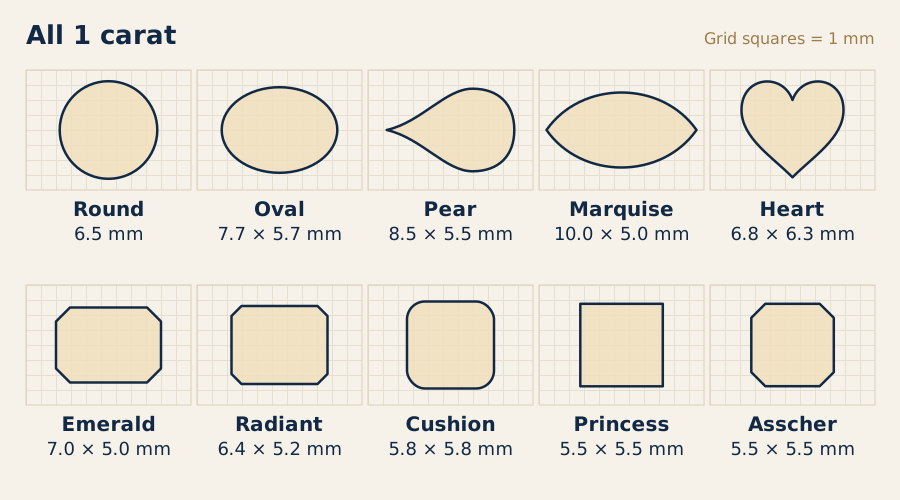
Elongated shapes such as the marquise, pear and oval usually look larger than a round of the same weight, which is one reason they are chosen when size matters. Princess, asscher and many cushions look smaller, because their corners and depth carry weight you cannot see from the top. GIA gives a cut grade only to round brilliants, so comparing fancy shapes means reading measurements and proportions yourself; our guide to judging cut in fancy shapes without a GIA cut grade explains how.
Related guideHow to Make a Diamond Look BiggerHow does diamond size look on the hand?
On the finger, what you notice is the diameter of the stone against the width of the finger. The table shows typical diameters for well-cut round brilliants, and roughly how much of a size L finger (the inside of the ring is about 16 mm across) each one covers.
| Carat weight (round) | Typical diameter | Share of a size L finger's width |
|---|---|---|
| 0.50 ct | about 5.1 mm | about one third |
| 0.75 ct | about 5.8 mm | about 36% |
| 1.00 ct | about 6.4–6.5 mm | about 40% |
| 1.50 ct | about 7.3–7.4 mm | about 46% |
| 2.00 ct | about 8.0–8.2 mm | about half |
| 3.00 ct | about 9.2–9.4 mm | close to 60% |
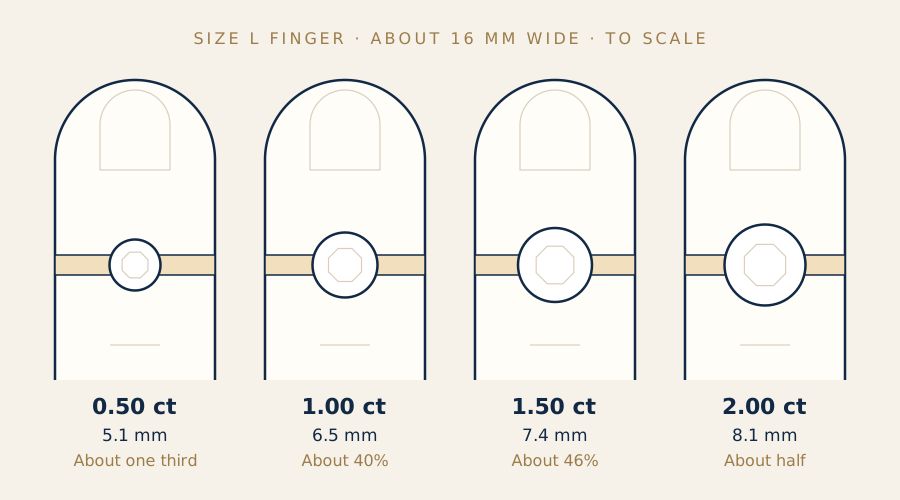
Two patterns stand out. First, weight grows much faster than width: doubling from 1 ct to 2 ct widens a round by only about 1.6 mm, roughly 25%, while the face-up area grows by around 60%. Second, the same stone looks larger on a slim finger and smaller on a broad one, so a 0.75 ct on a size J finger covers about as much as a 1 ct on a size N.
The setting changes the picture too. Fine claws and a slim band make a centre stone look larger, and a halo of small diamonds can add 2–3 mm to its visual width. Our guide to practical ways to make a diamond look bigger on the hand compares the options.
Not sure which one is right?
Send us the stones you are looking at and our gemologist will tell you which to choose and why.
Which diamond grades can you actually see?
This is where most of the size-versus-quality decision is made. Some grades change what you see in everyday light; others are only visible to a trained grader with a loupe (a 10× magnifier).
| Grade | Can you see the difference? | Where most people settle |
|---|---|---|
| Cut: Excellent vs Good | Yes: brightness, sparkle and face-up size | Excellent or Very Good in rounds; strong proportions in fancy shapes |
| Colour: E vs G | Barely, face-up, in white metal | G–H in white gold or platinum; I–J in yellow or rose gold |
| Clarity: VVS1 vs VS2 | No, not without a loupe | Eye-clean VS2 or SI1, checked stone by stone |
| Polish: Excellent vs Very Good | No | Very Good or better |
| Fluorescence: None vs Medium | Rarely | None to Medium; see Strong stones in person |
| Weight: 0.90 vs 1.00 ct | No: about 0.2 mm in a round | Just under a magic size |
Colour is graded from D (colourless) to Z (light yellow). Face-up in a white gold or platinum setting, most people cannot pick a G from an E unless the two sit side by side. In yellow or rose gold, I or J often looks white, because the metal warms everything around it. Fancy shapes such as ovals and pears show colour a little more than rounds, at the ends.
Clarity runs from Flawless through VVS and VS to SI and I. The goal is an eye-clean stone, with nothing visible at normal viewing distance, and the type and position of an inclusion matter more than the grade. Fine bearding at the girdle, twinning wisps and internal graining are often invisible face-up, while a dark crystal under the table can show even at VS2. Also check the report for laser drill holes from clarity treatment and etch channels that reach the surface.
Two smaller grades nudge the price. Our explainer on what polish grades really tell you shows why Excellent and Very Good look the same to the eye. Faint or medium blue fluorescence rarely changes the look and can lower the price; our guide to fluorescence from None to Very Strong covers the uncommon stones where strong fluorescence looks hazy.
Is a bigger diamond or better quality worth more of your budget?
Think of each grade step as a trade. The comparison below shows what you give up, and what usually happens to the price, when you move one step at a time with everything else equal.
| The change | What you see | Usual effect on price |
|---|---|---|
| Colour E → G (white metal) | Very little, face-up | A clear drop per carat |
| Clarity VVS1 → VS2 | Nothing without a loupe | A clear drop per carat |
| Clarity VS2 → SI1 | Depends on the inclusion; check each stone | Another drop, worth it only if eye-clean |
| Weight 1.00 → 0.90 ct | About 0.2 mm narrower | Often noticeably lower per carat |
| Fluorescence None → Medium blue | Rarely visible | Often a little lower |
| Cut Excellent → Good | Less brightness; can look smaller | Lower, but a poor trade |
The weight step is the easiest saving to miss. Because price per carat tends to jump at the magic sizes, a 0.90–0.97 ct diamond can cost noticeably less than a 1.00 ct while looking almost the same on the hand. The same applies just under 0.50, 0.75, 1.50 and 2.00 ct.
So is a bigger diamond worth it? It usually is when the stone sits in a solitaire on a broader finger, or when the person wearing it has said size matters most. Dropping from E to G and from VVS to an eye-clean VS2 or SI1 often pays for a visible step up in carat. Better quality wins when the stone goes into a bezel or a setting that shows colour, when you are sensitive to warmth, or when the wearer simply wants top grades for their own peace of mind. Neither choice is wrong; it depends on what will make you happy every time you look at it.
How can you get a bigger-looking diamond without lowering quality?
Size on the hand is about millimetres, not carats, so you can gain visible size without giving up colour or clarity:
- Choose spread, not just weight: a round with a depth of about 59–62.5% shows its full diameter, while one at 64% or more hides weight underneath and can measure 0.2–0.3 mm smaller. Our look at shallow rounds with extra spread explains how far you can go before brightness suffers.
- Consider an elongated shape: an oval, pear or marquise covers more of the finger per carat than a round, princess or asscher.
- Buy just under a magic size: 0.90–0.97 ct instead of 1.00 ct, or 1.40–1.47 ct instead of 1.50 ct.
- Use the setting: slim claws, a fine band or a halo add visual width; heavy claws and a wide band make the stone look smaller.
If you are having a ring made, trying a wax or resin model of your ring lets you check the scale of the centre stone on your own hand before anything is cast.
Does lab-grown change the bigger diamond or better quality choice?
Yes, a great deal. Laboratory-grown diamonds have the same chemistry, hardness (10 on the Mohs scale) and optical properties as natural diamonds, and they are graded on the same scales. If you are curious about the process, our guide on how laboratory-grown diamonds are made explains it.
Lab-grown diamonds cost much less than natural diamonds of the same size and grades, so the trade-off is far less tight. As a rough guide, a 1 ct G VS2 round with an Excellent cut is often around AUD 8,000–15,000 natural and AUD 1,000–3,000 lab-grown. Natural diamonds are rarer and keep that rarity; lab-grown diamonds give you more size for the money. Both are real diamond; the difference is origin.
With lab-grown, the quality checks shift. Size is easy to come by, so cut becomes the main thing to judge, and our guide to cut quality in lab-grown diamonds covers what to look for. Some CVD-grown stones also show a brown or grey tint that the colour grade alone may not describe, so look at the stone in daylight or a good video.
Browse natural and lab-grown diamonds in our stock
How to choose between size and quality: step by step
- Set the budget and the metal. White gold or platinum shows colour more; yellow and rose gold forgive it.
- Fix the cut first. Excellent or Very Good in a round, strong proportions in a fancy shape. Our cut grade comparison shows what you lose below that.
- Choose colour for the setting. About G–H in white metal, I–J in yellow or rose gold.
- Aim for eye-clean, not a grade. Start at VS2 and SI1 and check where each inclusion sits.
- Compare millimetres, not carats. Check the report measurements and depth, and look just under the magic sizes.
- Check it on the hand. Use the card circles, a video or a visit to see the size against your finger.
- Decide natural or lab-grown. Lab-grown loosens the size budget; natural offers rarity. Then put any saving where it shows.
Free consultation
Talk to a gemologist
Compare stones in person or online with Raj Sood, Graduate Gemologist (GIA), AJP (GIA).
Book a consultationShop this shape
FAQ
Common questions
Is it better to get a bigger diamond or better quality?
For most people, a well-cut diamond in the largest size that still looks white and eye-clean is the sweet spot. Cut should never be traded for size, but top colour and clarity grades often can be.
Is a bigger diamond worth it?
It can be, because carat weight is one of the few things you see from across a room. Just remember that doubling from 1 to 2 carats widens a round by only about 25%, while the price rises by much more than double.
How big is a 1 carat diamond in mm?
A well-cut 1 carat round brilliant is about 6.4–6.5 mm across. Fancy shapes vary: an oval is about 7.7 × 5.7 mm, a pear about 8.5 × 5.5 mm and a princess about 5.5 mm square.
What does ctw mean on a ring?
Ctw means carat total weight, the combined weight of every diamond in the piece. A 1 ct tw ring can have a much smaller centre stone than a 1 ct solitaire, so always check the centre stone's own weight.
Can you tell the difference between a 0.90 and a 1 carat diamond?
Not by eye. A well-cut 0.90 ct round is only about 0.2 mm narrower than a 1 ct, but it often costs noticeably less per carat because it sits below a magic size.
Should I spend more on colour or clarity?
Colour usually shows before clarity, because most clarity differences above SI1 need magnification. In white metal aim for about G–H, and for clarity aim for an eye-clean stone rather than a particular grade.
Does a lab-grown diamond look smaller than a natural diamond?
No. A lab-grown and a natural diamond with the same cut and measurements look the same size. The differences are origin, rarity and price, not appearance.

Ask a gemologist
Not sure which diamond to choose?
Raj Sood is a Graduate Gemologist (GIA) and master jeweller. Bring the stones you are considering, or send the reports, and he will tell you honestly which one is better and why.
Keep learning
Related guides
 Diamond 4Cs & GradingHow to Make a Diamond Look Bigger
 Diamond Anatomy & LightShallow Round Diamonds: Bigger Spread, Better Value?
 Diamond 4Cs & GradingExcellent vs Very Good vs Good Cut Diamonds
 Lab-Grown DiamondsCan I Make a Lab-Grown Diamond or Gemstone at Home?Lab-Grown DiamondsLab-Grown Diamond Cut QualityDiamond 4Cs & GradingCut Quality in Fancy Shapes (No GIA Cut Grade)
 Lab-Grown DiamondsBrown or Grey Tint in CVD Lab-Grown Diamonds
Explore more
More guides on this topic
Education