
- Education
- Wedding Bands & Eternity
- Wedding Bands for Low Profile Engagement Rings: How to Get a Flush Fit
Wedding Bands & Eternity
Wedding Bands for Low Profile Engagement Rings: How to Get a Flush Fit
Choosing wedding bands for low profile engagement rings is harder than it looks, because the stone sits so close to the finger that an ordinary band often cannot slide in beside it. Here is how the geometry works and which band shapes solve it.
 Reviewed by Raj Sood, Graduate Gemologist (GIA), AJP (GIA)Master jeweller and Graduate Gemologist (GIA) · reviewed 4 November 2026
Quick answer
Many wedding bands for low profile engagement rings will not sit flush, because the stone sits so close to the finger that a straight band hits it. Choose a straight band only if the setting clears it; otherwise use a curved, notched or custom-fitted band in the same metal, usually 1.5–2.5 mm wide.
What is a low profile engagement ring?
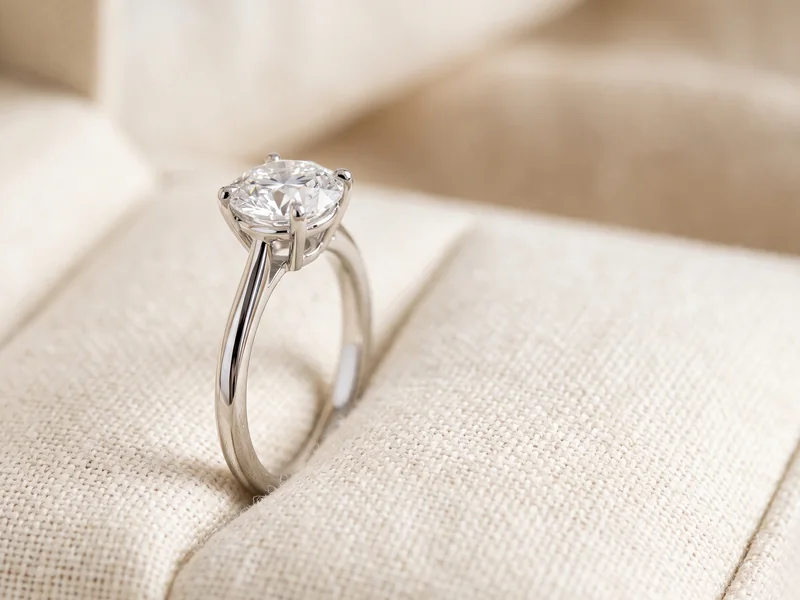
A low profile engagement ring holds the centre stone close to the finger rather than lifting it up on tall claws. The head (the part of the ring that grips the stone) is short, and the gallery (the metalwork under the stone that you see from the side) is shallow or missing altogether. Our guide on how low and high settings compare for everyday wear explains why people choose them: they catch less on jumpers, gloves and hair, slip under a work glove more easily and leave the stone less exposed to knocks.
There is no industry standard for what counts as low. As a rough guide, a low profile setting puts the girdle (the widest edge of the stone) about 4–6 mm above the top of the finger, while high and cathedral settings often sit 7 mm or more. The easiest way to judge your own ring is side-on at eye level, and our guide to reading an engagement ring from the side shows exactly what to look at.
That same lowness is what makes choosing the wedding band tricky. In this guide, 'wedding band' means the plain or stone-set ring worn next to the engagement ring; if you are unsure how the two terms differ, see the difference between a wedding ring and a wedding band. Any other term you have not met before is in our A–Z of jewellery terms.
Why won't a straight wedding band sit flush with a low profile ring?
It comes down to millimetres. A well-cut 1 carat round diamond is about 6.4–6.5 mm across and about 3.9–4.0 mm deep, and roughly 2.7–2.8 mm of that depth sits below the girdle in the pavilion (the cone-shaped lower half). A typical wedding band is 1.5–2.0 mm thick from the skin to its top surface. In a tall setting, the pavilion and claws sit well above that line, so a band slides underneath. In a low setting, they reach down to within a couple of millimetres of the finger, right where the wedding band wants to be.
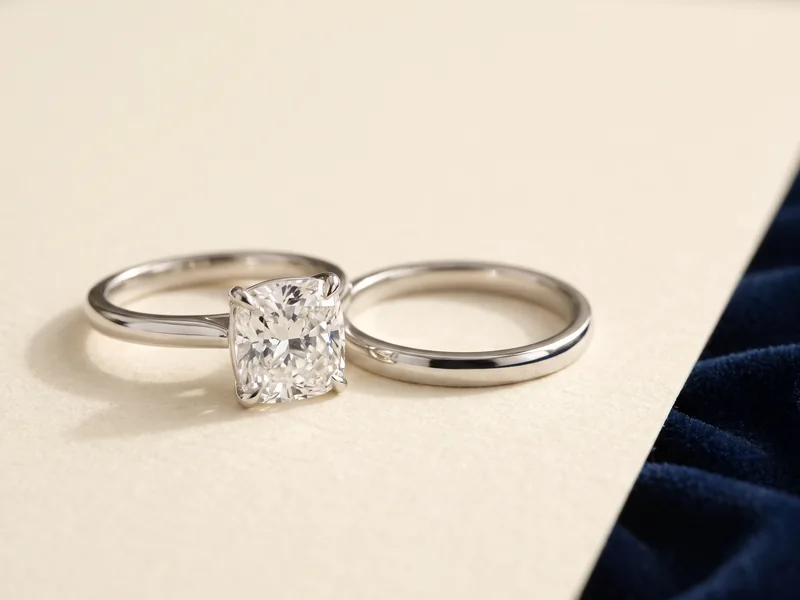
The stone also overhangs the engagement ring's shank (the band part of the ring). Take a 6.5 mm stone on a 2 mm shank: it sticks out about 2.25 mm on each side. A straight band pushed up against the engagement ring meets that overhang before it meets the shank, so it either stops short and leaves a gap or rides up against the claws.
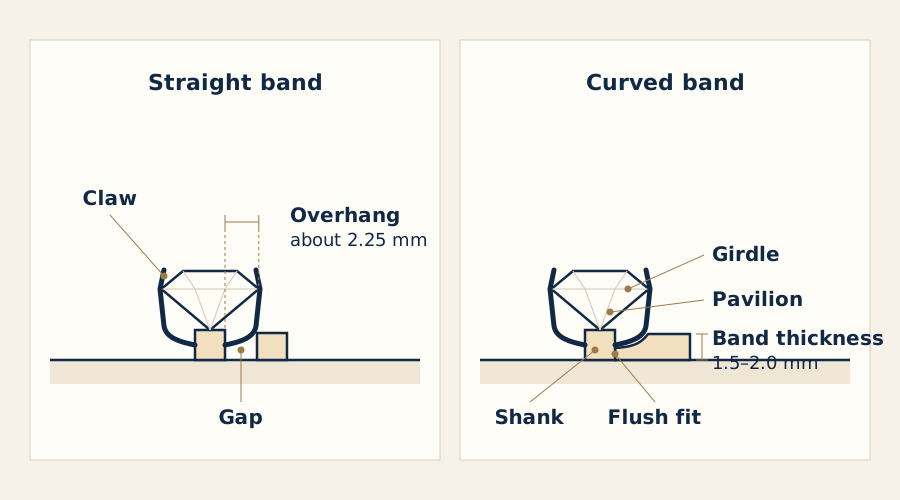
What usually gets in the way:
- Claw tips and claw bases: on a low four- or six-claw head, the claws flare outwards at the bottom and catch the band edge.
- Bezel walls: a bezel (a rim of metal wrapping the stone) is solid all the way down, so there is no gap for a band to tuck under.
- Hidden halos: a ring of small diamonds under the stone widens the gallery by 1–2 mm.
- Shoulder stones: pavé or claw-set diamonds on the shoulders sit proud of the shank and can rub a neighbouring band.
- Stone orientation: an oval or pear set north-south (long way along the finger) overhangs much more than the same stone set east-west.
Forcing a straight band hard against the head is not a good long-term answer. The two rings rub every time your hand moves, which wears claw tips, can loosen the stone over time and leaves scratches on both pieces. Taller settings avoid most of this, which is one of the trade-offs covered in the pros and cons of setting height.
Is a gap between engagement ring and wedding band OK?
Yes. Not every pair has to touch, and a small gap is the most common result with a low ring and a straight band. The real question is which look you prefer and how much flexibility you want later.
| Flush fit | Small gap | |
|---|---|---|
| Look | The two rings read as one set | Each ring reads on its own; a sliver of skin shows at the top |
| Band options | Curved, notched or custom-fitted | Almost any straight band |
| Changing bands later | Limited to bands shaped for that ring | Easy to swap, stack or add bands |
| Wear between rings | Contact points must be smooth to avoid rubbing | Rings meet mainly on the palm side |
| Spinning and tilting | Less, because the shapes lock together | More; the head can lean towards the gap |
| Cost | Higher if custom made | Lowest |
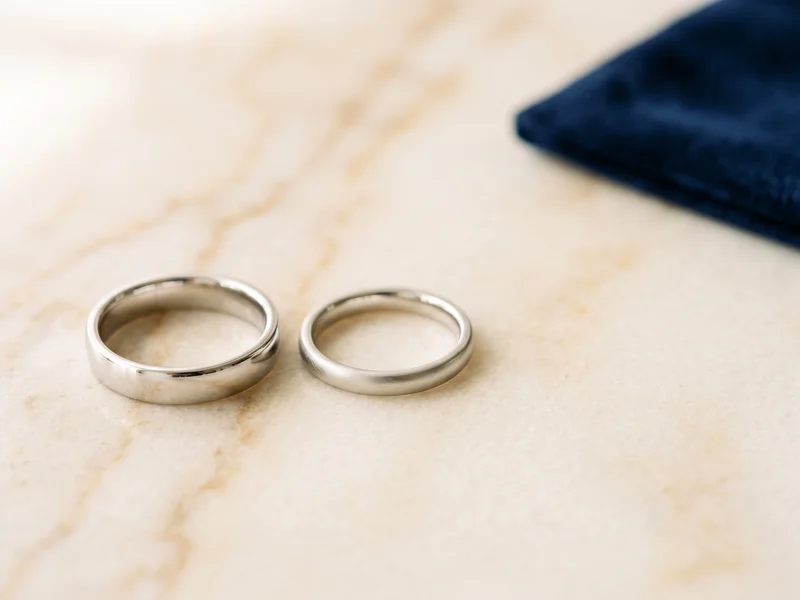
A gap of about 1–3 mm across the top of the finger is typical and, for many people, looks deliberate rather than accidental. If it bothers you, or if the engagement ring keeps tipping towards it, a slim third ring can fill the space; our article on when a spacer band between rings helps goes through the options. If you want the rings to touch along their whole length, you are looking at a shaped band, and the curved vs straight band comparison is the place to start.
What are the best wedding bands for low profile engagement rings?
There is no single right band, but there are five shapes that cover almost every low setting. Which one suits you depends on how far the stone overhangs and how you want the pair to look.
| Band type | How it works | Usually suits | Trade-off |
|---|---|---|---|
| Straight | An even band of the same width all the way round | Settings where the head sits fully above the shank, or if you accept a gap | Simple and versatile; may leave a gap |
| Curved (contour) | A gentle arc that bends around the head | Rounds, ovals and cushions with a modest overhang | Curve must be deep enough to clear; looks curved when worn alone |
| Notched | A straight band with a small cut-out in the centre | Low solitaires with small claw bases | The notch shows when the band is worn by itself |
| Chevron (V) | A pointed band that echoes the tip of the stone | Pears, marquises and hearts set point-down | Strong look that only suits pointed shapes |
| Fitted (shadow) | Custom shaped to mirror the engagement ring's outline | Halos, bezels, elongated stones and unusual heads | Made for one ring; needs the engagement ring for fitting |
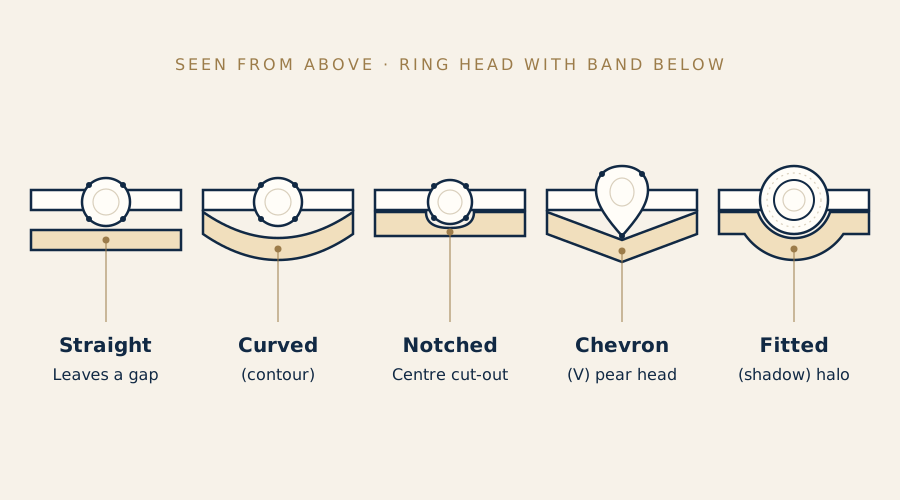
A curved wedding band for a low engagement ring is often the simplest fix for a round or oval solitaire, while a notched wedding band keeps a mostly straight line for people who like a band that also looks plain on its own. For halos and bezels, a fitted band is usually the only way to get a true flush fit; our page on how fitted and shadow bands are made explains the process from measurements to final fitting.
Not sure which one is right?
Send us the stones you are looking at and our gemologist will tell you which to choose and why.
Which wedding band suits each low profile setting style?
The setting style matters as much as the height. This table sets out the usual clash for each low setting and the band that most often solves it.
| Low profile setting | Typical clash | Band that usually works |
|---|---|---|
| Four- or six-claw solitaire | Claw bases catch the band edge | Straight with a small gap, or a gentle curve |
| Full bezel | Solid wall reaches down to the shank | Curved or fitted; a straight band rarely sits flush |
| Half-bezel | Metal on two sides only | Often a straight band, if the open sides face the band |
| Hidden halo | Halo widens the gallery under the stone | Notched or fitted |
| Visible halo | Halo adds about 1–1.5 mm of overhang each side | Fitted shadow band |
| East-west oval or emerald | Short overhang towards the band | Often straight or a slight curve |
| North-south oval, pear or marquise | Long overhang towards the band | Curved, fitted or chevron |
| Princess or square | Corners overhang the shank | Notched, fitted or straight with a gap |
Stone orientation makes a bigger difference than most people expect. A 1 carat oval is about 7.7 × 5.7 mm. Set north-south, it reaches about 3.85 mm from the centre towards the wedding band; on a 2 mm shank, that is roughly 2.85 mm of overhang. Turn the same stone east-west and the overhang drops to about 1.85 mm. That single millimetre can be the difference between a straight band fitting and needing a curved one.
For a bezel engagement ring, the wedding band almost always needs some shaping, because the metal wall continues straight down to the shank. With halos, the outline of the halo is what the band has to follow, which is why custom shadow bands for halo rings are so common. Square shapes bring their own corner problem; our guide to band pairings for princess cut engagement rings covers it in detail.
How wide and thick should the band be next to a low profile ring?
Most low profile engagement rings have a shank of about 1.8–2.5 mm wide, and a wedding band within about 0.5 mm of that width usually looks balanced. A band much wider than the engagement ring's shank can look heavy and pushes the head further from the band, while a much thinner band can look lost beside it.
Thickness (how high the band stands off the finger) matters more for low settings than width. A band 2.0 mm thick has its top surface 2.0 mm above the skin, right where the stone's pavilion and claws sit. Drop to a band about 1.4–1.6 mm thick and it may tuck under the overhang where a thicker band would not. Go too thin, though, and the band can bend out of round over years of wear; for everyday wear in gold or platinum, around 1.4 mm is a sensible minimum.
The profile, the shape of the band in cross-section, also changes the fit:
- Court: rounded inside and out. Comfortable, and the rounded edge slides under an overhang more easily.
- Flat court: flat on top, rounded inside. Looks crisp next to a bezel but has a squarer edge that can meet the head sooner.
- D-shape: domed on top, flat inside. A classic look, slightly less comfortable than a court.
- Knife-edge: peaked along the centre. Looks fine and light, and the low sides help it clear a head.
Our page on court, D-shape and knife-edge profiles compared shows each one in cross-section.
Should the wedding band be plain or diamond set, and in which metal?
A plain band is the easiest partner for a low ring because it has no stones or settings to catch on the head. Diamond-set bands work well too, but the setting style matters: claw- or pavé-set bands have tiny raised beads of metal that can rub against a low head, while channel-set bands (stones held between two smooth walls) present a smooth edge. Our plain vs diamond band guide sets out the trade-offs in look, comfort and upkeep. If the band is diamond set, the stones can be natural or lab-grown; lab-grown diamonds are real diamond grown in a laboratory and cost much less than natural.
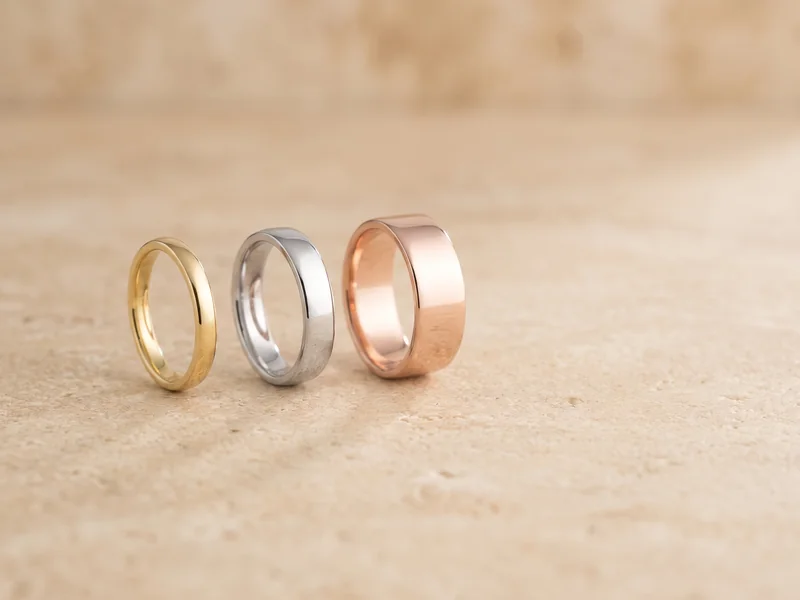
Match the metal as closely as you can. Rings worn together rub against each other every day, and a harder alloy slowly wears a softer one. Platinum (usually 95% pure, Pt950) tends to move and form a soft patina rather than lose metal, while 18 carat gold (75% pure gold) wears away very slowly. White gold is usually plated with rhodium, a bright white metal, which wears off with time and needs replating every year or two for many wearers. Rose and yellow gold shades vary between alloys, so two rose gold rings from different makers can look noticeably different side by side.
If your partner is choosing a band too, theirs does not need to match yours, though many couples like the same metal. Our guide to men's wedding band widths and finishes covers the heavier side of the range.
How much does a fitted wedding band cost in Australia?
The shape of the band affects the price, because curved and fitted bands take more design and fitting time than a straight band. These are broad approximate ranges only; prices depend on metal, weight, width and the current metal price.
| Band type (about 2 mm wide) | Approximate price range (AUD) |
|---|---|
| Plain straight, 18ct gold | about $700–$1,500 |
| Plain straight, platinum | about $900–$2,000 |
| Curved or notched, 18ct gold or platinum | about $900–$2,500 |
| Custom fitted, plain | about $1,200–$3,000 |
| Fitted or curved, diamond set (lab-grown) | about $1,500–$3,500 |
| Fitted or curved, diamond set (natural) | about $2,500–$6,000 |
A fitted wedding band in Australia is usually designed in CAD (computer-aided design) around the exact measurements of your engagement ring, then made and test-fitted. That is why the engagement ring needs to be available during the process, and why the band is designed for that one ring. For the wider question of how style, metal and shape work together, read matching a band to your engagement ring.
Related guideHow to Match a Wedding Band to an Engagement RingCreate your ring or a matching wedding band
How do you choose wedding bands for low profile engagement rings? Step by step
Work through these in order and you will know which band shape you need before you look at styles. For the bigger picture on budget, sizing and timing, our complete Australian wedding ring buying guide covers everything else.
- Look from the side. With the engagement ring on, check side-on at eye level how low the stone and claws sit and how far they overhang the shank.
- Decide flush or gap. If a small gap is fine, a straight band is the simplest choice. If you want the rings to touch, you need a curved, notched, chevron or fitted band.
- Note the setting style. Bezels and halos almost always need a shaped band; east-west stones and half-bezels often take a straight one.
- Match the metal. Choose the same metal and, ideally, the same alloy colour so the rings wear and look alike.
- Match width and thickness. Aim for a width within about 0.5 mm of the engagement shank and a thickness of about 1.4–1.8 mm.
- Try the pair together. Test the fit with both rings on, checking for rubbing, rocking and spinning.
- Finish the details. Confirm the ring size for both rings and add any engraving inside the band; see engraving ideas that still read well in decades.
Free consultation
Talk to a gemologist
Compare stones in person or online with Raj Sood, Graduate Gemologist (GIA), AJP (GIA).
Book a consultationShop this shape
FAQ
Common questions
Will a straight wedding band sit flush with a low profile engagement ring?
Sometimes, but often not. If the stone or claws overhang the shank close to the finger, a straight band will stop short and leave a gap of about 1–3 mm. East-west stones and half-bezels are the most likely to take a straight band flush.
What is the difference between a curved and a notched wedding band?
A curved band arcs smoothly around the head along its whole top section, while a notched band stays straight and has a small cut-out in the centre for the head to drop into. Notched bands look closer to a plain band when worn alone.
Can I have my engagement ring and wedding band joined together?
Yes. A jeweller can solder the two rings together so they cannot spin or separate. It keeps them aligned, but it means both rings must be resized together and you can no longer wear them separately unless they are cut apart.
Does a bezel engagement ring need a curved wedding band?
Usually. A full bezel's metal wall runs down to the shank, so a straight band normally leaves a gap. A curved or custom-fitted band is the common choice if you want them to touch.
Should my wedding band be the same metal as my engagement ring?
It is the safest choice. Different metals and alloys wear at different rates when they rub, and white gold, platinum and rose gold shades can look noticeably different side by side.
Can I get a fitted wedding band later, after the engagement ring is made?
Yes. A fitted band is designed around your finished engagement ring, so it is normally made afterwards. You will need to have the engagement ring available for measuring and test-fitting.

Ask a gemologist
Not sure which diamond to choose?
Raj Sood is a Graduate Gemologist (GIA) and master jeweller. Bring the stones you are considering, or send the reports, and he will tell you honestly which one is better and why.
Keep learning
Related guides
 Wedding Bands & EternityFitted Wedding Bands Explained | Custom Curved BandsWedding Bands & EternityCurved vs Straight Wedding Bands
 Engagement Rings & SettingsLow-Profile vs High-Profile Engagement Rings
 Wedding Bands & EternityDo You Need a Spacer Band Between Rings?Wedding Bands & EternityWedding Ring Buying Guide
 Wedding Bands & EternityWedding Band Profiles Explained
 Wedding Bands & EternityWedding Ring vs Wedding Band
 Wedding Bands & EternityMen’s Wedding Band Guide
Explore more
More guides on this topic
Education