
- Education
- Engagement Rings & Settings
- Claw Placement for Pointed Diamonds: Where the Claws Should Go
Engagement Rings & Settings
Claw Placement for Pointed Diamonds: Where the Claws Should Go
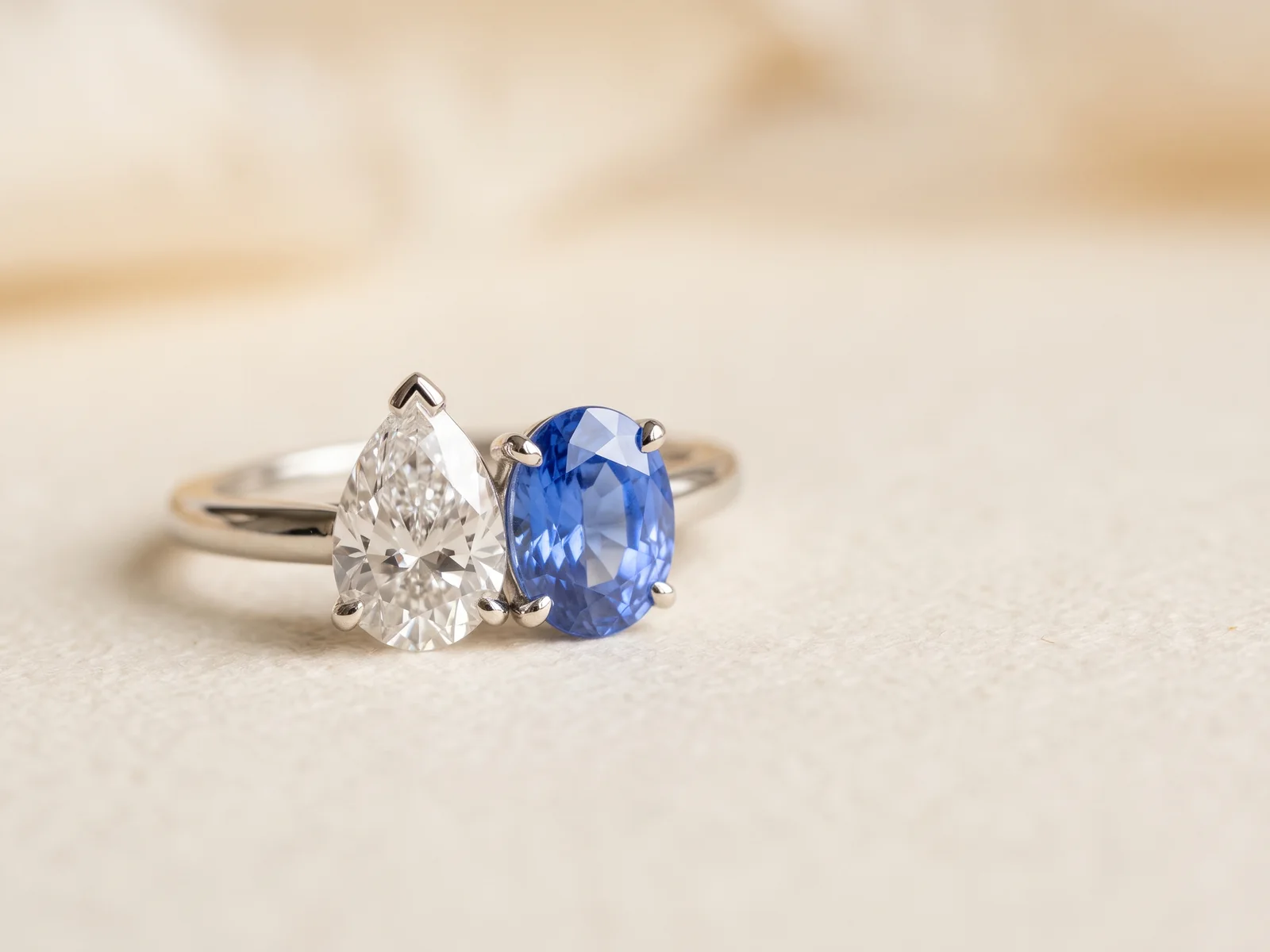
The point of a pear, marquise or princess is the thinnest part of the diamond and the part most likely to chip. Good claw placement for pointed diamonds keeps that edge covered without hiding the shape you chose.
 Reviewed by Raj Sood, Graduate Gemologist (GIA), AJP (GIA)Master jeweller and Graduate Gemologist (GIA) · reviewed 4 November 2026
Quick answer
Claw placement for pointed diamonds means putting a claw over every point so the thinnest edge is never exposed. Pears, hearts and trillions need a V-claw on each tip, marquises two, and princess cuts four, on the corners. Add round or tab claws along the curves for grip, and check the claws every 6–12 months.
What is claw placement for pointed diamonds?
A claw (also called a prong) is a small post of metal that rises from the base of the setting, bends over the edge of the diamond and holds it in place. Claw placement is simply where those claws sit around the stone. On a round diamond, the claws can be spaced evenly anywhere around the circle. On a pointed diamond they cannot, because every point is a weak spot that needs its own protection. Our guide to the parts of an engagement ring shows where the claws sit in relation to the head, gallery and band.
The pointed shapes are the pear, marquise, heart, princess, trillion (a triangle), kite and shield. Emerald, Asscher, radiant and cushion cuts have their corners cut off or rounded, so they are not truly pointed, although their corners still benefit from careful placement. The rule for all of them is the same: the setting should take the knock, not the diamond.
Jewellers have been setting pointed stones for centuries, and the V-shaped claw grew out of that practical need; the story of how engagement rings developed covers the wider picture. For the full menu of claw shapes and how each looks on the hand, see how different claw styles look and hold. Any unfamiliar word on this page is defined in our plain-English jewellery glossary.
Why do pointed diamonds chip more easily?
Diamond is the hardest natural material, 10 on the Mohs scale, with a refractive index of about 2.42. Hardness, though, only means resistance to scratching. Toughness, the resistance to breaking, is a different property. Diamond has cleavage in four directions, meaning planes in the crystal along which it can split cleanly. A sharp knock at the wrong angle can lift a flake off, and a thin edge is where that is most likely.
At a point, two sides of the outline meet at a sharp angle, and the girdle (the narrow band around the widest part of the stone, where the top half meets the bottom half) has very little material behind it. A princess corner is about 90°, and the tip of a pear or marquise is usually sharper still. Those tips are also the first part of the ring to meet a door frame, a benchtop or a car door. On a grading report, check the girdle description: a girdle listed as very thin or extremely thin at the points is a warning sign, while thin to medium or medium is more robust.
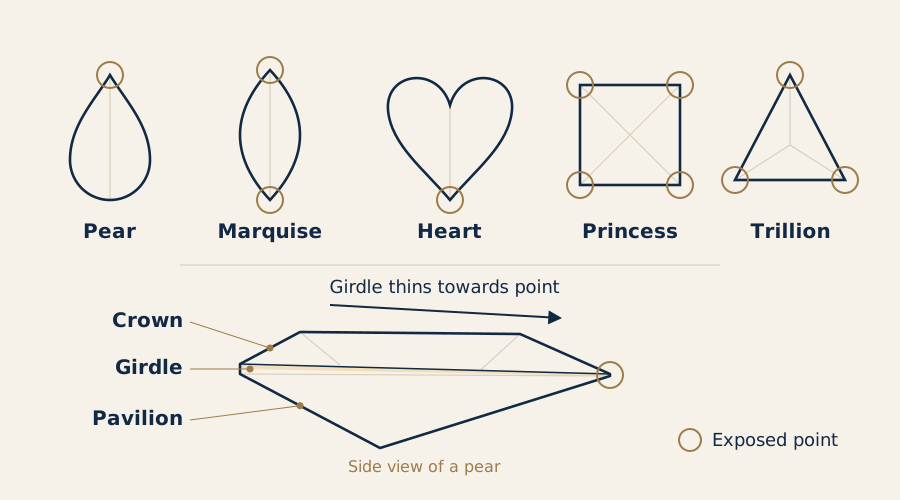
From the repair bench, the common ways a point gets damaged are:
- A direct knock on a hard surface, usually while the hand is moving.
- Pressure during setting, if a claw is pushed hard against an unprotected tip.
- An existing feather (a small internal crack) at or near the point that a knock opens further.
- A worn claw that lets the stone shift, so the point rubs or catches on metal.
What claw types protect a pointed diamond?
Not every claw does the same job. Some are designed to cover a point; others are designed to grip a curve. A well-made setting for a pointed stone usually mixes two types.
| Claw type | What it looks like | Where it goes on a pointed stone | Protection |
|---|---|---|---|
| V-claw (V-prong, chevron) | A V-shaped piece of metal that wraps both sides of the point | Every true point: pear tip, marquise ends, heart point, princess and trillion corners | Highest for a tip |
| Tab (flat) claw | A flat, squared claw that sits over the edge | Princess and kite corners; corners of emerald and Asscher cuts | High; shows more metal |
| Round claw | A rounded wire finishing in a small dome | Along curves: the round end of a pear, the sides of a marquise | Good grip; does not cover a point |
| Eagle (pointed) claw | A claw that tapers to a fine point over the stone | Curved areas, for a lighter look | Good grip; less metal to wear |
| Double claw | Two thin claws side by side | Curved areas, often the round end of a pear | Back-up if one claw wears |
A common mistake is a single round claw placed right on the tip. It holds the stone, but it leaves both sides of the point open, and the tip can still chip beside the claw. A V-claw covers both facets that meet at the point. Our guide to round, eagle, tab, V-prong and double claws compares each shape in close-up.
How a pointed-shape setting is built. The setting is designed around the measurements on the diamond's report, so the V-claw matches the angle of that particular point. After casting, the jeweller cuts a seat for the stone, fits the V-claw snugly around the tip and then shapes the remaining claws over the girdle. On a 1 carat stone, claws are typically about 0.8–1.2 mm thick; thinner looks finer but wears through sooner.
How should claw placement for pointed diamonds change by shape?
Each shape has its own number of points, so each gets its own layout. These are the usual arrangements, which a jeweller adjusts for the stone's size and your daily life.
| Shape | Points | Typical claw layout | Notes |
|---|---|---|---|
| Pear | 1 | 1 V-claw at the tip plus 4 round claws (5 in total); 6 on larger stones | The round end needs even spacing so it does not look lopsided |
| Marquise | 2 | 2 V-claws at the ends plus 4 round claws along the sides (6) | Both ends are exposed; this is the most fragile common shape |
| Heart | 1 | V-claw at the point plus 1 on each lobe (3), or 2 more near the cleft (5) | The cleft is a second thin area to watch |
| Princess | 4 | 4 V-claws or tab claws, one on each corner | Never place claws mid-side on a princess |
| Trillion | 3 | 3 V-claws, one on each corner | Curved-sided trillions sometimes use 3 round claws |
| Kite or shield | 3–5 | A V or tab claw on every point | Usually custom-made to the stone |
| Emerald, Asscher, radiant | 0 (cut corners) | 4 claws on the corners, often double or tab | The cut corners already reduce chipping |
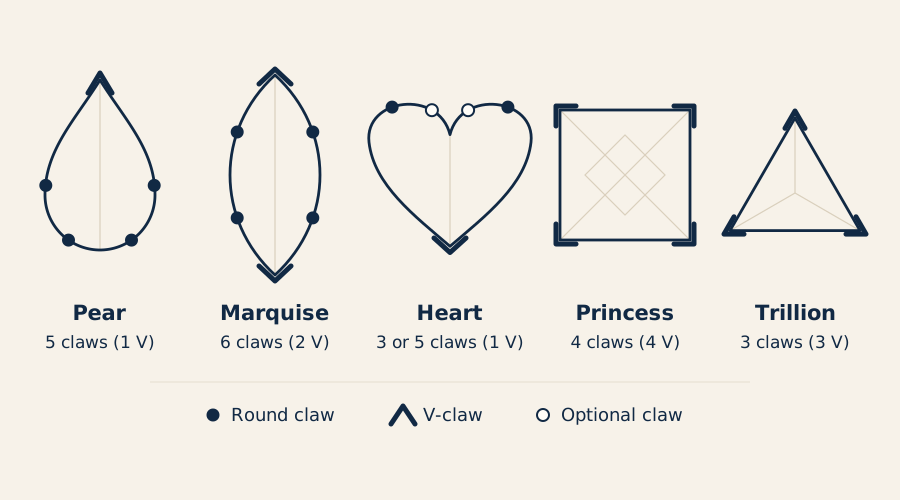
With a princess cut, the claw count follows the corners: four. The pear and marquise are where six-claw layouts appear, and our comparison of four-claw and six-claw solitaires explains the trade-off between security and showing more diamond. For ovals, pears and marquises together, see these setting ideas for elongated diamond shapes.
Pointed fancy shapes usually cost less per carat than a round of the same grades, which our page on how price per carat varies by diamond shape sets out. It is worth putting a little of that difference into a properly protective setting.
Coloured gemstones follow the same layouts but need more care. Natural and lab-created sapphire (9 on the Mohs scale) is durable enough for V-claws. Aquamarine and morganite (about 7.5–8) are fine with V-claws for careful wear. Emerald (7.5–8) is often included and brittle, so many jewellers prefer a bezel at the points. Tanzanite (about 6–6.5) and opal (about 5.5–6.5) in pear or marquise shapes are much safer in a bezel. Lab-grown diamonds have the same hardness and cleavage as natural diamonds, so they need exactly the same placement.
Not sure which one is right?
Send us the stones you are looking at and our gemologist will tell you which to choose and why.
How do V-claws change the look of a pear or marquise ring?
A V-claw covers the very tip of the stone, so it shortens the visible outline slightly, often by a fraction of a millimetre at each end. On a pear you barely notice it. On a marquise, with a V-claw at both ends, the stone can look a little softer and less sharp. A neatly shaped, slim V keeps the outline crisp; a heavy, blunt V makes the point look rounded.
Metal colour matters too. In a yellow or rose gold ring, many people still choose white gold or platinum claws for a white diamond, so the metal does not reflect warm colour into the thin tip. In an all-white ring, the V-claw almost disappears against the stone. Some people deliberately choose a contrasting yellow V-claw on a white ring as a design detail.
- Slim V-claws: finer look, but need checking more often.
- Heavier V-claws: more metal to wear down before retipping, slightly blunter outline.
- Two small claws either side of the tip: shows the very point, but leaves it exposed; not recommended for daily wear.
- Half-bezel over the tip: a smooth, modern alternative that covers the point fully.
In a halo, small diamonds surround the centre stone and the halo itself shields much of the edge, but the centre still needs a V-claw at its point. Our guide to how halos follow pear, marquise and heart outlines shows how the halo's own tiny claws are laid out. In a bypass design where the band ends sweep past the stone, check whether the point sits clear of the metal or tucked against it, since a point pressed against a band end can be stressed when the ring is knocked.
Is a bezel better than V-claws for pointed diamonds?
A bezel is a thin rim of metal that runs around the whole edge of the stone. It gives the point the most protection of any setting. A half-bezel covers only the ends or sides. The choice depends on how you use your hands and how much of the diamond you want to see.
| Setting | Point protection | Look and light | Maintenance | Suits |
|---|---|---|---|---|
| V-claws plus round claws | Good | Most of the diamond visible; bright | Check every 6–12 months; retip as claws wear | Diamonds and sapphires for most people |
| Half-bezel at the points | Very good at the tips | Sides open, outline clean | Low | Marquise and pear on active hands |
| Full bezel | Highest | Slightly smaller look; less light from the sides | Lowest; the rim can be reshaped | Softer gems, opal, tanzanite, hands-on work |
| Halo with V-claw centre | Very good | Centre looks larger | Many small claws to check | Smaller centre stones |
If you work with your hands, garden, lift weights or wear gloves often, a bezel or half-bezel on a marquise or pear is a sensible choice. If you want the most sparkle and are happy to have the ring checked, V-claws work well for years. Our page on bezel and claw settings for everyday wear goes further, and the overview of every engagement ring setting style puts both in context alongside channel, pavé and tension styles.
Related guideEngagement Ring Setting Styles GuideHow do claws on pointed diamonds wear over time?
From the repair side of the counter, V-claws take more wear than any other claw on a ring, because they sit at the extremes of the stone where knocks land first. The tip of the V flattens, the metal thins where it rubs against clothing and surfaces, and eventually a gap opens between the claw and the point. Marquise ends and pear tips show this first.
Metal choice changes how claws wear. Platinum is dense and tends to move and smear rather than wear away, so a platinum claw keeps its bulk longer but can be pushed out of shape. 18ct gold wears away gradually, so the claw gets thinner. White gold is usually rhodium plated (a thin coating of a bright white metal), and that plating wears first on the claws, showing a slightly warmer colour; many people have it re-plated every 12–18 months.
- A click or rattle when you tap the stone lightly with a fingernail.
- Catching on clothing, often a sign a claw has lifted.
- A visible gap between the V and the point.
- A thin, flat claw when viewed side-on.
- The tip of the point showing past the end of the V-claw.
Retipping means adding new metal to the top of a worn claw and reshaping it, usually with a laser or a fine torch. A V-claw needs careful work, because the new metal has to follow the angle of the point exactly. If a claw is worn too far, the jeweller rebuilds it. As a rough guide, retipping costs about AUD $60–$150 per claw, more in platinum or for a full rebuild. With daily wear, many V-claws need retipping within about 5–10 years. Our guide on the signs that ring claws need retipping explains the process step by step.
How does claw placement affect wedding band fit?
Pointed stones change the way a wedding band sits. A pear is usually set with the point towards the fingertip, although some people prefer it reversed. A marquise is usually set north–south (along the finger); set east–west (across the finger), its points face the neighbouring fingers, where they rub rather than take a front-on knock.
The V-claw at a point often reaches down towards the band. If the stone sits low, that claw can stop a straight wedding band sitting flush against the engagement ring. Engagement ring bands commonly run from about 1.8 to 4 mm wide, and our guide to choosing a band width between 1.8 and 4 mm explains how width affects strength and stone size. A larger pear or marquise on a band under 2 mm can twist, which puts extra load on the V-claws.
- Raise the head slightly so a straight band slides under the point.
- Choose a contoured or notched band that curves around the V-claw.
- Accept a small gap between the rings, which some people like.
- Design both rings together so the claws and band match from the start.
Matching a band to the engagement ring is a long tradition, covered in our history of the wedding ring. The same placement rules apply to small stones too: a little pear or marquise in a promise ring with a small centre stone still needs a V-claw on the point, because a tiny tip chips just as easily as a large one.
How do you check claw placement on a pointed diamond? Step by step
- Count the points. Note every point on the stone: one on a pear or heart, two on a marquise, three on a trillion, four on a princess.
- Check each point is covered. Every tip should sit inside a V-claw, tab claw or bezel, with no bare edge showing.
- Look side-on. The claw should sit tight against the girdle, with no light showing between metal and stone.
- Check the curves. Round or double claws along the sides should be evenly spaced, so the stone does not lean.
- Read the report. Look at the girdle thickness at the points and any feathers plotted near a tip.
- Try the band. Hold the wedding band against the ring to see whether the V-claw stops it sitting flush.
- Book regular checks. Have the claws looked at every 6–12 months, and sooner after any hard knock.
Design a setting with protected points
Free consultation
Talk to a gemologist
Compare stones in person or online with Raj Sood, Graduate Gemologist (GIA), AJP (GIA).
Book a consultationShop this shape
FAQ
Common questions
How many claws should a pear shaped diamond have?
Most pears have five claws: a V-claw over the point and four round claws around the rounded end. Larger pears, or people who are hard on their hands, sometimes choose six.
Do marquise diamonds need V-claws on both ends?
Yes. A marquise has two thin points, and each needs a V-claw or a bezel. The usual layout is two V-claws plus four round claws along the sides, six in total.
Do princess cut diamonds need V-claws?
A princess has four sharp corners, so each corner needs a V-claw or a tab claw. Claws placed in the middle of the sides leave the corners exposed and are not recommended.
Is a V-claw setting secure enough for everyday wear?
Yes, for diamonds and sapphires, provided the claws are well fitted and checked every 6–12 months. For softer gems or very hands-on work, a bezel or half-bezel gives more protection.
How often do claws on a pointed diamond need retipping?
It depends on the metal, claw thickness and how the ring is worn. Many V-claws need retipping within about 5–10 years of daily wear, but a regular check is the only reliable way to know.
Do lab-grown diamonds need the same claw placement as natural diamonds?
Yes. Lab-grown diamonds have the same hardness, toughness and cleavage as natural diamonds, so their points need the same V-claw or bezel protection.
Terms in this guide

Ask a gemologist
Not sure which diamond to choose?
Raj Sood is a Graduate Gemologist (GIA) and master jeweller. Bring the stones you are considering, or send the reports, and he will tell you honestly which one is better and why.
Keep learning
Related guides
 Engagement Rings & SettingsClaw Types: Round, Eagle, Tab, V-Prong, Double
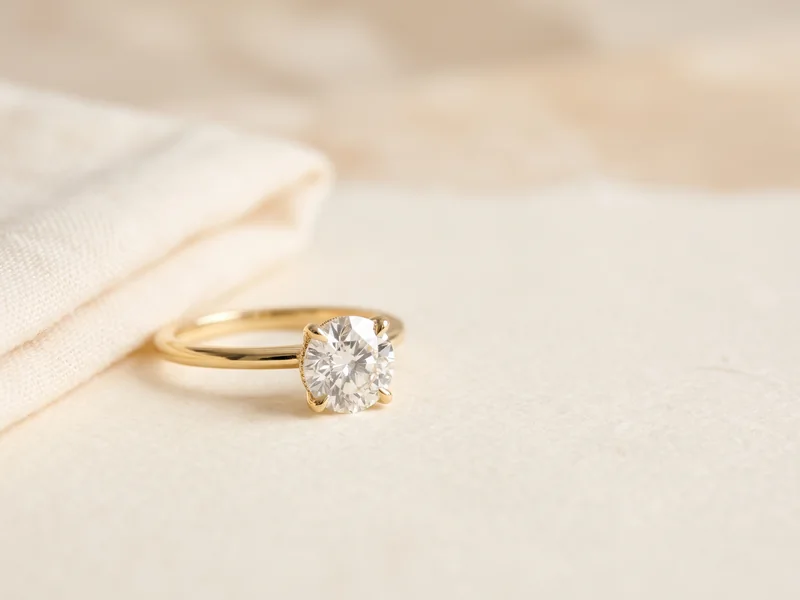 Care, Repairs & RemodellingWhen Do Ring Claws Need Retipping?
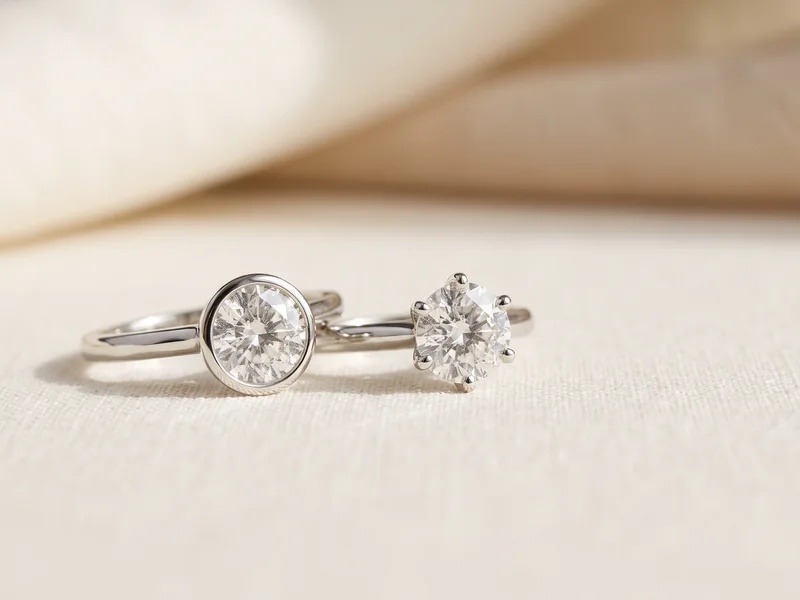 Engagement Rings & SettingsBezel vs Claw Settings for Everyday Wear
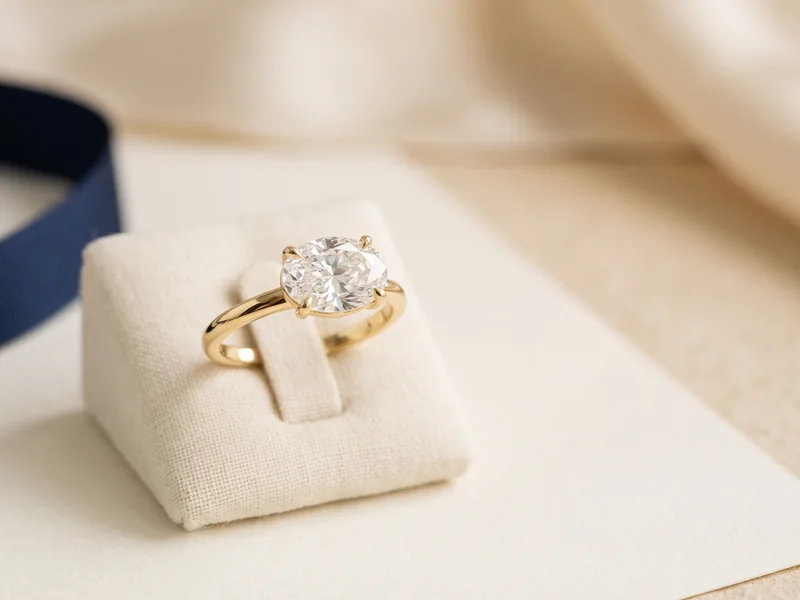 Engagement Rings & SettingsBest Settings for Elongated Diamond ShapesEngagement Rings & SettingsEngagement Ring Setting Styles Guide
 Engagement Rings & SettingsEngagement Ring Claw Styles ExplainedEngagement Rings & SettingsFour-Claw vs Six-Claw Solitaire Engagement Rings
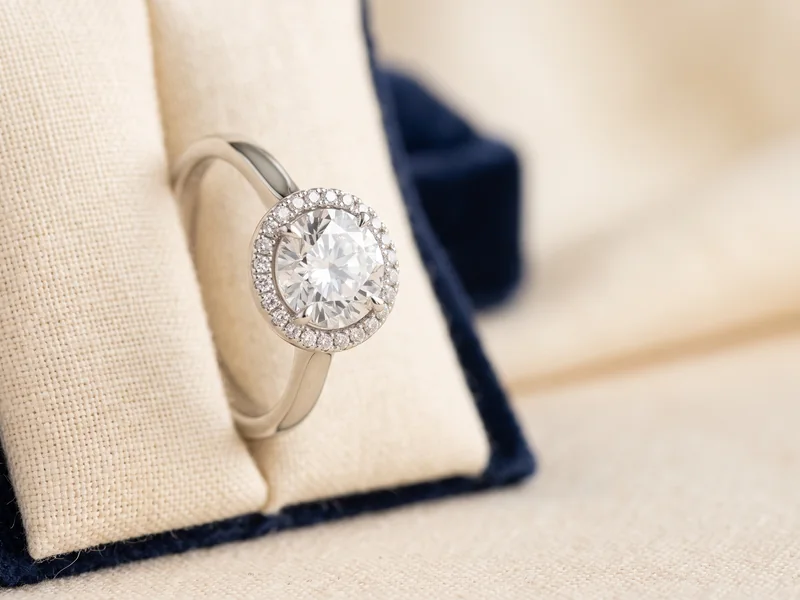 Engagement Rings & SettingsHalo Shapes Explained
Explore more
More guides on this topic
Education