
- Education
- Diamond 4Cs & Grading
- 0.5 Carat Diamond Guide: Size, Price and How It Looks
Diamond 4Cs & Grading
0.5 Carat Diamond Guide: Size, Price and How It Looks
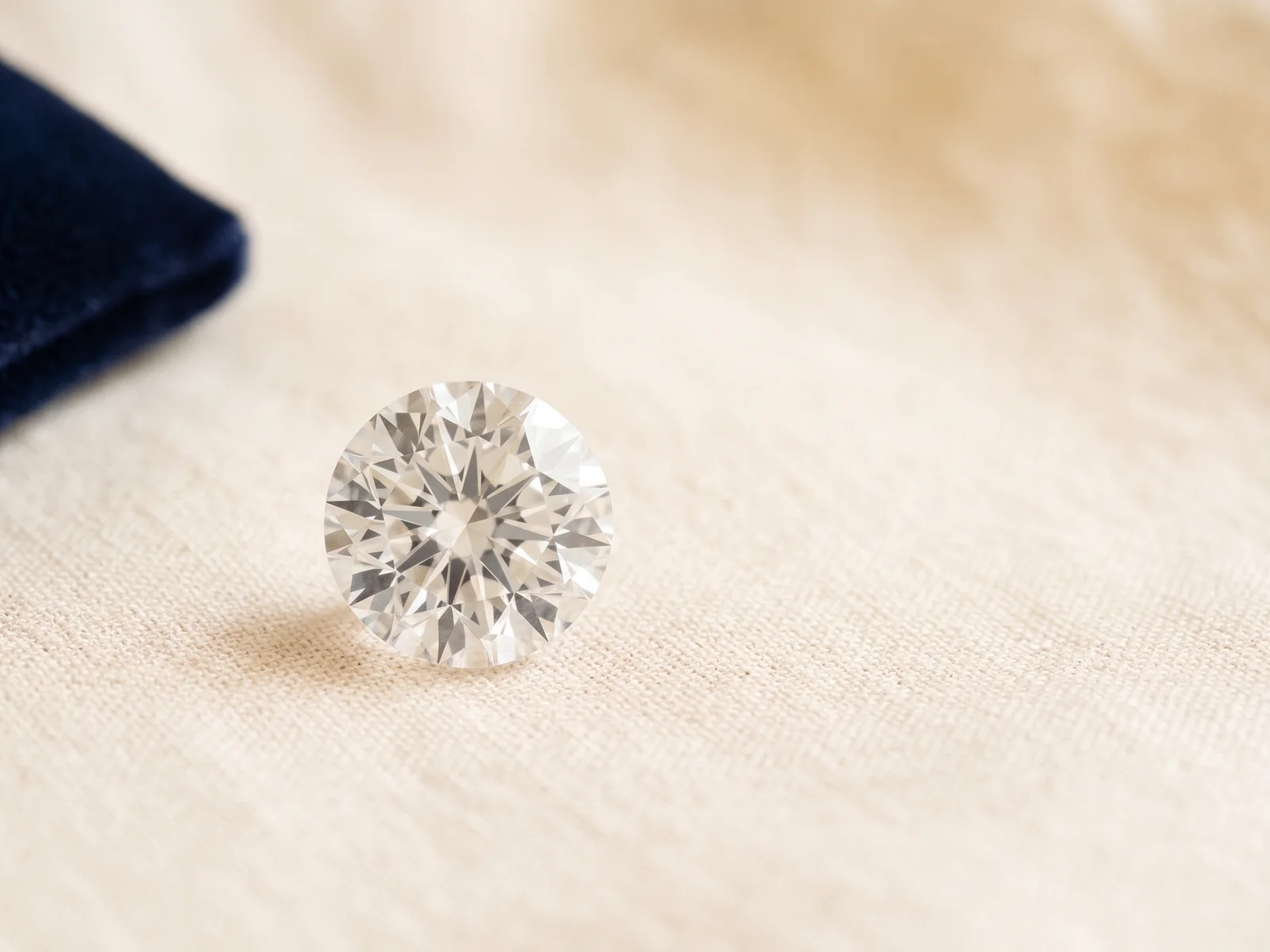
A 0.5 carat diamond is where many engagement rings, pendants and studs begin, and where small choices about cut, shape and setting change how big it looks. Here are the real millimetre sizes, approximate AUD prices and grade combinations worth considering.
 Reviewed by Raj Sood, Graduate Gemologist (GIA), AJP (GIA)Master jeweller and Graduate Gemologist (GIA) · reviewed 4 November 2026
Quick answer
A 0.5 carat diamond weighs 0.10 grams and, as a well-cut round brilliant, measures about 5.0–5.2 mm across. It looks modest but clearly visible on most fingers. In Australia, expect roughly AUD 1,500–4,500 for a natural half carat and AUD 300–1,000 for lab-grown. G–H colour with VS2–SI1 clarity is the sweet spot.
What is a 0.5 carat diamond?
Carat is a unit of weight, not size. One carat is 0.2 grams, so a 0.5 carat diamond weighs 0.1 grams. The trade also divides a carat into 100 points, which is why a half-carat stone is often called a fifty-pointer. Our guide to diamond carat weight explains how weight turns into visible size, and the 4Cs of diamond grading show how carat sits alongside cut, colour and clarity.
Grading reports give weight to two decimal places. A stone listed at 0.50 ct sits on what jewellers call a magic size: a round number where demand, and the price per carat, steps up. Diamonds from 0.50 to 0.59 ct are generally priced in the same band, while a 0.45–0.49 ct stone falls into the band below and often costs noticeably less for a size difference you cannot see on the hand.
Half a carat is a common centre stone for engagement rings, a classic weight for a solitaire pendant and the total carat weight (the combined weight of every stone in a piece) of many pairs of studs, where each earring holds about 0.25 ct. If you are looking at stones that size, see our guide to diamonds from 0.25 to 0.4 carat.
How big is a 0.5 carat diamond in mm?
A well-cut round brilliant at 0.50 ct measures about 5.0–5.2 mm across. Other shapes spread the same weight differently, so some look larger face-up and some smaller. These are typical measurements for well-proportioned stones:
| Shape | Typical size at 0.50 ct | How it reads face-up |
|---|---|---|
| Round brilliant | 5.0–5.2 mm | The benchmark; maximum sparkle |
| Princess | about 4.4 × 4.4 mm | Smaller across, but the corners add presence |
| Cushion | about 4.8 × 4.6 mm | Soft square; many cushions are cut deep and look smaller |
| Oval | about 6.0 × 4.0 mm | Looks longer and a little larger than a round |
| Pear | about 6.8 × 4.5 mm | Elongated; flatters the finger |
| Marquise | about 8.0 × 4.0 mm | The largest-looking shape per carat |
| Emerald | about 5.7 × 4.0 mm | Step cut; shows clarity more openly |
| Asscher | about 4.6 × 4.6 mm | Compact square step cut |
| Radiant | about 5.2 × 4.3 mm | Brilliant sparkle in a rectangle |
| Heart | about 5.4 × 5.0 mm | The minimum size where the heart outline reads clearly |
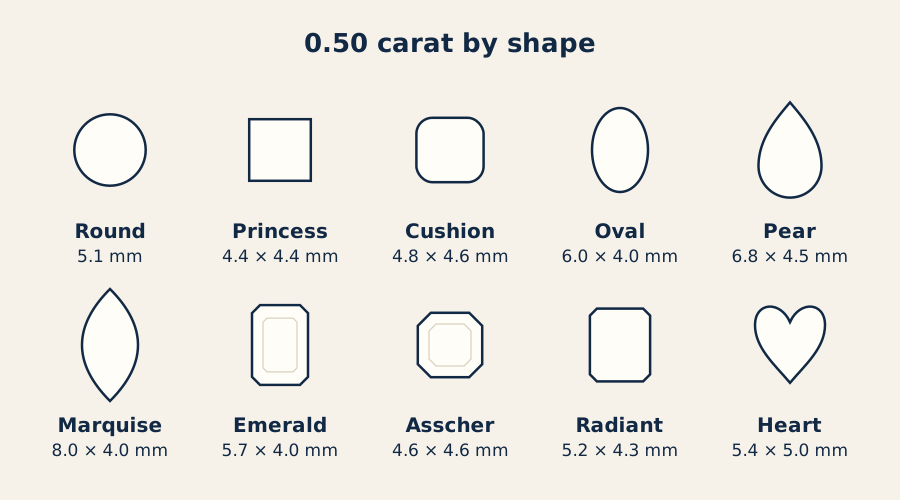
Proportions matter as much as shape. A round with a depth of about 59–62.5% and a table of 53–58% will usually measure 5.1–5.2 mm. The same weight cut deeper, at 64% or more, hides weight underneath and may measure only 4.9 mm. Jewellers call the face-up width a stone's spread. Our mm-to-carat size chart for every shape lets you compare spread at any weight.
What does a 0.5 carat diamond look like on a finger?
On an average Australian ring size, roughly M to N, the finger is about 16.5–17 mm across. A 5.1 mm round covers a little under a third of that width. It reads as a clear, defined centre stone: noticeable across a table, not dominant across a room. On a slimmer finger, around size J, the same stone looks proportionally larger.
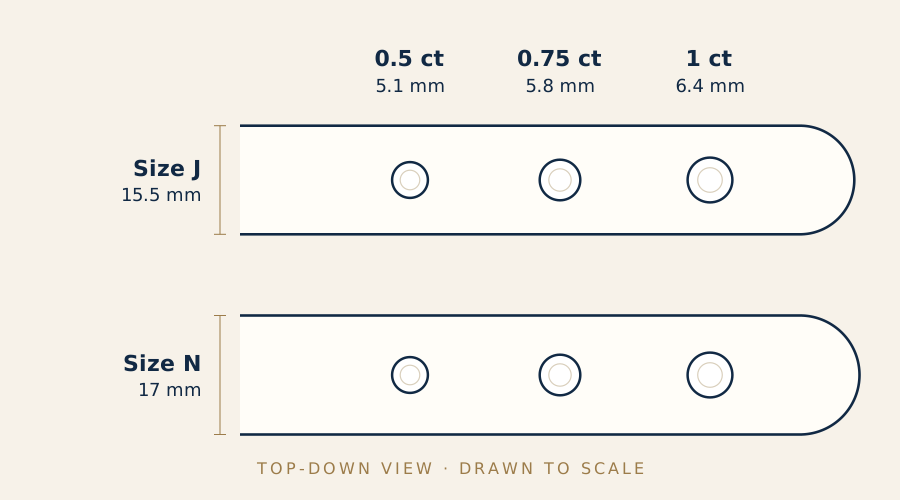
Four things change how big a half carat looks once it is on the hand:
- Finger size: the slimmer the finger, the larger the stone appears.
- Band width: a fine band of about 1.8–2.0 mm makes the centre look bigger than a 3 mm band does.
- Shape: an oval, pear or marquise covers more of the finger lengthways.
- Setting: a halo or slim claws add visual size; a heavy bezel can subtract a little.
Photos online are taken at different distances and magnifications, so they rarely show true scale. If you can, try a stone or a sample ring of the same size on your own hand before deciding.
How much does a 0.5 carat diamond cost in Australia?
Price depends on whether the diamond is natural or lab-grown, then on cut, colour and clarity. These approximate AUD ranges are for well-cut round brilliants from 0.50 to 0.59 ct with an independent grading report. Fancy shapes are usually a little lower per carat than rounds of the same grade.
| Colour and clarity | Natural (approx. AUD) | Lab-grown (approx. AUD) |
|---|---|---|
| D–F, VVS1–VVS2 | 3,500–6,000 | 600–1,200 |
| G–H, VS1–VS2 | 2,200–4,500 | 450–900 |
| H–I, SI1 | 1,500–2,800 | 350–700 |
| J–K, SI1–SI2 | 1,000–1,800 | 300–600 |
Diamond prices do not rise in a straight line. Price per carat climbs as the stones get rarer, so a 1 ct stone costs far more than two half carats of the same grade. Compare these ranges with what a 1 carat diamond costs, or see how sharply the curve steepens at two carats and beyond at three carats.
Within the half-carat band, the biggest price movers after natural versus lab-grown are colour and clarity, then cut. Fluorescence (a blue glow under UV light) can lower the price of a natural stone slightly without changing how it looks in daylight in most cases.
Not sure which one is right?
Send us the stones you are looking at and our gemologist will tell you which to choose and why.
Should you choose a natural or lab-grown 0.5 carat diamond?
Both are real diamond. A laboratory-grown diamond is made of the same crystallised carbon as a natural one, with the same hardness (10 on the Mohs scale) and the same refractive index of 2.42, so it sparkles the same way. Lab-grown stones are made by one of two processes, HPHT (high pressure, high temperature) or CVD (chemical vapour deposition), and the grading report must say laboratory-grown.
| Natural 0.5 ct | Lab-grown 0.5 ct | |
|---|---|---|
| Origin | Formed in the earth over millions of years | Grown in a laboratory over weeks |
| Look and hardness | Identical to the eye; Mohs 10 | Identical to the eye; Mohs 10 |
| Approx. price (G–H, VS) | AUD 2,200–4,500 | AUD 450–900 |
| Rarity | Finite and rarer at higher grades | Readily available in most grades |
| Resale | Some resale market, well below retail | Very limited resale market |
| Report | GIA, IGI and others | IGI, GIA and others, marked laboratory-grown |
At this size, the choice is mostly about what matters to you. Natural stones carry the story of rarity; lab-grown stones let the same budget reach a higher colour and clarity, or a larger size. If a lab-grown stone tempts you to go bigger, our guide to lab-grown diamond sizes from 1 to 5 carats shows what each step looks like.
Browse 0.5–0.59 carat natural and lab-grown diamonds
What colour and clarity is best for a 0.5 carat diamond?
A smaller stone shows less colour than a large one, simply because light travels a shorter path through it. That gives you more room at half a carat. The aim is a stone that faces up white in your chosen metal and is eye-clean, meaning no inclusions are visible at normal viewing distance.
| Your priority | Colour | Clarity | Why it works |
|---|---|---|---|
| Icy white in platinum or white gold | E–F | VS1–VS2 | Very white face-up; inclusions invisible to the eye |
| Balance of look and price | G–H | VS2–SI1 | White in any metal; SI1 is often eye-clean at this size |
| Yellow or rose gold | I–J | SI1 | The warm metal masks a faint tint |
| Step cuts (emerald, Asscher) | G–H | VS2 or better | Large open facets show inclusions more readily |
SI2 stones can be eye-clean in a round brilliant, but check each one individually: an inclusion near the centre of the table or a dark crystal is easier to see than a light feather near the edge. If any grading term is new, our jewellery glossary explains it in plain language.
Does cut matter more than carat at half a carat?
For a round brilliant, yes. GIA grades round cuts from Excellent to Poor, and IGI uses a similar scale, with Ideal at the top for some reports. An Excellent-cut 0.50 ct round returns light strongly and spreads to its full 5.1–5.2 mm. A Good-cut stone of the same weight can look smaller and duller, even with better colour and clarity.
Fancy shapes such as the oval, pear and cushion do not receive an overall GIA cut grade, so look at the length-to-width ratio, the depth percentage and, above all, a video of the stone. Watch for a dark bow-tie across the middle of elongated shapes.
This is also where buying shy helps. A 0.46–0.49 ct stone with an excellent cut measures within a fraction of a millimetre of a 0.50 ct, sits in a lower price band and looks the same once set. If you want the report to read 0.50, that is a fair choice too; just know you are paying for the number.
Which settings make a half carat engagement ring look bigger?
The setting can add or take away a surprising amount of visual size at this weight:
- Four-claw solitaire: shows the most diamond and lets light in from the sides. Six claws are a little more secure but cover more of the edge.
- Halo: a ring of small diamonds adds roughly 1.5–2 mm to the face-up width, so a 0.5 ct round with a halo can read close to the size of a 1 ct solitaire.
- Fine band: 1.8–2.0 mm bands make the centre stone look larger by contrast.
- Three-stone: two side stones add width and sparkle without the cost of a bigger centre.
- Bezel: very secure and modern, but the metal rim can make the stone look slightly smaller, especially in yellow gold.
Setting height matters too. A low setting is practical for everyday wear and sits well against a wedding band; a higher setting lets more light in from the side. For how weight and spread work together once a stone is mounted, revisit how carat weight relates to size.
0.5 carat vs 1 carat diamond: is the step up worth it?
Weight doubles from half a carat to one carat, but face-up area grows by only about 60%, because extra weight also goes into depth. Here is how round brilliants compare:
| Weight | Typical round diameter | Face-up area | Price per carat |
|---|---|---|---|
| 0.25 ct | about 4.1 mm | about 13 mm² | Lowest |
| 0.50 ct | about 5.1 mm | about 20 mm² | Steps up at the 0.50 magic size |
| 0.75 ct | about 5.8 mm | about 26 mm² | Higher again |
| 1.00 ct | about 6.4 mm | about 32 mm² | Large jump at the 1.00 magic size |
The step to a three-quarter carat diamond adds about 0.7 mm across, which is visible side by side. Going to one carat adds about 1.3 mm and can roughly double the natural price per carat compared with a half carat. Beyond that, our guides to 1.25 carat stones, one-and-a-half carat diamonds and 2.5 carat diamonds show how size and price keep climbing, right up to four-carat centre stones, 5 carat diamonds and the rare 6 to 10 carat range.
Related guide1 Carat DiamondsWhether the step up is worth it comes down to the hand it will sit on and the budget. On a slim finger, a well-cut half carat in a fine band can look generous. If you want the stone to read from further away, a halo or an elongated shape often gets you there before a bigger stone does.
How to choose a 0.5 carat diamond: step by step
- Decide natural or lab-grown. This sets your price range more than any other choice.
- Pick the shape. Check the expected millimetre size on our shape-by-shape millimetre chart so you know what to expect.
- Check the report. Look for an independent report from GIA or IGI, confirm the weight, measurements, colour, clarity and, for rounds, a cut grade of Excellent or Ideal.
- Check the measurements. A round should measure about 5.0–5.2 mm; under 5.0 mm usually means it is cut deep.
- Look at the stone itself. Watch a 360° video or see it in person for eye-cleanliness, brightness and any dark areas.
- Consider buying shy. Compare a 0.46–0.49 ct stone with a 0.50 ct to see whether the report number matters to you.
- Plan the setting. Choose claws, band width and any halo with the finished look on your hand in mind.
Free consultation
Talk to a gemologist
Compare stones in person or online with Raj Sood, Graduate Gemologist (GIA), AJP (GIA).
Book a consultationShop this shape
FAQ
Common questions
Is a 0.5 carat diamond big enough for an engagement ring?
Yes, half a carat is a common engagement ring centre stone. On an average finger a well-cut round looks clear and defined, and a halo or fine band makes it look larger.
How much does a 0.5 carat diamond cost in Australia?
Roughly AUD 1,500–4,500 for a natural round with good colour and clarity, and about AUD 300–1,000 for lab-grown. Higher grades and excellent cuts sit at the top of each range.
Can you tell the difference between a 0.5 carat and a 1 carat diamond?
Side by side, yes. A 1 ct round is about 6.4 mm across compared with about 5.1 mm for a half carat, and it covers roughly 60% more of the finger face-up.
What does 0.5 ct TW mean?
TW stands for total weight. A ring or pair of earrings marked 0.5 ct TW has half a carat across all its diamonds, so each stud in a pair is about 0.25 ct.
Is a lab-grown 0.5 carat diamond a real diamond?
Yes. A laboratory-grown diamond has the same chemistry, hardness and sparkle as a natural one; it is simply grown above ground, and its report must say laboratory-grown.
What is the most popular colour and clarity for a half-carat diamond?
G–H colour with VS2–SI1 clarity is the most common choice. It faces up white and is usually eye-clean, leaving more of the budget for a well-cut stone.

Ask a gemologist
Not sure which diamond to choose?
Raj Sood is a Graduate Gemologist (GIA) and master jeweller. Bring the stones you are considering, or send the reports, and he will tell you honestly which one is better and why.
Keep learning
Related guides
 Diamond 4Cs & Grading0.75 Carat DiamondsDiamond 4Cs & Grading1 Carat Diamonds
 Diamond 4Cs & GradingDiamond Carat Weight
 Diamond 4Cs & GradingDiamond MM to Carat Size Chart (All Shapes)Diamond 4Cs & GradingDiamond 4Cs
 Diamond 4Cs & Grading5 Carat DiamondsDiamond 4Cs & Grading1.5 Carat DiamondsDiamond 4Cs & Grading2.5 Carat Diamonds
Explore more
More guides on this topic
Education