
- Education
- Diamond 4Cs & Grading
- 1.25 Carat Diamond Guide: Size in mm, Look on the Hand and AUD Prices
Diamond 4Cs & Grading
1.25 Carat Diamond Guide: Size in mm, Look on the Hand and AUD Prices
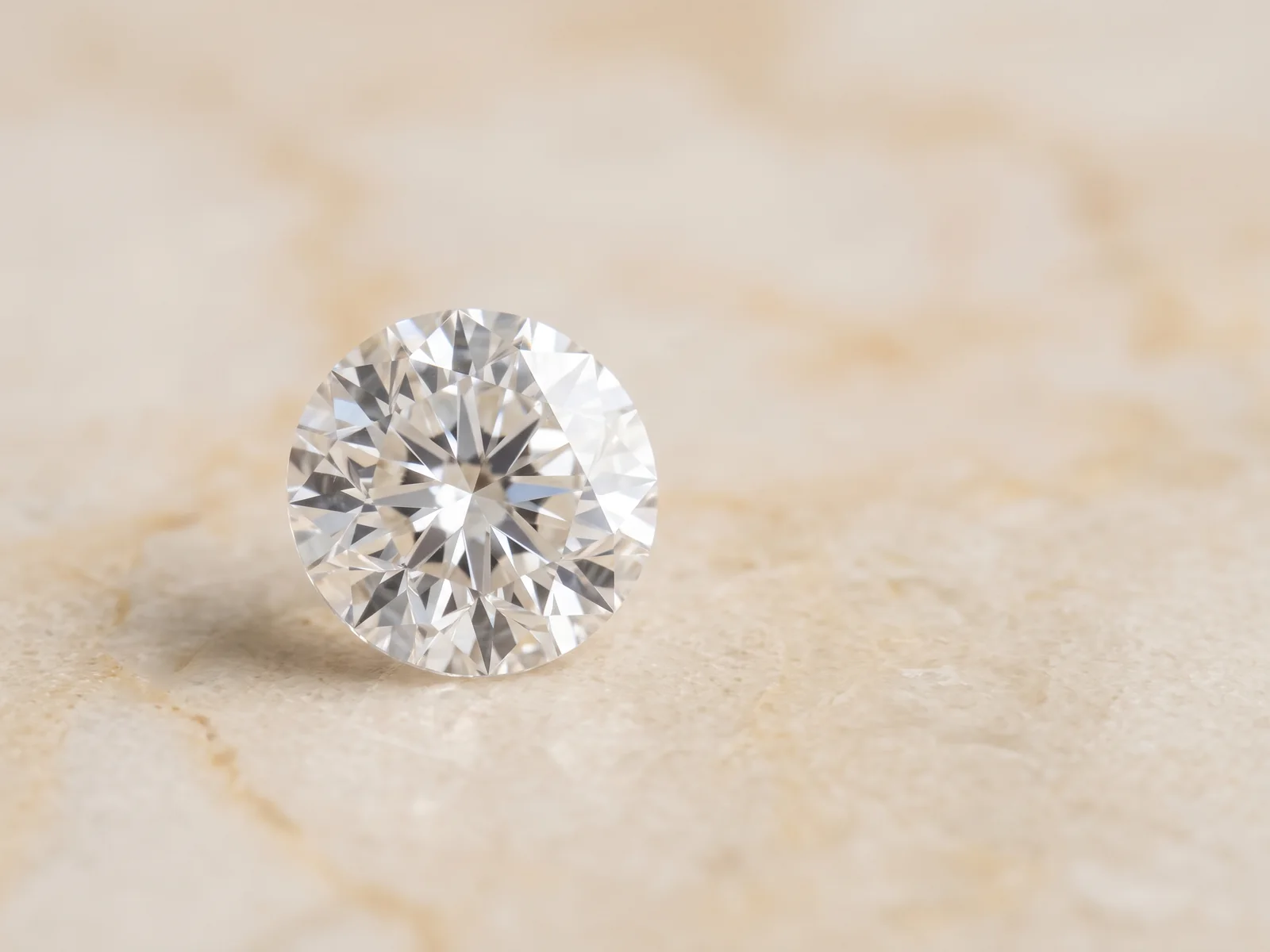
A 1.25 carat diamond sits in a useful middle ground: visibly larger than a 1 carat, but well short of the price step at 1.5 carats. Here is how big it really looks in each shape, what it costs in Australia and which grades make sense.
 Reviewed by Raj Sood, Graduate Gemologist (GIA), AJP (GIA)Master jeweller and Graduate Gemologist (GIA) · reviewed 4 November 2026
Quick answer
A 1.25 carat diamond weighs 0.25 grams and, as a well-cut round, measures about 6.9 mm across, roughly 16% more face-up area than a 1 carat. In Australia a natural G–H VS round costs about AUD $11,000–$19,000, a lab-grown one about $800–$2,500. G–H colour with eye-clean VS2–SI1 clarity suits most rings.
What is a 1.25 carat diamond?
A carat is a unit of weight, not size. One carat equals 0.2 grams, and each carat is divided into 100 points. A 1.25 carat diamond therefore weighs 0.25 grams and is often written as 125 points or 1¼ ct. If you want the full background on how carat weight is measured and rounded, that guide explains why two stones of the same weight can look quite different in size.
Carat is only one of the four grading factors. Colour, clarity and cut matter just as much to how a diamond looks, and at this size they all become easier to see. Our overview of the four Cs of diamond grading covers each one, and any unfamiliar term on this page is defined in our jewellery glossary.
Diamond is 10 on the Mohs hardness scale, with a refractive index of about 2.42, whether it is natural or lab-grown. The numbers below apply to both. Grading reports from labs such as GIA and IGI state weights to two decimal places. GIA, for example, rounds up only when the third decimal is a 9, so a stone listed as 1.25 ct generally weighs from about 1.249 to just under 1.26 ct.
Most people who land on 1.25 carats are comparing it with the sizes either side. If you are still deciding, our pages on 1 carat diamond sizes and prices and the 1.5 carat diamond guide use the same layout, so you can compare like with like.
How big is a 1.25 carat diamond in mm by shape?
Because carat is weight, the face-up size (what you see from above) depends on the shape and on how deep the stone is cut. Elongated shapes spread their weight over a longer outline, so they look larger than a round of the same weight. Deep shapes such as cushions hold more weight underneath and look smaller.
| Shape | Typical ratio | Approx. size at 1.25 ct | Face-up impression |
|---|---|---|---|
| Round | 1.00 | about 6.9 mm diameter | The reference point |
| Oval | 1.30–1.50 | about 8.3 × 5.9 mm | Looks larger than a round |
| Pear | 1.45–1.75 | about 9.0 × 5.8 mm | Looks larger than a round |
| Marquise | 1.85–2.10 | about 10.8 × 5.4 mm | Looks the largest for its weight |
| Emerald | 1.30–1.50 | about 7.6 × 5.4 mm | Similar to a round, more length |
| Radiant | 1.00–1.35 | about 7.0 × 5.8 mm | Similar to a round |
| Heart | 0.90–1.10 | about 7.3 × 6.8 mm | Slightly larger than a round |
| Cushion | 1.00–1.15 | about 6.6 × 6.2 mm | Slightly smaller than a round |
| Princess | 1.00–1.05 | about 6.0 × 6.0 mm | Smaller outline, sharp corners |
| Asscher | 1.00–1.05 | about 6.0 × 6.0 mm | Smaller outline, deep step cut |
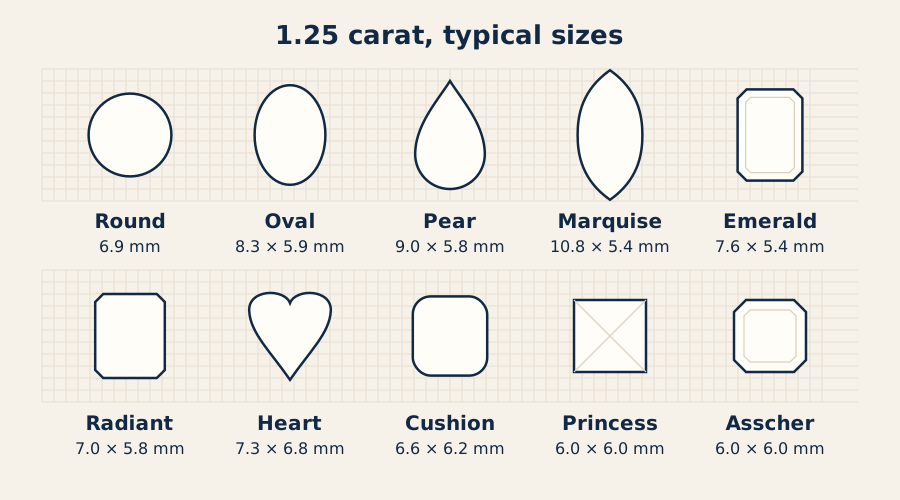
These are typical figures for well-proportioned stones. Two 1.25 carat ovals can differ by half a millimetre or more in length, depending on ratio and depth. Always compare the measurements printed on the grading report rather than assuming every stone of the same weight is the same size.
For a round, the jump in diameter from 1 ct (about 6.4–6.5 mm) to 1.25 ct (about 6.9 mm) is roughly half a millimetre. That sounds small, but diameter grows in two directions, so the visible area grows by about a sixth.
How does a 1.25 carat diamond look on the finger?
On a typical Australian ring size of L to N, the top of the finger is roughly 16–18 mm across. A 6.9 mm round covers a little under half of that width, which reads as a clear, confident centre stone without dominating the hand. On slimmer fingers (size H to K) the same stone looks noticeably bigger; on larger hands (size Q and above) it looks more modest.
- Round: sits neatly within the finger width; the most classic look.
- Oval and pear: set north-south (lengthways along the finger), they lengthen the finger and cover more of it, often looking closer to a 1.5 ct round.
- Marquise: at about 10.8 mm long it covers a large share of the finger between the knuckles; very striking at this weight.
- Emerald: the long, flat table (top facet) shows off clarity rather than sparkle; it looks elegant and slightly understated.
- Princess and Asscher: at about 6 mm square they look compact, but the corners give a crisp, geometric outline.
Band width also changes the impression. A fine band of about 1.8–2.2 mm makes the centre stone look larger by contrast, while a wide 3 mm band or a chunky setting makes it look smaller. If you are weighing a step down in size, see how 0.75 carat diamonds look on the hand; if you want more presence, compare it with how a 2 carat diamond compares.
Is a 1.25 carat diamond much bigger than a 1 carat?
It is a real step up, but not a dramatic one. The table shows well-cut round brilliants across the common sizes, with face-up area compared to a 1 carat.
| Carat weight | Typical round diameter | Face-up area | Compared with 1 ct |
|---|---|---|---|
| 0.50 ct | about 5.1–5.2 mm | about 21 mm² | about two-thirds of the area |
| 0.75 ct | about 5.8 mm | about 26 mm² | about four-fifths |
| 1.00 ct | about 6.4–6.5 mm | about 32 mm² | the reference |
| 1.25 ct | about 6.9 mm | about 37 mm² | about 16% larger |
| 1.50 ct | about 7.3–7.4 mm | about 42 mm² | about 30% larger |
| 2.00 ct | about 8.1 mm | about 52 mm² | about 60% larger |
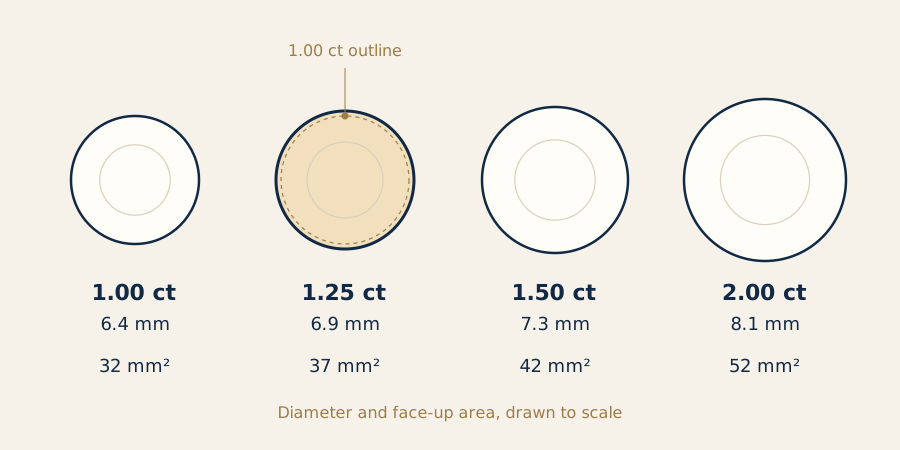
Side by side, most people can see the difference between 1 ct and 1.25 ct straight away. On the hand, without a comparison stone, it is harder to pick; what you notice more is that the 1.25 fills a little more of the finger. Between 1.25 and 1.5 ct the gap is similar again, roughly another 0.4–0.5 mm in diameter.
For perspective across the whole range, half-carat diamonds and small diamonds from 0.25 to 0.4 carat are common for studs and side stones, while 2.5 carat stones and 3 carat diamonds move into statement territory.
Not sure which one is right?
Send us the stones you are looking at and our gemologist will tell you which to choose and why.
How much does a 1.25 carat diamond cost in Australia?
Price depends on whether the diamond is natural or lab-grown, then on colour, clarity, cut and shape. The bands below are approximate retail ranges for round brilliants with a good to excellent cut and an independent report. Fancy shapes usually cost somewhat less per carat than rounds of the same grades.
| 1.25 ct round | Typical grades | Approximate price range (AUD) |
|---|---|---|
| Natural, high grades | D–F, VVS2–VS1 | about $16,000–$28,000 |
| Natural, popular middle | G–H, VS1–VS2 | about $11,000–$19,000 |
| Natural, value grades | I–J, SI1 | about $6,000–$10,000 |
| Lab-grown, high grades | D–F, VVS–VS1 | about $1,200–$2,500 |
| Lab-grown, middle grades | G–H, VS–SI1 | about $800–$1,800 |
These are broad ranges only. Natural and lab-grown prices both move with the market, and lab-grown retail prices in particular have fallen a long way in recent years. The stock links on this page show current natural and lab-grown stones in the 1.25–1.39 ct range with their individual prices.
Diamond prices also tend to step up at round numbers, often called magic sizes, such as 1.00, 1.50 and 2.00 carats. Many price lists group stones from 1.00 to 1.49 ct together, so the price per carat of a 1.25 is often close to that of a 1.10 or a 1.40 with the same grades. The big jump comes at 1.50. That makes 1.25–1.45 ct a sensible zone if you want more size than a 1 carat without paying the 1.5 premium.
Natural diamonds with medium or strong blue fluorescence (a glow under ultraviolet light) are often priced a little lower, and in most stones it has no visible effect in normal light. It is worth asking about if you are buying natural.
Should you choose a natural or lab-grown 1.25 carat diamond?
Both are real diamond. A natural diamond formed deep in the earth, typically one to three billion years ago, and was mined. A lab-grown diamond (also called laboratory-grown) is grown in a laboratory, usually by CVD (chemical vapour deposition) or HPHT (high pressure, high temperature). The two have the same chemistry, hardness and sparkle, and they look identical to the eye. Only gemmological testing can tell them apart, and the grading report always states which one it is.
- Price: a 1.25 ct lab-grown diamond costs a small fraction of a natural stone with the same grades.
- Rarity: natural diamonds are finite and each formed over geological time; some people value that origin.
- Resale: neither should be thought of as an investment. Natural diamonds generally keep more of their resale value than lab-grown, but resale for both is well below the retail price.
- Grades: because higher grades add little to the price of a lab-grown stone, many buyers choose E–F colour and VS1 or better.
If lab-grown is your direction, our guide to lab-grown diamond sizes from 1 to 5 carats shows how prices scale, and most of the advice in choosing a 1 carat lab-grown diamond applies equally at 1.25 ct.
Shop 1.25 carat diamonds: natural and lab-grown
What colour and clarity are best for a 1.25 carat diamond?
The larger the diamond, the more body colour it shows, because light travels further through it. A faint warmth that is invisible in a 0.50 ct stone can start to show in a 1.25. Inclusions (internal features) are also larger in absolute terms, so a clarity grade that was eye-clean at 1 ct is not automatically eye-clean at 1.25. Eye-clean means you cannot see any inclusion without magnification at normal viewing distance.
| Shape and metal | Colour | Clarity | Why |
|---|---|---|---|
| Round in platinum or white gold | G–H | VS2–SI1 (eye-clean) | Brilliant faceting hides small inclusions and a hint of warmth |
| Oval, pear, marquise, heart in white metal | F–H | VS2–SI1 (eye-clean) | Colour tends to gather at the ends and points |
| Emerald or Asscher | F–H | VS1–VS2 | The open step-cut table shows inclusions more readily |
| Princess, cushion, radiant in white metal | G–H | VS2–SI1 (eye-clean) | Busy faceting hides inclusions well |
| Any shape in yellow or rose gold | I–J | VS2–SI1 (eye-clean) | Warm metal makes the stone look whiter |
| Lab-grown, any shape | D–G | VS1–VS2 | Higher grades add relatively little cost |
These are starting points, not rules. An SI1 with a small white crystal near the edge can look cleaner than a VS2 with a dark spot under the table. Ask for a 360° video or view the stone in person, and check the plotting diagram on the report, which maps where each inclusion sits.
Related guide1.5 Carat DiamondsWhy does cut matter so much at 1.25 carats?
Cut decides both how bright the diamond looks and how big it faces up. For round brilliants, GIA gives an overall cut grade; at this size most people choose Excellent (or Ideal on some reports). Well-cut rounds usually have a total depth of about 59–62.5% and a table of about 54–58% of the diameter.
A stone cut too deep hides weight underneath. A 1.25 ct round at 64% depth might measure about 6.7 mm, the face-up size of a well-cut 1.15 ct. A stone cut too shallow spreads wider, perhaps 7.0 mm or more, but can leak light and look glassy. That balance between weight and visible diameter is called spread.
Fancy shapes have no overall GIA cut grade, so judge them by ratio, depth, polish, symmetry and, above all, how they look on video. In ovals, pears and marquises watch for a bow-tie, a dark band across the middle; a faint one that shifts as the stone moves is normal, a solid one that never changes is not.
What setting suits a 1.25 carat engagement ring?
At 1.25 ct the centre stone is large enough to carry most styles, so the choice comes down to look and practicality.
- Four claws: show the most diamond and make a round look slightly squarer.
- Six claws: hold the stone more securely and keep a round looking round.
- Bezel: a thin rim of metal around the edge; very secure for active hands, though it hides a fraction of the outline.
- Halo: a ring of small diamonds that adds roughly 2.5–3 mm to the overall width, so a 6.9 mm round reads at about 9.5 mm across.
- Low or cathedral profile: a lower setting catches less; a higher one shows off the stone and makes room for a straight wedding band.
The same setting principles scale up to larger stones such as 4 carat diamonds, a 5 carat diamond centre stone and 6 to 10 carat diamonds, where the weight of the stone makes a secure claw or bezel even more important.
How do you choose a 1.25 carat diamond? Step by step
- Decide natural or lab-grown. This sets your price band before anything else.
- Choose the shape. Check its millimetre size in the table above so you know how big it will look.
- Read the report. Confirm weight, measurements, colour, clarity, cut, polish and symmetry, and that it states natural or lab-grown.
- Check the cut. For rounds, look for Excellent with about 59–62.5% depth; for fancy shapes, check the ratio and watch for a fixed bow-tie.
- Match colour to the metal. G–H in white metal, I–J in yellow or rose gold.
- Confirm it is eye-clean. Watch a 360° video or view the stone in person, and look at the plotting diagram.
- Compare nearby weights. Stones from about 1.20 to 1.45 ct often share similar per-carat pricing; compare face-up size, not just weight.
- Plan the setting. Choose claws, bezel or halo and a band width before you commit to the stone.
Free consultation
Talk to a gemologist
Compare stones in person or online with Raj Sood, Graduate Gemologist (GIA), AJP (GIA).
Book a consultationFAQ
Common questions
How big is a 1.25 carat diamond in mm?
A well-cut 1.25 carat round measures about 6.9 mm across. An oval of the same weight is about 8.3 × 5.9 mm, and a princess about 6.0 mm square.
Can you tell the difference between a 1 carat and a 1.25 carat diamond?
Side by side, yes: the 1.25 is about half a millimetre wider and has roughly 16% more face-up area. On the hand without a comparison, the difference is subtler.
How much is a 1.25 carat diamond in Australia?
As a rough guide, a natural G–H VS round costs about AUD $11,000–$19,000, while a lab-grown 1.25 carat round costs about $800–$2,500. Prices vary with grades, shape and the market.
What clarity is good for a 1.25 carat diamond?
VS2 or a carefully chosen SI1 is usually eye-clean in round and other brilliant shapes. Emerald and Asscher cuts show more, so VS1–VS2 is safer.
Is a 1.25 carat lab-grown diamond a real diamond?
Yes. A lab-grown diamond has the same chemistry, hardness and sparkle as a natural diamond; it is grown in a laboratory rather than mined, and the grading report says so.
Is 1.25 carats a good size for an engagement ring?
It suits most hands well, covering a little under half the width of a typical finger as a round. It gives more presence than a 1 carat without the price step at 1.5 carats.

Ask a gemologist
Not sure which diamond to choose?
Raj Sood is a Graduate Gemologist (GIA) and master jeweller. Bring the stones you are considering, or send the reports, and he will tell you honestly which one is better and why.
Keep learning
Related guides
 Diamond 4Cs & Grading1 Carat Diamonds
 Diamond 4Cs & Grading1.5 Carat DiamondsDiamond 4Cs & GradingDiamond Carat Weight
 Lab-Grown DiamondsLab-Grown Diamond Carat Sizes: 1 to 5 CaratsDiamond 4Cs & GradingDiamond 4Cs
 Diamond 4Cs & Grading5 Carat Diamonds
 Diamond 4Cs & Grading4 Carat DiamondsDiamond 4Cs & Grading3 Carat Diamonds
Explore more
More guides on this topic
Education