
- Education
- Diamond 4Cs & Grading
- Diamond MM to Carat Size Chart: Every Shape, 0.25 to 10 Carats
Diamond 4Cs & Grading
Diamond MM to Carat Size Chart: Every Shape, 0.25 to 10 Carats
Carat is a weight, not a size, so two 1 carat diamonds can look quite different on the hand. This diamond mm to carat size chart gives typical millimetre measurements for every popular shape, from a quarter carat to 10 carats.
 Reviewed by Raj Sood, Graduate Gemologist (GIA), AJP (GIA)Master jeweller and Graduate Gemologist (GIA) · reviewed 4 November 2026
Quick answer
A diamond mm to carat size chart converts weight into face-up size. A well-cut 1 carat round measures about 6.4 mm across, 0.50 ct about 5.1 mm and 2 ct about 8.1 mm. Elongated shapes such as oval, pear and marquise spread wider per carat; princess, Asscher and cushion cuts look slightly smaller. Natural and lab-grown sizes match.
What does a diamond mm to carat size chart show?
Carat is a unit of weight, not size. One carat (ct) is 0.2 grams, or 200 milligrams, and it is split into 100 points, so a 0.75 ct stone is often called a '75-pointer'. Our guide to diamond carat weight explains how the unit came about and how stones are weighed.
A size chart translates that weight into what you actually see: the face-up size, measured in millimetres across the top of the stone. For a round that is one number, the diameter. For fancy shapes it is two numbers, length × width, because the stone is longer one way than the other.
Carat is only one of the four Cs of diamond quality, and it is the one people most often misread. A heavier stone is not automatically a bigger-looking one. The cut proportions decide how much of the weight sits on top, where you can see it, and how much is hidden underneath. Any unfamiliar term on this page is explained in our jewellery glossary of trade terms.
Every figure below is a typical measurement for a well-cut stone. Individual diamonds vary by a few tenths of a millimetre either way, so always check the measurements printed on the stone's grading report.
How many mm is a 1 carat round diamond?
A well-cut 1 carat round brilliant measures about 6.4 mm across, give or take 0.1–0.2 mm depending on its depth. The table gives typical diameters for rounds cut to standard proportions: a depth of roughly 59–62.5% of the diameter and a medium girdle (the thin edge around the widest point).
| Carat | Points | Diameter (approx.) | Face-up area | Area compared with 1 ct |
|---|---|---|---|---|
| 0.25 ct | 25 | 4.1 mm | 13 mm² | 40% |
| 0.30 ct | 30 | 4.3 mm | 15 mm² | 45% |
| 0.40 ct | 40 | 4.8 mm | 18 mm² | 54% |
| 0.50 ct | 50 | 5.1 mm | 20 mm² | 63% |
| 0.75 ct | 75 | 5.9 mm | 27 mm² | 83% |
| 0.90 ct | 90 | 6.2 mm | 30 mm² | 93% |
| 1.00 ct | 100 | 6.4 mm | 33 mm² | 100% |
| 1.25 ct | 125 | 6.9 mm | 38 mm² | 116% |
| 1.50 ct | 150 | 7.4 mm | 43 mm² | 131% |
| 2.00 ct | 200 | 8.1 mm | 52 mm² | 159% |
| 2.50 ct | 250 | 8.8 mm | 60 mm² | 184% |
| 3.00 ct | 300 | 9.3 mm | 68 mm² | 208% |
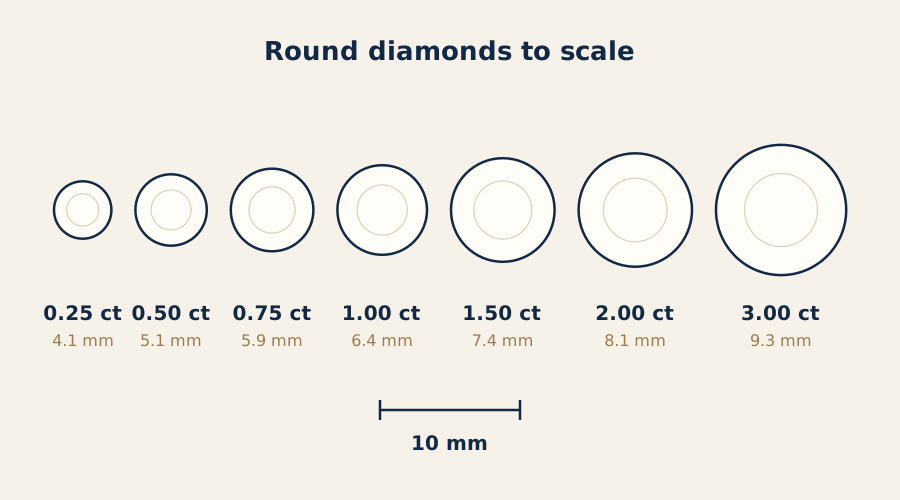
Look at the last column. Doubling the weight from 1 ct to 2 ct adds only about 1.7 mm across the top and roughly 60% more face-up area, because the extra weight is spread through the depth of the stone as well as its width. The same works in reverse: a half-carat diamond is not half the size to the eye. At about 5.1 mm it is roughly 80% of the diameter of a carat.
The popular in-between weights follow the same curve. A 0.75 carat diamond sits at about 5.9 mm, a 1 carat round diamond at 6.4 mm and a 1.25 carat stone at about 6.9 mm. Each step is only around half a millimetre, which is why seeing stones side by side tells you more than numbers on a screen.
Diamond mm to carat size chart for every shape
Fancy shapes carry their weight differently. Long, shallow shapes such as the marquise and pear spread their weight across the top; square step cuts such as the Asscher carry more of it underneath. These are typical face-up measurements at common length-to-width ratios (length divided by width, shown in brackets). Elongated shapes are listed as length × width.
| Shape (typical ratio) | 0.50 ct | 1.00 ct | 1.50 ct | 2.00 ct | 3.00 ct |
|---|---|---|---|---|---|
| Round (1.00) | 5.1 mm | 6.4 mm | 7.4 mm | 8.1 mm | 9.3 mm |
| Princess (1.00) | 4.4 mm | 5.5 mm | 6.3 mm | 6.9 mm | 7.9 mm |
| Cushion (1.00–1.05) | 4.5 mm | 5.7 mm | 6.5 mm | 7.2 mm | 8.2 mm |
| Asscher (1.00) | 4.3 mm | 5.4 mm | 6.2 mm | 6.8 mm | 7.8 mm |
| Oval (1.35) | 6.1 × 4.5 mm | 7.7 × 5.7 mm | 8.8 × 6.5 mm | 9.7 × 7.2 mm | 11.1 × 8.2 mm |
| Emerald (1.40) | 5.6 × 4.0 mm | 7.0 × 5.0 mm | 8.0 × 5.7 mm | 8.8 × 6.3 mm | 10.1 × 7.2 mm |
| Radiant (1.25) | 5.2 × 4.1 mm | 6.5 × 5.2 mm | 7.4 × 6.0 mm | 8.2 × 6.6 mm | 9.4 × 7.5 mm |
| Pear (1.60) | 6.4 × 4.0 mm | 8.0 × 5.0 mm | 9.2 × 5.7 mm | 10.1 × 6.3 mm | 11.5 × 7.2 mm |
| Marquise (2.00) | 7.9 × 4.0 mm | 10.0 × 5.0 mm | 11.5 × 5.7 mm | 12.6 × 6.3 mm | 14.4 × 7.2 mm |
| Heart (0.93, width × length) | 5.4 × 5.0 mm | 6.8 × 6.3 mm | 7.8 × 7.2 mm | 8.6 × 7.9 mm | 9.8 × 9.1 mm |
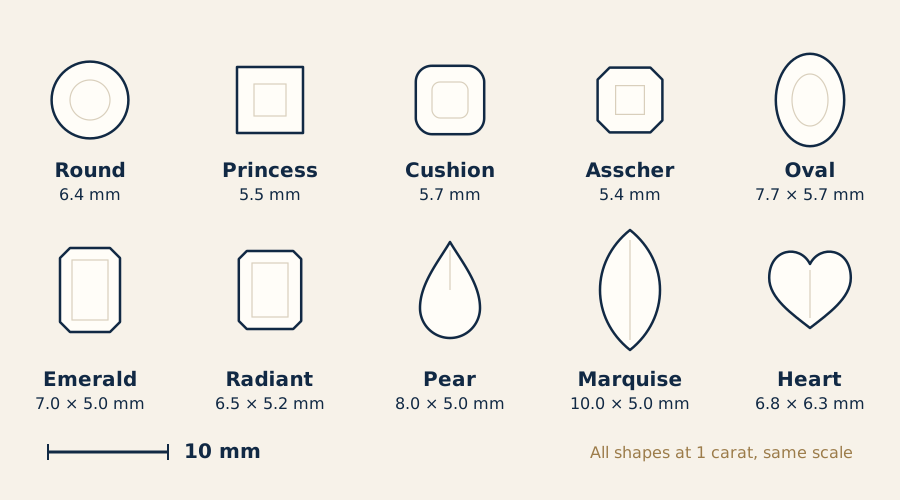
Read down a column and you can see how much shape matters. At 1 carat, a marquise is about 10 mm long while an Asscher is about 5.4 mm square, yet they weigh exactly the same. A few shape-specific points:
- Oval, pear and marquise: the longest face-up measurement per carat, and the ratio changes everything. A 1 ct oval at 1.45 looks longer and slimmer than one at 1.30, even at the same weight.
- Princess: measured edge to edge, but the corner-to-corner diagonal is about 1.4 times the side, so a 5.5 mm princess reads close to 7.8 mm across the points.
- Cushion: the widest variation of any shape. A deep 'crushed ice' cushion can measure half a millimetre less across than a shallower cushion of the same weight.
- Emerald and Asscher: step cuts with long, flat facets and often a deeper pavilion (the lower half of the stone), so they show less spread per carat than brilliant cuts.
For the mid-range weights, our pages on 1.5 carat diamonds, what a 2 carat diamond looks like, choosing a 2.5 carat diamond and 3 carat diamond sizes and grades go deeper on each size, including the colour and clarity that tend to suit it.
How big is a 4 or 5 carat diamond in mm?
Large stones follow the same rule: width grows with the cube root of the weight, so each extra carat adds less than the one before. Here are typical measurements at 4 and 5 carats.
| Shape (typical ratio) | 4.00 ct | 5.00 ct |
|---|---|---|
| Round (1.00) | 10.2 mm | 11.0 mm |
| Princess (1.00) | 8.7 mm | 9.4 mm |
| Cushion (1.00–1.05) | 9.0 mm | 9.7 mm |
| Oval (1.35) | 12.2 × 9.0 mm | 13.2 × 9.7 mm |
| Emerald (1.40) | 11.1 × 7.9 mm | 12.0 × 8.6 mm |
| Radiant (1.25) | 10.3 × 8.3 mm | 11.1 × 8.9 mm |
| Pear (1.60) | 12.7 × 7.9 mm | 13.7 × 8.6 mm |
| Marquise (2.00) | 15.9 × 7.9 mm | 17.1 × 8.6 mm |
Above 5 carats, rounds keep growing slowly: about 11.7 mm at 6 ct, 12.3 mm at 7 ct, 12.9 mm at 8 ct and 13.9 mm at 10 ct. A 10 carat round is only about 2.9 mm wider than a 5 carat, even though it weighs twice as much. Our guide to 6 to 10 carat diamonds covers what changes at those sizes, including how settings are built to carry them.
At this scale the stone shows more of everything: colour is easier to see because there is more diamond to look through, and inclusions are larger in absolute terms. Our pages on 4 carat diamonds and 5 carat diamond proportions explain which grades hold up when the stone is this big.
Not sure which one is right?
Send us the stones you are looking at and our gemologist will tell you which to choose and why.
Why do diamonds of the same carat weight look different sizes?
Because weight can sit in two places: across the top, where you see it, or underneath, where you do not. A 1.00 ct round cut to a 60% depth measures about 6.5 mm across. The same weight cut to a 67% depth measures about 6.25 mm, so its face-up area is only around nine-tenths of the shallower stone's. The trade calls the face-up size for the weight a stone's spread.
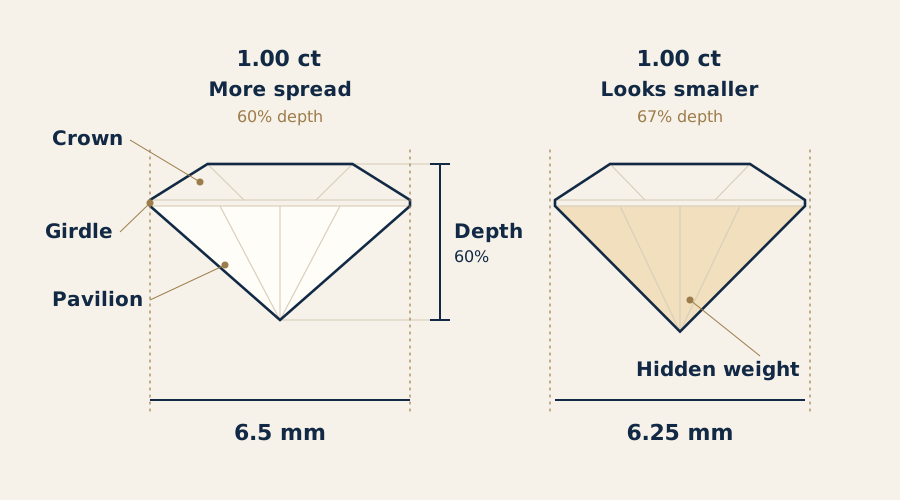
- Depth percentage: total depth divided by width. Deep stones face up smaller; very shallow stones face up larger but can leak light and look glassy.
- Girdle thickness: a thick girdle adds weight around the edge without adding visible width.
- Crown height: a tall crown (the upper part of the stone) adds weight above the girdle without widening the outline.
- Shape and ratio: elongated shapes cover more length, and a longer ratio stretches the same weight further.
Gemmologists estimate weight from measurements with a simple formula, useful when a stone is already set and cannot be weighed. For a round: diameter × diameter × depth × 0.0061, all in millimetres. A stone 6.45 mm across and 3.97 mm deep works out at about 1.01 ct. Fancy shapes use length × width × depth with a different factor: roughly 0.0062 for ovals, 0.0059 for pears and hearts, 0.0080–0.0092 for emerald cuts (rising with the ratio) and 0.0083 for princess cuts. These are estimates only; a calibrated scale gives the true weight.
Related guideWhich Diamond Shape Looks Biggest per CaratIf face-up size matters most to you, our guide to the shapes that look largest for their weight ranks every shape by spread and explains the trade-offs in sparkle and colour.
How big does a diamond look on the hand?
A diamond's size on the hand depends as much on the finger as on the stone. A ring size around M or N in Australian letter sizes is roughly 16.5–17 mm across the inside of the band, and the top of the finger is about the same width. The table shows how much of a finger that width a round centre stone covers.
| Round carat | Diameter | Share of a 17 mm finger | How it usually reads |
|---|---|---|---|
| 0.50 ct | 5.1 mm | about 30% | Neat and understated |
| 0.75 ct | 5.9 mm | about 35% | Clearly a centre stone |
| 1.00 ct | 6.4 mm | about 38% | The size many people picture |
| 1.50 ct | 7.4 mm | about 44% | Noticeably fuller |
| 2.00 ct | 8.1 mm | about 48% | Covers nearly half the finger |
| 3.00 ct | 9.3 mm | about 55% | Bold; spans more than half |
On a slimmer finger the same stone covers more and looks larger; on a broader finger it looks smaller. The setting changes the impression too. Fine claws and a slim band of about 1.8–2 mm make the centre stone look bigger by contrast, while a halo of small diamonds typically adds 2–3 mm to the overall width of the head. A 3 mm band beside a half carat can make the stone look small.
If the ring is a surprise, estimating their ring size discreetly also gives you the finger width you need to judge the stone against.
What do ct, ctw, points and TDW mean?
Carat terms on jewellery labels look similar but mean different things. The difference between carat and carat total weight matters most, because it can change the size of each stone dramatically.
| Term | What it means | Example |
|---|---|---|
| Carat (ct) | Weight of one diamond; 1 ct = 0.2 g | A 1.00 ct centre stone weighs 200 mg |
| Points (pt) | Hundredths of a carat | 0.75 ct = 75 points |
| Carat total weight (ctw) | Combined weight of every diamond in the piece | 1 ctw studs = two 0.50 ct diamonds |
| Total diamond weight (TDW) | Another name for ctw | A ring of 1.20 TDW may have a 0.70 ct centre and 0.50 ct of side stones |
| Centre stone weight | The main diamond only | Ask for this figure on any multi-stone ring |
| Magic sizes | Round-number weights where prices step up | 0.50, 0.70, 0.90, 1.00, 1.50, 2.00 ct |
| Carat in gold (18ct, 9ct) | Gold purity out of 24 parts, not weight | 18ct gold is 75% gold |
Two practical points follow from this. First, a 1 ctw pair of earrings is two half-carats of about 5.1 mm each, not two 6.4 mm stones. Second, diamonds just below a magic size, such as 0.90–0.99 ct, are often priced noticeably lower than a full carat while measuring only about 0.1–0.2 mm smaller, a difference that is hard to see once set.
Are lab-grown diamonds the same size per carat as natural diamonds?
Yes. A laboratory-grown diamond is the same material as a natural diamond: carbon in the same crystal structure, with the same density of about 3.52 g/cm³. A 1 ct lab-grown round cut to the same proportions measures the same 6.4 mm as a natural one, so every chart on this page applies to both.
The real difference is price and availability. Lab-grown diamonds cost much less than natural diamonds of the same weight and grade, so many people choose a larger lab-grown stone; natural diamonds are rarer, especially above 2 carats. Proportions vary by cutter in both, so compare the measurements and depth percentage rather than assuming. Our guide to lab-grown diamond sizes from 1 to 5 carats goes through each weight.
Browse natural and lab-grown diamonds by size
Both should come with an independent grading report from a laboratory such as GIA or IGI. A lab-grown report states clearly that the stone is laboratory-grown, and many lab-grown stones carry a tiny laser inscription on the girdle saying so.
How to use a diamond size chart when choosing a stone: step by step
- Start with the look, not the weight. Decide how many millimetres you want on the finger, using the paper-circle or ruler test.
- Choose the shape. Find that size in the chart for your shape, then note the carat weight it points to.
- Read the report's measurements. A round is listed as minimum – maximum diameter × depth, for example 6.45 – 6.48 × 3.98 mm. Fancy shapes are listed as length × width × depth.
- Check the depth percentage. For rounds, about 59–62.5% gives a good balance of spread and brightness; deeper stones face up smaller for their weight.
- Work out the ratio for fancy shapes. Divide length by width and compare it with the ratios in the chart, so you know what outline you are getting.
- Look just under the magic sizes. Compare a 0.90–0.99 ct stone with a full carat; the size difference is a fraction of a millimetre.
- Judge it in the setting. Consider band width, claws or a halo, and the wearer's finger size, before you commit to the stone.
Free consultation
Talk to a gemologist
Compare stones in person or online with Raj Sood, Graduate Gemologist (GIA), AJP (GIA).
Book a consultationShop this shape
FAQ
Common questions
How many mm is a 1 carat diamond?
A well-cut 1 carat round measures about 6.4 mm across. In other shapes, a 1 ct oval is about 7.7 × 5.7 mm, a princess about 5.5 mm square and a pear about 8.0 × 5.0 mm.
How many mm is a 2 carat diamond?
A 2 carat round is about 8.1 mm across, only around 1.7 mm wider than a 1 carat. A 2 ct oval is typically about 9.7 × 7.2 mm.
Which diamond shape looks biggest per carat?
The marquise usually has the longest face-up measurement for its weight, followed by the pear and oval. Step cuts such as the Asscher and deep cushions tend to look smallest per carat.
What is the difference between ct and ctw?
Ct is the weight of a single diamond; ctw (carat total weight) is the combined weight of all the diamonds in a piece. A 1 ctw pair of earrings is usually two 0.50 ct stones.
Is a lab-grown diamond bigger than a natural diamond of the same carat?
No. Lab-grown and natural diamonds have the same density, so the same weight and proportions give the same size. Differences come from how each stone is cut, not where it formed.
Can you tell a 0.90 ct diamond from a 1 ct by eye?
Rarely. A 0.90 ct round is about 6.2 mm against 6.4 mm for a full carat, a difference most people cannot see once the stone is set.

Ask a gemologist
Not sure which diamond to choose?
Raj Sood is a Graduate Gemologist (GIA) and master jeweller. Bring the stones you are considering, or send the reports, and he will tell you honestly which one is better and why.
Keep learning
Related guides
 Diamond 4Cs & GradingDiamond Carat Weight
 Diamond ShapesWhich Diamond Shape Looks Biggest per Carat
 Diamond 4Cs & Grading1 Carat Diamonds
 Lab-Grown DiamondsLab-Grown Diamond Carat Sizes: 1 to 5 CaratsDiamond 4Cs & GradingDiamond 4Cs
 Diamond 4Cs & Grading5 Carat Diamonds
 Diamond 4Cs & Grading4 Carat DiamondsDiamond 4Cs & Grading3 Carat Diamonds
Explore more
More guides on this topic
Education