
- Education
- Diamond 4Cs & Grading
- 0.25 Carat Diamond Size Guide: Real mm Sizes up to 0.4 Carat
Diamond 4Cs & Grading
0.25 Carat Diamond Size Guide: Real mm Sizes up to 0.4 Carat
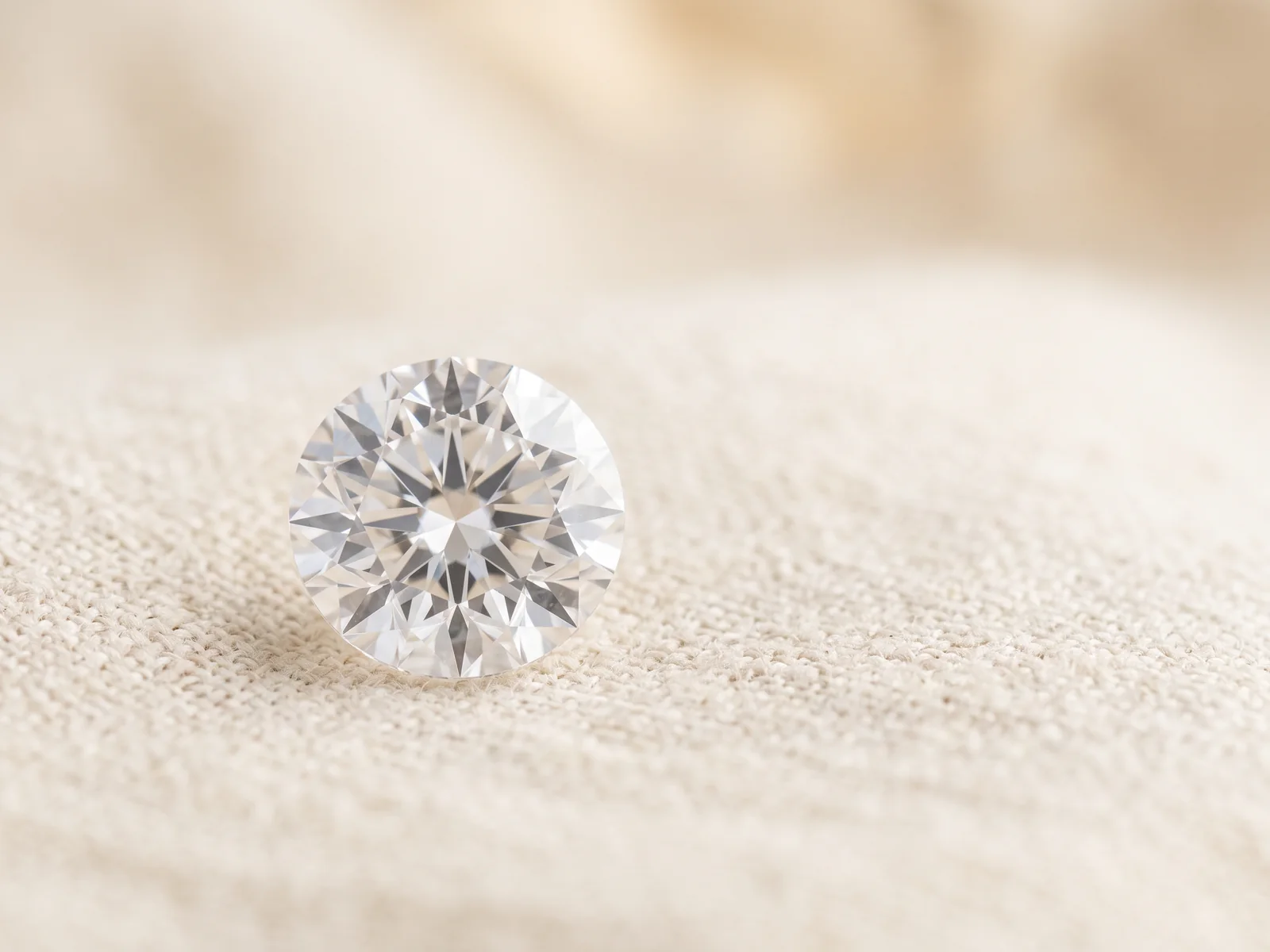
Between a quarter and four-tenths of a carat is where many first engagement rings, everyday studs and side stones sit. Here are the real millimetre sizes for every shape, what the carat terms on a tag mean, and how to make a small diamond look its best.
 Reviewed by Raj Sood, Graduate Gemologist (GIA), AJP (GIA)Master jeweller and Graduate Gemologist (GIA) · reviewed 4 November 2026
Quick answer
A 0.25 carat diamond weighs 50 milligrams and, as a well-cut round, measures about 4.1 mm across; a 0.40 carat round is about 4.8 mm. Fancy shapes such as ovals and marquises look longer for the same weight. On the hand these are neat, everyday sizes, and choosing an excellent cut matters more than adding points.
What is a 0.25 carat diamond?
Carat is a unit of weight, not size. One carat is 0.2 grams, so a 0.25 carat diamond weighs 50 milligrams, about the same as two grains of rice. Carat is divided into 100 points, which is why the trade calls a 0.25 carat stone a "25 pointer" and a 0.40 carat stone a "40 pointer". Our guide to how carat weight is measured and recorded goes into the scales and rounding in more detail.
You will also see this size called a quarter carat diamond, and 0.33 carat called a "third of a carat". These are everyday names, not grades. The weight that matters is the exact decimal figure on the grading report, given to two decimal places, such as 0.27 or 0.38.
Weight is only one of the four Cs of diamond grading: carat, colour, clarity and cut. At small sizes the balance between them shifts. Colour and small inclusions are harder to see, while cut decides almost everything about how bright and how big the stone looks. Any term you have not met before is explained in our plain-English jewellery glossary.
Diamonds from 0.25 to 0.40 carat are almost always full cut, meaning a round brilliant with 57 or 58 facets, the same as a 1 carat stone. Much smaller stones, called melee (pronounced "mel-ay", usually under about 0.20 carat), are sometimes single cut with only 17 or 18 facets. That is one reason a 0.30 carat stone still has the full sparkle you expect: diamond's refractive index of about 2.42 works just as well at 4 mm as it does at 8 mm.
How big is a 0.25 carat diamond in mm?
For a well-cut round brilliant with a total depth of about 60–62%, these are the typical measurements across the range. The diameter is the distance across the widest part of the stone (the girdle), which is what you see from above.
| Carat weight | Points | Typical diameter | Typical depth |
|---|---|---|---|
| 0.25 ct | 25 | about 4.0–4.1 mm | about 2.5 mm |
| 0.30 ct | 30 | about 4.3–4.4 mm | about 2.6–2.7 mm |
| 0.33 ct | 33 | about 4.4–4.5 mm | about 2.7 mm |
| 0.35 ct | 35 | about 4.5–4.6 mm | about 2.8 mm |
| 0.40 ct | 40 | about 4.7–4.8 mm | about 2.9 mm |
| 0.45 ct | 45 | about 4.9–5.0 mm | about 3.0 mm |
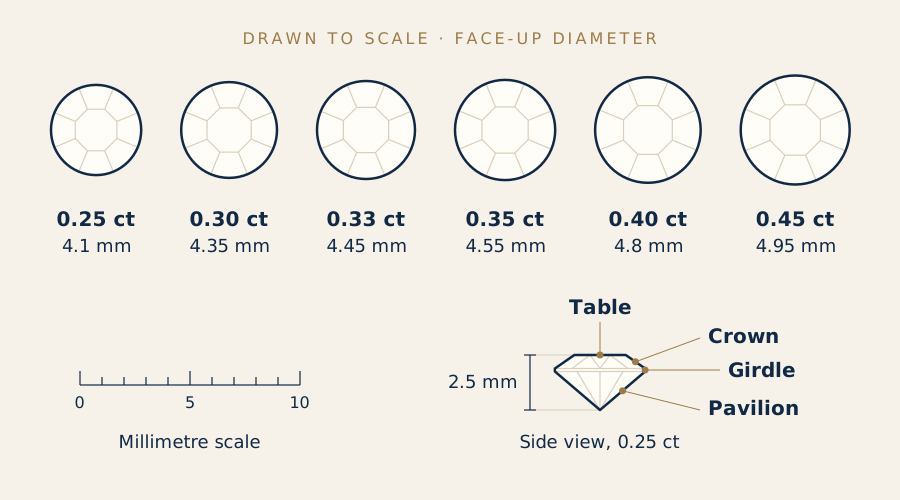
Notice how slowly the diameter climbs. Going from 0.25 to 0.40 carat adds 60% more weight, yet the stone grows only about 0.7 mm across. That is because weight follows volume, which grows with the cube of the diameter. Face-up area (the surface you see from above) grows faster than the diameter, though: about 13 mm² at 0.25 carat against about 18 mm² at 0.40 carat, which the eye reads as a clear step up.
The figures assume good proportions. A stone cut deep, at 64% or more, hides weight underneath and might measure only 4.2 mm at 0.30 carat. A stone cut shallow spreads wider but can look glassy and dull. Always compare the millimetre measurements on the report, not just the carat weight. For the next size up, see our page on half-carat diamond sizes and prices.
How big is a 0.3 or 0.4 carat diamond in each shape?
Fancy shapes spread their weight differently. Elongated shapes such as ovals, pears and marquises put more of the weight into length, so they look longer on the finger than a round of the same weight. Square shapes such as princess and Asscher carry more weight in the corners and the pavilion (the lower half), so they measure smaller across.
| Shape | 0.25 ct | 0.33 ct | 0.40 ct |
|---|---|---|---|
| Round | 4.1 mm | 4.4 mm | 4.8 mm |
| Princess | 3.5 × 3.5 mm | 3.8 × 3.8 mm | 4.1 × 4.1 mm |
| Cushion | 3.7 × 3.7 mm | 4.0 × 4.0 mm | 4.3 × 4.3 mm |
| Asscher | 3.5 × 3.5 mm | 3.8 × 3.8 mm | 4.1 × 4.1 mm |
| Oval | 4.8 × 3.3 mm | 5.2 × 3.5 mm | 5.6 × 3.8 mm |
| Pear | 4.8 × 3.2 mm | 5.2 × 3.5 mm | 5.6 × 3.7 mm |
| Marquise | 6.3 × 3.2 mm | 7.0 × 3.5 mm | 7.4 × 3.7 mm |
| Emerald | 4.0 × 2.8 mm | 4.4 × 3.0 mm | 4.7 × 3.3 mm |
| Radiant | 4.0 × 3.2 mm | 4.4 × 3.5 mm | 4.6 × 3.7 mm |
| Heart | 4.3 × 4.0 mm | 4.7 × 4.4 mm | 5.0 × 4.6 mm |
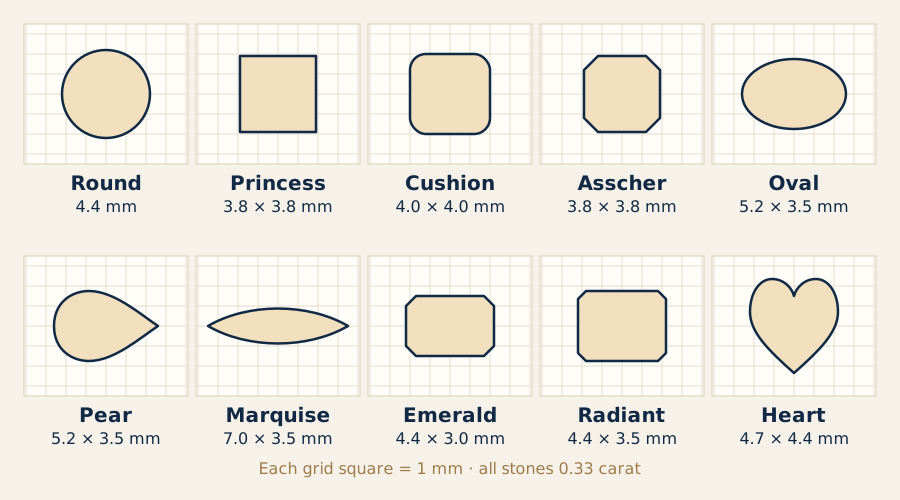
These are typical figures; real stones vary with ratio and depth. A 0.40 carat marquise, at about 7.4 mm long, covers more of the finger lengthways than a 0.75 carat round, which is why marquise and oval are popular when someone wants a small diamond engagement ring to look bigger. Hearts are worth a note: below about 0.30 carat, the lobes and cleft become so small that the outline can read as a rounded triangle once claws are in place. To see how the same shapes measure higher up the scale, our 1 carat diamond size chart by shape uses the same layout.
How does a small diamond look on the hand?
A typical ring finger in Australian sizes L to O measures roughly 16–18 mm across the inside of the ring. On that finger:
- 0.25 carat round (4.1 mm): covers about a quarter of the finger's width. Neat and low-key, the size many people choose for everyday wear or a first diamond.
- 0.30–0.33 carat round (4.3–4.5 mm): noticeably more presence from a metre away, still easy to wear under gloves and at work.
- 0.40 carat round (4.8 mm): close to a half carat in appearance; most people cannot tell 4.8 mm from 5.1 mm without the two side by side.
- Elongated shapes: a 0.33 carat oval or pear at about 5.2 mm long looks larger than its weight suggests, and slims the finger.
- Smaller hands: on a size H–J finger, a 0.30 carat stone covers a bigger share of the width and looks proportionally larger.
The band and setting change the impression too. A slim band of about 1.6–2.0 mm makes a 4 mm stone look larger by contrast, while a wide 3 mm band can make it look small. If you are deciding between this range and a step up, our guide to three-quarter carat diamonds on the hand shows the next jump.
Not sure which one is right?
Send us the stones you are looking at and our gemologist will tell you which to choose and why.
What do ct, ctw and points mean on a diamond tag?
Small diamonds are where carat terms cause the most confusion, because many pieces in this range hold more than one stone.
- ct (carat): the weight of a single diamond. A "0.30 ct solitaire" has one 0.30 carat stone.
- ctw or tcw (carat total weight): the combined weight of every diamond in the piece. A pair of "0.50 ctw" studs is two stones of about 0.25 carat each, roughly 4.1 mm per ear.
- pt (points): hundredths of a carat. A "30 pt" stone is 0.30 carat.
- Fractions: tags such as "1/4 ct" or "1/3 ct" are shorthand. Ask for the exact decimal weight, because a fraction can cover a range of real weights.
A halo ring tagged "0.40 ctw" might have a 0.25 carat centre and fifteen points of small diamonds around it, which looks very different from a single 0.40 carat stone. The full breakdown, with worked examples, is in our guide to ct, ctw and tcw.
Related guideCT vs CTW vs TCW: Carat Weight TermsWhat colour, clarity and cut suit a 0.3 carat diamond?
Cut first. A small stone has less surface to return light, so poor proportions show up quickly as a dark or glassy centre. For rounds, choose an Excellent (GIA) or Ideal/Excellent (IGI) cut grade, with polish and symmetry of Very Good or better. For fancy shapes, which have no overall cut grade at GIA, judge by ratio, depth and a 360° video.
Colour is harder to see in a small diamond, because there is less depth for light to travel through and pick up tint. In white gold or platinum, G to I colour usually faces up white at 0.25–0.40 carat; in yellow or rose gold, J can look just as white. Clarity works the same way: inclusions (internal features) are smaller in absolute terms, so SI1 and many SI2 stones are eye-clean, meaning nothing visible without magnification at normal viewing distance. Step shapes such as emerald and Asscher show inclusions more, so aim for VS2 or better there.
- Round, white metal: G–I colour, SI1–SI2 eye-clean, Excellent cut.
- Round, yellow or rose gold: I–J colour, SI1–SI2 eye-clean.
- Emerald or Asscher: G–H colour, VS2 or better.
- Studs: seen from further away, so H–J and SI2 are common choices.
How much does a 0.25 carat diamond cost in Australia?
Prices in this range depend heavily on whether the diamond is natural or lab-grown. Both are real diamond, with the same hardness (10 on the Mohs scale) and refractive index. Lab-grown diamonds are grown in a laboratory rather than mined, and cost much less. Natural diamonds are formed in the earth over very long periods and are rarer. The figures below are broad ranges for a loose round, G–H colour, VS2–SI1 clarity, Excellent cut.
| Loose round, G–H, VS2–SI1 | Lab-grown (approx. AUD) | Natural (approx. AUD) |
|---|---|---|
| 0.25 ct | about $200–$500 | about $600–$1,400 |
| 0.30 ct | about $250–$600 | about $800–$1,900 |
| 0.40 ct | about $300–$800 | about $1,100–$2,600 |
Prices move with the market and with the exact grades, so treat these as a guide only. Natural prices also step up at certain weights the trade calls magic sizes: 0.30, 0.40 and 0.50 carat. A 0.29 carat stone can cost noticeably less per carat than a 0.30, yet the difference in diameter is only about 0.05 mm, which no one can see. Looking just under a step, at 0.28–0.29 or 0.38–0.39 carat, is a common way to stretch a budget. Lab-grown prices follow the same pattern far more gently.
Grading reports matter here too. Many natural diamonds under 0.30 carat are sold with a brief report or none at all, because a full report costs more relative to the stone's value. Ask for an independent report from a lab such as GIA or IGI that states whether the diamond is natural or lab-grown. Lab-grown stones in larger sizes are covered in our guide to lab-grown diamond sizes from 1 to 5 carats, and if you want to see how the price curve continues, look at 1.25 carat diamonds.
Browse 0.25–0.45 carat diamonds: natural and lab-grown
What settings make a small diamond look bigger?
The setting can add as much visual size as another ten points of weight. Common choices for a 0.25 to 0.40 carat centre:
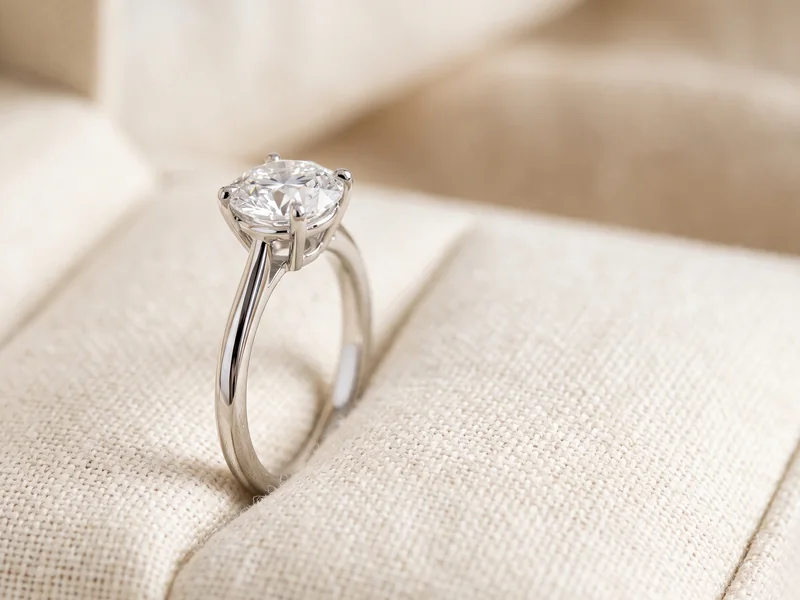
- Slim four-claw solitaire: shows the most diamond and lets light in from the sides. Fine claws matter: heavy claws can cover a noticeable share of a 4 mm stone.
- Six claws: rounder look and extra security, but more metal over a small outline.
- Halo: a ring of small diamonds of about 1 mm each brings a 4.1 mm centre to roughly 6.5 mm across, close to the look of a 1 carat round from a distance.
- Bezel: a thin rim of metal around the edge. Very secure and sleek, and the metal edge can make the stone read slightly larger, though it lets in less light from the side.
- Illusion or white-metal heads: a white gold or platinum head under a yellow gold band makes the stone look whiter and blends the claws into the diamond.
- Slim band: about 1.6–2.0 mm wide keeps the proportions in the stone's favour.
Small diamonds are also the backbone of many larger pieces. A pair of 0.25–0.30 carat stones either side of a 1.5 carat centre stone makes a classic three-stone ring, and matched 0.33 carat sides suit two-carat centre diamonds in the same way. Studs of 0.25–0.40 carat each are one of the most worn diamond pieces, and a single 0.30 carat stone on a fine chain makes a pendant you can wear every day.
Is a 0.4 carat diamond too small for an engagement ring?
No. Size is personal, and a well-cut 0.40 carat round at 4.8 mm is a clear, bright engagement stone. What helps is seeing where it sits against the sizes above it.
| Round carat weight | Typical diameter | Face-up area | Compared with 0.25 ct |
|---|---|---|---|
| 0.25 ct | 4.1 mm | about 13 mm² | — |
| 0.30 ct | 4.35 mm | about 15 mm² | about 1.1× the area |
| 0.40 ct | 4.8 mm | about 18 mm² | about 1.4× the area |
| 0.50 ct | 5.1–5.2 mm | about 21 mm² | about 1.6× the area |
| 0.75 ct | 5.8–5.9 mm | about 27 mm² | about 2.1× the area |
| 1.00 ct | 6.4–6.5 mm | about 33 mm² | about 2.5× the area |
The step from 0.40 to 0.50 carat adds only about 0.4 mm to the diameter, while the price step for natural stones is usually much larger. For people who wear their ring every day with gloves, at a desk or on the tools, a smaller, lower-profile stone also sits closer to the finger and catches less. If you are weighing up the jump, our 0.5 carat guide and one-carat diamond guide are the natural next reads.
For a sense of the full scale, the same size charts continue through 2.5 carat stones, three-carat diamonds, 4 carat diamonds, five-carat stones and up to 6 to 10 carat diamonds, where a round passes 12 mm across.
How to choose a 0.25 to 0.4 carat diamond: step by step
- Decide the look first. Round, square or elongated; check the millimetre table for each shape at your budget.
- Check the exact weight. Read the decimal carat weight and whether the tag says ct (one stone) or ctw (all stones).
- Compare millimetres, not just carats. A 0.30 carat round should measure about 4.3–4.4 mm; much less means it is cut deep.
- Prioritise cut. Excellent cut for rounds; for fancy shapes, a good ratio and an even look in a 360° video.
- Set sensible colour and clarity. G–I and SI1–SI2 eye-clean usually look clean at this size; adjust for metal colour.
- Look just under a price step. Consider 0.28–0.29 or 0.38–0.39 carat if the measurements suit you.
- Confirm the report. Make sure it states natural or lab-grown and matches the stone's measurements.
- Plan the setting. Fine claws, a slim band or a halo, depending on how much presence you want. The colour and clarity grades in our 4Cs guide help you fine-tune before you commit.
Free consultation
Talk to a gemologist
Compare stones in person or online with Raj Sood, Graduate Gemologist (GIA), AJP (GIA).
Book a consultationFAQ
Common questions
How big is a 0.25 carat diamond?
A well-cut 0.25 carat round measures about 4.0–4.1 mm across and about 2.5 mm deep. Fancy shapes differ: a 0.25 carat oval is about 4.8 × 3.3 mm and a princess about 3.5 mm square.
Is a quarter carat diamond the same as 0.25 ct?
Yes, a quarter carat is 0.25 carat, or 25 points. On jewellery tags a fraction such as 1/4 ct can cover a range of real weights, so ask for the exact decimal figure.
What is the difference between 0.3 ct and 0.3 ctw?
0.3 ct is a single diamond of 0.30 carat. 0.3 ctw is the total weight of all the diamonds in a piece, so a pair of 0.3 ctw studs is two stones of about 0.15 carat each.
Can you see the difference between a 0.3 and 0.4 carat diamond?
Side by side, yes: a 0.40 carat round is about 4.8 mm against about 4.35 mm, with roughly a fifth more face-up area. On the hand without a comparison, many people find it hard to tell.
Are lab-grown 0.3 carat diamonds real diamonds?
Yes. Laboratory-grown diamonds are real diamond with the same hardness, refractive index and sparkle as natural diamonds. They cost much less and the grading report states that the stone is lab-grown.
Do small diamonds look bigger in a halo?
Yes. A halo of small diamonds around a 4.1 mm centre takes the overall width to about 6.5 mm, which reads close to a 1 carat round from a distance.

Ask a gemologist
Not sure which diamond to choose?
Raj Sood is a Graduate Gemologist (GIA) and master jeweller. Bring the stones you are considering, or send the reports, and he will tell you honestly which one is better and why.
Keep learning
Related guides
 Diamond 4Cs & Grading0.5 Carat DiamondsDiamond 4Cs & GradingDiamond Carat Weight
 Diamond 4Cs & GradingCT vs CTW vs TCW: Carat Weight TermsDiamond 4Cs & Grading0.75 Carat DiamondsDiamond 4Cs & GradingDiamond 4Cs
 Diamond 4Cs & Grading4 Carat DiamondsDiamond 4Cs & Grading1.25 Carat Diamonds
 Diamond 4Cs & Grading5 Carat Diamonds
Explore more
More guides on this topic
Education