
Metals
Cobalt, Tantalum and Carbon Fibre Rings: A Workshop Guide to Wear, Cost and Care
Cobalt, tantalum and carbon fibre rings are popular choices for wedding bands, but each behaves very differently on the hand and at the jeweller's bench. Here is what each is made of, how it wears, what it costs and what can and cannot be repaired later.
 Reviewed by Raj Sood, Graduate Gemologist (GIA), AJP (GIA)Master jeweller and Graduate Gemologist (GIA) · reviewed 4 November 2026
Quick answer
Cobalt, tantalum and carbon fibre rings are modern, non-precious alternatives to gold and platinum. Cobalt chrome is bright white, hard and mid-weight; tantalum is a dense, dark grey metal that feels like gold on the hand; carbon fibre is a feather-light resin composite, usually an inlay. All usually cost less than gold but are hard or impossible to resize.
What are cobalt, tantalum and carbon fibre rings?
None of these three materials is a precious metal. Cobalt and tantalum are industrial metals borrowed from medicine and aerospace, and carbon fibre is not a metal at all but a composite (a material made by combining two others, here carbon filaments and resin). Jewellers group them as alternative metals. They are mostly chosen for men's and unisex wedding bands, and they are a very different proposition from gold, platinum or palladium when you are choosing a metal for a wedding band you will wear every day for decades.
- Cobalt: really a cobalt-chromium alloy. Bright white, hard, mid-weight, and it does not need plating.
- Tantalum: a pure element (symbol Ta). Dark gunmetal grey, very heavy, soft enough to scratch but easy to refinish, and very kind to sensitive skin.
- Carbon fibre: woven or chopped carbon filaments set in epoxy resin. Extremely light, black with a woven or marbled pattern, and usually used as an inlay in a metal band.
The big trade-off is shared by all three. They are tough and usually affordable, but they are usually machined (or, for carbon fibre, moulded) rather than cast in a jewellery workshop, and they cannot be soldered with standard jewellery equipment. That means they can rarely be resized, repaired or remodelled the way a gold ring can. Keep that in mind through the rest of this guide; it matters more than colour or price for most people. Any unfamiliar term here is also defined in our A to Z of jewellery terms.
What is a cobalt ring made of, and how does it wear?
A cobalt wedding band is not pure cobalt. It is a cobalt chrome alloy, typically around 60–65% cobalt and 27–30% chromium, with a few per cent of molybdenum and sometimes tungsten. This is the same family of alloys used for hip replacements and dental frameworks, chosen there because it resists corrosion and wear inside the body. The chromium forms a thin, invisible oxide film on the surface, which is why cobalt chrome does not tarnish.
The colour is a bright, slightly cool white, very close to polished platinum. Unlike 14K white gold, which is naturally a little warm, cobalt does not need a white coating, so it never goes through the rhodium plating that white gold needs every few years. What you see on day one is the colour all the way through.
For hardness, jewellers often use the Vickers scale (HV), which measures how far a diamond point presses into a metal: higher numbers mean harder. Cobalt chrome sits at roughly 300–450 HV, against about 125–220 HV for 18K gold and around 100–150 HV for platinum. In practice a cobalt band keeps its polish noticeably longer than gold. It is not scratch-proof, though: grit, concrete and steel tools will still leave fine marks, and a cobalt ring that has been knocked about can be repolished with the right abrasives.
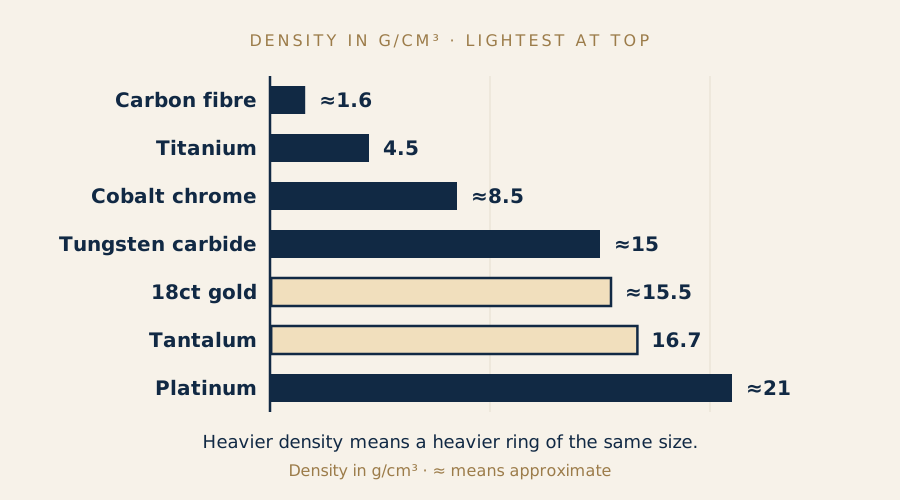
Weight is in the middle of the range. At about 8.3–8.9 g/cm³ (grams per cubic centimetre), a cobalt band feels roughly half as heavy as the same band in 18K gold, and far lighter than platinum, which is the heaviest common ring metal. Many people like that: present on the finger without the heft of precious metal.
One practical point in cobalt's favour over tungsten carbide: in an emergency, such as a swollen finger after an injury, a standard ring cutter can cut through cobalt. It takes longer than gold, but it can be done. Tungsten carbide cannot be cut and has to be cracked off instead.
What is a tantalum ring, and why is it so heavy?
Tantalum is element number 73, a rare, dense metal mostly used in electronics, chemical plant and medical implants such as pacemaker components and bone screws. A tantalum ring is usually close to pure tantalum, not an alloy. Its density is about 16.7 g/cm³, which is slightly heavier than 18K yellow gold (about 15.5–16) and well below platinum at around 20–21. If you have ever handled a platinum band and read about how platinum 950 and 900 differ, tantalum lands somewhere between gold and that kind of weight on the hand.
Polished, tantalum is a dark gunmetal grey with a faint blue undertone, noticeably darker than titanium or cobalt. It can also be anodised: an electrical process grows a thin, clear oxide layer on the surface, and the thickness of that layer makes it look blue, purple, bronze or green through light interference, the same effect as oil on water. There is no dye involved, but the layer is thin, so anodised colour can wear off the high points of a ring over time.
Tantalum is often paired with gold, silver or other metals as an inlay or a stripe. If that contrast appeals, our guide to two-tone and mixed-metal designs covers how different metals sit together in one band.
On wear, tantalum surprises people. At about 100–200 HV it is roughly as soft as gold, so it scratches at a similar rate. But it is very ductile (it bends and flows rather than cracking), so a scratch mostly pushes metal aside instead of removing it, and the ring can be brushed or polished back to an even finish. It will not tarnish or corrode in normal wear.
From the workshop side, tantalum is one of the most awkward materials a ring maker can choose. It melts at about 3,017 °C, far beyond what jewellery torches and casting machines reach, so it cannot be cast or soldered in an ordinary workshop. Every ring is machined from solid bar, and tantalum tends to stick to and blunt cutting tools. That machining, plus the cost of the raw metal, is why tantalum rings usually cost several times more than cobalt. Tantalum also comes from coltan ore, and it is one of the four minerals (tin, tantalum, tungsten and gold) covered by conflict-mineral rules in the United States and European Union, so it is reasonable to ask any maker where their tantalum comes from.
Is a carbon fibre ring a good choice for everyday wear?
Carbon fibre is made from thousands of carbon filaments, each about 5–10 micrometres across (much thinner than a human hair), bound together in epoxy resin, a hard plastic that sets when cured. The result is very strong along the direction of the fibres and extremely light: about 1.5–1.6 g/cm³, roughly a third of the weight of titanium. Two looks are common: a classic woven chequerboard, and forged carbon, where chopped fibres are pressed into a marbled, stone-like pattern.
A carbon fibre ring comes in two forms. A solid carbon fibre ring is built from layers of fibre and resin, usually with thick walls, sometimes with a metal liner inside. A carbon fibre inlay ring is far more common: a channel is machined into a metal band, typically titanium bands, cobalt or tungsten carbide, and the carbon fibre is set into it. The metal takes the knocks at the edges, and the carbon fibre gives the pattern.
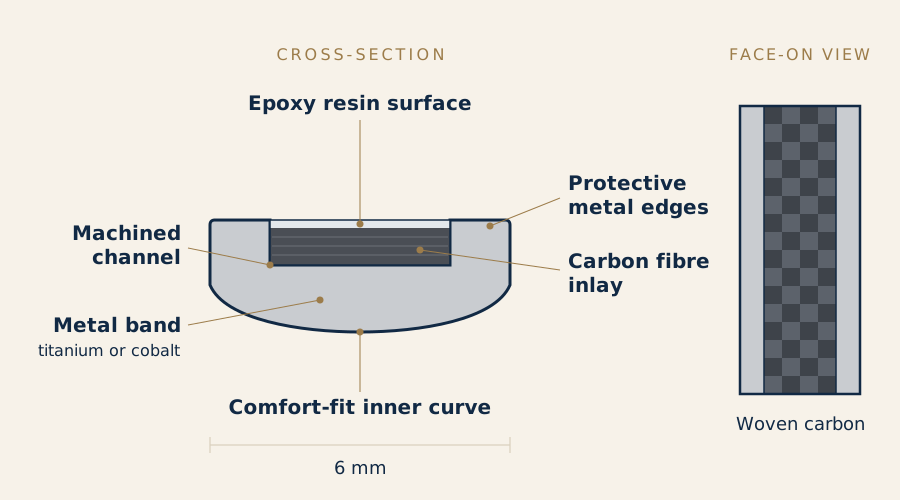
How does it wear? The fibres themselves are tough, but what touches the world is the resin surface, which is much softer than any of the metals above. Expect scuffs and a gradual loss of gloss, especially if you work with your hands. Some epoxies can dull or yellow slightly after years of strong sunlight, and resin softens with heat, so avoid leaving the ring on a hot car dashboard or wearing it near ovens and grills. A hard knock on the edge of an inlay can chip the carbon or loosen it in its channel.
Carbon fibre cannot be resized, and it cannot be polished like metal: refreshing a dull surface means re-coating the resin, which is specialist work. If what you love is the pattern rather than the lightness, mokume gane's wood-grain layered metal gives a patterned band in precious metals that a jeweller can work on later.
Not sure which one is right?
Send us the stones you are looking at and our gemologist will tell you which to choose and why.
How do cobalt, tantalum and carbon fibre rings compare with titanium, tungsten and gold?
| Cobalt chrome | Tantalum | Carbon fibre | Titanium | Tungsten carbide | 18K gold | |
|---|---|---|---|---|---|---|
| Colour | Bright white | Dark gunmetal grey; can be anodised | Black, woven or marbled | Mid grey | Grey; often plated black | Yellow, white or rose |
| Density (g/cm³) | about 8.3–8.9 | about 16.7 | about 1.5–1.6 | about 4.5 | about 14–15.6 | about 15–16 |
| Approx. hardness (HV) | 300–450 | 100–200 | Resin surface is soft | 150–350 | 1,500–2,200 | 125–220 |
| Scratch resistance | Good | Fair, similar to gold | Fair to poor | Fair | Very high, but brittle | Fair |
| Resizable | Rarely | Slightly, sometimes | No | Rarely | No | Yes |
| Cut off in an emergency | Yes, with effort | Yes | Yes | Yes, with effort | No, must be cracked | Yes |
| Precious metal fineness stamp | No | No | No | No | No | Yes (750) |
Cobalt vs tungsten ring is the comparison we hear most. Both are white and scratch resistant, but tungsten carbide is a ceramic-like material: much harder, so it holds its polish almost indefinitely, yet brittle enough to crack if dropped on tiles. Cobalt is a true metal that bends before it breaks and can be cut off. Tantalum vs titanium is the other common question: titanium is light and lightly grey, tantalum is nearly four times heavier and darker, and both are excellent for sensitive skin.
None of these three tarnish. That sets them apart from sterling silver bands, which darken with sulphur in the air; our page on why silver tarnishes and how patina forms explains the chemistry. For a ring that will hold a centre diamond, though, the picture changes: claw settings, re-tipping and resizing all favour precious metals, which is covered in which metal suits an engagement ring.
Are cobalt, tantalum and carbon fibre rings hypoallergenic?
Tantalum is one of the most biocompatible metals known, which is why it is used inside the body. It is a very safe choice for people who react to nickel or to most other jewellery metals.
Cobalt needs more care. Cobalt itself is a common contact allergen, and it is included in standard dermatology patch tests. Good cobalt chrome alloys release very little metal because of their chromium oxide film, and most people wear them without trouble. But if you already know you react to cobalt, avoid it. Also ask for confirmation that the alloy is nickel-free: some low-cost rings sold as cobalt contain nickel. A suspected cobalt ring allergy is worth checking with a GP or dermatologist rather than guessing.
Carbon fibre is chemically inert carbon, and fully cured epoxy rarely causes problems, though uncured epoxy is a known skin sensitiser. In an inlay ring your skin mostly touches the metal band or liner, so check that metal too. Our guide to nickel-free options for sensitive skin goes through each metal and what patch testing can tell you.
Can cobalt rings be resized or repaired?
This is where the workshop view matters most. A gold or platinum band is resized by cutting it, adding or removing a small section and soldering it closed, then polishing so the join disappears. Cobalt, tantalum and carbon fibre do not allow that. Here is what is realistic for each:
| Job | Cobalt chrome | Tantalum | Carbon fibre | Gold or platinum |
|---|---|---|---|---|
| Resize | Usually not; replace the ring | Up to about half a size by stretching, depending on design | No | Yes, usually several sizes |
| Remove scratches | Yes, with specialist abrasives | Yes, easily brushed or polished | Limited; resin must be re-coated | Yes |
| Engrave inside | Laser engraving | Laser or machine engraving | Laser on the metal liner | Hand, machine or laser |
| Add stones later | Difficult | Difficult | No | Yes |
| Melt down and remodel | No | No | No | Yes |
Some makers offer an exchange or resizing program instead, where you swap the ring for a new size within a set period. It is worth asking about before you buy, because the answer differs from maker to maker. These rings also carry no precious metal fineness stamp. You may see a laser mark such as Co, CoCr or Ta, but that is a material label, not a hallmark in the sense covered in Australian hallmarks and fineness stamps.
Related guideTitanium RingsIf resizing, re-polishing and the option to remodel matter to you, a precious-metal band is the more flexible long-term choice. That is the work our workshop is set up for.
How much do cobalt, tantalum and carbon fibre rings cost in Australia?
With alternative metals, most of the price is machining and finishing, not the raw material. That is the opposite of gold and platinum, where the metal itself is a large part of the cost and keeps a scrap value. Approximate ranges for a plain 6 mm band:
| 6 mm plain band | Approximate price range (AUD) |
|---|---|
| Carbon fibre (solid or inlay) | about $100–$600 |
| Tungsten carbide | about $100–$400 |
| Titanium | about $100–$500 |
| Cobalt chrome | about $150–$600 |
| Tantalum | about $500–$1,500 |
| Palladium 950 | about $1,000–$2,500 |
| 18K gold | about $1,800–$4,500 |
These are broad ranges only. Width, profile, inlays, engraving and brand all move the price, and precious metal prices change with the market. Tantalum costs more than cobalt mainly because it is harder to machine and the metal itself is costlier. If you want a grey-white precious metal that can be resized, compare palladium, a lighter platinum-group metal alongside the alternatives.
Remember the resale side too. Cobalt, tantalum and carbon fibre rings have little or no value as scrap, so think of them as something to wear, not something to sell or melt down later.
Browse ring settings by metal
How do you choose and care for a cobalt, tantalum or carbon fibre ring?
- Decide whether resizing matters. If your hands are likely to change, or the ring may be handed down, a precious metal is the safer choice.
- Check for allergies. Avoid cobalt if you have a known cobalt allergy, and confirm any cobalt alloy is nickel-free.
- Feel the weight. Tantalum is heavy, cobalt mid-weight and carbon fibre almost weightless. Try each on if you can.
- Choose width and profile. Bands of 6–8 mm feel tighter than narrow ones at the same size; a comfort-fit (domed inside) profile slides on more easily.
- Get sized properly. Size late in the day, in a mild temperature, with a sizer the same width as the ring.
- Ask the right questions. What exact alloy is it, where is the metal sourced, and is there an exchange policy if the size is wrong?
- Care for it. Wash in warm soapy water with a soft brush, take it off for the gym and heavy work, and keep carbon fibre away from heat, solvents and harsh cleaners.
Cobalt and tantalum need little ongoing care beyond an occasional clean and, if you like a fresh finish, a re-polish every few years. Carbon fibre needs the most gentle handling of the three: treat the inlay as you would a good watch face.
Free consultation
Talk to a gemologist
Compare stones in person or online with Raj Sood, Graduate Gemologist (GIA), AJP (GIA).
Book a consultationShop this shape
FAQ
Common questions
Can cobalt rings be resized?
Usually not. Cobalt chrome cannot be soldered with standard jewellery equipment, so a ring that no longer fits is normally replaced rather than resized. Some makers offer an exchange for a new size within a set period.
Is tantalum better than titanium for a wedding band?
It depends on what you value. Tantalum is nearly four times heavier and darker, with a gold-like weight on the hand, while titanium is very light; both are excellent for sensitive skin, and tantalum usually costs more.
Do carbon fibre rings break or wear out?
The carbon fibres are strong, but the resin surface scuffs and can lose its gloss over time, and a hard knock can chip an inlay. Most carbon fibre rings are inlays in a metal band, which protects the edges.
Is cobalt the same as tungsten?
No. Cobalt chrome is a true metal alloy that bends before it breaks and can be cut off in an emergency, while tungsten carbide is a much harder, brittle compound that holds its polish longer but can crack and must be cracked off.
Can a cobalt or tantalum ring be cut off in an emergency?
Yes. A standard ring cutter will cut tantalum easily and cobalt with more effort. Carbon fibre also cuts easily, but the metal band it sits in may take longer.
Do cobalt or tantalum rings have resale value?
Very little. Unlike gold or platinum, these materials have almost no scrap value at jewellers, so their worth is in wearing them rather than reselling.

Ask a gemologist
Not sure which diamond to choose?
Raj Sood is a Graduate Gemologist (GIA) and master jeweller. Bring the stones you are considering, or send the reports, and he will tell you honestly which one is better and why.
Keep learning
Related guides
 MetalsTitanium Rings
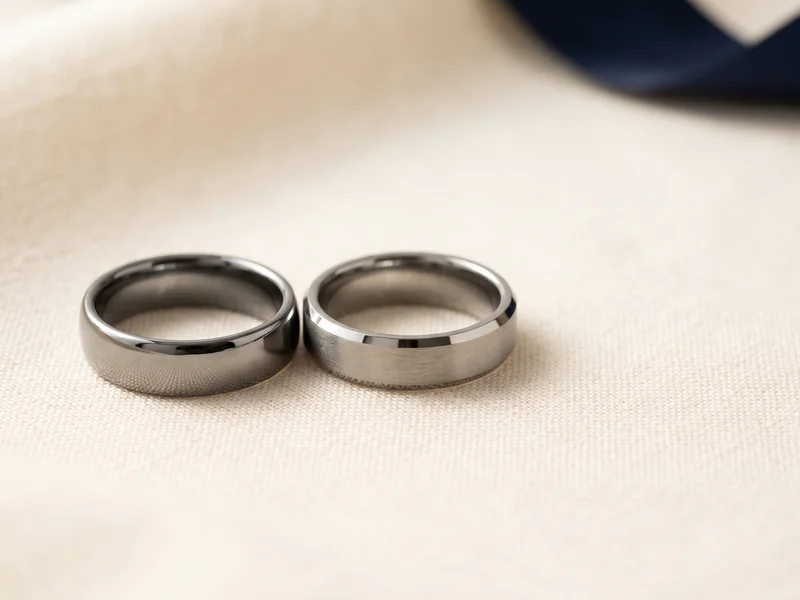 MetalsTungsten Jewellery: Modern Strength, Scratch Resistance & Contemporary Style
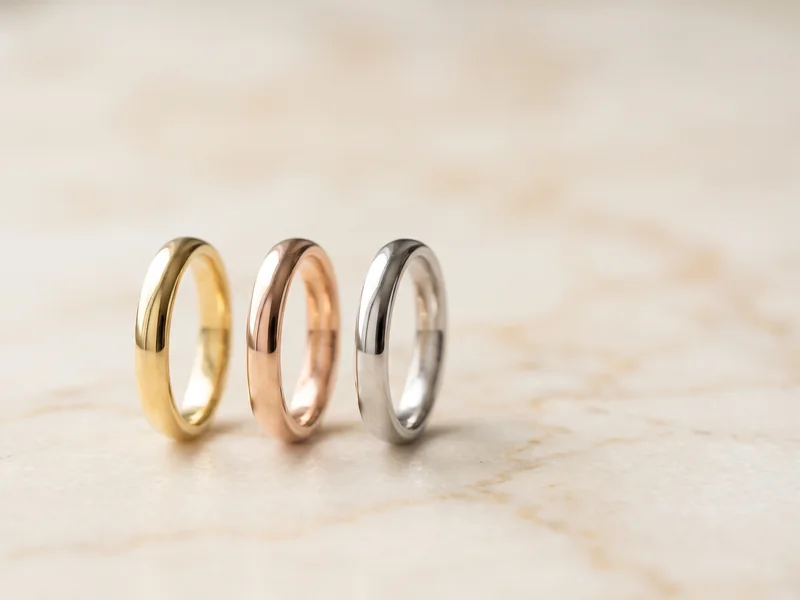 MetalsBest Metal for Wedding BandsMetalsMetal Allergies and Nickel-Free OptionsMetalsBest Metal for Engagement RingsMetalsAustralian Hallmarks and Metal Stamps
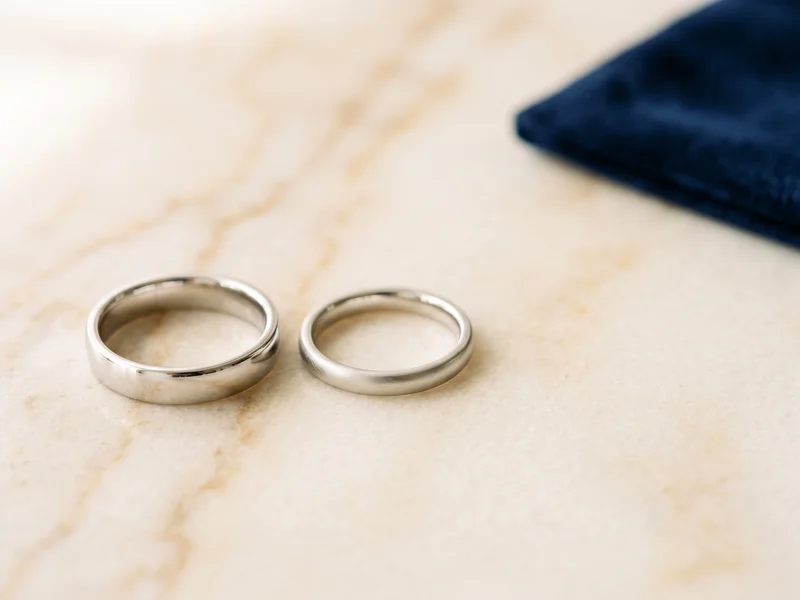 MetalsSilver Tarnish and Patina
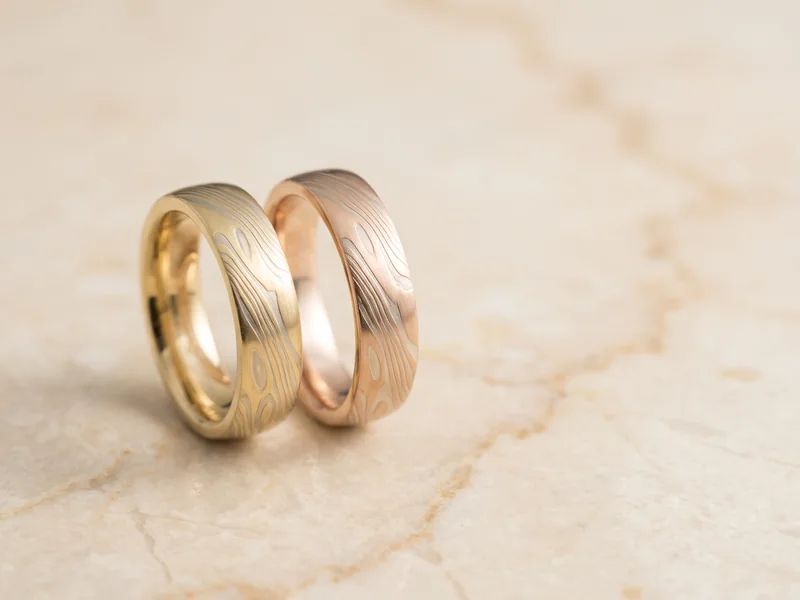 MetalsMokume Gane Rings Melbourne
Explore more
More guides on this topic
Education