
- Education
- Diamond 4Cs & Grading
- Colour vs Clarity: Which Should You Prioritise in a Diamond?
Diamond 4Cs & Grading
Colour vs Clarity: Which Should You Prioritise in a Diamond?
Colour and clarity are the two grades most people trade against each other once the budget is set. Knowing which one you will actually see lets you put the money where it shows.
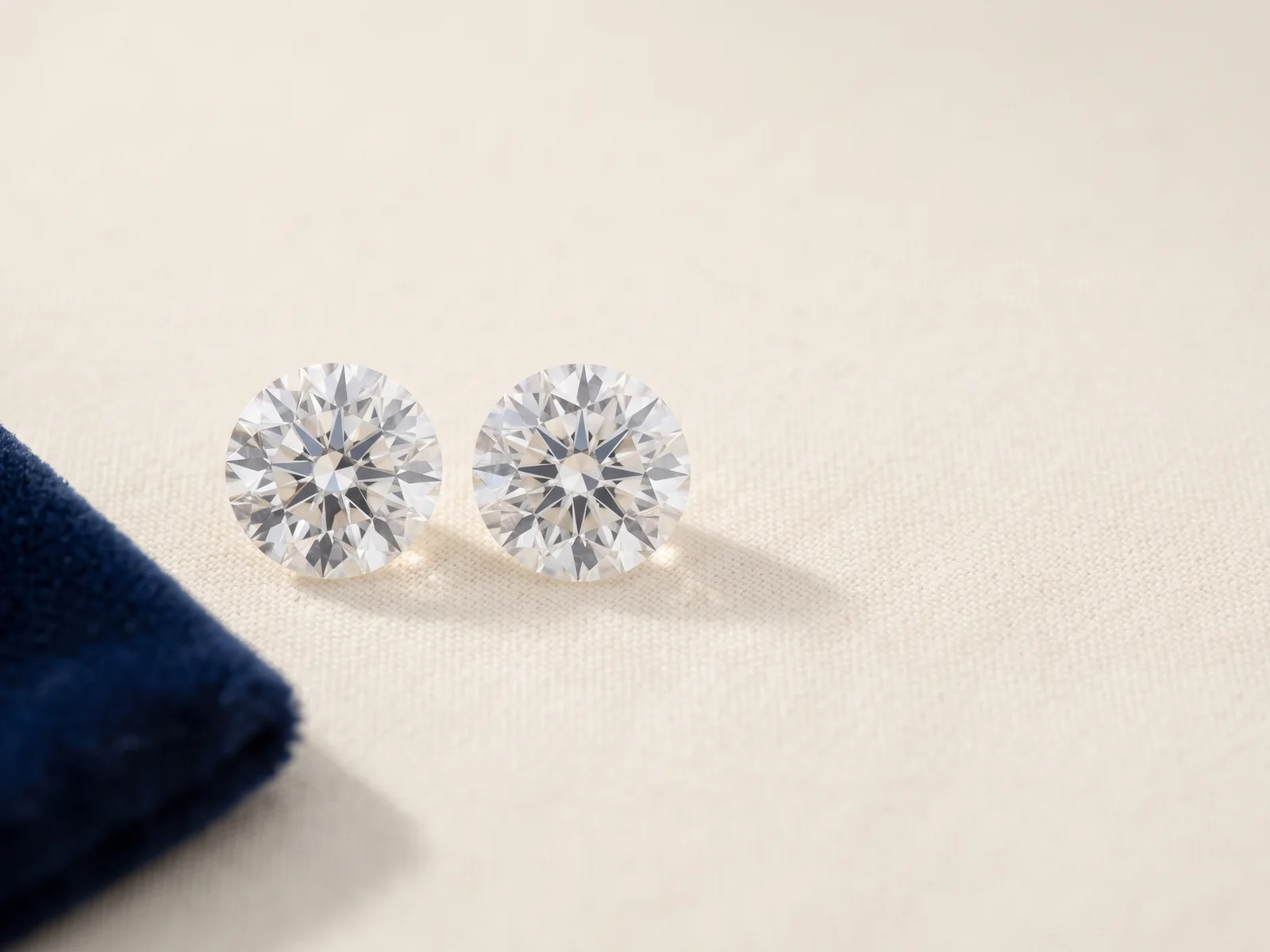
 Reviewed by Raj Sood, Graduate Gemologist (GIA), AJP (GIA)Master jeweller and Graduate Gemologist (GIA) · reviewed 4 November 2026
Quick answer
In the colour vs clarity trade-off, colour usually matters more, because you notice warmth at a glance while most inclusions need 10x magnification. For a round in white metal, aim for G–H colour and an eye-clean VS2 or SI1. Raise clarity for emerald and Asscher cuts; relax colour in yellow or rose gold.
What is the difference between colour vs clarity in a diamond?
Colour and clarity are two of the four Cs, and they measure completely different things. Colour is how much body tint a white diamond has, usually a faint yellow or brown from traces of nitrogen or structural strain. Clarity is how many internal features (inclusions) and surface marks (blemishes) the stone has, and how visible they are.
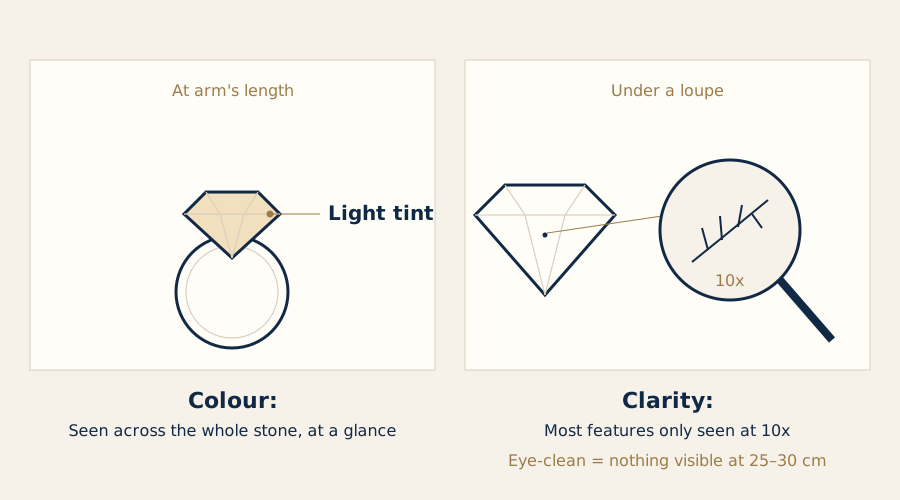
The key difference for your eye: colour is spread through the whole stone, so it affects the look of the diamond all the time, from any distance. Clarity features are usually tiny points or feathers in one spot, and in the higher grades you cannot find them without a loupe. That is why, for most diamonds, a step down in clarity is easier to live with than a step down in colour.
Neither grade measures sparkle. Brightness and fire come from the cut, which is why a well-cut H colour diamond can look livelier than a poorly cut D. Keep cut as your first priority, then balance colour and clarity with what is left.
What does the lab check when grading colour and clarity?
Grading labs such as GIA and IGI grade the two qualities separately, under different conditions. Our full guide to how diamond colour is graded covers the process in detail; here is the short version.
Colour is judged with the diamond face-down on a white tray, under controlled daylight-equivalent lighting, and compared with a set of master stones of known grade. Face-down removes the sparkle that would otherwise mask tint. The scale runs from D (colourless) to Z (light yellow or brown).
| Colour range | Grades | What it means |
|---|---|---|
| Colourless | D, E, F | No tint visible to a trained eye face-up |
| Near colourless | G, H, I, J | Tint only visible face-down or side by side with a whiter stone |
| Faint | K, L, M | Warmth visible face-up, especially in larger stones |
| Very light | N–R | Clear yellow or brown tint |
| Light | S–Z | Obvious tint; beyond Z it becomes a fancy colour |
Clarity is judged face-up at 10x magnification. Graders consider five factors: the size of each feature, the number of features, their position (under the table is worse than near the edge), their nature (crystal, feather, cloud, pinpoint) and their relief (how much they contrast with the diamond). Our explainer on clarity grades from FL to I3 walks through each grade.
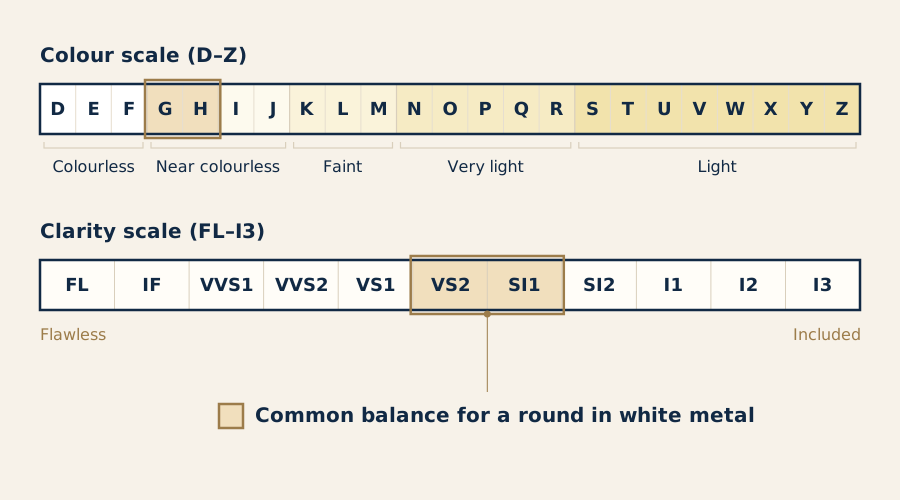
At the very top sit flawless and internally flawless diamonds, which show no inclusions at 10x (flawless stones show no blemishes either). At the bottom, the included I1 to I3 grades have features you can usually see without magnification, and some that may affect durability.
How much do colour and clarity actually change the look?
This is where the report and real life part ways. A report separates every grade, but your eye, at a normal viewing distance with the stone set in a ring, does not. The table below is the honest gemmologist view of what each range looks like once the diamond is on a hand.
| Grade | On the report | On the hand, at normal distance |
|---|---|---|
| D–F colour | Colourless | Icy white; difference between D and F not visible to most people |
| G–H colour | Near colourless | Looks white in white metal; a whisper of warmth beside a D |
| I–J colour | Near colourless | Slight warmth in white metal, especially in fancy shapes; white in yellow or rose gold |
| FL–VVS2 clarity | Minute or no inclusions at 10x | Identical to the eye; only a grader with a loupe sees a difference |
| VS1–VS2 clarity | Minor inclusions at 10x | Eye-clean in almost all rounds and most fancy shapes |
| SI1 clarity | Noticeable at 10x | Often eye-clean, but needs checking stone by stone |
| SI2 clarity | Easily seen at 10x | Sometimes visible face-up, especially in larger or step-cut stones |
The practical line for clarity is eye-clean: no inclusion visible face-up to the unaided eye at about 25–30 centimetres. Beyond that point, paying for higher clarity buys you a better report, not a different-looking diamond. VVS1 stones and VVS2 clarity are lovely to own, but you will not see their extra purity across a dinner table.
Colour behaves differently. There is no single cut-off where it stops mattering, because warmth builds gradually and shows more in some shapes, sizes and metals. Photos also exaggerate it in both directions: bright studio lighting can make a J look whiter than it is, and warm indoor light can make a G look slightly creamy. Always compare stones in the same light.
Colour vs clarity: which should you prioritise?
For most diamonds, prioritise colour until the stone looks white in its setting, then choose the lowest clarity that is still eye-clean. In practice that usually means:
- Round brilliant in white gold or platinum: G colour or H, with VS2 or a checked SI1.
- Elongated fancy shapes (oval, pear, marquise): one grade higher in colour if you are sensitive to warmth, because tint gathers at the ends.
- Step cuts (emerald, Asscher): clarity moves up the list; aim for VS1 or better, because the open facets act like a window.
- Yellow or rose gold: colour can drop to I or J, since the metal warms the stone anyway; spend the difference on carat or cut.
Many people find H colour diamonds the point where colour stops being worth extra money in white metal.
On the clarity side, the VS2 grade is the most common choice because it is almost always eye-clean in a round, while VS1 diamonds give extra margin for step cuts and larger stones.
Not sure which one is right?
Send us the stones you are looking at and our gemologist will tell you which to choose and why.
Does diamond shape change whether colour or clarity matters more?
Yes, quite a lot. Brilliant-cut facets break up light and hide both tint and small inclusions. Step cuts, with long parallel facets, show both more clearly. Shapes with points or long ends concentrate colour where the stone is shallowest.
| Shape | Colour shows | Clarity shows | Typical balance |
|---|---|---|---|
| Round brilliant | Least | Least | G–H, VS2–SI1 |
| Princess, cushion | Moderate (corners) | Low | G–H, VS2–SI1 |
| Oval, pear, marquise | More (at the ends) | Low to moderate | F–G, VS2 |
| Radiant | More | Low | F–G, VS2–SI1 |
| Emerald, Asscher | Moderate | Most | F–H, VS1 or better |
| Heart | More (lobes and point) | Moderate at the point | F–H, VS2 |
Our guide to colour and clarity pairings shape by shape goes deeper, with notes for each of the less common cuts.
Related guideBest Colour and Clarity Combination for Each ShapeHow do carat size and metal colour change the answer?
Size: a larger diamond has a longer path for light to travel, so body colour deepens and inclusions are bigger in absolute terms. A 0.50 carat round at I colour and SI1 can look white and clean, while the same grades at 2 carats may show warmth and a visible crystal. As a rough guide, many people move up one grade in colour and one in clarity once a centre stone passes about 1.5 carats.
Metal: yellow and rose gold reflect warm light into the diamond, which masks tint. That is why I colour stones often look perfectly white in yellow gold but faintly warm in platinum. Some people set a white-metal head (the claws) on a yellow gold band to keep a whiter look around a G or H stone.
Fluorescence: some diamonds glow blue under ultraviolet light. Faint to medium blue fluorescence can make a near-colourless stone (H–K) look slightly whiter in daylight, and it is rarely a problem. Very strong fluorescence occasionally gives a hazy look, so check the stone in person or on video.
When is it worth paying for higher colour or clarity?
Price climbs at every grade, and it climbs fastest at the top. Moving from VS2 to VVS2, or from G to E, often costs more than the visual difference justifies. At the same carat and cut, each colour step in the near-colourless range commonly moves the price by roughly 5–15%, and each clarity step by a similar or slightly smaller amount.
Higher grades make sense when:
- You are choosing a step cut such as an emerald or Asscher, where clarity is genuinely visible.
- The stone is large (around 2 carats or more), where both tint and inclusions are easier to see.
- You simply value knowing the stone is near-perfect, and the budget allows it. That is a personal choice, not a visual one.
- An SI-grade stone has an inclusion near the girdle or a point that could affect durability.
Lower grades can be good value when the inclusion is well placed. Some SI2 diamonds are eye-clean because the features sit near the edge and are hidden by a claw, but they need a careful look at the stone or a 360° video, never the grade alone.
Is the colour vs clarity trade-off different for lab-grown diamonds?
Lab-grown (laboratory-grown) diamonds are real diamonds, and labs such as IGI grade them on the same D–Z and FL–I3 scales (GIA now uses simplified descriptive grades for lab-grown stones). Because they cost much less than natural diamonds, the step up from H to F or from VS2 to VVS2 costs far fewer dollars, so many buyers choose higher grades without compromising on size.
The visual rules do not change: an eye-clean lab-grown VS2 looks the same as an eye-clean natural VS2. Lab-grown stones can show different inclusion types, such as dark metallic flux in some HPHT-grown stones, or a faint brown or grey tint in some CVD-grown stones before treatment. Many CVD stones are post-growth treated to improve colour, and a good report discloses this.
As a rough guide, a 1 carat round at G VS2 with an excellent cut sits in the region of AUD 7,000–12,000 natural and AUD 1,000–2,500 lab-grown, though prices vary widely and lab-grown prices have been falling.
Browse natural and lab-grown diamonds
If you are also weighing up moissanite, which is a different mineral, see how moissanite is graded; its colour scale is not the same as a diamond's.
How to balance colour and clarity: step by step
- Fix the cut first. For a round, choose Excellent (GIA) or Ideal/Excellent (IGI); for fancy shapes, check proportions and a 360° video.
- Choose the metal. White metal: start at G–H colour. Yellow or rose gold: I–J is usually enough.
- Adjust for shape. Go one colour grade higher for elongated shapes and one clarity grade higher for step cuts.
- Adjust for size. Above about 1.5 carats, consider stepping up one grade in each.
- Find the clarity floor. Start at VS2 or SI1 and confirm the stone is eye-clean on video or in person, not just on paper.
- Read the report plot. Check where inclusions sit and whether any are near the girdle or a point.
- Compare in the same light. View short-listed stones side by side, face-up, at arm's length.
New to the terms used here? Our jewellery glossary explains each one in plain English.
Free consultation
Talk to a gemologist
Compare stones in person or online with Raj Sood, Graduate Gemologist (GIA), AJP (GIA).
Book a consultationShop this shape
FAQ
Common questions
Is colour or clarity more important in a diamond?
For most diamonds colour is more important, because tint is visible face-up while most inclusions are only visible under magnification. The exception is step cuts such as emerald and Asscher, where clarity shows more.
Can you tell the difference between G and H colour?
Face-up and set in a ring, most people cannot. The difference is usually only visible face-down or side by side under controlled lighting.
What is the lowest clarity that is still eye-clean?
VS2 is eye-clean in almost all rounds, and many SI1 stones are too. Some SI2 stones can be eye-clean if the inclusions sit near the edge, but each one needs checking.
Is VVS clarity worth it?
VVS1 and VVS2 look identical to VS2 without a loupe. They are worth it only if you value the higher grade itself, or for large step-cut stones.
What colour diamond should I choose for yellow gold?
I or J colour usually looks white in yellow or rose gold, because the metal warms the stone. Paying for D–F colour in yellow gold is rarely visible.
Are lab-grown diamonds graded the same way as natural diamonds?
Mostly. Labs such as IGI grade lab-grown diamonds on the same colour and clarity scales, while GIA now uses simplified descriptive grades for lab-grown stones. Either way, the report states that the stone is laboratory-grown.

Ask a gemologist
Not sure which diamond to choose?
Raj Sood is a Graduate Gemologist (GIA) and master jeweller. Bring the stones you are considering, or send the reports, and he will tell you honestly which one is better and why.
Keep learning
Related guides
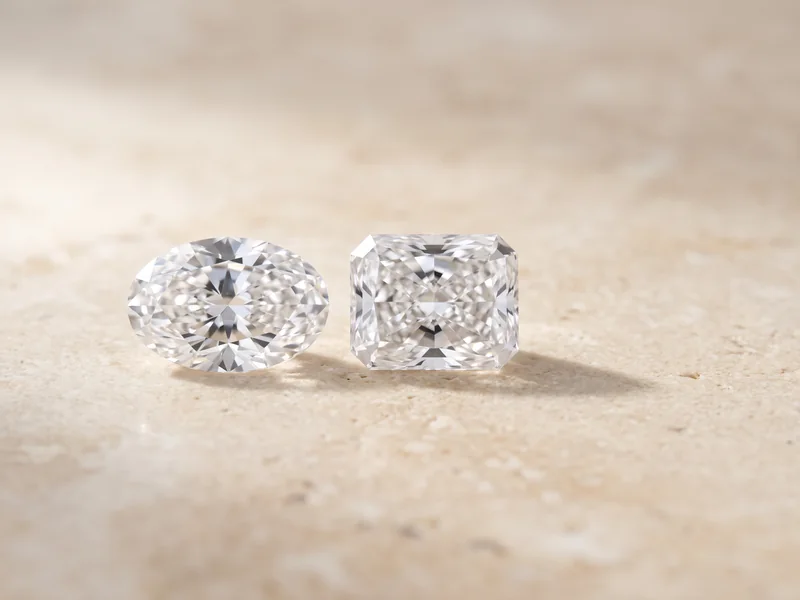 Diamond 4Cs & GradingBest Colour and Clarity Combination for Each Shape
 Diamond 4Cs & GradingDiamond Colour Grading
 Diamond 4Cs & GradingUnderstanding Diamond Clarity Grades: FL to I3 ExplainedDiamond 4Cs & GradingDiamond 4Cs
 Diamond 4Cs & GradingVS2 Clarity Diamonds
 Diamond 4Cs & GradingVS1 Clarity DiamondsDiamond 4Cs & GradingVVS2 Clarity DiamondsDiamond 4Cs & GradingVVS1 Clarity Diamonds
Explore more
More guides on this topic
Education