
- Education
- Diamond 4Cs & Grading
- Bearding in Diamonds: What a Bearded Girdle Means for Clarity and Durability
Diamond 4Cs & Grading
Bearding in Diamonds: What a Bearded Girdle Means for Clarity and Durability
Bearding in diamonds is one of the most common clarity characteristics on a grading report, and one of the least understood. Here is what it is, how it gets there, and when it is worth worrying about.
 Reviewed by Raj Sood, Graduate Gemologist (GIA), AJP (GIA)Master jeweller and Graduate Gemologist (GIA) · reviewed 4 November 2026
Quick answer
Bearding in diamonds is a fringe of tiny hair-like feathers running from the girdle into the stone, caused when the girdle is ground round during cutting. Minor bearding is common, rarely visible to the eye and has little effect on durability. Heavy bearding can lower the clarity grade, look grey around the edge and weaken the girdle.
What is bearding in diamonds?
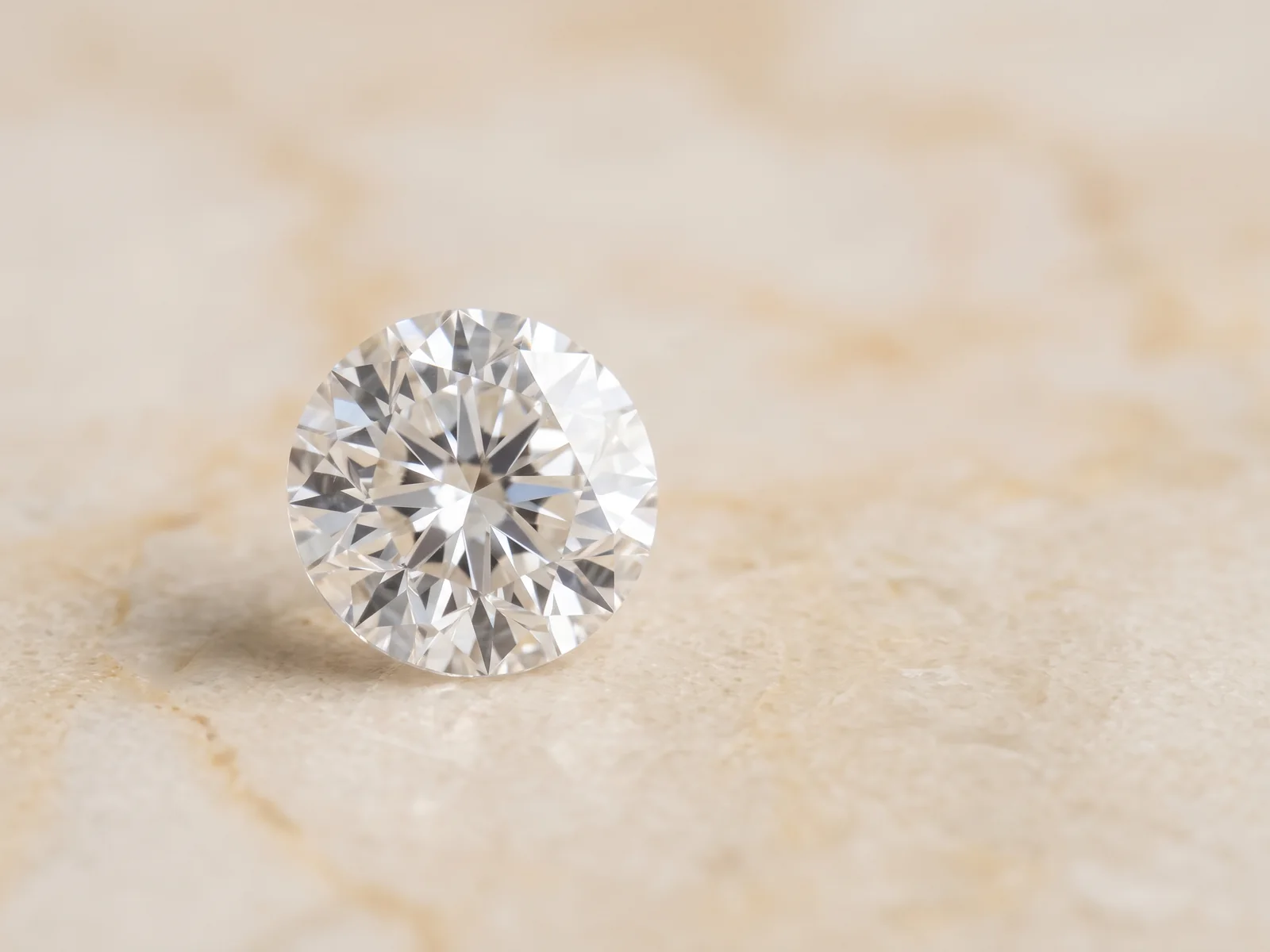
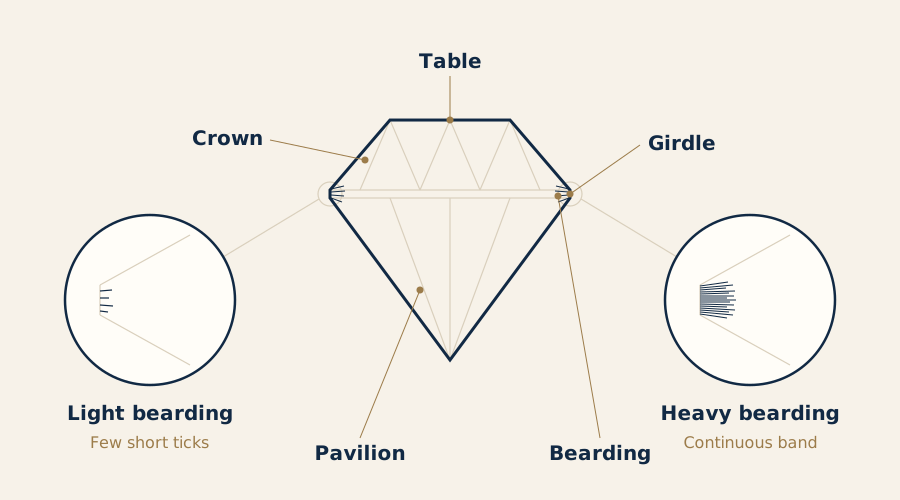
Bearding is a type of inclusion (an internal clarity characteristic) made up of tiny, hair-like feathers that run from the girdle, the thin outer edge where the top of the diamond (the crown) meets the underside (the pavilion), a short distance into the stone. Under a loupe it looks like fine whiskers or a fuzzy fringe around the edge, which is why the trade also calls it a bearded girdle or a girdle fringe. A feather is simply a small break inside a diamond; bearding is many very small feathers lined up along the edge.
Bearding is one of the features graders record when they assess clarity, one of the 4Cs of diamond grading. It is common, usually minor and almost always made by people rather than by nature. Crystals, clouds and most feathers form deep in the earth (or in the growth chamber, for lab-grown stones), but bearding appears when the diamond is being cut. Where a beard sits and how far it reaches inward decide whether it matters at all.
Clarity is graded at 10× magnification, the standard loupe power. At that level, light bearding on a well-cut round often looks like a faint grey line or a few short ticks along the edge. Heavy bearding looks like a continuous furry band right around the stone. Our guide to clarity grades from FL to I3 explains how features like this map to each grade, and the jewellery glossary of grading terms covers crown, girdle and pavilion if those words are new to you.
How does bearding form during cutting?
After a rough diamond is sawn or cleaved, the cutter gives it a round outline by bruting. Traditionally that meant spinning the stone on a lathe and grinding its edge against another diamond; today it is often done with a laser or a computer-controlled bruting machine. Diamond is the hardest natural material, 10 on the Mohs scale, but hardness is not toughness. Diamond is brittle and has four directions of cleavage (planes along which it can split cleanly). If the edge is bruted too fast or with too much pressure, it is bruised, and tiny fractures run inward from the girdle along those weak directions. Those fractures are the beard.
The usual causes are:
- Speed and pressure: pushing the stones together too hard or turning them too fast while bruting.
- Hand bruting: older diamonds were rounded by hand, where control was harder, so bearding is common in antique stones.
- Strained or knotted rough: crystals with internal stress or twinned areas bruise more easily at the edge.
- A thin girdle: a very thin edge has less material to absorb the grinding, so fractures run further in.
Because traditional bruting was done by hand, bearding turns up often in old mine and Old European cut diamonds. Modern laser girdling and automated bruting have made heavy bearding much less common in newly cut stones, though it has not disappeared. Bearding is related to other features made at the cutting wheel: burn marks and lizard skin left by polishing are surface marks from heat and grain direction, while bearding reaches inside the stone. After bruting, many girdles are polished or faceted, which can remove light bearding; the finish of the girdle also feeds into how polish and symmetry are graded, which is a separate assessment from clarity.
How is bearding shown on a GIA report plot?
A full grading report from GIA, IGI or a similar laboratory includes a clarity plot: a drawing of the diamond's crown and pavilion with each clarity characteristic marked in its position. By convention, inclusions are drawn in red and blemishes (features only on the surface) in green. Bearding is an inclusion, so it is drawn in red, usually as short hair-like strokes at the girdle outline, at the clock positions where it occurs.
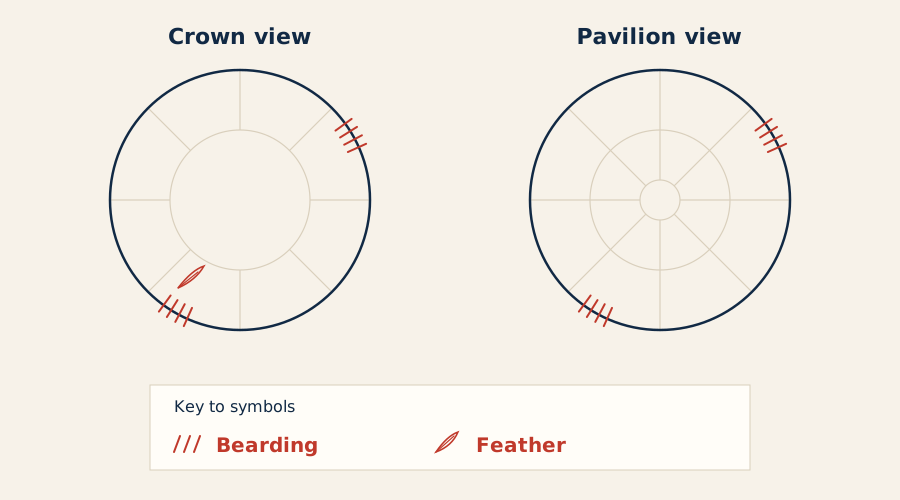
When you read the plot for bearding, look at four things: whether 'Bearding' appears in the key to symbols, how many places it is marked, how much of the outline it covers, and the comments box. Grading labs do not always draw every minute feature, and some reports note in the comments that minor characteristics are not shown, so read the comments as well as the drawing. Other features have their own symbols: laser drill holes, for example, are marked separately and noted in the comments, because they are a treatment that must be disclosed.
| What the plot shows | What it usually means | Worth a closer look? |
|---|---|---|
| A few red ticks at the girdle | Minor, localised bearding | Rarely; it is seldom the feature that sets the grade |
| Red strokes most of the way round | Extensive bearding | Yes: check magnified photos of the girdle |
| Bearding listed first among the characteristics | It may be one of the grade-setting features | Yes: ask how deep it reaches |
| Bearding marked next to a feather | A beard joined to a larger break | Yes: ask a gemmologist about durability |
Does bearding affect a diamond's clarity grade?
It can, but usually only a little. A grader judges every characteristic by its size, number, position, nature and relief (how much it stands out from the surrounding diamond), and bearding is judged the same way. Flawless and Internally Flawless diamonds have no inclusions visible at 10×, so visible bearding rules those grades out. Minute bearding, found only with effort at 10×, is compatible with very high grades such as VVS. Moderate bearding can be the feature that sets a VS or SI grade. Heavy bearding that circles the stone or reaches well inside can pull a diamond down to SI2 or into the I (included) grades.
| Bearding level | What you see at 10× | Typical effect on clarity | Durability concern |
|---|---|---|---|
| Minute | A few faint ticks, hard to find | Compatible with VVS–VS | Negligible |
| Light | Short whiskers at several points | Often present in VS–SI stones, rarely the main feature | Very low |
| Moderate | Fuzzy band over part of the girdle | Can set an SI grade | Low, unless joined to a larger feather |
| Heavy | Continuous grey fringe all round | SI2 to I grades | Higher, especially with a thin girdle |
Because it sits at the edge, bearding is usually a less serious feature than an inclusion of similar size under the table (the large flat top facet), where your eye goes first. That is why two SI1 diamonds can look very different: one may be SI1 because of a dark crystal in the centre, the other because of bearding you will never notice once it is set. The grade alone does not tell you which, but the plot does.
Related guideUnderstanding Diamond Clarity Grades: FL to I3 ExplainedNot sure which one is right?
Send us the stones you are looking at and our gemologist will tell you which to choose and why.
Is bearding in diamonds visible to the naked eye?
Usually not. Bearding sits at the very edge of the stone, where the crown facets bend light and where a claw, bezel or halo often covers part of the girdle. Light and moderate bearding is almost never seen at a normal viewing distance of about 25–30 cm, so most bearded diamonds still count as eye-clean, meaning no inclusions you can see without magnification. Our guide to what eye-clean really means in practice explains how that judgement is made.
The exception is a heavy bearding diamond. When fine feathers run all the way round, they scatter light and can give the outline a soft, frosted grey look. Seen through the crown, that grey rim can reflect into the stone, so the edge looks duller than the centre. This is not body colour. The warm tint of a J colour diamond, a K colour stone with its light warm tint or faint yellow L and M diamonds is spread evenly through the stone, while a beard is greyish and confined to the rim. Strong blue fluorescence can occasionally make a diamond look slightly hazy too, but that haze covers the whole stone, not just the girdle.
You are more likely to notice bearding when:
- It is heavy and continuous around the whole girdle.
- The setting leaves most of the girdle exposed, such as a fine four-claw solitaire.
- You look at the stone from the side, where the girdle is seen edge-on.
- The diamond is large, roughly 2 carats and up, so the girdle is longer and more of it shows.
Is a bearded girdle a durability risk?
For minute and light bearding, the answer is no in normal wear. The feathers are tiny and shallow and do not spread on their own. The concern is heavier bearding, because the girdle is the part of a diamond most exposed to knocks, and every feather is a small break. Many fine breaks lined up along the edge can behave a little like a perforated line: a hard knock on that spot, or uneven pressure from a claw being tightened, can let a small chip break away.
The risk goes up when bearding is combined with:
- A thin or extremely thin girdle: the report lists girdle thickness; a thin edge has less material behind the beard.
- A larger feather: a beard joined to a feather that reaches deeper or breaks the surface.
- Claw placement: a claw sitting directly on the heaviest bearding concentrates pressure there.
- Points and corners: in fancy shapes such as pears, marquises and princess cuts, bearding at a point or corner matters more than along a curved edge.
- Hard daily wear: rings worn for gardening, gym work or trade jobs take more knocks on the edge.
Bearding does not grow by itself over time; it only gets worse if the girdle takes an impact. Ultrasonic cleaning is generally fine for diamonds with minor bearding, but if a stone has heavy bearding or a feather reaching the surface, ask a jeweller before using an ultrasonic or steam cleaner, as vibration and heat can stress an existing break.
Bearding vs feather: how is it different from other inclusions?
Bearding is easy to confuse with other features on a plot or in a photo. The simplest test: if it starts at the girdle and looks like whiskers pointing inward, it is bearding; a single larger break anywhere else in the stone is a feather.
| Feature | Where it sits | How it forms | Inclusion or blemish | Durability concern |
|---|---|---|---|---|
| Bearding | At the girdle, reaching inward | Bruting during cutting | Inclusion | Low unless heavy |
| Feather | Anywhere in the stone | Stress during growth, or later damage | Inclusion | Depends on size and whether it reaches the surface |
| Twinning wisp | Along a twinning plane, often near the centre | Distorted growth as the crystal formed | Inclusion | Generally low |
| Etch channel | A tube running in from the surface | Natural dissolution in the earth | Inclusion | Low to moderate |
| Internal graining | Lines or planes through the stone | Irregular crystal growth | Inclusion when internal | None |
| Laser drill hole | A fine tunnel from the surface | Treatment to reach a dark inclusion | Inclusion (a treatment) | Low; must be disclosed |
| Pit or extra facet | On the surface | Small damage or polishing | Blemish | None to very low |
Each of these has its own guide. Twinning wisps form along growth planes deep inside the crystal, while etch channels carved by natural dissolution run in from the surface as hollow tubes. Internal graining is a growth feature with no effect on durability. On the surface, pits and extra facets are blemishes that sometimes sit right at the girdle too, and a girdle with both bearding and small nicks is worth checking closely.
Do lab-grown diamonds have bearding too?
Yes, they can. Bearding comes from cutting, not from where the crystal grew, so bearding in lab-grown diamonds looks exactly the same as in natural stones. Laboratory-grown diamonds, made by the CVD (chemical vapour deposition) or HPHT (high pressure, high temperature) method, are real diamond: 10 on the Mohs scale with a refractive index of about 2.42, and they bruise in the same way if the girdle is bruted badly. Many lab-grown diamonds are cut on modern laser and automated equipment, so heavy bearding tends to be less common in them than in older natural stones, but it is not unknown.
What differs is the rest of the inclusion picture. Natural diamonds can show crystals, clouds, twinning wisps and etch channels formed in the earth. Lab-grown diamonds can show metallic flux inclusions (HPHT) or dark pinpoints and growth lines (CVD). Bearding is recorded and plotted the same way on reports from IGI and GIA for both, and the report will always state clearly whether the diamond is natural or laboratory-grown.
Browse natural and lab-grown diamonds
Can bearding be removed from a diamond?
Usually, yes. Because bearding sits only at the edge, a diamond cutter can often remove it by re-bruting or re-polishing the girdle, or by faceting it. The stone loses a little weight, often a few points (hundredths of a carat) for light bearding and more if the beard runs deep. The diameter also shrinks slightly, which can change the proportions and, on a round, occasionally the cut grade. If the beard was a grade-setting feature, clarity may improve, and a new report is needed to show any change.
Recutting is most worth considering when:
- An older diamond with heavy bearding is being remodelled into a new setting anyway.
- The girdle already has a small chip or nick next to the bearding.
- The bearding is joined to a feather that a cutter can polish away safely.
For most minor bearding, leaving it alone is the sensible choice. The durability risk is low, it is rarely visible, and every recut costs weight and time with the cutter.
How to check a diamond for bearding: step by step
- Read the key to symbols. See whether 'Bearding' is listed, and where it sits among the clarity characteristics.
- Find it on the plot. Note the clock positions and how much of the girdle outline is marked in red.
- Read the comments. Check whether minor characteristics are not shown, and whether any treatment is noted.
- Check the girdle thickness. A thin or extremely thin girdle with heavy bearding deserves extra care.
- Ask for magnified photos. A 10× face-up image and a side view of the girdle show how deep the beard runs.
- Look face-up at arm's length. Check whether the rim looks grey or frosted compared with the centre.
- Plan the setting. Keep claws off the heaviest bearding, or choose a bezel or halo that protects the edge.
For the other clarity characteristics and grading topics, see the rest of our diamond education library.
Free consultation
Talk to a gemologist
Compare stones in person or online with Raj Sood, Graduate Gemologist (GIA), AJP (GIA).
Book a consultationShop this shape
FAQ
Common questions
Is bearding in diamonds bad?
Usually not. Minor bearding is common, rarely visible and has little effect on durability. Heavy bearding that circles the stone can lower the clarity grade, give the edge a grey look and weaken a thin girdle.
Does bearding affect clarity?
It can. Minute bearding is compatible with VVS grades, moderate bearding can set a VS or SI grade, and heavy bearding can pull a stone to SI2 or the I grades.
Can you see bearding without a loupe?
Light and moderate bearding is almost never visible to the naked eye. Heavy, continuous bearding can sometimes show as a soft grey or frosted rim around the girdle.
Does bearding make a diamond more likely to chip?
Minor bearding does not in normal wear. Heavy bearding, especially with a thin girdle or a claw sitting on it, makes that part of the edge more vulnerable to a knock.
Can bearding be polished out?
Often, yes. A cutter can re-polish or facet the girdle to remove it, at the cost of a little weight and diameter, and a new report would be needed to record any clarity change.
Do lab-grown diamonds have bearding?
They can, because bearding comes from cutting rather than growth. Lab-grown diamonds cut on modern equipment tend to show it less often, and reports plot it the same way for natural and lab-grown stones.

Ask a gemologist
Not sure which diamond to choose?
Raj Sood is a Graduate Gemologist (GIA) and master jeweller. Bring the stones you are considering, or send the reports, and he will tell you honestly which one is better and why.
Keep learning
Related guides
 Diamond 4Cs & GradingTwinning Wisps in DiamondsDiamond 4Cs & GradingEtch Channels in Diamonds
 Diamond 4Cs & GradingUnderstanding Diamond Clarity Grades: FL to I3 ExplainedDiamond 4Cs & GradingEye Clean DiamondsDiamond 4Cs & GradingDiamond 4CsDiamond 4Cs & GradingGraining in Diamonds
 Diamond 4Cs & GradingLaser Drill Holes in DiamondsDiamond 4Cs & GradingPits and Extra Facets on Diamonds
Explore more
More guides on this topic
Education