
- Education
- Wedding Bands & Eternity
- Choosing a Wedding Band for a Cushion Engagement Ring: Flush, Gap, Width and Metal
Wedding Bands & Eternity
Choosing a Wedding Band for a Cushion Engagement Ring: Flush, Gap, Width and Metal
A cushion cut sits taller than many shapes and is often set in a halo, so finding the right wedding band for a cushion engagement ring takes a little planning. Here is how to get the fit, width and metal right the first time.
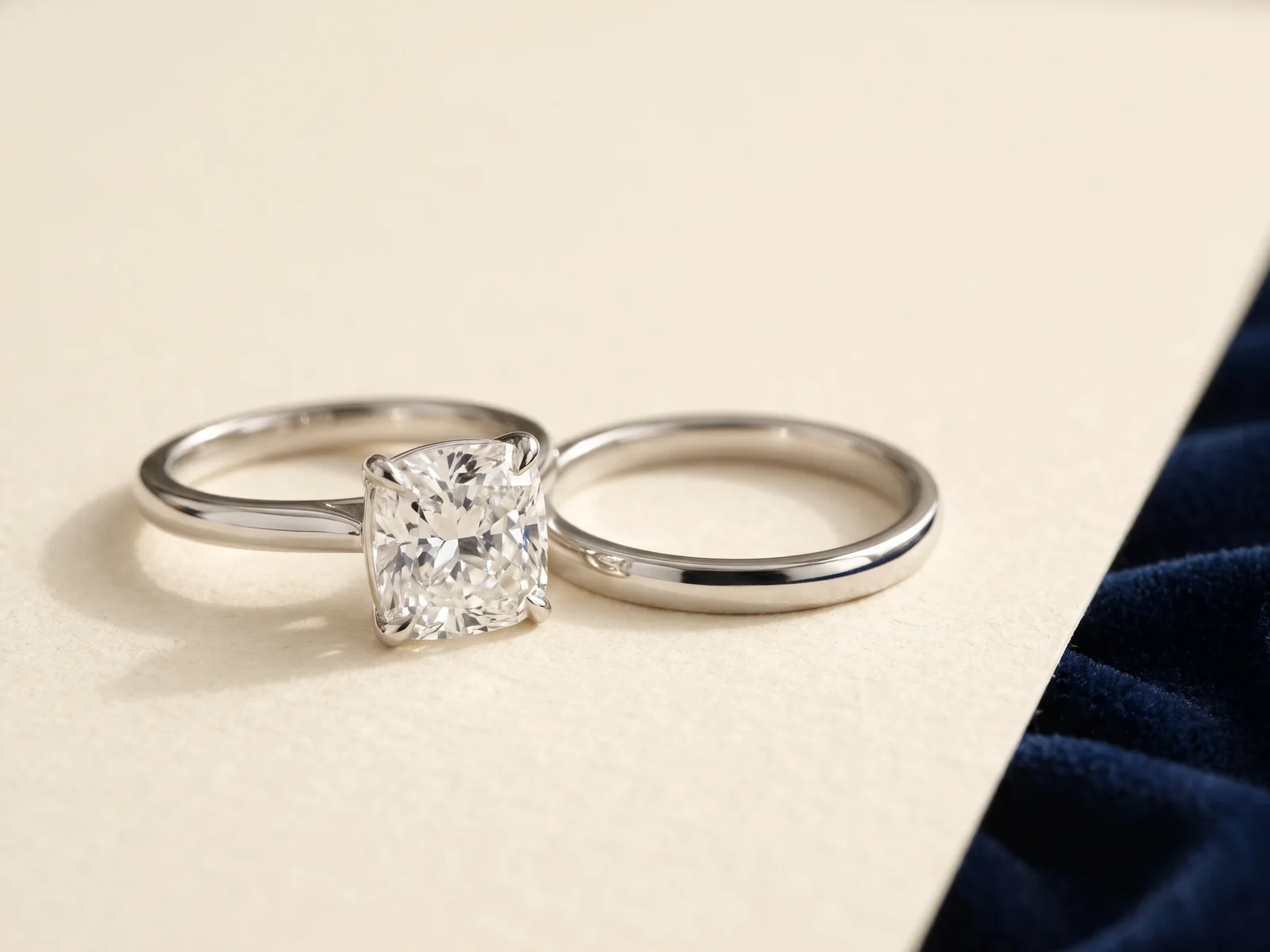
 Reviewed by Raj Sood, Graduate Gemologist (GIA), AJP (GIA)Master jeweller and Graduate Gemologist (GIA) · reviewed 4 November 2026
Quick answer
The best wedding band for a cushion engagement ring depends on the setting. A low-set solitaire or bezel usually takes a straight band of about 1.8–2.5 mm sitting flush. A halo, hidden halo or high basket usually needs a contoured or notched band, or a deliberate gap. Match the metal so both rings wear evenly.
What is the best wedding band for a cushion engagement ring?
A cushion cut is a square or slightly rectangular diamond with rounded corners and gently curved sides, a modern descendant of the old mine cut. Most are either cushion brilliants, with larger, chunkier facets, or cushion modified brilliants, sometimes called crushed ice for their busier, more scattered sparkle. When you are choosing a wedding band for a cushion engagement ring, the cut itself matters less than the way it is held: the claws, the basket under the stone, any halo, and how high it all sits above the finger.
That is why there is no single best band for every cushion. The right choice is the one that sits where you want it, either flush against the engagement ring or with a small, even gap, in a width and metal that balance the centre stone. If you are new to the terminology, start with the difference between a wedding ring and a wedding band, and our complete wedding ring buying guide covers sizing, budgets and timing. Any unfamiliar word on this page is also explained in the GemTrove jewellery glossary.
Cushions bring two particular challenges. First, many are cut deep, often with a total depth of about 61–70% (depth divided by width), so the stone sits taller and its claws or basket reach down towards the finger. Second, cushions are very often set in a halo (a ring of small diamonds around the centre) or a hidden halo (a row of small diamonds tucked under the stone, visible from the side). Both can stop a straight band from touching the engagement ring. Square cushions, with a length-to-width ratio of about 1.00–1.05, and elongated cushions, at about 1.10–1.30, also pair a little differently, which we cover in the width section.
Should a wedding band sit flush or with a gap beside a cushion?
A flush fit means the wedding band touches the engagement ring along its whole length, so the two read as one continuous line of metal. A gap is the space, usually about 1–3 mm under the centre stone, that appears when the setting overhangs the shank (the band of the ring that goes around the finger) and stops a straight band from sliding all the way up.
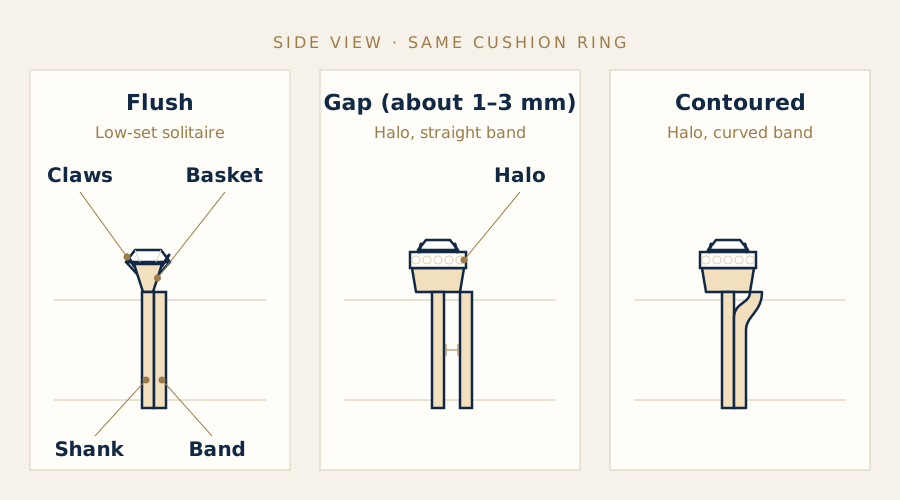
| Flush straight band | Contoured or notched band | Straight band with a gap | |
|---|---|---|---|
| How it looks | One continuous line of metal | Seamless; the band hugs the setting | Two separate rings with a visible space |
| Suits | Low-set solitaires, bezels, bridal-fit settings | Halos, hidden halos, low baskets, wide claws | Any setting, including high halos |
| Wear and rubbing | Rings touch evenly along the length | Contact concentrated where the curve meets the setting | Rings can spin and knock together |
| Flexibility later | Pairs with most future bands | Made to fit one engagement ring | Easy to swap or add bands |
| Approximate cost, plain 18ct gold, about 2 mm | about $700–$1,500 | about $900–$2,000 | about $700–$1,500 |
Neither look is wrong. People who like a gap often say it lets each ring read on its own, and it leaves room to change bands over the years. People who prefer flush like the tidy, single-piece look and the fact that the rings do not slide apart. What matters is that a gap looks intentional: an even space under the stone looks designed, while a gap that is wider on one side, or a band that tilts because it is resting on a claw, looks accidental.
The shape of the band's cross-section also changes how it meets the setting. A flat band presents a square edge to the engagement ring, a court (rounded) band touches at a single curved line, and a knife-edge band meets it at a narrow ridge. Our guide to flat, court and knife-edge band profiles shows how each one looks side by side.
Which cushion settings let a straight wedding band sit flush?
The quickest way to predict the fit is to look at your engagement ring from the side, at finger level. If any part of the setting, whether a claw, the basket, a halo or a gallery rail, sits lower than the top of the shank, a straight band will stop against it. This table sums up the usual result for common cushion settings.
| Cushion setting | Will a straight band sit flush? | Usual answer |
|---|---|---|
| Low-set four-claw solitaire | Often yes | Straight band, about 1.8–2.5 mm |
| Double-claw (eight-claw) solitaire | Sometimes; corner claws can overhang | Straight band or a small notch |
| Cathedral (shoulders rise up to the head) | Usually yes; the band sits under the arches | Straight band |
| Bezel or half-bezel | Depends on how low the metal rim sits | Straight band or a gentle curve |
| Hidden halo | Often no | Contoured band, or a bridal-fit setting |
| Classic halo | Rarely | Contoured or notched band, or a gap |
| Three-stone with side stones | Usually no | Contoured band or a gap |
If you have not made the engagement ring yet, you can design it as a bridal-fit (also called wedding-fit) setting. The head (the part holding the stone) is raised just enough, and the basket kept narrow enough, that a straight band slides underneath and sits flush. It is one of the simplest ways to keep your band options open, because almost any straight band will then pair with it.
Claw position matters too. A cushion with four claws at the corners sits with those claws projecting slightly beyond the outline, and a deep cushion pushes them lower. A compass setting, with claws at the middle of each side rather than the corners, leaves the rounded corners exposed; that is less of a risk on a cushion than on a sharp-cornered shape, and it often lets a band sit a fraction closer. Halos, especially, change the picture, so if yours has one, see our advice on fitting bands around halo settings.
Related guideBest Wedding Band for Halo Engagement RingsWhat is a contoured wedding band for a cushion ring?
A contoured band (also called a curved or shaped band) dips around the outline of the halo or the setting, so it can sit flush even when a straight band cannot. A notched band is a straight band with a small U- or V-shaped cut-out where the setting sits, so it looks straight on either side. For a cushion, the curve should follow the soft, rounded-square outline, which usually means a broad, shallow U rather than the sharp V used for bands that frame a pear shaped stone or the long double curve of bands that wrap around a marquise.
- Custom contour: built from a scan or CAD model of your exact engagement ring, so the curve follows its edge closely, typically leaving well under 1 mm of space.
- Ready-made curved band: a generic curve. It may fit, but it rarely matches a particular halo exactly and can leave small gaps at the ends of the curve.
- Notched band: a straight band with a cut-out. Good if you want a mostly straight look and the setting only overhangs in one small area.
- Enhancer or ring wrap: a band that curves around the stone on both sides, sometimes as two bands joined into one piece. It adds a lot of visual weight.
- Open or split band: two thin bands joined at the ends, leaving a space the setting sits into. Light and modern.
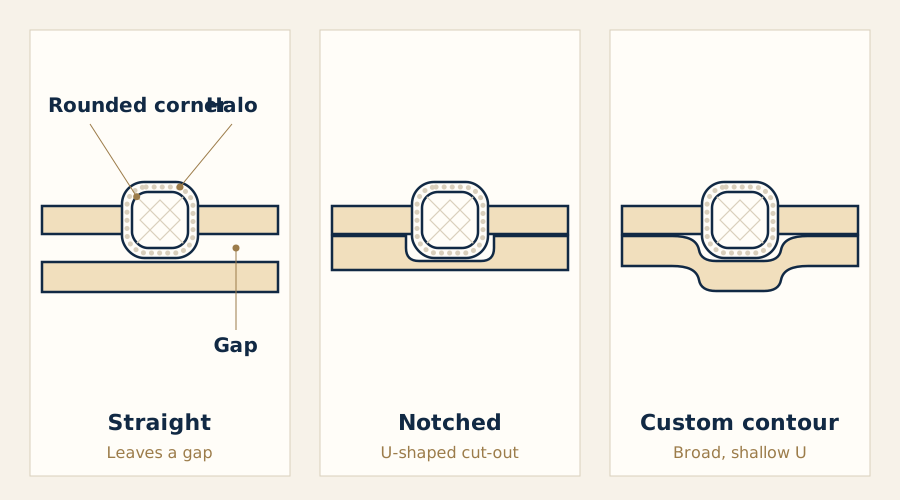
The trade-off is flexibility. A contour band is made for one engagement ring, so if you later reset the centre stone or change the halo, it may no longer fit. It can also look a little unusual worn on its own, though many people like the curve. Some couples have the two rings soldered (permanently joined) once the wedding is over, which stops them rubbing, but it means both must be resized together. Rings that combine two centre stones raise similar questions, covered in our guide to pairing bands with toi et moi designs.
Not sure which one is right?
Send us the stones you are looking at and our gemologist will tell you which to choose and why.
What width wedding band suits a cushion engagement ring?
The simplest rule is to match the width of the engagement ring's shank, or go slightly narrower. A band much wider than the shank draws the eye away from the cushion and can make it look smaller, while a very thin band beside a large cushion can look spindly. Width is measured across the top of the band, from edge to edge, in millimetres.
| Cushion size (approx. face-up width) | Typical engagement ring shank | Band width that usually balances |
|---|---|---|
| Under 0.75 ct (up to about 5.5 mm) | 1.5–2.0 mm | 1.5–2.0 mm |
| 0.75–1.50 ct (about 5.5–7.0 mm) | 1.8–2.5 mm | 1.8–2.5 mm |
| 1.50–2.50 ct (about 7.0–8.5 mm) | 2.0–3.0 mm | 2.0–3.0 mm |
| 3 ct and above (about 8.5 mm+) | 2.5–3.5 mm | 2.5–3.5 mm, or two thinner bands |
Shape within the cushion family also plays a part. An elongated cushion already looks longer on the finger, and a slightly narrower band keeps that length in proportion. A square cushion is broad, so it can carry a slightly wider band, or two thin bands either side. Finger size matters as well: on smaller fingers (around Australian size H to K) the same band takes up more of the visible finger, so many people go about 0.2–0.5 mm narrower. Square shapes with sharp corners follow slightly different rules, as our guides on bands for princess cuts and their pointed corners and asscher cut band pairing explain.
Do not forget thickness, the measurement from the outside of the band to the inside. For a band worn every day, about 1.5–1.8 mm thick is a sensible minimum; thinner bands, especially in 18ct gold, can bend out of round over time. A wedding band for a cushion cut engagement ring should also be the same thickness as, or close to, the engagement shank, so the two sit level rather than one standing proud of the other.
Should your wedding band match the engagement ring metal?
In most cases, yes. Matching metals look consistent and, just as importantly, wear at the same rate where the rings rub together. Each common metal behaves a little differently over the years:
| Metal | Colour over time | Upkeep | Notes |
|---|---|---|---|
| Platinum 950 | Stays naturally white; develops a soft grey patina | Polish as needed | Dense and heavy; metal tends to move rather than wear away |
| 18ct white gold | Usually rhodium plated; may show a faint warm tone as plating wears | Replating roughly every 1–2 years on a daily ring | Lighter than platinum; bright white when plated |
| 18ct yellow gold | Stays warm yellow | Polish as needed | Flatters warmer cushion colours |
| 18ct rose gold | Stays pink; may deepen slightly | Polish as needed | Copper content gives the colour |
| 9ct gold | Stable colour | Polish as needed | Lower gold content and lower cost; can tarnish slightly over time |
Mixing metals is perfectly fine for looks: a yellow gold band beside a platinum cushion setting is a popular contrast. The practical catch is wear. Where two different alloys rub together every day, the softer one can wear faster, and a diamond-set band will slowly abrade any metal it touches, because diamond (10 on the Mohs scale) is far harder than any jewellery metal. It is worth checking claws and the inside edges of both rings at least once a year. Our comparison of platinum, white gold, yellow gold and rose gold for wedding bands goes into the detail, and if your partner is choosing a matching band, the guide to men's wedding bands covers wider widths and alternative metals.
How do you stack rings with a cushion engagement ring?
A cushion is one of the easier shapes to stack once the fit is sorted, because its rounded corners do not catch neighbouring bands the way sharp corners can. A few combinations people often choose:
- The classic pair: a low four-claw cushion solitaire with a plain 2 mm court band in the same metal, sitting flush.
- Matching pavé: a cushion with a pavé shank (tiny diamonds set close together in the band) and a matching 1.8–2 mm pavé wedding band, so the sparkle continues across both rings.
- Halo and contour: a cushion halo with a custom contoured diamond band that follows the halo's outline.
- The sandwich: an eternity or half-eternity band either side of the engagement ring, often one at the wedding and one added for an anniversary.
- Vintage pairing: milgrain (a fine beaded edge) or hand-engraved bands beside an antique-style or old mine cushion.
- Mixed metals: a platinum cushion setting with a yellow or rose gold band for contrast.
- Elongated emphasis: an elongated cushion with a fine, slightly curved band that draws the eye along the length of the finger.
An eternity band with a cushion engagement ring works best when the band's diamonds are similar in colour to the centre stone, and when the claws on the band are low enough not to rub the engagement ring's basket. A full eternity band (diamonds all the way around) cannot easily be resized, so confirm your ring size carefully first.
Which ring goes first is personal. A common tradition is to wear the wedding band closest to the hand, under the engagement ring, but plenty of Australians wear it on top or on the other hand altogether. If you are comparing cushions with other shapes, our pairing guides for round brilliant engagement rings, oval engagement rings and their curves, step-cut emerald engagement rings and radiant cuts, the cushion's closest relative show how the advice shifts from shape to shape.
Does a natural or lab-grown cushion change the wedding band choice?
Not for the fit. Lab-grown diamonds are real diamond, grown in a laboratory rather than mined, with the same hardness (10 on the Mohs scale) and refractive index (about 2.42) as natural diamond. They sit in a setting, and against a band, in exactly the same way. A lab-grown cushion usually costs much less than a natural cushion of the same size and grades, and some couples put part of that difference towards a diamond-set band.
Where it can matter is colour matching. Small diamonds in wedding bands are often around F–G colour. Beside a natural cushion in, say, I or J colour, very white band diamonds can make the centre look slightly warmer by contrast; beside a G-colour centre they blend. You can pair a lab-grown centre with natural or lab-grown band diamonds, or the other way round; whichever you choose, each should be clearly described as natural or lab-grown on the paperwork.
Browse cushion diamonds and design a matching band: natural and lab-grown
How to choose a wedding band for a cushion engagement ring: step by step
- Look at the engagement ring side-on. Note whether claws, the basket, a hidden halo or a halo sit lower than the top of the shank.
- Decide flush or gap. Choose whether you want one continuous line or two rings that read separately.
- Pick the band type. Straight for low settings and bridal-fit designs; notched or contoured for halos and overhanging baskets.
- Match the width and thickness. Aim for the engagement shank's width or slightly narrower, and at least about 1.5 mm thick.
- Match the metal. Same alloy for even wear, or mix deliberately and check both rings yearly.
- Compare diamond colour. If the band is diamond-set, keep its diamonds close in colour to the cushion.
- Try the pair together. Test the fit palm down and with your hand closed, and confirm the ring size before ordering an eternity band.
Free consultation
Talk to a gemologist
Compare stones in person or online with Raj Sood, Graduate Gemologist (GIA), AJP (GIA).
Book a consultationFAQ
Common questions
Can you wear a straight wedding band with a cushion halo ring?
You can, but with most halos a straight band leaves a gap of roughly 1–3 mm under the stone. If you want them to touch, a contoured or notched band is the usual answer.
What width wedding band goes with a 1 carat cushion?
A 1 carat cushion is usually about 5.5–6.0 mm across, and a band of about 1.8–2.5 mm generally balances it. Matching the engagement ring's shank width is a reliable starting point.
Does a wedding band have to sit flush with a cushion engagement ring?
No. A flush fit and an even, deliberate gap are both common choices. What looks unplanned is an uneven gap or a band that tilts against a claw.
Can a contoured wedding band be resized?
Usually by a size or so, but resizing can distort the curve, so it is best done by the jeweller who made it. A band soldered to the engagement ring must be resized together with it.
Should my wedding band have diamonds if my cushion ring has a pavé shank?
It is a matter of taste. A matching pavé band continues the sparkle, while a plain band lets the cushion stand out; just keep the band's diamonds similar in colour to the centre.
Can I add an eternity band to a cushion engagement ring later?
Yes. Many people add one at an anniversary, either on the other side of the engagement ring or in place of the wedding band. Bring the engagement ring so the new band's height and claws can be matched.

Ask a gemologist
Not sure which diamond to choose?
Raj Sood is a Graduate Gemologist (GIA) and master jeweller. Bring the stones you are considering, or send the reports, and he will tell you honestly which one is better and why.
Keep learning
Related guides
 Wedding Bands & EternityBest Wedding Band for Halo Engagement Rings
 Wedding Bands & EternityBest Wedding Band for Radiant Cut Engagement Rings
 Wedding Bands & EternityWedding Band Profiles Explained
 MetalsBest Metal for Wedding BandsWedding Bands & EternityWedding Ring Buying Guide
 Wedding Bands & EternityWedding Ring vs Wedding Band
 Wedding Bands & EternityBest Wedding Band for Princess Engagement Rings
 Wedding Bands & EternityMen’s Wedding Band Guide
Explore more
More guides on this topic
Education