
- Education
- Wedding Bands & Eternity
- Wedding Band for Marquise Engagement Ring: Flush, Contour and Stacking Guide
Wedding Bands & Eternity
Wedding Band for Marquise Engagement Ring: Flush, Contour and Stacking Guide
A marquise has a point at each end, and one of them aims straight at your wedding band. Choosing a wedding band for a marquise engagement ring means deciding how the two rings meet, before you fall for a band that will not sit beside it.
 Reviewed by Raj Sood, Graduate Gemologist (GIA), AJP (GIA)Master jeweller and Graduate Gemologist (GIA) · reviewed 4 November 2026
Quick answer
The best wedding band for a marquise engagement ring is usually a contoured or chevron (V-shaped) band that curves around the point so the two rings sit flush, or a straight band about 2–2.5 mm wide with a small gap. Match the metal and alloy, keep the band no wider than the shank, and protect the points.
What is the right wedding band for a marquise engagement ring?
A marquise is a long, boat-shaped diamond with a point at each end. Most are cut with a length-to-width ratio (the length divided by the width) of about 1.85–2.10, so a 1 carat marquise measures roughly 10 × 5 mm. That length is the whole appeal: it makes the finger look longer and gives more face-up size per carat than most shapes. It is also why pairing a band takes more thought than with a round.
When the stone is set north-south (lengthways along the finger), one point faces your knuckle and the other faces your fingertip. The wedding band sits right beside the engagement ring, so it meets that point head-on. A plain straight band either bumps the point and the claw that guards it, or sits a few millimetres away and leaves a visible gap. Neither is wrong. You simply need to choose which look you want.
There are three broad answers. A contour band curves around the point so the rings touch along their whole length. A chevron band has a V in the middle that mirrors the point. A straight band leaves a gap, which many people like for its clean, separate look. If the terms are new, our explainer on what separates a wedding ring from a wedding band sets out the basics, and the plain-English jewellery glossary defines every part of a ring mentioned here.
This page covers marquise pairing only. For sizing, metals, budgets and timing across every style, see our complete wedding ring buying guide.
Why is a marquise hard to pair with a straight band?
It comes down to overhang. A typical engagement ring shank (the band part of the ring) is about 1.8–2.5 mm wide. A 1 carat marquise set north-south is about 10 mm long, so each point reaches roughly 4 mm past the edge of the shank on either side. A straight band pushed up against the ring hits the point, not the shank.
The points themselves are the most fragile part of the stone. Diamond is 10 on the Mohs hardness scale, but hardness is resistance to scratching, not to knocks. A thin point can chip along a cleavage plane (a natural weak direction in the crystal) if it takes a sharp hit. That is why most marquise rings protect each end with a V-claw, a V-shaped claw that wraps the point. Our guide to settings that hold a marquise securely compares V-claws, bezels and halos.
A straight band rubbing against a V-claw day after day wears the claw thin, and a worn claw is how points get exposed. So the band choice is not only about looks; it decides how much contact the most vulnerable part of the ring takes. For more on that, read how to keep marquise points safe from knocks.
Setting height matters too. A high-set marquise (the stone sitting well above the finger, often on a cathedral or basket setting) may leave room for a straight band to slide partly underneath the point. A low-set marquise sits close to the finger, and almost always needs either a curved band or a gap.
Should a wedding band sit flush or leave a gap with a marquise?
Flush means the two rings touch along their full length with no light between them. A gap means a visible space, usually 1–4 mm at its widest, where the straight band meets the overhanging point. Both are common, and the choice is mostly personal.
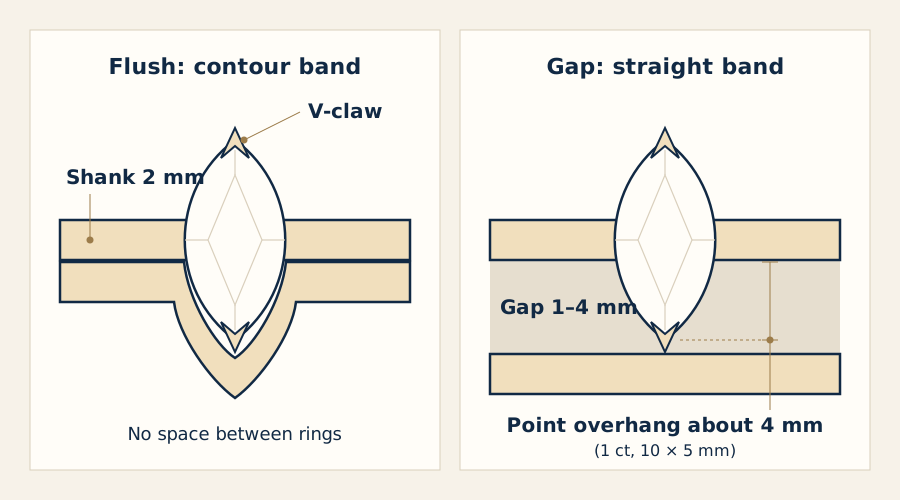
| Flush (contour or chevron) | Gap (straight band) | |
|---|---|---|
| Look | Rings read as one matched set | Two separate rings, cleaner lines |
| Contact with the point | Close; the curve must clear the V-claw | None, if the gap is kept |
| Spinning | Band can rotate out of line and need adjusting | Spinning does not change the look |
| Future flexibility | Works mainly with this engagement ring | Pairs with almost any ring later |
| Wearing the band alone | Curve or V shows on its own | Looks like a classic band |
| Usual making | Often custom, shaped to your ring | Ready-made widths widely available |
A gap is not a fault. Many people prefer it because each ring keeps its own shape, and a plain straight band can be worn alone when the engagement ring is off for work, sport or travel. If you love the look of a single, tidy set, a flush contour is the way to get it.
Which wedding band shapes work for a marquise engagement ring?
Here are the main band shapes people choose, with how each one fits a north-south marquise.
| Band shape | How it fits | Gap | Suits | Watch out for |
|---|---|---|---|---|
| Straight plain | Sits beside the shank, clear of the point | Yes, 1–4 mm | Minimal looks; wearing the band alone | Gap is larger with bigger stones |
| Contour (curved) | Gentle curve follows the point and V-claw | None | A matched bridal set | Must be shaped to your exact ring |
| Chevron (V) | Sharp V mirrors the point angle | Little or none | Bold, geometric look | V angle must match the stone |
| Notched | Straight band with a small cut-out | Small | Keeping a mostly straight line | Notch can look abrupt on its own |
| Shadow or enhancer | Wraps the ring, sometimes both sides | None | Adding a frame of diamonds | Hides part of the shank and points |
| Open or split | Two ends that frame the point | None | Modern, unusual designs | Open ends can catch on clothing |
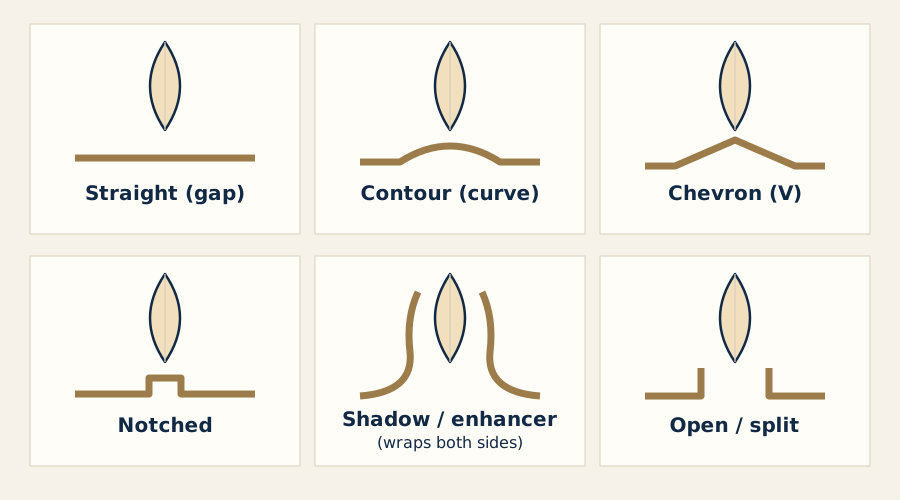
A contour band is the most common flush choice. Its curve is shallow, so it looks soft when worn alone. A chevron band has a sharper V; it works well with a slim marquise where the point angle is narrow, and can look out of line if the V is wider or narrower than the stone. A shadow band, sometimes called an enhancer, wraps the engagement ring and often carries a line of small diamonds, so the marquise looks framed.
The marquise shares its pairing problem with other pointed shapes. A pear has only one point, so the logic is similar but asymmetric; see pairing bands with a single-point pear. A heart has a wide top and a point at the bottom, covered in our heart ring band pairing guide. Shapes with no points, such as the soft-cornered cushion, the cropped-corner radiant and the square, step-cut Asscher, sit beside straight bands much more easily.
Not sure which one is right?
Send us the stones you are looking at and our gemologist will tell you which to choose and why.
How wide should a wedding band be next to a marquise?
As a rule, the wedding band should be the same width as the engagement ring shank or a little narrower. A marquise is a slim, elegant shape, and a heavy band beside it can make the stone look smaller. Most women's bands paired with a marquise fall between 1.5 and 3 mm.
| Marquise size | Typical size (length × width) | Band width that usually suits |
|---|---|---|
| 0.50 ct | about 8 × 4 mm | 1.5–2.0 mm |
| 0.75 ct | about 9 × 4.5 mm | 1.8–2.2 mm |
| 1.00 ct | about 10 × 5 mm | 2.0–2.5 mm |
| 1.50 ct | about 12 × 6 mm | 2.0–3.0 mm |
| 2.00 ct | about 13 × 6.5 mm | 2.5–3.0 mm |
These are guides, not rules. A fine 1.5 mm band beside a 2 carat stone gives a delicate, stone-first look; a 3 mm band suits a larger hand or a bolder stack. Depth matters as well as width. A band about 1.5–1.8 mm deep (top to bottom) is strong enough for daily wear; very thin bands bend and go out of round over the years.
Consider the profile too. A comfort fit band is rounded on the inside so it slides over the knuckle easily. A flat or knife-edge band (one that rises to a ridge) looks slimmer from above. If your engagement ring shank is knife-edge, a matching knife-edge band keeps the set looking consistent.
Does an east-west marquise need a different wedding band?
Yes. An east-west marquise is set sideways, so its length runs across the finger and the points face either side of the hand. Now the band meets the belly (the wide middle edge) of the stone instead of a point. On a 1 carat stone about 5 mm wide, the belly reaches only about 1.5 mm beyond each side of a 2 mm shank, so the overhang is much smaller.
That makes an east-west marquise one of the easier pointed rings to pair. A straight band often sits close or flush, especially if the stone is low-set or bezel-set. A very gentle contour closes any remaining gap. The points, now facing outwards across the hand, are more exposed to door frames and benchtops, so the setting still needs V-claws or a bezel.
Other settings change the picture too. A marquise inside a halo of small diamonds is wider all round, so the band meets the halo rather than the stone; our guide to choosing a band beside a halo setting covers that fit. A marquise paired with a second stone in a two-stone design is often asymmetric, and the band has to suit both stones, which is why bands for toi et moi rings are usually custom-shaped.
Should the wedding band match the engagement ring metal?
In most cases, yes, and ideally the same alloy too. An alloy is the mix of metals that makes up gold or platinum: 18ct gold is 75% pure gold, 14ct is about 58.5% and 9ct is 37.5%, with the rest made up of metals such as silver, copper, zinc or palladium. Platinum jewellery is usually 95% platinum.
- Wear: rings worn together rub. If one metal is harder than the other, the softer one wears faster, and the claws that hold the marquise points are the first place you notice.
- Colour: white gold is usually plated with rhodium, a bright white metal, which wears off over time. Platinum is naturally white and greys softly to a satin look. Side by side, the difference shows.
- Rose and yellow gold: the exact shade depends on the alloy recipe, so two rose gold rings from different makers may not match. Ask for the same alloy as your engagement ring.
- Mixed metals: pairing yellow and white on purpose can look deliberate and modern. Mixing is fine for looks; just know that wear will be uneven.
If the band is part of a matched pair, it helps to think about the other band at the same time. Our guide to choosing his wedding band covers widths, profiles and metals that sit well alongside a slim marquise set.
What are good marquise ring stacking ideas?
A marquise suits stacking well because its length draws the eye along the finger. A few combinations people often choose:
- Contour band below: a single plain or diamond contour band sitting under the marquise. The classic bridal set.
- Contour bands both sides: one above and one below, so the marquise is cradled. Often added later as an anniversary band.
- Chevron and straight: a chevron band next to the marquise, then a fine straight band beyond it, giving the eye a step from point to line.
- Marquise eternity band: a band set with small marquise diamonds laid end to end or in a leaf pattern, echoing the centre stone's shape.
- Straight band with a gap: a 2 mm plain band, gap left on purpose, with a thin diamond band on the other side for balance.
If you are comparing shapes before you commit to the centre stone, it helps to see how pairing changes. Rounded elongated stones are gentler; see band options for an oval. A round usually takes a straight band with no trouble, as our round engagement ring band guide shows. Step cuts with straight edges suit straight bands too: compare the emerald cut pairing options and the princess cut band choices.
How much does a wedding band for a marquise engagement ring cost?
The band price depends mostly on metal, width, whether it is shaped to your ring and whether it carries diamonds. A contour or chevron band is often made to order, which adds design and making time. Bands set with small diamonds can use natural or laboratory-grown diamonds. Lab-grown diamonds are real diamond, grown in a laboratory rather than mined, with the same hardness and sparkle; they cost much less than natural, and both look the same to the eye.
| Band type (about 2–2.5 mm) | Approximate price range (AUD) |
|---|---|
| Plain straight band, 18ct gold | about $600–$1,500 |
| Plain contour or chevron band, 18ct gold | about $900–$2,500 |
| Plain band, platinum | about $1,000–$2,500 |
| Diamond contour band, lab-grown diamonds | about $1,000–$3,000 |
| Diamond contour band, natural diamonds | about $1,500–$5,000 |
These are broad ranges only. Gold and platinum prices move with the market, and diamond bands vary a lot with the total carat weight and grade of the small stones. If you have not chosen your centre stone yet, both natural and lab-grown marquise diamonds come with independent grading reports from labs such as GIA or IGI.
Shop marquise diamonds and create your wedding band
How to choose a wedding band for a marquise engagement ring: step by step
- Decide flush or gap. Try a straight band beside your ring and look at the gap. If you like it, you have your answer; if not, plan a contour or chevron.
- Check the orientation. A north-south marquise needs more curve than an east-west one. Note how far the point reaches past the shank.
- Measure the shank. Choose a band width equal to or a little narrower than the engagement ring shank, usually 1.5–3 mm.
- Match the metal and alloy. Use the same carat of gold, or platinum with platinum, so the rings wear evenly and keep their colour.
- Protect the claws. Make sure a contour band clears the V-claw rather than pressing on it.
- Try it on the finger. Wear both rings together, make a fist and check the band does not spin into the point or pinch between rings.
- Think ahead. If you may add an anniversary band later, leave room for a second band on the other side.
Free consultation
Talk to a gemologist
Compare stones in person or online with Raj Sood, Graduate Gemologist (GIA), AJP (GIA).
Book a consultationFAQ
Common questions
Can you wear a straight wedding band with a marquise engagement ring?
Yes. With a north-south marquise a straight band usually leaves a small gap, often 1–4 mm at the point. Many people like that look, and it keeps the band clear of the V-claws.
What is a contour wedding band?
A contour band has a gentle curve shaped to follow the outline of the engagement ring, so the two rings sit flush. For a marquise, the curve wraps around the point and its V-claw.
Should my wedding band be the same width as my engagement ring?
Usually the same width as the engagement ring shank or slightly narrower, which for most marquise rings is about 2–2.5 mm. A much wider band can make the marquise look smaller.
Is a chevron band or a contour band better for a marquise?
Neither is better in general. A chevron mirrors the point with a sharp V and suits slimmer marquise shapes, while a contour is softer and looks more like a classic band when worn alone.
Does an east-west marquise need a curved band?
Often not. An east-west marquise presents its wide middle to the band rather than a point, so a straight band can sit close or flush, depending on the stone size and setting height.
Can I mix metals in a marquise wedding set?
You can, and it can look deliberate. Rings worn together rub, though, so different metals or alloys wear unevenly, and the claws holding the marquise points need checking more often.

Ask a gemologist
Not sure which diamond to choose?
Raj Sood is a Graduate Gemologist (GIA) and master jeweller. Bring the stones you are considering, or send the reports, and he will tell you honestly which one is better and why.
Keep learning
Related guides
 Engagement Rings & SettingsBest Settings for Marquise Diamonds
 Diamond ShapesProtecting Marquise Diamond Points
 Wedding Bands & EternityBest Wedding Band for Pear Engagement RingsWedding Bands & EternityWedding Ring Buying Guide
 Wedding Bands & EternityWedding Ring vs Wedding Band
 Wedding Bands & EternityBest Wedding Band for Princess Engagement Rings
 Wedding Bands & EternityMen’s Wedding Band GuideWedding Bands & EternityBest Wedding Band for Cushion Engagement Rings
Explore more
More guides on this topic
Education