
- Education
- Fancy Colour Diamonds
- Fancy Colour Intensity Scale: Every Grade from Faint to Fancy Vivid
Fancy Colour Diamonds
Fancy Colour Intensity Scale: Every Grade from Faint to Fancy Vivid
Two diamonds can both be called pink and differ in price many times over. The fancy colour intensity scale explains why, so here is how each grade from Faint to Fancy Vivid is judged and what it means for natural, treated and lab-grown stones.
 Reviewed by Raj Sood, Graduate Gemologist (GIA), AJP (GIA)Master jeweller and Graduate Gemologist (GIA) · reviewed 4 November 2026
Quick answer
The fancy colour intensity scale is GIA's system for grading how strong a coloured diamond's colour is. It runs through nine grades: Faint, Very Light, Light, Fancy Light, Fancy, Fancy Intense, Fancy Vivid, Fancy Deep and Fancy Dark. Grades combine tone and saturation, judged face-up, and stronger, purer colour is rarer and costs more.
What is the fancy colour intensity scale?
The fancy colour intensity scale is the set of grades GIA (the Gemological Institute of America) uses to describe how strong the colour is in a coloured diamond. A fancy colour diamond is one with obvious colour: pink, blue, green, orange, purple, red, or a yellow or brown stronger than the normal white range. If you are new to these stones, start with our complete guide to fancy colour diamonds, then come back here for the grades.
The scale is easy to confuse with the familiar D-to-Z scale for white diamonds, explained in how diamond colour grading works for white stones. That scale rewards the absence of colour. A D colour diamond, the top of the white scale, is valued for showing none at all, and the exceptionally white E colour grade and F colour, the last colourless grade sit just below it. The fancy scale flips that logic. Once a diamond has real colour, more colour and purer colour are what is rare.
Each grade on the fancy scale is a word, not a letter or a number, and the words always appear in the same order on a report. They are combined with the colour name, so you will see grades such as 'Fancy Light Yellow', 'Fancy Intense Pink' or 'Fancy Vivid Blue'. Any term on this page you have not met before is also in our jewellery glossary of gem and setting terms.
How does GIA judge hue, tone and saturation?
Gemmologists describe any colour with three measurements. The intensity grade is really a shorthand for where a diamond sits on two of them:
- Hue: the colour itself, such as pink, blue or yellow. GIA uses around 27 hue names, from simple ones like 'Green' to combinations like 'Yellowish Green'.
- Tone: how light or dark the colour is, from very light to very dark.
- Saturation: how strong or pure the colour is. Low saturation looks washed out or greyish (in cool colours) or brownish (in warm colours); high saturation looks rich and clean.
White diamonds are graded face-down, looking through the side of the stone, so the cut has little effect. Fancy colour diamonds are graded face-up, the way you see them on a hand, because the cut changes how colour gathers in the stone. A grader compares the diamond against colour references in a neutral viewing box under controlled daylight-equivalent light, and judges the overall face-up impression rather than the darkest or lightest spot.
The report also records colour distribution: 'Even' if the colour looks uniform face-up, or 'Uneven' if it is patchy or zoned. Uneven colour usually lowers the value. For the full process, including how hue, modifiers and distribution are written up, see how GIA grades a fancy colour diamond in the lab.
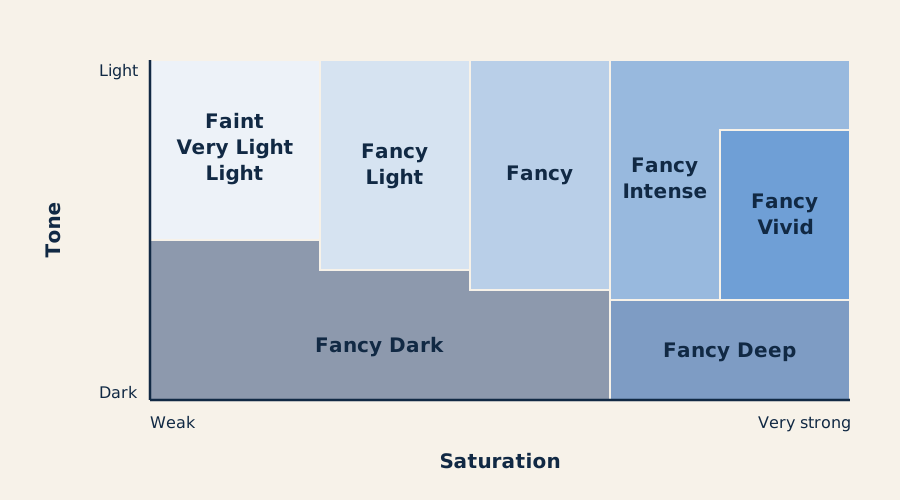
What are the nine grades on the fancy colour intensity scale?
From lightest to strongest, then into the darker grades, the GIA intensity grades are:
| Grade | Tone and saturation (approximate) | What you see face-up |
|---|---|---|
| Faint | Very light tone, very weak saturation | A hint of colour, often only next to a white diamond |
| Very Light | Very light tone, weak saturation | Pale colour you notice when you look for it |
| Light | Light tone, weak saturation | Clear but soft colour |
| Fancy Light | Light tone, weak to moderate saturation | Colour obvious at a glance, pastel |
| Fancy | Light to medium tone, moderate saturation | A definite, even colour |
| Fancy Intense | Light to medium tone, strong saturation | Rich, clean colour |
| Fancy Vivid | Medium tone, very strong saturation | The strongest, purest colour on the scale |
| Fancy Deep | Medium-dark to dark tone, strong saturation | Dark, rich colour |
| Fancy Dark | Dark tone, weak to moderate saturation | Dark colour with a muted, greyish or brownish look |
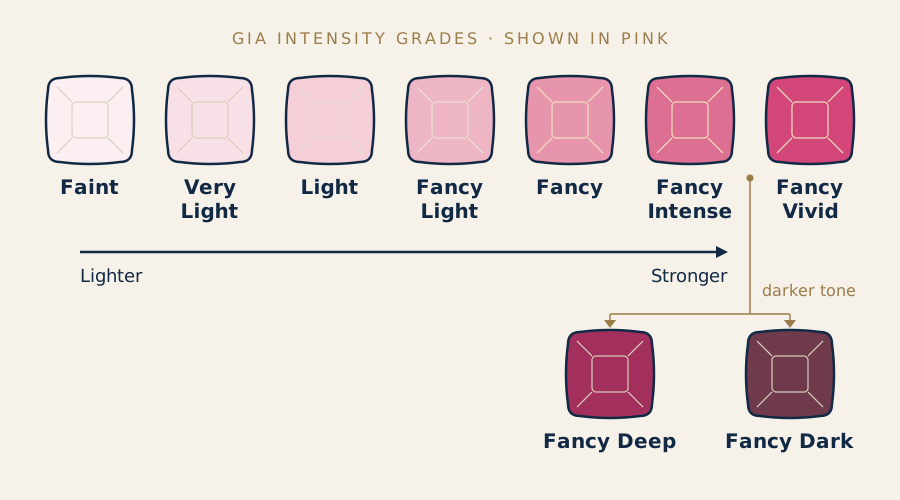
The scale is not a straight ladder. Fancy Deep and Fancy Dark are not steps above Fancy Vivid; they sit off to the darker side. A Fancy Deep stone has strong colour at a darker tone, while Fancy Vivid combines the strongest saturation with a medium tone, which is why Vivid is usually the most sought-after grade. Our page on what it takes to earn a Fancy Vivid grade shows real examples.
The difference between Fancy Intense vs Fancy Vivid is often the one people ask about. Both are strong. Vivid has noticeably more saturation, so the colour looks purer and stays strong across the whole stone, while Intense can show slightly softer areas near the edges or under the table. Side by side, most people can see it; on its own, an Intense stone still reads as unmistakably coloured.
Related guideFancy Colour Modifiers and OvertonesWhat causes colour in a diamond?
Pure diamond is pure carbon and colourless. Colour comes from tiny departures from that: a few atoms of another element trapped in the crystal, damage to the crystal structure, or exposure to natural radiation over millions of years. The cause decides which colours exist, how strong they can get and how rare they are.
| Colour | Main cause | Notes |
|---|---|---|
| Yellow and orange | Nitrogen atoms in the crystal | The most common fancy colour. Isolated nitrogen (type Ib) gives the saturated 'canary' yellows and orangey yellows |
| Blue | Boron atoms (type IIb) | Boron also makes blue diamonds conduct electricity, a useful test |
| Pink, red and purple | Plastic deformation (the crystal lattice bent under pressure deep in the earth) | Colour often sits in fine coloured bands called graining |
| Brown and champagne | Plastic deformation | Very common, especially from the Argyle mine |
| Green | Natural radiation | Colour is often only in a thin skin near the surface of the rough |
| Grey and violet | Hydrogen, sometimes with boron | Argyle produced rare grey-violet and violet stones |
| Black | Dense dark inclusions such as graphite | Most black diamonds sold are treated |
These causes explain the rarity pattern. Nitrogen is in most natural diamonds and plastic deformation is common, so yellow and brown are relatively plentiful. Boron is rare, and deformation strong enough to produce a clean pink or red is rarer still. That is why a Fancy Light Pink can cost more than a Fancy Vivid Yellow of the same weight: the intensity grade matters, but the hue matters first.
Fancy colour diamonds as a group are a tiny share of the diamonds mined; a figure of about 1 in 10,000 carats is often quoted. Within that group, most are yellow or brown.
Not sure which one is right?
Send us the stones you are looking at and our gemologist will tell you which to choose and why.
Does the intensity scale work the same way for every colour?
Not quite. For yellow and brown, the lightest grades overlap with the white diamond scale. A diamond with a light tint is still a white diamond: near-colourless G colour diamonds and H colour diamonds look white face-up, I colour stones with a hint of warmth begin to show it, and by L and M diamonds with a faint yellow tint the report describes the stone as 'Faint'. A yellow only becomes a fancy colour diamond, starting at Fancy Light, once its colour is stronger than Z.
For pink, blue, green, purple and orange, any colour a grader can see counts. A diamond graded 'Faint Pink' or 'Very Light Blue' is already a coloured diamond on the fancy report, and it is priced as one.
A few colours use fewer grades:
- Red: graded simply 'Fancy Red', with modifiers such as 'Fancy Purplish Red'. A lighter red is pink, so there are no lighter red grades.
- Black: graded 'Fancy Black', because the stone is opaque and tone and saturation cannot be judged the usual way.
- White: a milky, translucent diamond can be graded 'Fancy White'. This is different from a colourless D-to-Z stone.
Many diamonds show a second colour, called a modifier, written before the main hue, as in 'Fancy Intense Purplish Pink' or 'Fancy Brownish Yellow'. The modifier can raise or lower the price a great deal: purplish usually adds appeal to pink, brownish usually lowers yellow. Our page explaining how modifiers and overtones change a colour grade goes through the common ones.
Why were Australia's Argyle pink diamonds so special?
The Argyle mine in the East Kimberley region of Western Australia opened in 1983 and became, by volume, one of the largest diamond mines in the world. Most of its output was brown, champagne and cognac diamonds, but it also produced a tiny fraction of pinks, reds and violets. Over its life Argyle supplied the large majority of the world's pink diamonds, often quoted as around 90%, before it closed in November 2020.
Argyle's pinks are linked to plastic deformation, and many show the strong colour and fine pink graining that gemmologists associate with the mine. The best were sold each year through the Argyle Pink Diamonds Tender, and those stones carry a laser inscription on the girdle (the thin outer edge) and an Argyle certificate.
Argyle also used its own grading system alongside GIA. It combines a number for intensity, from 1 (strongest) to 9 (lightest), with a letter code for hue:
- PP: purplish pink
- P: pink
- PR: pink rosé, a softer pink
- PC: pink champagne, a pink with brown
- BL: blue-violet and violet stones
- Red: the rarest category, graded separately
So '4PP' is a mid-strength purplish pink, and '1P' is among the strongest pinks Argyle graded. Argyle also popularised a champagne scale for its browns, running from about C1 (light champagne) to C7 (cognac). Many Argyle pinks have a GIA report as well; the two systems do not translate grade for grade, so read them side by side rather than converting one into the other.
Because no new Argyle pinks are being mined, supply now comes only from stones already in the market. That has kept interest high, but prices still depend on the individual diamond's colour, size and paperwork, not the name alone.
Natural, treated or lab-grown: what does the report say?
Colour can be natural, added by treatment or grown in a laboratory, and all three can look alike. The grading report is how you tell them apart. A GIA coloured diamond report includes a colour origin line, and a laboratory-grown diamond report names the stone as laboratory-grown on the report itself and with a girdle inscription.
| What the report shows | What it means |
|---|---|
| Fancy Intense Pink, colour origin: Natural | A natural diamond whose pink colour formed in the earth, with no detected treatment |
| Fancy Vivid Yellow, colour origin: Natural, distribution: Even | Natural colour, uniform face-up; a strong yellow at the top of the saturation range |
| Fancy Deep Blue, colour origin: Treated | A natural diamond whose colour was created or changed after mining, for example by irradiation or HPHT |
| Colour origin: Undetermined | The lab could not conclude whether the colour is natural; treat it as unproven and price accordingly |
| Laboratory-grown, Fancy Vivid Blue, 'As Grown' | A lab-grown diamond with no sign of post-growth treatment (wording used by labs such as IGI) |
| Laboratory-grown, Fancy Pink, post-growth treatment noted | A lab-grown diamond whose colour was created or improved after growth |
Treated fancy colour diamonds are real diamonds, but their colour is not natural. Common treatments are irradiation followed by heating (green, blue, yellow, pink), HPHT (high pressure, high temperature, used for yellows, greens and pinks), and surface coatings for pink and blue. Irradiated and HPHT colours are stable in normal wear; coatings can wear or be damaged by heat, harsh chemicals or polishing. Treated stones cost far less than natural colour of the same grade, and the treatment must be disclosed.
Lab-grown fancy colour diamonds are real diamond with the same hardness (10 on the Mohs scale) and refractive index (about 2.42) as natural diamond. Blue lab-grown diamonds get their colour from boron and yellows from nitrogen, just as natural ones do; pinks are usually created or enhanced after growth. They cost a small fraction of natural colour and reach Fancy Intense and Fancy Vivid grades much more often. Our guide to lab-grown pink, blue and yellow diamonds covers how they are made and graded.
Shop fancy colour diamonds: natural and lab-grown
How much does the intensity grade change a fancy colour diamond's price?
Within one hue, price rises with intensity, and the steps get larger towards the top. The jump from Fancy Intense to Fancy Vivid is usually the largest. But the hue sets the starting point: natural pink and blue start far higher than yellow at any grade. These are broad indicative ranges for natural yellow, the colour most people compare first:
| Natural yellow, about 1 ct, eye-clean | Approximate price range (AUD) |
|---|---|
| Fancy Light Yellow | about $5,000–$10,000 |
| Fancy Yellow | about $6,000–$14,000 |
| Fancy Intense Yellow | about $9,000–$22,000 |
| Fancy Vivid Yellow | about $18,000–$50,000 |
| About 1 ct, by colour and origin | Approximate price range (AUD) |
|---|---|
| Natural champagne or brown | about $2,000–$6,000 |
| Natural pink or blue, Fancy grade or stronger | usually six figures, and much more for Vivid |
| Treated natural colour | usually well below natural colour of the same grade |
| Lab-grown fancy colour (pink, blue or yellow) | about $800–$4,000 |
Other factors move the price too: modifiers, even or uneven distribution, carat weight, shape and clarity. Clarity matters less in fancy colour than in white diamonds, because buyers pay mainly for colour. Cut matters in a different way: cutters often choose radiant, cushion and other fancy shapes because they concentrate colour and can lift a stone by a whole intensity grade. Our page on what drives fancy colour diamond prices sets out each factor in turn.
What is the best setting for a coloured diamond, and which metal?
The metal touching the diamond affects how its colour reads, especially in the lighter grades. As a general guide:
- Yellow gold for yellow and orange diamonds. It reflects warm light into the stone, so a Fancy Light Yellow can look closer to Fancy.
- Rose gold for pink, champagne and cognac diamonds. It warms and deepens soft pinks and browns.
- Platinum or white gold for blue, green and grey diamonds, and for anyone who wants the colour to read exactly as graded.
- Mixed metals: a yellow gold cup and claws holding the diamond on a platinum band is a common way to boost a yellow while keeping a white look on the finger.
- A halo of white diamonds frames the colour and adds sparkle; it makes stronger grades stand out and can make pale grades look a little paler by contrast.
Natural and lab-grown coloured diamonds are as hard as white diamonds, so claws, bezels and halos all suit everyday wear. If your diamond is treated, tell any jeweller who works on the ring: coated stones should not be heated or cleaned ultrasonically, and irradiated colours can change under a jeweller's torch. For design ideas, see fancy coloured diamond engagement rings and settings.
How do you choose an intensity grade? Step by step
- Choose the hue first. Decide on pink, blue, yellow or another colour, because hue sets the price range before intensity does.
- Read the full colour grade. Note the intensity word, any modifier and the distribution (Even or Uneven).
- Check the origin line. Natural, Treated, Undetermined or laboratory-grown changes the value more than any other line on the report.
- Compare grades side by side. Look at Fancy, Fancy Intense and Fancy Vivid together; decide whether the step up is worth it to your eye.
- View it face-up in different light. Daylight, warm indoor light and cool LEDs, ideally in a 360° video as well.
- Match the metal. Choose yellow, rose or white metal to suit the hue before you finalise the stone.
Free consultation
Talk to a gemologist
Compare stones in person or online with Raj Sood, Graduate Gemologist (GIA), AJP (GIA).
Book a consultationShop this shape
FAQ
Common questions
What is the highest grade on the fancy colour intensity scale?
Fancy Vivid is generally the most sought-after grade, because it combines the strongest saturation with a medium tone. Fancy Deep and Fancy Dark are darker grades, not higher ones.
What is the difference between Fancy Intense and Fancy Vivid?
Both are strong colours, but Fancy Vivid has more saturation, so the colour looks purer and more even across the stone. Vivid usually costs considerably more than Intense of the same hue and size.
Is a Faint Pink diamond a fancy colour diamond?
Yes. For pink, blue and green, any visible colour is graded on the coloured diamond report, so Faint Pink is a coloured diamond. For yellow and brown, Faint to Light grades fall within the white D-to-Z range.
Are treated fancy colour diamonds real diamonds?
Yes. They are natural diamonds whose colour was created or changed after mining, usually by irradiation, HPHT or coating. They should be disclosed and cost much less than natural colour of the same grade.
Do lab-grown fancy colour diamonds use the same intensity grades?
Yes, labs such as GIA and IGI describe lab-grown coloured diamonds with the same grade words, from Fancy Light to Fancy Vivid. The report always states that the diamond is laboratory-grown and notes any post-growth treatment.
Why are Argyle pink diamonds graded differently?
Argyle used its own system combining an intensity number from 1 to 9 with a hue code such as PP or PR. Many Argyle pinks also carry a GIA report, and the two systems do not convert directly.

Ask a gemologist
Not sure which diamond to choose?
Raj Sood is a Graduate Gemologist (GIA) and master jeweller. Bring the stones you are considering, or send the reports, and he will tell you honestly which one is better and why.
Keep learning
Related guides
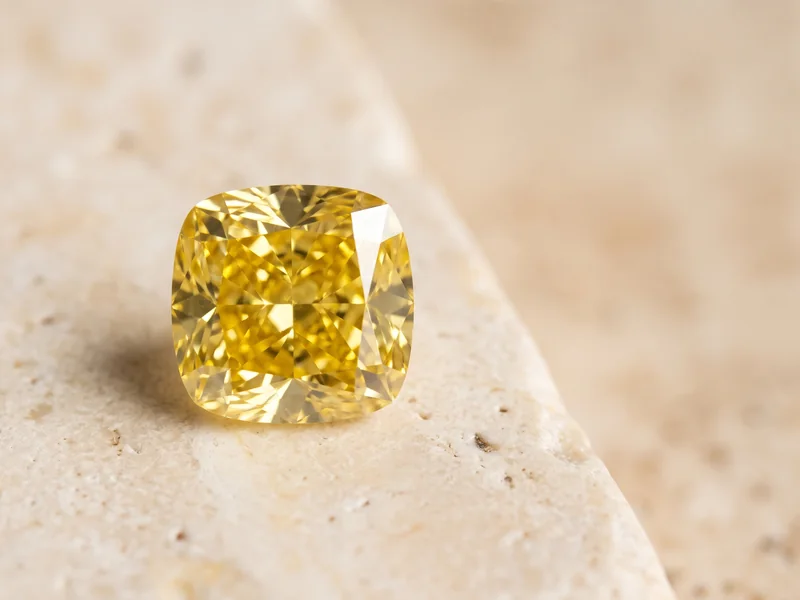
 Fancy Colour DiamondsWhat Is a Fancy Vivid Diamond?
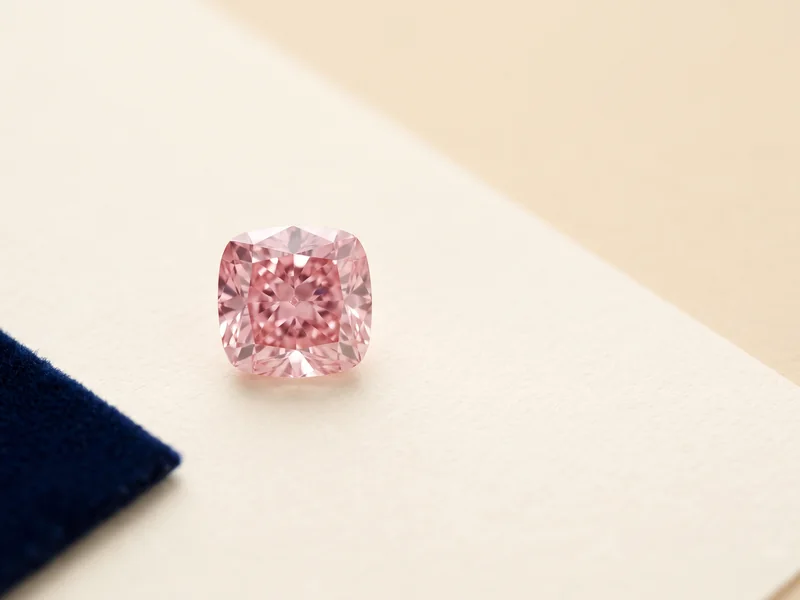
 Fancy Colour DiamondsHow Fancy Colour Diamonds Are Graded
 Fancy Colour DiamondsFancy Colour Modifiers and OvertonesLab-Grown DiamondsLab-Grown Fancy Colour DiamondsFancy Colour DiamondsFancy Colour Diamonds Guide
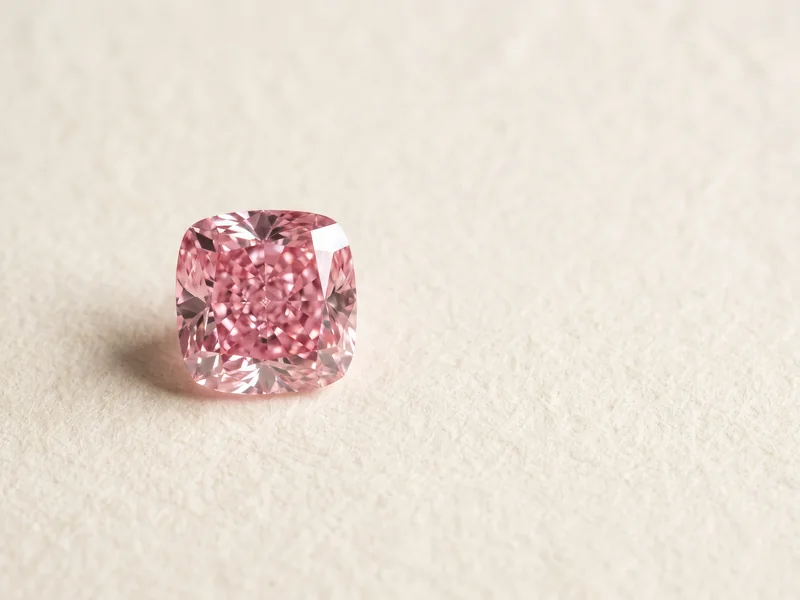 Fancy Colour DiamondsWhat Drives Fancy Colour Diamond Prices
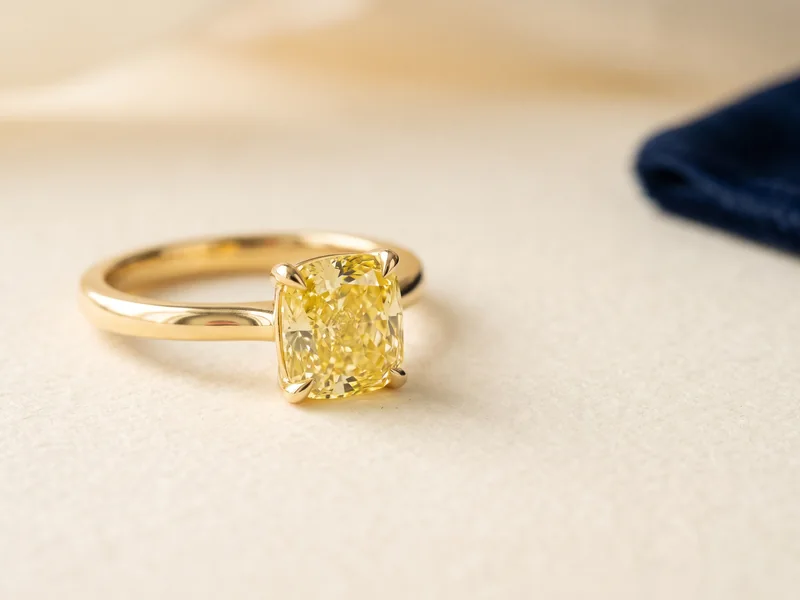 Fancy Colour DiamondsFancy Coloured Diamond Engagement Rings
 Diamond 4Cs & GradingL and M Colour Diamonds (Faint Yellow)
Explore more
More guides on this topic
Education