
- Education
- Fancy Colour Diamonds
- Fancy Colour Modifiers and Overtones: How to Read a Coloured Diamond's Name
Fancy Colour Diamonds
Fancy Colour Modifiers and Overtones: How to Read a Coloured Diamond's Name
Two coloured diamonds can share an intensity grade and still look completely different because of one extra word on the report. Fancy colour modifiers tell you which overtone sits beside the main colour, and that word changes the look, the rarity and the price.
 Reviewed by Raj Sood, Graduate Gemologist (GIA), AJP (GIA)Master jeweller and Graduate Gemologist (GIA) · reviewed 4 November 2026
Quick answer
Fancy colour modifiers are the extra colour words in a coloured diamond's grade, such as “purplish” in Fancy Intense Purplish Pink. The last word is the main hue; a modifier ending in “-ish” or “-y” is a secondary overtone, and a hyphen means both colours are strong. Modifiers change the look, rarity and price, often by a wide margin.
What are fancy colour modifiers in a diamond?
Most diamonds are graded on the D-to-Z scale, where the aim is as little colour as possible. A fancy colour diamond works the other way round: the colour is the whole point. GIA describes it with a name built from three parts: an intensity grade (how strong the colour is), one or more modifiers, and the main hue (the basic colour, such as pink, yellow or blue). The modifiers are the secondary colour words, and gemmologists call the colour they describe an overtone: a second colour you see alongside the main one. If coloured diamonds are new to you, start with our full guide to fancy colour diamonds and come back here for the detail.
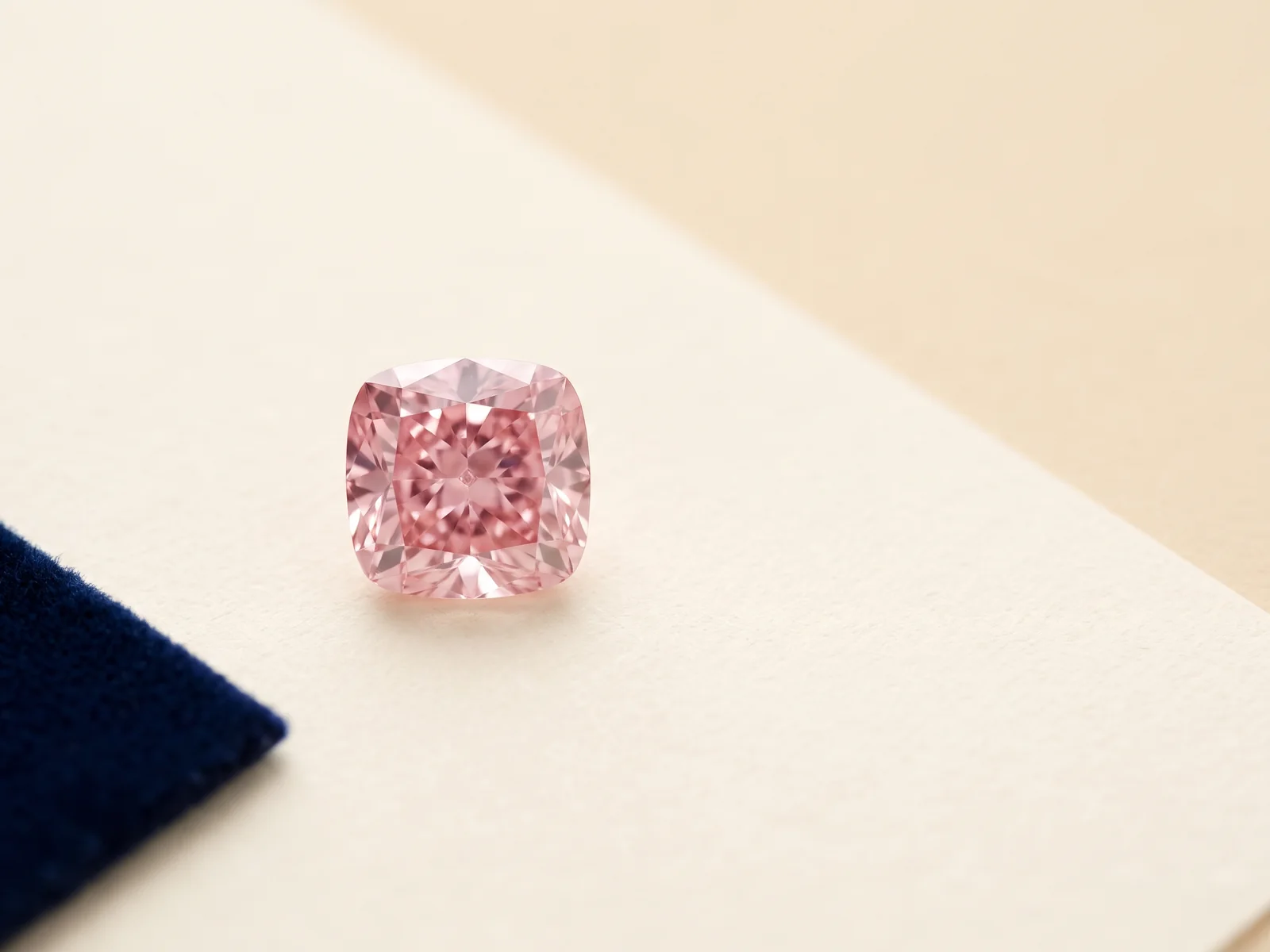
Take three pinks with the same intensity. A Fancy Pink is a straightforward pink. A Fancy Purplish Pink leans cool, towards lilac. A Fancy Brownish Pink looks warmer and softer, closer to a rosé wine. On the report they differ by a single word; on the hand, and on the price ticket, they can be very different stones. Any term you have not met before is explained in our plain-English jewellery glossary.
One thing modifiers do not tell you is anything about durability. Every diamond, whatever its colour, is 10 on the Mohs hardness scale with a refractive index of about 2.42. A modifier describes only how the colour looks face-up (from above, the way you see it in a ring). That is also how GIA grades fancy colours, whereas colourless diamonds are graded face-down, looking through the side of the stone.
How do you read a fancy colour diamond grade?
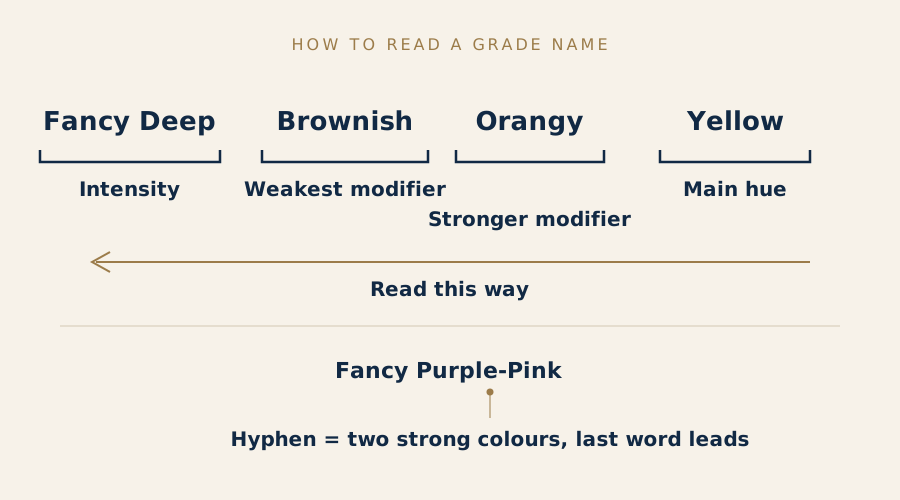
The grade name follows a fixed order, and once you know the rules you can picture the stone before you see it:
- The intensity grade comes first. Fancy Light, Fancy, Fancy Intense, Fancy Vivid, Fancy Deep and so on.
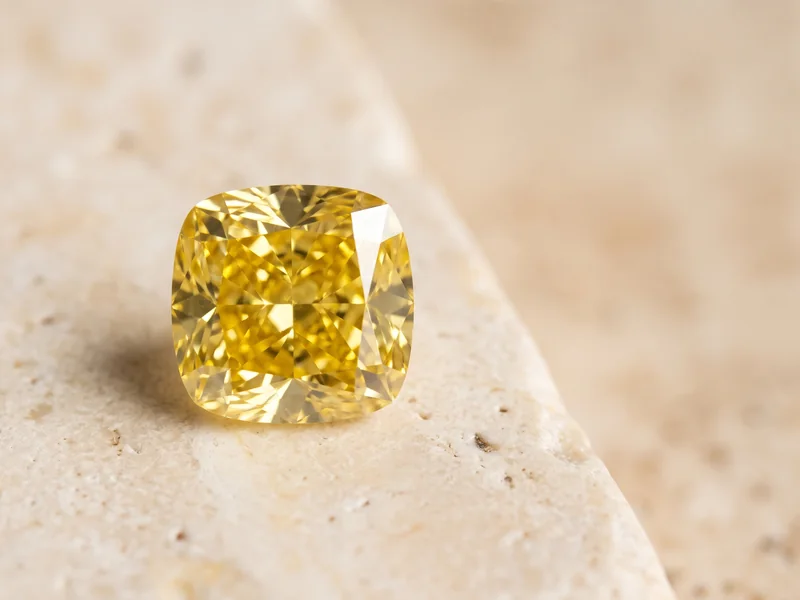
- The last word is the main hue. In Fancy Intense Orangy Yellow, the stone is yellow first and foremost.
- A word ending in “-ish” or “-y” is a modifier. Purplish, greenish, brownish, greyish, pinkish and orangy all describe a secondary colour that is clearly weaker than the main hue.
- A hyphen means two strong colours. A name such as Yellow-Green or Purple-Pink means both colours are significant, with the last word still slightly leading.
- Modifiers can stack. In Fancy Deep Brownish Orangy Yellow, read from right to left: yellow is the main hue, orange is the next strongest, and brown is the faintest.
| Grade name | Main hue | Overtone | What you see |
|---|---|---|---|
| Fancy Intense Pink | Pink | None | A clean, even pink |
| Fancy Intense Purplish Pink | Pink | Purple, secondary | A cooler pink leaning towards lilac |
| Fancy Purple-Pink | Pink | Purple, strong | Pink and purple close to equal |
| Fancy Brownish Pink | Pink | Brown, secondary | A softer, warmer, muted pink |
| Fancy Vivid Greenish Yellow | Yellow | Green, secondary | A bright lemon yellow |
| Fancy Greyish Blue | Blue | Grey, secondary | A steely, muted blue |
| Fancy Deep Brownish Orangy Yellow | Yellow | Orange, then brown | A deep amber, cognac-like yellow |
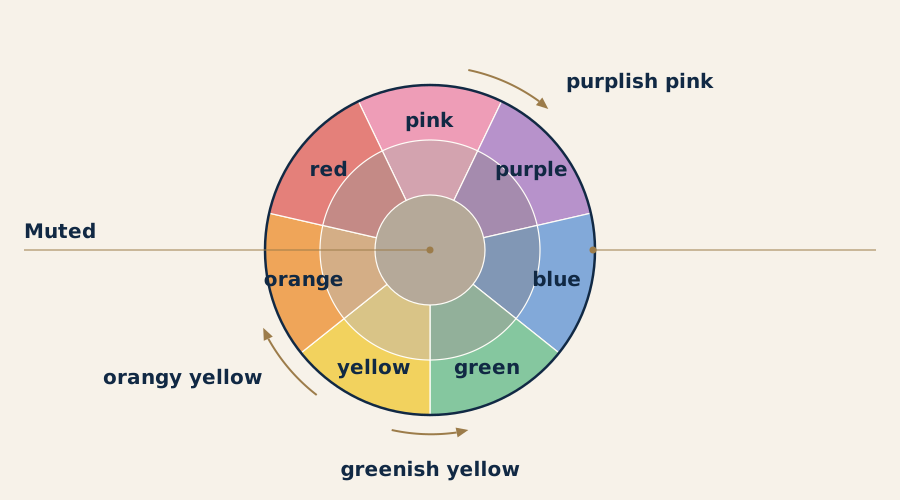
GIA's system uses 27 hue names arranged around a colour wheel, and each name covers a slice of it. A modifier simply tells you which neighbouring slice the stone leans towards. Our guide to how GIA grades fancy colour diamonds explains the viewing booth, the controlled lighting and the comparison stones graders use to land on a name.
Which overtones are most common in each fancy colour?
Some hue and modifier pairs turn up constantly; others are rare enough that a dealer may see only a handful in a career. This table sets out the overtones you will meet most often, and the usual effect on how the stone looks.
| Main hue | Common modifiers | Usual effect on the look |
|---|---|---|
| Yellow | Greenish, orangy, brownish | Greenish reads lemon; orangy reads warm and rich; brownish reads muted |
| Pink | Purplish, orangy, brownish | Purplish reads cool; orangy reads peachy; brownish reads soft and dusty |
| Blue | Greenish, greyish, violetish | Greyish is the most common and gives a steely look |
| Green | Yellowish, bluish, greyish | Yellowish reads lime; bluish reads teal; greyish reads olive |
| Orange | Yellowish, pinkish, brownish | Pure orange is rare; brownish gives a burnt-orange tone |
| Brown | Orangy, pinkish, yellowish | Sold under trade names such as champagne and cognac |
| Purple | Pinkish, greyish | Pinkish purple is the more common combination |
Brown and grey are the two overtones that most often appear across many hues. They do not add a new colour so much as dull the main one, which is why they matter so much to price. Pink, orange and purple overtones, by contrast, can shift a stone into a colour some buyers prefer.
Related guideFancy Colour Intensity Scale: Faint to VividWhat causes the colour and the overtone in a fancy diamond?
Pure diamond is a lattice of carbon atoms and is colourless. Colour comes from small departures from that perfect structure, and an overtone usually means more than one cause is at work in the same crystal. Gemmologists sort diamonds into types by their chemistry: Type Ia and Ib contain nitrogen, Type IIa has almost none, and Type IIb contains boron.
| Cause | Main colours | What is happening |
|---|---|---|
| Nitrogen | Yellow, orange | Nitrogen atoms absorb blue light, so the stone looks yellow; isolated nitrogen (Type Ib) gives the strongest canary yellows |
| Boron | Blue, greyish blue | Boron atoms absorb red light; Type IIb blues also conduct electricity |
| Plastic deformation | Pink, red, purple, brown | Pressure deep in the earth bends the crystal lattice, leaving coloured bands called graining |
| Natural radiation | Green | Radiation in the rock displaces carbon atoms; the green is often only a thin skin near the surface |
| Hydrogen and related defects | Grey, violet, some chameleons | Linked to the unusual greys and violets from Argyle and to colour-change chameleon diamonds |
| Dense inclusions | Black | Masses of tiny dark inclusions, such as graphite; most black diamonds on the market are treated |
Overtones are where these causes overlap. A pink caused by plastic deformation often carries brown from the same distortion, giving a brownish pink. A yellow from nitrogen that also has some deformation becomes a brownish yellow. A blue with a little nitrogen can lean greenish. When you read a modifier, you are really reading a short summary of the diamond's history underground.
Not sure which one is right?
Send us the stones you are looking at and our gemologist will tell you which to choose and why.
How do overtones change tone, saturation and the intensity grade?
GIA judges three things together. Hue is the colour itself. Tone is how light or dark it is. Saturation is how strong or pure the colour is. The intensity grade blends tone and saturation into one word, from lightest to strongest: Faint, Very Light, Light, Fancy Light, Fancy, Fancy Intense and Fancy Vivid, with Fancy Deep and Fancy Dark for darker stones. Our page on the nine intensity grades from Faint to Fancy Dark shows each step with examples.
Grey and brown are known as saturation reducers. They make the main colour look less pure, so a stone with a greyish or brownish overtone rarely reaches the top grades. That is part of why what earns a Fancy Vivid grade is so specific: a Vivid stone needs strong saturation with little grey or brown holding it back.
Yellow and brown also connect to the scale used for white diamonds. On the D-to-Z colour scale, a stone at D colour, the top of the colourless range shows no body colour at all, while one around K colour diamonds with a faint warm tint already shows a little yellow. Once a yellow diamond has more colour than a Z, it moves off that scale and is graded as a fancy colour, starting at Fancy Light.
Do fancy colour modifiers raise or lower the price?
Usually the modifier matters as much as the intensity. As a general pattern, a pure main hue with no modifier sits at the top for its intensity, and the overtone then nudges the price up or down depending on how buyers feel about it:
- Brownish and greyish: in most hues these lower the price, sometimes considerably, because they dull the main colour.
- Orangy in yellow: a warm, rich yellow is popular and can hold its value well against a pure yellow.
- Greenish in yellow: gives a lemon look that often prices a little below a pure or orangy yellow of the same intensity.
- Purplish in pink: widely liked; many buyers see little or no penalty compared with a pure pink.
- Pinkish in purple, or any red: red is the rarest hue, and even a trace of it can lift the price.
To give a sense of scale, a natural 1 carat Fancy Intense Yellow often sits roughly between AUD 6,000 and 20,000 depending on modifiers and clarity, while natural pinks of similar size and intensity commonly run into six figures. Lab-grown coloured diamonds of 1 carat are usually in the region of AUD 1,000 to 5,000. Treat these as broad ranges only; the market moves, and individual stones vary widely. Brown diamonds are often sold under trade names such as champagne and cognac, which are marketing words for brown with various modifiers, not grades in their own right.
Intensity, hue, modifier, colour distribution, size and origin all interact, and our guide to the factors behind fancy colour prices sets out how each one moves the figure.
What did Australia's Argyle mine teach us about pink overtones?
For most people, the words “pink diamond” lead straight to Argyle. The mine in the Kimberley region of Western Australia produced diamonds from the mid-1980s until it closed in 2020, and it supplied the great majority of the world's pink diamonds. Most Argyle output was actually brown, which is why the mine also helped make champagne and cognac diamonds popular.
Argyle graded its pinks with its own system, and it shows how central modifiers are. Each stone received a number for intensity, from 1 (most intense) to 9 (lightest), plus a colour code:
- PP: purplish pink, the cooler end.
- P: pink, with no strong overtone.
- PR: pink rose, a softer and slightly warmer pink.
- PC: pink champagne, a pink with a brownish overtone.
- Red, BL and V: rare reds, blues and violets, the last often greyish.
So a 4PP is a fairly strong purplish pink, and a 7PC is a light, brownish pink. These Argyle codes sit alongside GIA reports on many stones; the GIA report gives the international grade name, and the Argyle certificate confirms the mine of origin. With the mine closed, the supply of natural Argyle pinks is now limited to what is already in circulation.
Natural, lab-grown or treated: how does a GIA colour-origin report show it?
With fancy colours, the most important line on a report is often not the grade but the colour origin: whether the colour formed naturally, was created or changed by treatment, or belongs to a laboratory-grown diamond. Treatments include HPHT (high pressure, high temperature), which can turn brown into yellow or green, irradiation and annealing, which can create green, blue, yellow, pink and red, and surface coatings, which are thin and can wear.
| Report wording | What it means | Example |
|---|---|---|
| Colour origin: Natural | The colour formed in the earth with no treatment detected | Fancy Intense Purplish Pink, Natural, distribution Even |
| Colour origin: Treated | The colour was created or changed after mining | Fancy Vivid Green, Treated (irradiated) |
| Colour origin: Undetermined | The lab cannot confirm whether the colour is natural | Common in some green diamonds, where natural and laboratory radiation look alike |
| Laboratory-grown, with post-growth treatment noted | A lab-grown diamond whose colour was created or enhanced after growth | Fancy Intense Pink, laboratory-grown, treated |
Reports also give colour distribution, usually Even or Uneven. An even stone shows the same colour across the face; an uneven one may show zones or bands, and the modifier can look stronger in some areas than others.
Lab-grown coloured diamonds are real diamond, grown by CVD (chemical vapour deposition) or HPHT methods. Blues are grown with boron and yellows with nitrogen, while most lab-grown pinks get their colour from treatment after growth. They cost much less than natural colours, and the report always identifies them as laboratory-grown. Our guide to lab-grown coloured diamonds and how they are made goes deeper into each colour. Natural colours are far rarer; both are genuine diamond, and the choice is about what matters to you.
Browse fancy colour diamonds: natural and lab-grown
Which metals and settings suit each overtone?
Metal reflects into a diamond from behind and beside it, so it can strengthen or soften an overtone. General guidance by colour:
- Purplish or pure pink: rose gold claws warm and deepen the pink; platinum or white gold gives a cleaner, cooler contrast that suits purplish pinks.
- Orangy or pure yellow: yellow gold claws or a yellow gold cup under the stone intensify the colour, often by what looks like a step in intensity.
- Greenish yellow: white metal keeps the lemon look crisp; yellow gold pulls it warmer.
- Blue and greyish blue: platinum or white gold, which keeps the steely tone from looking muddy.
- Brown, champagne and cognac: rose or yellow gold flatter the warmth.
- Green: white metal for bluish greens; yellow gold for yellowish greens.
Side stones matter too. White diamonds around a coloured centre make the colour look stronger by contrast. Many designers choose G colour side stones or H colour accents as a sensible balance, while crisp E colour melee or F colour diamonds give the sharpest frame around a pale pink or blue. Around a yellow centre in yellow gold, I colour diamonds in yellow gold often look white enough and blend with the metal. For complete ring ideas, see engagement ring designs for coloured centre stones.
How do you choose a diamond by its fancy colour modifiers? Step by step
- Read the grade name right to left. Identify the main hue, then each modifier in order of strength, then the intensity.
- Check the colour origin. Confirm Natural, Treated, Undetermined or laboratory-grown, and note any treatment such as HPHT or irradiation.
- Look at colour distribution. Even is the norm to aim for; ask to see an Uneven stone in a video before you decide.
- Decide how you feel about brown and grey. They lower the price; some people love the softer look, others want the purest colour their budget allows.
- View the stone in two lights. Daylight and warm indoor light, face-up on white, as a ring would be seen.
- Match the metal to the overtone. Rose or yellow gold for warm overtones, platinum or white gold for cool and greyish ones, and plan white side stones if you want more contrast.
Free consultation
Talk to a gemologist
Compare stones in person or online with Raj Sood, Graduate Gemologist (GIA), AJP (GIA).
Book a consultationShop this shape
FAQ
Common questions
What does “purplish pink” mean on a diamond report?
It means the diamond is pink first, with a weaker purple overtone. Purplish pinks look slightly cooler than pure pinks and are widely liked.
Is a brownish modifier a bad thing?
Not necessarily. A brownish overtone usually lowers the price because it softens the main colour, but many people prefer the warm, muted look, especially in rose or yellow gold.
What is the difference between a modifier and a hyphenated colour?
A modifier ending in “-ish” or “-y” is clearly weaker than the main hue. A hyphenated name, such as Yellow-Green, means both colours are strong, with the last word still slightly leading.
Can a fancy colour diamond have more than one modifier?
Yes. A grade such as Fancy Deep Brownish Orangy Yellow has two modifiers; read it right to left, so yellow is the main hue, orange the next strongest and brown the faintest.
Do lab-grown fancy colour diamonds have modifiers too?
Yes. Lab-grown coloured diamonds are graded with the same hue, modifier and intensity terms, and the report also states that the diamond is laboratory-grown and whether its colour was treated after growth.
What do Argyle codes like 4PP mean?
They come from the Argyle mine's own pink grading system. The number is intensity, from 1 (strongest) to 9 (lightest), and the letters give the hue, such as PP for purplish pink or PC for pink champagne.

Ask a gemologist
Not sure which diamond to choose?
Raj Sood is a Graduate Gemologist (GIA) and master jeweller. Bring the stones you are considering, or send the reports, and he will tell you honestly which one is better and why.
Keep learning
Related guides
 Fancy Colour DiamondsHow Fancy Colour Diamonds Are Graded
 Fancy Colour DiamondsFancy Colour Intensity Scale: Faint to Vivid
 Fancy Colour DiamondsWhat Drives Fancy Colour Diamond Prices
 Lab-Grown DiamondsLab-Grown Fancy Colour DiamondsFancy Colour DiamondsFancy Colour Diamonds Guide
 Fancy Colour DiamondsFancy Coloured Diamond Engagement RingsFancy Colour DiamondsWhat Is a Fancy Vivid Diamond?
 Diamond 4Cs & GradingDiamond Colour Grading
Explore more
More guides on this topic
Education