
- Education
- Lab-Grown Diamonds
- Lab-Grown Sapphire, Ruby and Emerald: What They Are, How They Compare and How to Tell
Lab-Grown Diamonds
Lab-Grown Sapphire, Ruby and Emerald: What They Are, How They Compare and How to Tell
A lab-grown sapphire, ruby or emerald is real gem material, not an imitation, and it often costs a small fraction of the mined stone. Here is how they are made, how they compare with diamond, and how a gemologist actually tells them apart.
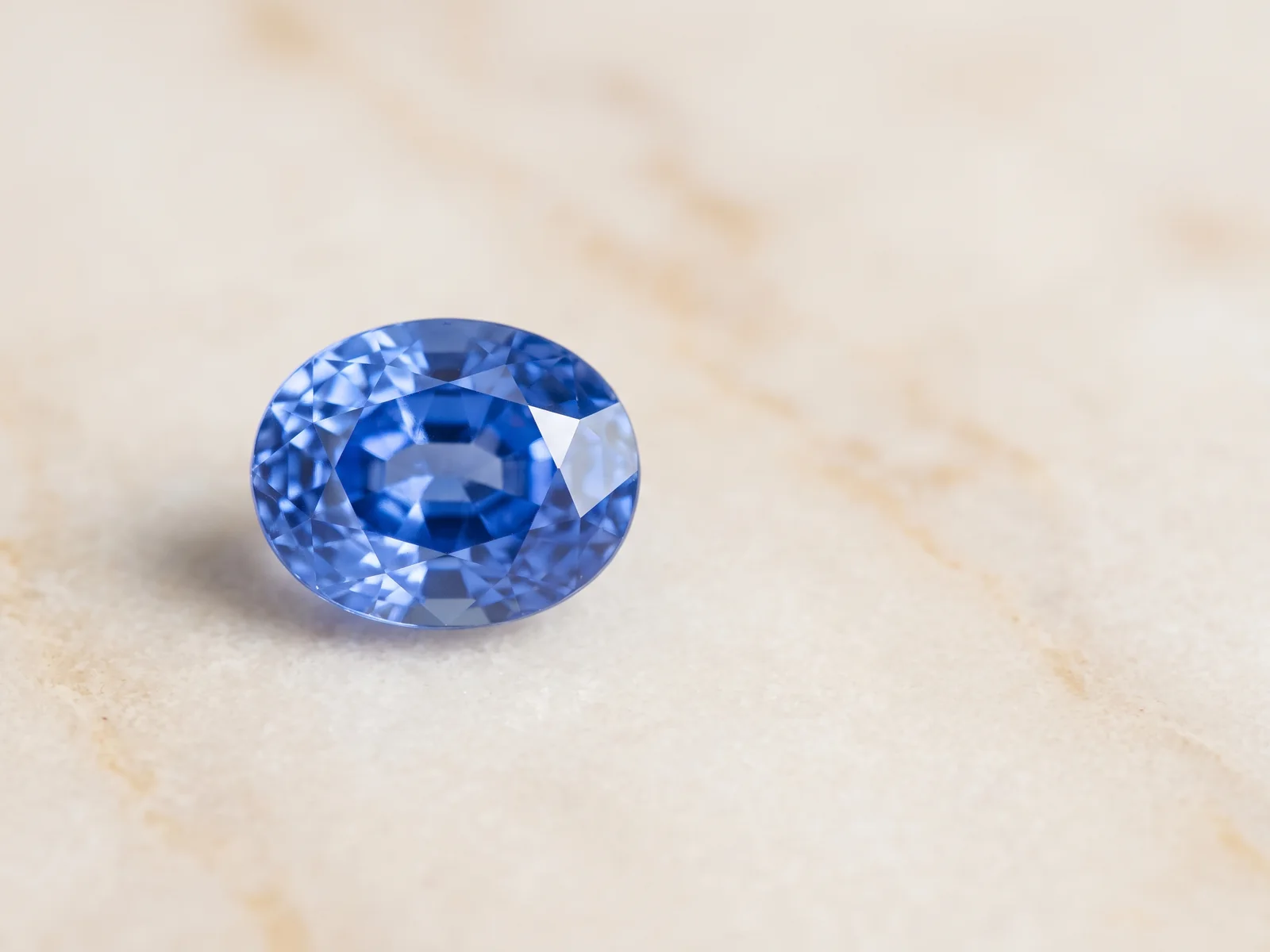
 Reviewed by Raj Sood, Graduate Gemologist (GIA), AJP (GIA)Master jeweller and Graduate Gemologist (GIA) · reviewed 4 November 2026
Quick answer
A lab-grown sapphire, ruby or emerald has the same chemistry, crystal structure and hardness as the natural gem, but is grown in a laboratory instead of underground. Lab-grown sapphire and ruby rate 9 on the Mohs scale; emerald rates 7.5–8. They usually cost far less than natural stones, and identifying them takes a gemologist's microscope.
What is a lab-grown sapphire, ruby or emerald?
A lab-grown sapphire is corundum, the same mineral as a mined sapphire, crystallised in a laboratory instead of deep in the earth. The same goes for lab-grown ruby, which is red corundum, and lab-grown emerald, which is green beryl. Gemologists also call these stones synthetic or lab-created. All three words mean the stone has a natural counterpart with identical chemistry and crystal structure. That is what separates them from imitations such as glass or cubic zirconia, which only look similar.
Ruby and sapphire are aluminium oxide (Al2O3). A trace of chromium turns it red, which makes ruby. Iron and titanium give blue sapphire, and other traces give pink, yellow, purple and the pink-orange padparadscha. Emerald is a beryllium aluminium silicate (Be3Al2Si6O18), coloured green by chromium, vanadium or both. Growers add the same trace elements, so a well-made lab-grown ruby shows the same red as a mined one under the same light.
The idea is the same as with diamonds, and our guide to how lab-grown diamonds work covers that side. Coloured lab gems actually came first. Lab-grown ruby has been sold for more than a century, decades before the first gem-quality laboratory diamonds. If you meet a word here you do not know, our glossary of jewellery terms explains it.
How are lab-grown sapphires, rubies and emeralds made?
There are four main ways to grow coloured gems. They differ in speed and cost, and each leaves its own clues inside the stone. Those clues matter later, because they are how a gemologist identifies a lab-grown stone.
| Method | Gems | How it works | Typical clues inside | Relative cost |
|---|---|---|---|---|
| Flame fusion (Verneuil) | Ruby, sapphire | Fine alumina powder falls through a hot oxy-hydrogen flame and builds up a carrot-shaped crystal (a boule) in a few hours | Curved growth lines, round gas bubbles | Lowest |
| Czochralski (pulling) | Ruby, sapphire | A seed crystal is slowly pulled upward from molten alumina, drawing a long crystal with it | Very clean; faint curved lines, occasional bubbles | Low to moderate |
| Flux growth | Ruby, sapphire, emerald | Ingredients dissolve in a molten chemical flux and crystallise slowly over weeks to months as it cools | Wispy flux 'fingerprints', platinum flakes from the crucible | Higher |
| Hydrothermal | Emerald, also ruby and sapphire | Crystals grow on a seed plate in a hot, high-pressure water solution inside a steel vessel (an autoclave) | Zigzag or chevron growth patterns, nail-head spikes | Higher |
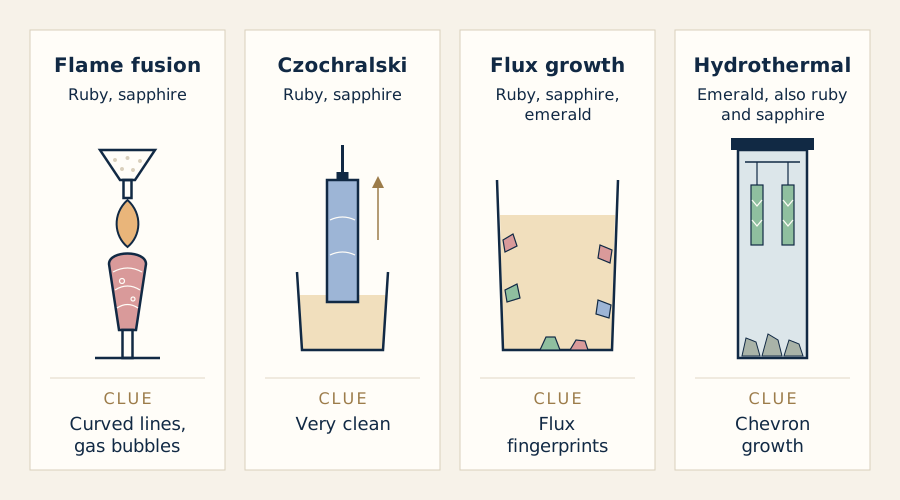
Flame fusion was refined by the French chemist Auguste Verneuil and announced in the early 1900s. It is still used today because it is fast and cheap. Most low-cost lab-grown rubies and sapphires in jewellery are flame fusion, and lab-grown corundum is also made into scratch-resistant sapphire watch glasses. Flux and hydrothermal stones take much longer to grow and tend to look more like natural gems inside, which is why they cost more.
Some well-known names are tied to these methods. Chatham (USA) has grown flux emeralds, rubies and sapphires since the mid twentieth century. Gilson (France) made flux emeralds from the 1960s. Kashan and Ramaura made flux rubies, and Biron hydrothermal emeralds were developed in Western Australia. None of these processes can be done safely on a kitchen bench, as we explain in whether you can grow a gemstone at home.
Are lab-created gemstones real or fake?
Lab-created gemstones are real. A lab-grown ruby is ruby in every physical sense: same mineral, same hardness, same refractive index (how strongly it bends light). What changes is where it formed and how it formed. It is still useful to separate four groups, because sellers sometimes blur them:
- Natural: formed in the earth and mined. It may or may not be treated.
- Lab-grown (synthetic, lab-created): the same material as the natural gem, grown by people. It must always be disclosed as lab-grown.
- Simulant (imitation): a different material that only looks similar, such as red glass, green glass, coloured cubic zirconia or lab-created spinel sold to look like sapphire.
- Composite: pieces glued or fused together, such as a doublet with a natural sapphire top and a synthetic base, or a ruby filled with lead glass.
Treatments are a separate question from origin. Many natural sapphires and rubies are heated to improve their colour, and most natural emeralds are filled with oil or resin to hide surface-reaching cracks. A good grading report states the origin (natural or synthetic) and any treatment detected. Under Australian Consumer Law, a seller must not mislead you about either.
Coloured diamonds are now grown in labs too, so a red or pink stone could be a lab-grown diamond rather than a ruby. See lab-grown diamonds in pink, blue and yellow for how those compare.
Lab-grown vs natural sapphire, ruby and emerald: what is the difference?
Chemically, there is no difference. The differences are in what the stone carries inside, how it has been treated, what it costs and the story behind it.
| Natural | Lab-grown | |
|---|---|---|
| Chemistry and structure | Corundum (ruby, sapphire) or beryl (emerald) | Identical |
| Hardness (Mohs) | Ruby and sapphire 9; emerald 7.5–8 | Identical |
| Refractive index | Corundum about 1.762–1.770; emerald about 1.57–1.60 | Corundum identical; flux emerald slightly lower, about 1.56 |
| Typical inclusions | Rutile needles (silk), mineral crystals, healed fractures, emerald 'jardin' | Curved lines, gas bubbles, flux fingerprints, chevron growth, or very clean |
| Usual treatments | Heat common in ruby and sapphire; oil or resin in most emeralds | Usually none needed |
| Large, rich-coloured stones | Rare and costly | Easy to grow |
| Price | Driven by rarity, origin and colour | Driven mostly by growth method and cutting |
Emerald shows the gap most clearly. Natural emeralds almost always contain inclusions, so many that the trade calls them the jardin (French for garden), and most are oiled. Lab-grown emeralds are usually much cleaner and do not need oiling. They can actually be a little easier to live with, because there are fewer cracks for heat, chemicals or a knock to open up.
With sapphire, many Australians prefer the story of a natural stone, perhaps from the Queensland gemfields around Anakie or the New England region of New South Wales. That is a personal choice, not a quality difference you can see. Neither type should be bought as an investment. Natural coloured stones are hard to resell for what you paid, and lab-grown stones have very little resale value.
If environmental impact matters to you, keep in mind that growing crystals uses a lot of energy and that mining footprints vary widely. Neither type is automatically the greener option. The questions to ask about lab-grown sustainability claims apply just as well to coloured gems.
Not sure which one is right?
Send us the stones you are looking at and our gemologist will tell you which to choose and why.
Is a lab-grown sapphire a good alternative to a diamond?
Colourless lab-grown sapphire, usually sold as white sapphire, is sometimes offered as a diamond alternative, and coloured lab-grown gems are often chosen in place of a diamond centre. It helps to see the numbers side by side. Dispersion is how strongly a stone splits white light into rainbow flashes, which jewellers call fire.
| Stone | Mohs hardness | Refractive index | Dispersion (fire) | Toughness | How it looks |
|---|---|---|---|---|---|
| Lab-grown diamond | 10 | 2.42 | 0.044 | Good (can cleave) | Bright, strong sparkle and fire |
| Moissanite (lab-created) | 9.25 | 2.65–2.69 | 0.104 | Good | Very fiery, strong rainbow flashes |
| Lab-grown white sapphire | 9 | 1.76–1.77 | 0.018 | Excellent (no cleavage) | Softer, glassier sparkle |
| Lab-grown ruby or coloured sapphire | 9 | 1.76–1.77 | 0.018 | Excellent | Colour is the feature |
| Lab-grown emerald | 7.5–8 | about 1.56–1.58 | 0.014 | Fair (brittle) | Colour is the feature; little sparkle |
Corundum, the mineral in ruby and sapphire, is the hardest gem after diamond and moissanite. It is also tough, because it has no cleavage planes, the flat directions along which a diamond can split. For everyday wear that is a real strength. The trade-off is light. With a refractive index around 1.77 against diamond's 2.42, and less than half the dispersion, a white sapphire returns less light and shows little fire. It also picks up a film of skin oil and dulls faster between cleans. We compare the two in detail in lab-grown diamond versus white sapphire, and the fierier option is covered in moissanite compared with lab-grown diamond.
Coloured stones are a different decision. People choose a ruby or blue sapphire for the colour, not to look like a diamond. If you are weighing a red centre against a white one, read ruby or diamond for an everyday ring. Lab-grown emerald is the softest and most brittle of the three, so it suits careful wear and protective settings better than a ring worn to the gym.
How can you tell if a sapphire, ruby or emerald is lab-grown?
Usually you cannot tell by eye, and the tools sold online do much less than people hope. Here is what each common test can and cannot tell you.
- Diamond tester (thermal or electrical): it reads 'not diamond' for every sapphire, ruby and emerald, natural or lab-grown. It separates diamond from other stones. It does not separate natural from lab-grown.
- Refractometer: it measures refractive index and confirms whether a stone is corundum or beryl. It cannot separate lab-grown from natural corundum. For emerald it gives a useful clue, because flux-grown emerald reads lower (about 1.561–1.564) than most natural emerald (about 1.57 and up).
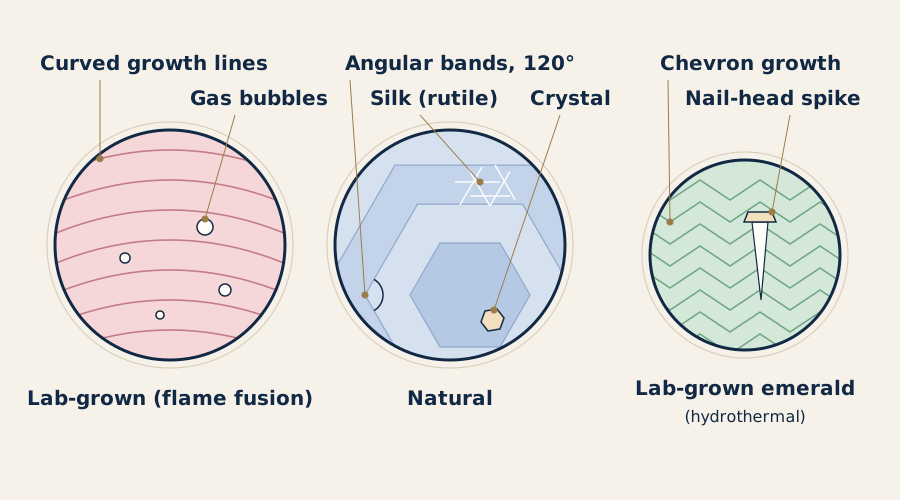
- 10× loupe and microscope: this is the main tool. Curved growth lines and round gas bubbles point to flame-fusion ruby or sapphire. Natural corundum shows straight, angular colour bands and fine rutile needles. Flux fingerprints, platinum flakes, chevron growth and nail-head spikes point to a flux or hydrothermal stone.
- UV lamp: lab-grown rubies often glow a strong red under ultraviolet light, and many flux emeralds glow red too. Some natural rubies, especially low-iron stones, glow just as strongly, so UV is a clue and not proof. Our guide to how UV fluorescence shows up in lab-grown diamonds explains the principle.
- Gem laboratory testing: spectroscopy and trace-element analysis at labs such as GIA, SSEF or GRS can confirm origin when the stone is very clean and shows no clues under the microscope.
| Gem | Common lab-grown clues | Common natural clues |
|---|---|---|
| Ruby | Curved lines, gas bubbles, flux fingerprints, platinum flakes, very strong red UV glow | Silk (rutile needles), mineral crystals, straight angular colour zoning |
| Blue sapphire | Curved colour banding, bubbles; very even colour | Hexagonal colour zoning, silk, crystals, fingerprints |
| Emerald | Chevron or zigzag growth, nail-head spikes, flux veils, lower RI and specific gravity | Three-phase inclusions (liquid, gas and crystal), jardin, oil in fractures |
How much do lab-grown sapphires, rubies and emeralds cost in Australia?
Lab-grown coloured gems cost far less than natural stones of similar appearance. Within lab-grown stones, the growth method makes the biggest difference to price. The figures below are broad retail guides for loose, well-cut stones in Australian dollars. Prices vary with colour, size, cutting quality and the grower.
| Stone | Approximate price per carat (AUD) |
|---|---|
| Flame-fusion lab-grown ruby or sapphire | about $20–$150 |
| Flux or hydrothermal lab-grown ruby or sapphire | about $150–$800 |
| Lab-grown emerald (flux or hydrothermal) | about $150–$800 |
| Natural blue sapphire, 1 ct, good colour | about $1,500–$8,000 |
| Natural ruby, 1 ct, good colour | about $2,500–$20,000 |
| Natural emerald, 1 ct, good colour | about $1,500–$12,000 |
On the cheapest flame-fusion stones, the cutting can cost more than the material, so a carefully cut lab stone is worth paying a little extra for. It will be well proportioned, with no dark 'window' in the centre. Many of the same forces move laboratory diamond prices, which we unpack in what sets lab-grown diamond prices.
If you are comparing a lab-grown coloured centre with a lab-grown diamond, compare like with like. See what to check in a 1 carat lab-grown diamond, what changes at 2 carats and sizing up to a 3 carat lab-grown centre.
Browse lab-grown diamonds
Is a lab-grown sapphire engagement ring good for everyday wear?
Ruby and sapphire, natural or lab-grown, are among the most practical gems for a ring worn every day. They are hard enough to resist scratching from household dust, which contains quartz at Mohs 7, and tough enough to shrug off ordinary knocks. Claw, bezel and halo settings all suit them. Ultrasonic cleaning is generally safe for untreated or lab-grown corundum.
Emerald needs more care. Keep it away from ultrasonic and steam cleaners, avoid sudden heat, and choose a setting that guards the corners. A bezel, a halo or the cropped corners of a classic emerald cut all help. Wash it in lukewarm soapy water with a soft brush.
Related guideRuby vs Sapphire Engagement RingsFor design ideas, see ruby engagement ring styles and settings and our side-by-side on choosing between ruby and sapphire for a ring. Even an inexpensive lab-grown stone can sit in a ring with real value in the metal and workmanship, so it is worth reading whether to insure lab-grown jewellery.
How do you buy a lab-grown gemstone? Step by step
- Decide what matters. Choose colour, budget and origin first. If a natural stone matters to you, make that clear from the start.
- Ask what it is, in writing. The invoice should say lab-grown, lab-created or synthetic, plus the gem name and the growth method if known.
- Ask for a report on higher-value stones. An independent lab report should state natural or synthetic and any treatments.
- Look at the cutting. Check for even colour, no dark or washed-out window in the centre, and a symmetrical outline.
- Check the millimetre size. Corundum is denser than diamond, so a 1 ct sapphire looks smaller than a 1 ct diamond. Compare measurements, not just weight.
- Match the setting to the stone. Claws or a bezel suit ruby and sapphire. Give emerald a protective bezel or halo, and plan on gentle cleaning.
Free consultation
Talk to a gemologist
Compare stones in person or online with Raj Sood, Graduate Gemologist (GIA), AJP (GIA).
Book a consultationShop this shape
FAQ
Common questions
Is a lab-grown sapphire a real sapphire?
Yes. It is corundum with the same chemistry, hardness (Mohs 9) and optical properties as a mined sapphire. It must always be described as lab-grown, lab-created or synthetic.
Can a jeweller tell if a ruby is lab-grown?
Often, yes, with a microscope. Curved growth lines, gas bubbles or flux inclusions are giveaways. Very clean stones may need testing at a gem laboratory, and a simple diamond tester cannot tell natural from lab-grown.
Are lab-grown emeralds worth it?
They suit people who want clean, rich green colour at a much lower price than natural emerald. They are still beryl at Mohs 7.5–8, so they need a protective setting and gentle care.
Why are some lab-grown sapphires so cheap?
Flame-fusion sapphire grows in hours from inexpensive powder, so the material costs very little. Flux and hydrothermal stones grow over weeks or months and cost more.
Does a lab-grown sapphire sparkle like a diamond?
No. Its refractive index is about 1.77 against diamond's 2.42, and it shows much less fire, so a white sapphire looks softer and glassier than a diamond.
Do lab-grown gemstones hold their value?
Lab-grown gems have very little resale value, so buy one for the look and the wear, not as a store of value. Natural coloured stones are also hard to resell for their retail price.

Ask a gemologist
Not sure which diamond to choose?
Raj Sood is a Graduate Gemologist (GIA) and master jeweller. Bring the stones you are considering, or send the reports, and he will tell you honestly which one is better and why.
Keep learning
Related guides
 GemstonesRuby vs Sapphire Engagement Rings
 Lab-Grown DiamondsLab-Grown Diamonds vs White SapphireLab-Grown DiamondsLab-Grown Diamond vs MoissaniteLab-Grown DiamondsLab-Grown Diamonds Guide
 Lab-Grown DiamondsShould a Lab-Grown Diamond Be Insured?
 Lab-Grown DiamondsLab-Grown Diamond Fluorescence Explained
 Lab-Grown DiamondsAre Lab-Grown Diamonds More Sustainable? Questions to Ask
 GemstonesRuby vs Diamond
Explore more
More guides on this topic
Education