
Gemstones
Paraiba Tourmaline Guide: Colour, Origins, Treatments, Value and Rings
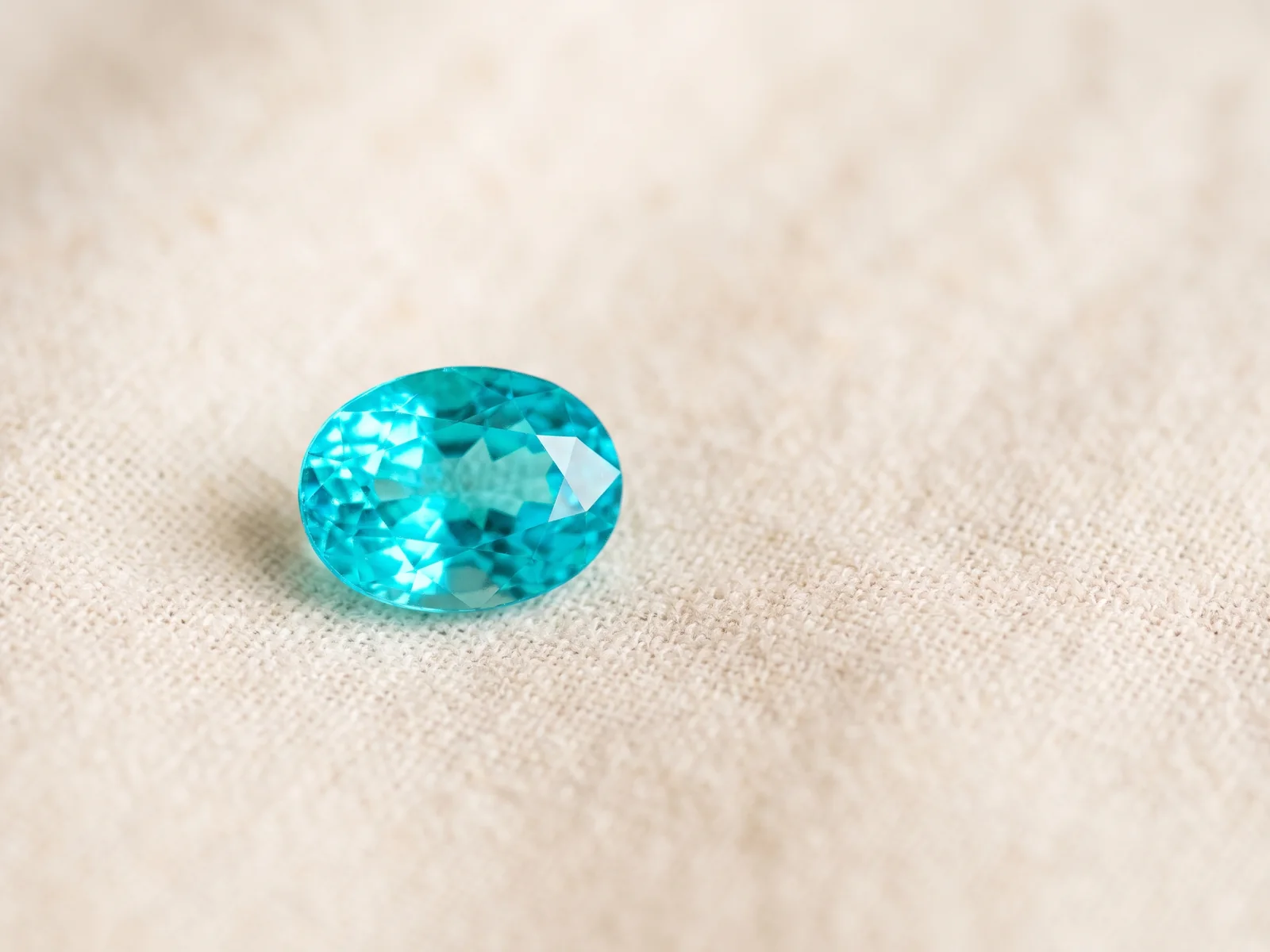
Paraiba tourmaline has a glowing blue-green colour that no other gem quite matches, and a price to go with it. This guide covers what makes a stone a true Paraiba, where it comes from, how it is treated and whether it suits a ring.
 Reviewed by Raj Sood, Graduate Gemologist (GIA), AJP (GIA)Master jeweller and Graduate Gemologist (GIA) · reviewed 4 November 2026
Quick answer
Paraiba tourmaline is a copper-bearing elbaite tourmaline with an intense neon blue to green colour, first found in Paraíba, Brazil, in the late 1980s and now also mined in Nigeria and Mozambique. It rates 7–7.5 on the Mohs scale with fair toughness, is often heated, and is priced mainly on colour saturation, size and clarity.
What is Paraiba tourmaline?
Paraiba tourmaline (often written Paraíba, after the Brazilian state) is a variety of elbaite, the lithium-rich member of the tourmaline group. What sets it apart from other blue and green tourmalines is copper. Copper in the crystal gives a saturated, almost electric blue to green colour that seems to glow even in dim light. Gem dealers call it neon. Most other tourmaline gets its colour from iron, manganese or other elements, and none of them produce quite the same effect. You can see how it fits into the wider tourmaline family in our main tourmaline guide.
The name started as a place: the first stones came from a single hill near the village of São José da Batalha in Paraíba state. Copper-bearing tourmaline was later found in the neighbouring state of Rio Grande do Norte, then in Nigeria and Mozambique. The Laboratory Manual Harmonisation Committee (LMHC), a group of major gem labs that harmonises report wording, now treats 'Paraíba tourmaline' as a variety name, not a statement of origin. A stone can be called Paraíba tourmaline if it is blue, green-blue or green elbaite coloured by copper and manganese, wherever it was mined. Labs such as GIA may add a separate origin opinion on the report.
So there are two questions to ask about any Paraiba: is it copper-bearing tourmaline at all, and if so, where did it come from? The first decides the name; the second has a large effect on price. Both are covered below. For other coloured stones, start with our coloured gemstone guides, and if a term here is unfamiliar, our plain-English jewellery glossary explains it.
What colours does Paraiba tourmaline come in?
Paraiba tourmaline runs from electric or neon blue through turquoise and green-blue to mint and grass green, with violet-blue stones where manganese adds a red component. The most valued colour is a highly saturated, pure neon blue to slightly greenish blue, with no grey and no dark, inky areas. Brightness matters as much as hue: a fine Paraiba looks lit from within because copper colour holds up well even when little light enters the stone.
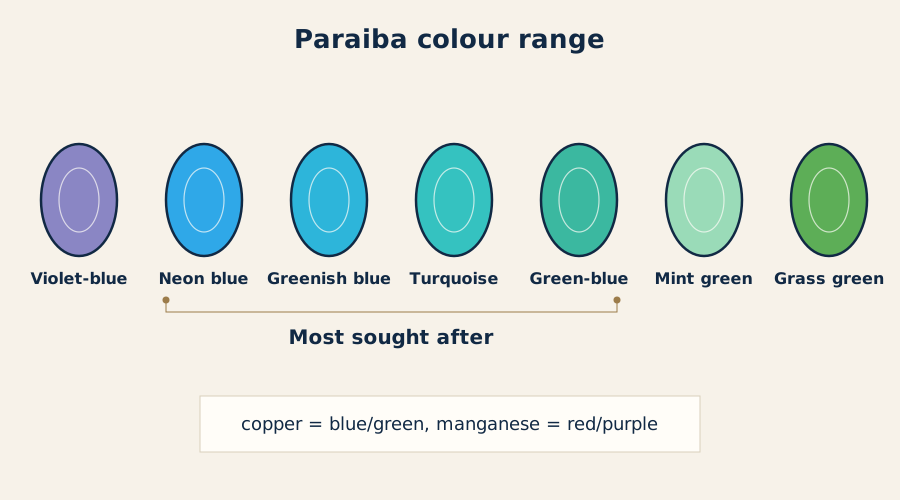
- Neon blue to turquoise: the classic Paraiba look, and the highest prices.
- Green-blue and bluish green: very popular, usually a little less per carat than pure blue of the same saturation.
- Green: still Paraiba if copper-bearing, but generally priced below the blues.
- Violet-blue: manganese adds red; purplish rough is often heated to remove the purple and leave blue.
- Pale or greyish: lower saturation, which lowers value sharply.
Tourmaline is strongly pleochroic, meaning it shows different colours or depths of colour when viewed along different directions in the crystal. Looking down the long axis of a tourmaline crystal often gives a darker colour than looking across it, so cutters orient the rough carefully. In a Paraiba, a poorly oriented stone can look darker or greener face-up (from the top) than it should.
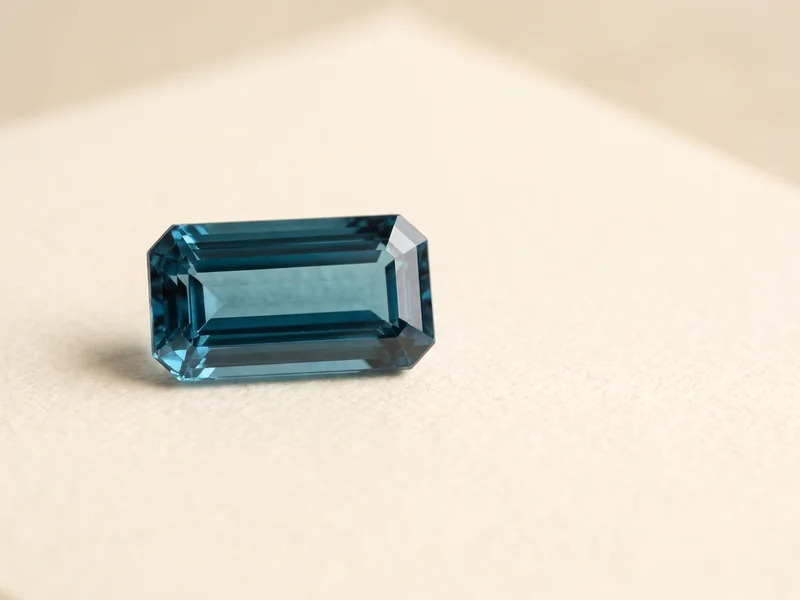
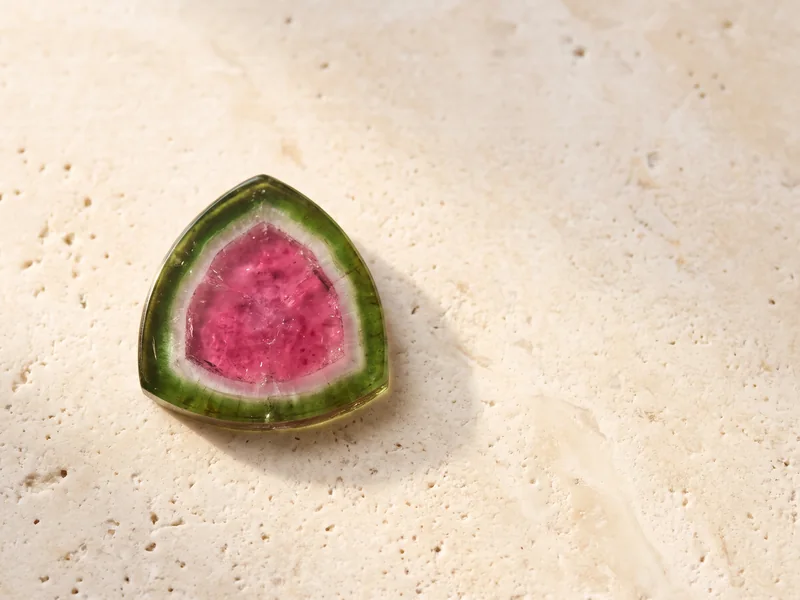
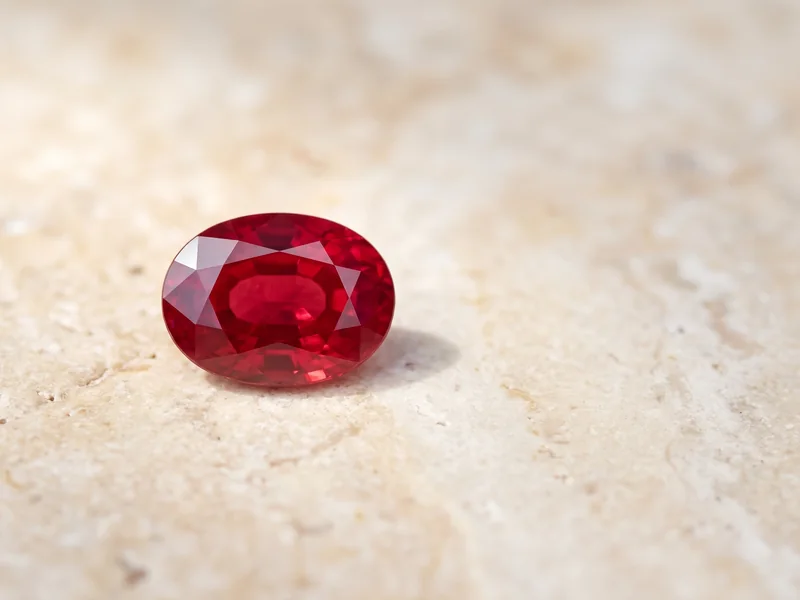
It helps to compare Paraiba with its relatives. Indicolite, the non-copper blue tourmaline, is coloured mainly by iron and tends towards a deeper, inkier blue that can go dark at night. Tourmaline also comes in rubellite's rich reds and pinks and in pink-and-green watermelon tourmaline, where colour zones sit in one crystal. None of these has the copper glow.
Where does Paraiba tourmaline come from? Brazil, Nigeria and Mozambique
Brazilian Paraiba tourmaline was found by prospector Heitor Dimas Barbosa, who worked the São José da Batalha hill for several years before gem crystals turned up in 1987. The stones reached the international market around 1989, and prices climbed quickly as demand outstripped supply. The Brazilian deposits are small, hard-rock workings, and production from them has been sporadic for many years. Most fine Brazilian stones are under 1 carat cut, and clean stones over a few carats are rare.
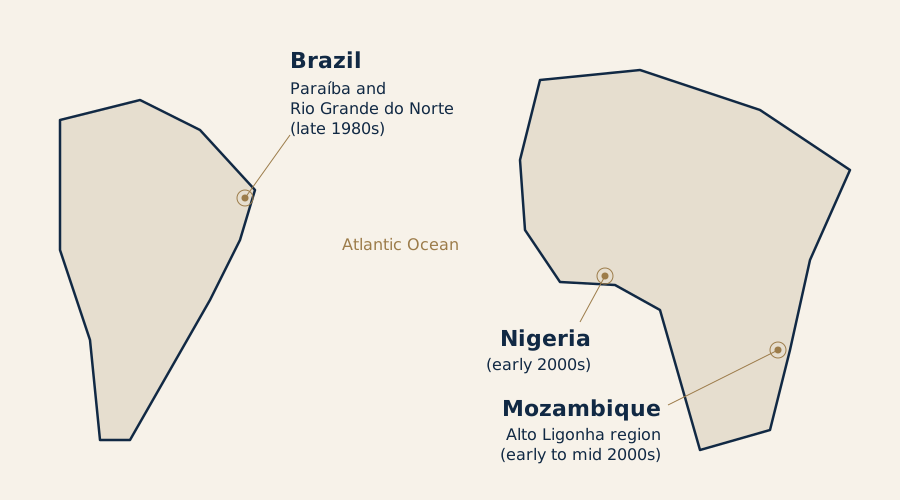
Copper-bearing tourmaline was reported from Nigeria in the early 2000s and from Mozambique (the Mavuco area of the Alto Ligonha region) a few years later. Mozambique Paraiba tourmaline now supplies most of the market. It often forms larger crystals than the Brazilian material, so 3 to 10 carat stones appear more often, and colours range from neon blue to green, sometimes a little softer in saturation than the top Brazilian stones. Nigerian production has been limited.
| Origin | Known since | Typical cut sizes | Character |
|---|---|---|---|
| Brazil (Paraíba and Rio Grande do Norte) | Late 1980s | Mostly under 1 ct | Often the most saturated neon blues; highest price per carat |
| Nigeria | Early 2000s | Mostly small to medium | Blue to green; limited production |
| Mozambique | Early to mid 2000s | 1–10 ct+ available | Wide colour range; main current supply; larger clean stones |
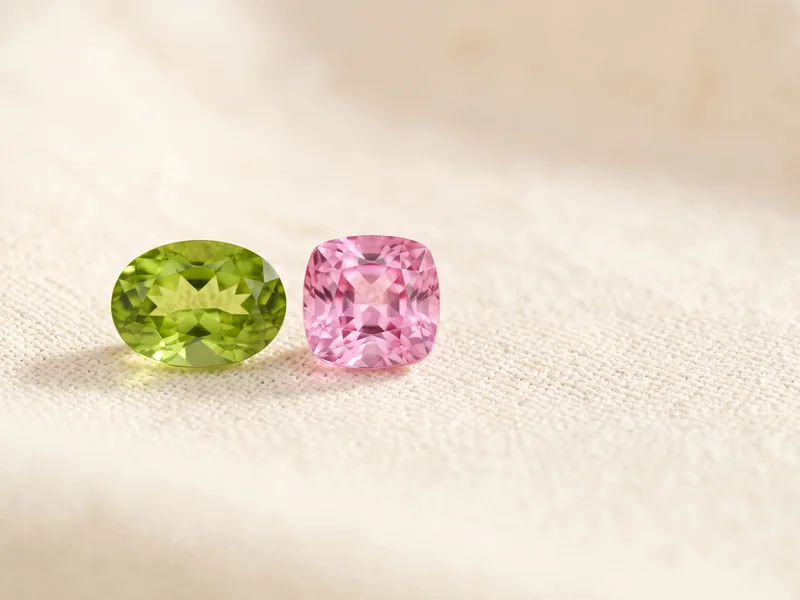
What about Australia? Tourmaline does occur here, and we cover local sources in our guide to tourmaline and opal as October birthstones. However, no copper-bearing Paraiba-type tourmaline has been mined commercially in Australia that we are aware of. A Paraiba sold in Australia will almost always be from Brazil, Mozambique or Nigeria.
Because the name no longer guarantees Brazil, ask what the origin is and how it was established. Origin is decided by a lab, not by eye: labs measure trace elements such as gallium and lead, along with copper and manganese levels, using laser-based chemical analysis. Brazilian stones generally carry the highest copper concentrations, but there is overlap, and some reports will say origin could not be determined.
How hard is Paraiba tourmaline? Hardness and toughness for rings
Paraiba tourmaline hardness is 7–7.5 on the Mohs scale, which ranks scratch resistance. Everyday dust contains quartz at 7, so a gem at 7–7.5 resists most scratching but will slowly lose its sharp facet edges if worn hard for years. Toughness, resistance to chipping and breaking, is rated fair. Tourmaline has no easy cleavage, but it is brittle, and many Paraibas contain fractures and fluid inclusions that can be weak points.
| Gem | Mohs hardness | Toughness | Daily ring wear? |
|---|---|---|---|
| Diamond | 10 | Good (has cleavage) | Yes |
| Sapphire | 9 | Excellent | Yes |
| Tsavorite garnet | 7–7.5 | Good | Yes, with some care |
| Amethyst | 7 | Good | Yes, with some care |
| Paraiba tourmaline | 7–7.5 | Fair | Occasional wear, or a protective setting |
| Demantoid garnet | 6.5–7 | Fair | Occasional wear |
| Peridot | 6.5–7 | Fair | Occasional wear |
| Zircon | 6–7.5 | Poor (brittle edges) | Better in pendants and earrings |
| Apatite (a Paraiba lookalike) | 5 | Poor | Earrings and pendants only |
Other physical properties a gemmologist uses: a refractive index of about 1.62–1.64 (how strongly the stone bends light), birefringence of about 0.018–0.020 (the difference between its two refractive indices, which can make back facets look slightly doubled under a loupe) and a specific gravity of about 3.06. Tourmaline is also pyroelectric: warm it and it picks up an electric charge that attracts dust.
In practical terms, Paraiba sits alongside tsavorite garnet, a tougher green option for hardness, but is less tough. It is a step above demantoid garnet's fiery green and lime-green peridot, and more robust than blue zircon, whose facet edges wear quickly. Purple amethyst is a useful comparison as an everyday quartz at Mohs 7.
Not sure which one is right?
Send us the stones you are looking at and our gemologist will tell you which to choose and why.
Is Paraiba tourmaline treated? Treatments and lookalikes
Yes, often. The two common treatments are:
- Heat treatment: moderate heating reduces the red or purple contribution from manganese, turning violet-blue or purplish stones into purer blue or green-blue. It is stable and permanent, and labs usually cannot prove whether a Paraiba has been heated, so the trade generally assumes most stones may be heated.
- Clarity enhancement (fracture filling): oil or resin is pushed into surface-reaching fractures to make them less visible. It is detectable under magnification, often by a coloured flash in the fracture, and should be disclosed. Fillers can be damaged by heat, solvents and ultrasonic cleaners.
There is no lab-created Paraiba tourmaline on the jewellery market. Imitations and lookalikes are a bigger concern, because Paraiba's price makes them tempting to misdescribe. Here is how they compare:
| Stone | Mohs | Refractive index | How a gemmologist tells them apart |
|---|---|---|---|
| Paraiba tourmaline | 7–7.5 | 1.62–1.64, birefringence 0.018–0.020 | Copper confirmed by chemical analysis; strong pleochroism |
| Indicolite (blue tourmaline) | 7–7.5 | 1.62–1.64 | Same optics but no copper; usually darker, inkier blue |
| Neon blue apatite | 5 | 1.63–1.64, birefringence about 0.002–0.008 | Overlapping RI but far lower birefringence; soft, scratched facets |
| Blue zircon | 6–7.5 | 1.92–1.98 | Much higher RI, strong facet doubling, chipped edges |
| Lab-created spinel or glass | 8 / 5–6 | about 1.72 / 1.50–1.70 | Singly refractive; glass may show gas bubbles |
| 'Paraiba quartz' | 7 | 1.54–1.55 | Quartz with copper mineral inclusions, not tourmaline |
Because apatite and indicolite overlap with Paraiba in refractive index, basic tests cannot confirm copper. For any stone sold as Paraiba, an independent lab report (GIA, SSEF, Gübelin, AGL or similar) stating 'copper-bearing tourmaline' or 'Paraíba tourmaline' is the reliable proof.
Related guideIndicolite TourmalineWhat affects the value of Paraiba tourmaline?
In order of influence, the factors are colour, origin, size, clarity and cut.
- Colour: saturation and brightness come first. A vivid neon blue can cost several times as much as a pale or greenish stone of the same size.
- Origin: a lab origin opinion of Brazil typically adds a large premium over Mozambique or Nigeria for comparable colour.
- Size: price per carat rises steeply with size, especially for Brazilian stones, where anything over 1–2 carats in fine colour is scarce.
- Clarity: Paraiba is usually included. Eye-clean stones (no inclusions visible without magnification) command a clear premium, and filled fractures lower value.
- Cut: many stones are cut to save weight, leaving deep bellies or windows (washed-out centres where light passes straight through). A well-proportioned cut that shows even colour face-up is worth paying for.
Prices vary enormously and the market for top Brazilian material is thin, so treat these as rough guides only:
| Paraiba tourmaline type | Approximate price per carat (AUD) |
|---|---|
| Mozambique or Nigeria, lighter colour or included, under 1 ct | about $1,000–$5,000 |
| Mozambique, good saturated colour, 1–3 ct | about $5,000–$20,000 |
| Mozambique, fine neon colour, 5 ct and over | about $15,000–$40,000+ |
| Brazil, fine neon blue, under 1 ct | about $20,000–$60,000+ |
If those figures sit outside your budget, other gems give saturated colour for far less. The garnet family is a good place to look: bright orange spessartine garnet, raspberry-toned rhodolite garnet and warm cinnamon hessonite are all durable and well priced. Within tourmaline, a green or blue non-copper stone gives the look of the family at a fraction of Paraiba prices.
Browse natural gemstones
Is Paraiba tourmaline good for an engagement ring?
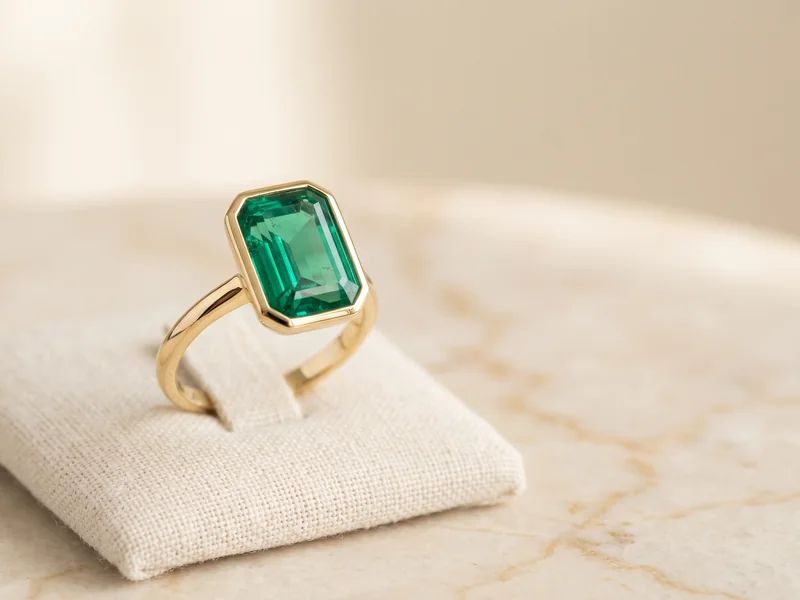
A Paraiba tourmaline engagement ring can work, but it needs more thought than a diamond or sapphire. At 7–7.5 hardness with fair toughness and frequent inclusions, a Paraiba worn every day will gradually show worn facet edges and is at some risk of chipping if knocked. Our guide to tourmaline engagement ring durability covers the trade-offs across all the colours.
- Choose a protective setting: a full or half bezel, or a halo, shields the edge and corners. Six claws are more secure than four.
- Avoid exposed points: pear, marquise and sharp-cornered shapes are more vulnerable than ovals, rounds and cushions.
- Watch for fractures: avoid stones with surface-reaching fractures near the girdle (the outer edge), where setting pressure is applied.
- Consider the use: for daily wear on the hand, a Paraiba ring suits someone careful with their hands; for occasional wear, pendants and earrings, it is excellent.
Metal choice shapes the colour too. White gold and platinum keep the neon blue cool and crisp; yellow gold can push a green-blue stone greener, which some people love and others do not. Small diamonds or white sapphires around the stone add brightness without competing with the colour. Setting a Paraiba takes care: tourmaline does not like sudden heat, so the jeweller will remove the stone or protect it before any soldering or sizing work.
How do you care for Paraiba tourmaline jewellery?
Clean a Paraiba with warm water, a drop of mild dishwashing liquid and a soft toothbrush, then rinse and pat dry. Brush gently behind the stone, where soap and skin oils build up and dull the colour.
- No ultrasonic or steam cleaners: vibration and heat can extend fractures and damage fillers.
- Avoid heat and sudden temperature changes: take rings off before cooking over a hot stove or in a sauna.
- Keep away from solvents: acetone, perfume and harsh cleaners can affect fracture fillers.
- Store separately: diamonds and sapphires will scratch tourmaline, so keep each piece in its own pouch.
- Check the setting: have claws and bezels checked about once a year, and take the ring off for gym work, gardening and sport.
How do you buy a Paraiba tourmaline? Step by step
- Ask for a lab report. It should confirm copper-bearing tourmaline or 'Paraíba tourmaline', any clarity enhancement and, if given, an origin opinion.
- Judge colour in several lights. Look in daylight, warm indoor light and shade; the colour should stay bright and even.
- Check for windows and dark areas. Tilt the stone and look for a washed-out centre or inky patches at the ends.
- Look at the inclusions. A few are normal; avoid fractures reaching the surface, especially near the girdle or corners.
- Compare price per carat. Weigh colour, origin and size against the AUD ranges above, remembering that small differences in saturation move prices a lot.
- Plan the setting and wear. Choose a bezel, halo or six claws for a ring, and decide whether it will be worn daily or for occasions.
Free consultation
Talk to a gemologist
Compare stones in person or online with Raj Sood, Graduate Gemologist (GIA), AJP (GIA).
Book a consultationShop this shape
FAQ
Common questions
Why is Paraiba tourmaline so expensive?
Copper-bearing tourmaline has been found in only a few deposits in Brazil, Nigeria and Mozambique, and fine neon stones are a small part of that production. Demand has stayed high since the stones appeared in 1989, so saturated colour in larger sizes is scarce and priced accordingly.
Is Mozambique Paraiba tourmaline real Paraiba?
Yes. Under the LMHC naming convention, copper-bearing blue to green elbaite can be called Paraíba tourmaline regardless of origin. A Brazilian origin usually costs more, so check the lab report for an origin opinion.
What is the difference between Paraiba tourmaline and indicolite?
Both are blue tourmaline, but Paraiba is coloured by copper and has a bright neon glow, while indicolite is coloured mainly by iron and tends to look deeper and darker. Only a lab test can confirm copper.
Is Paraiba tourmaline treated?
Many stones are heated to remove purple tones and leave a purer blue, which is permanent and usually undetectable. Some are also fracture-filled with oil or resin, which a lab can detect and should list on the report.
Can you wear a Paraiba tourmaline ring every day?
You can with care. At Mohs 7–7.5 with fair toughness, it is best in a bezel, halo or six-claw setting and taken off for sport, gardening and heavy work.
Is there lab-created Paraiba tourmaline?
No lab-created Paraiba tourmaline is sold in jewellery. Stones offered as cheap 'Paraiba' may be apatite, glass, lab-created spinel or quartz with copper inclusions, so ask for an independent lab report.

Ask a gemologist
Not sure which diamond to choose?
Raj Sood is a Graduate Gemologist (GIA) and master jeweller. Bring the stones you are considering, or send the reports, and he will tell you honestly which one is better and why.
Keep learning
Related guides
 GemstonesTourmalineGemstonesIndicolite Tourmaline
 GemstonesTourmaline Engagement Rings: Colour and DurabilityGemstonesGemstones | Coloured Gemstones, Birthstones and Custom Jewellery
 GemstonesWatermelon Tourmaline
 GemstonesRubellite Tourmaline
 GemstonesOctober Birthstone: Opal and Tourmaline
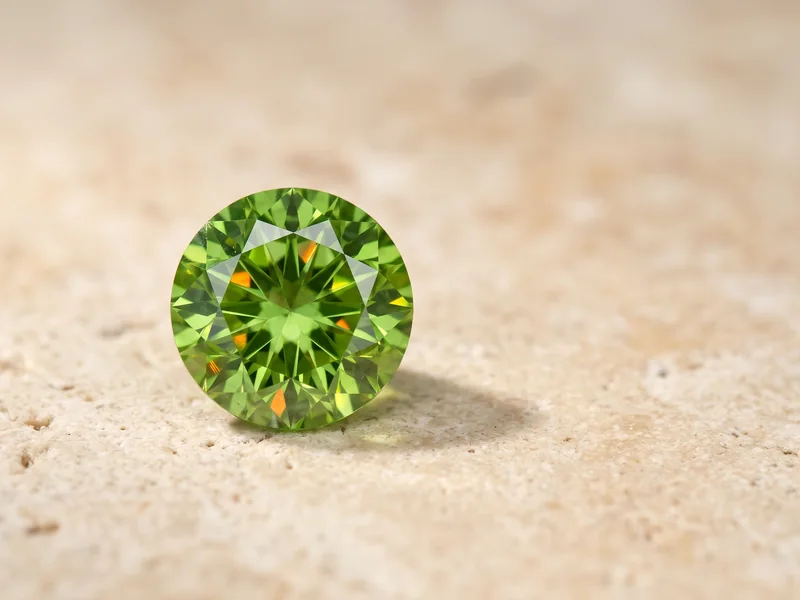 GemstonesTsavorite Garnet
Explore more
More guides on this topic
Education