
Gemstones
Morganite: The Complete Gemstone Guide
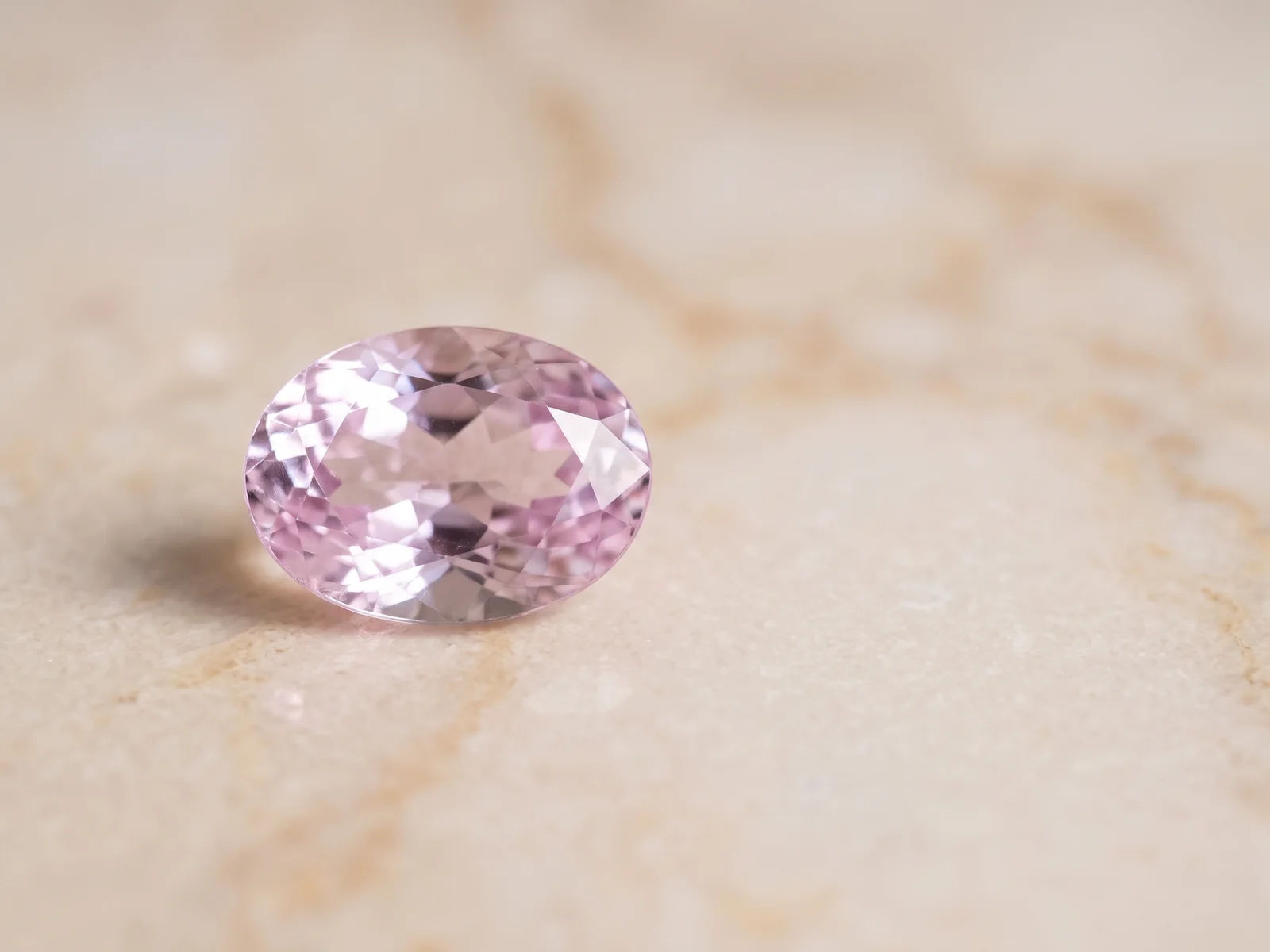
Morganite is one of the most popular pink gems for engagement rings, and one of the most misunderstood. Here is what it is, how it wears, how it is treated and what really decides its value.
 Reviewed by Raj Sood, Graduate Gemologist (GIA), AJP (GIA)Master jeweller and Graduate Gemologist (GIA) · reviewed 4 November 2026
Quick answer
Morganite is the pink to peach variety of beryl, the same mineral as emerald and aquamarine, coloured by manganese. It rates 7.5–8 on the Mohs scale, is usually eye-clean and is often heated to remove yellow. It suits engagement rings with a protective setting and regular cleaning, and costs far less per carat than pink sapphire.
What is morganite?
Morganite is the pink, peach and salmon-coloured variety of beryl, a beryllium aluminium silicate with the formula Be3Al2Si6O18. Beryl is colourless when pure. Tiny amounts of other elements give each variety its colour: chromium or vanadium makes emerald, iron makes aquamarine (blue) and heliodor (yellow), and manganese makes morganite.
The gem was identified in pink beryl found in Madagascar around 1910 and named in 1911 by George F. Kunz, Tiffany & Co.'s gemologist, after the banker and gem collector J.P. Morgan. Before that, pink beryl was simply called pink beryl, and you will still see both names on gem reports.
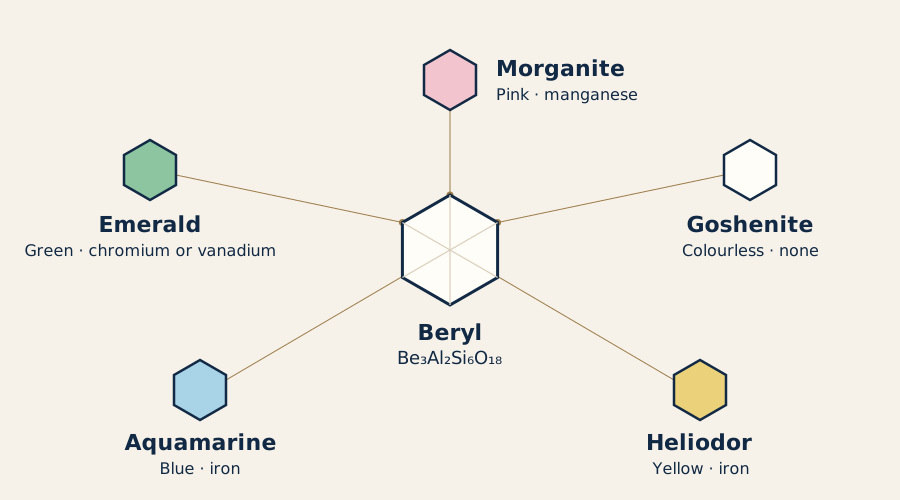
Because it shares beryl's structure, morganite also shares beryl's habits: it grows as large six-sided (hexagonal) crystals, it is often very clean inside, and it has a glassy (vitreous) lustre. It sits alongside sapphire, spinel and garnet in our coloured gemstone guides, and any unfamiliar term here is defined in our jewellery glossary.
What colour is morganite?
Morganite colour runs from very pale blush pink through peach and salmon to a purplish pink. The colour is always light to medium in tone; even the most saturated morganite is softer than a fine pink sapphire. The main colour families:
- Pale pink or blush: the most common. Pretty in a large stone, but can look almost colourless under 1 carat.
- Peach and salmon: pink with an orange or yellow component. Many stones come out of the ground this way; unheated peach morganite has become popular in its own right.
- Medium pink to purplish pink: the most valued trade colour. Usually the result of gentle heating that removes the yellow.
- Orange-pink: warmer and deeper, sometimes sold as "apricot" morganite.
Morganite is pleochroic, which means it shows slightly different colours when viewed from different directions: typically a paler pink one way and a deeper bluish or purplish pink the other. Cutters orient the rough to put the stronger colour face-up.
Size matters more for morganite than for most gems. Because the colour is light, a bigger stone holds a deeper body of colour. Most people find the pink reads clearly from about 8 × 6 mm (roughly 1.2 carats) in an oval, and many morganite engagement rings use 9 × 7 mm or larger. If you prefer a stronger yellow rather than pink, beryl's yellow variety, heliodor, is soft in colour too; our yellow sapphire guide covers a harder, more saturated option.
How hard is morganite? Hardness, toughness and key properties
Morganite hardness is 7.5–8 on the Mohs scale, the scratch-resistance scale where diamond is 10 and quartz is 7. Hardness is only half the story. Toughness is resistance to chipping and breaking, and beryl rates fair to good: it has an indistinct cleavage (a direction it can split along) and can chip on a sharp knock, especially at facet edges and corners.
| Property | Morganite |
|---|---|
| Mineral species | Beryl |
| Chemical formula | Be3Al2Si6O18 with manganese |
| Crystal system | Hexagonal |
| Mohs hardness | 7.5–8 |
| Toughness | Fair to good |
| Cleavage | Indistinct (basal) |
| Refractive index | about 1.572–1.600 |
| Birefringence | about 0.008–0.009 |
| Specific gravity | about 2.71–2.90 |
| Pleochroism | Weak to moderate: pale pink and bluish pink |
| Lustre | Vitreous (glassy) |
For a ring worn every day, what matters is how morganite compares with the other gems people consider. This table sets out hardness and toughness side by side:
| Gem | Mohs hardness | Toughness | Everyday ring wear |
|---|---|---|---|
| Diamond | 10 | Good (has cleavage) | Excellent |
| Sapphire and ruby | 9 | Excellent | Excellent |
| Alexandrite (chrysoberyl) | 8.5 | Excellent | Excellent |
| Spinel | 8 | Good | Very good |
| Morganite | 7.5–8 | Fair to good | Good with a protective setting |
| Tourmaline | 7–7.5 | Fair | Fair; better for occasional wear |
| Garnet | 6.5–7.5 | Fair to good | Fair to good, depending on species |
| Tanzanite | 6–7 | Poor to fair | Occasional wear; needs protection |
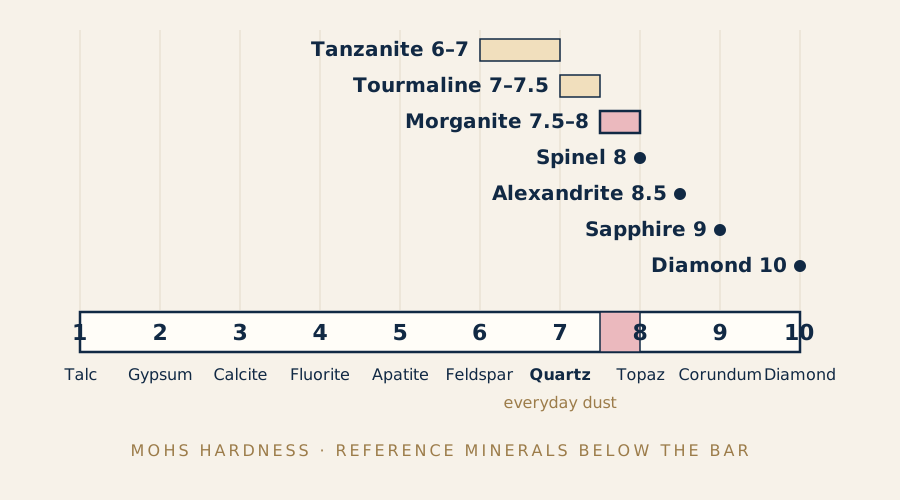
Sapphire, including star sapphire and star ruby, and the chrysoberyl behind alexandrite engagement rings are harder and tougher. Spinel is a close match with a little more durability. Morganite outperforms the tourmaline family, most garnet and especially tanzanite for daily wear.
Is morganite treated? Heat treated morganite and other treatments
Most morganite on the market has been heated. Rough often comes out of the ground peach or orange-pink because it contains a yellow colour component alongside the manganese pink. Heating at relatively low temperatures, a few hundred degrees Celsius, removes that yellow and leaves a purer pink. The result is permanent and stable in normal wear, and it cannot usually be detected, so labs often assume it.
- Heat treatment: very common, stable, generally accepted in the trade. Unheated pink is uncommon; unheated peach is more available.
- Irradiation: used on some pale beryl to create or deepen colour. Less common for morganite, and some irradiated colours can be less stable in strong light.
- Fracture filling: occasionally used on included stones to hide surface-reaching cracks with oil or resin. Less common than in emerald, but it does occur in lower grades.
- Coatings: very rare in fine morganite, but seen on cheap pale beryl to add colour. A coating can wear or scratch off.
Heat is the treatment you will meet almost every time, and it does not reduce durability. Our guide to heated and unheated gemstones explains how the market prices each. Fillings are a different matter: they need gentler cleaning and should always be disclosed. How fracture filling works covers what to look for.
Not sure which one is right?
Send us the stones you are looking at and our gemologist will tell you which to choose and why.
Where is morganite found?
Morganite forms in granite pegmatites, coarse-grained rocks that crystallised slowly from mineral-rich fluids, which is why it can grow into large, clean crystals. The main sources:
- Brazil: Minas Gerais is the largest commercial source, supplying much of the pink and peach material in jewellery.
- Madagascar: where morganite was first named; known for fine, more saturated pink.
- Mozambique, Namibia and Nigeria: important African sources of commercial and fine material.
- Afghanistan and Pakistan: pegmatites in the Hindu Kush and Karakoram produce good crystals.
- United States: historic production in San Diego County, California, and in Maine.
Australia has beryl-bearing pegmatites, and aquamarine and other beryl have been found in places such as Western Australia, New South Wales and the Northern Territory, but Australia is not a commercial source of gem morganite. If an Australian origin is offered for a morganite, ask for the evidence.
Unlike sapphire or emerald, origin has little effect on morganite's price. Colour, size and cutting matter far more, and most gem reports do not state a morganite's origin at all.
How do gemologists identify morganite?
Several pink gems look like morganite, so identification relies on measurements rather than the eye. A refractometer reads the refractive index (how much the stone bends light): morganite sits at about 1.57–1.60 with low birefringence. A dichroscope shows its two pleochroic colours, a polariscope confirms it is doubly refractive, and specific gravity separates it from glass and quartz. Our guide to the instruments gemologists use explains each tool.
Under the microscope, natural morganite often shows liquid "fingerprints", fine parallel growth tubes and two-phase inclusions (a fluid with a gas bubble). These inclusions point to a natural stone, though a lab report is the way to rule out lab-created beryl.
| Lookalike | How it differs from morganite |
|---|---|
| Pink glass | Single refraction, often gas bubbles and swirl marks; softer, around 5–6 Mohs |
| Lab-created spinel | Single refraction, higher RI (about 1.72) |
| Lab-created pink sapphire | Much higher RI (about 1.76–1.77), harder at 9 |
| Pink cubic zirconia | Very high RI and strong fire; heavy in the hand |
| Kunzite | Natural, RI about 1.66–1.68, strong pleochroism and perfect cleavage |
| Pink topaz | Natural (often treated), RI about 1.63; often heated or coated |
| Pink tourmaline | Natural, RI about 1.62–1.64, stronger pleochroism and higher birefringence |
Lab-created pink beryl, grown hydrothermally (in hot water under pressure), does exist but is uncommon in jewellery. Any lab-grown stone must be sold as lab-created or synthetic, never as just "morganite". Very cheap "morganite" online is often glass or a lab-created simulant. Our guide to natural and lab-grown gemstones compared explains how to tell the categories apart on paper.
How much is morganite worth? Morganite price per carat
Morganite is affordable compared with most pink gems. As rough guidance for loose, natural, heated stones, prices fall into these approximate ranges:
| Quality | Typical size | Approx. price per carat (AUD) |
|---|---|---|
| Pale pink or peach, commercial cut | 1–3 ct | about $60–$200 |
| Medium pink or fine peach, eye-clean, well cut | 2–5 ct | about $200–$500 |
| Strong pink, precision cut, excellent clarity | 5 ct+ | about $400–$1,000+ |
For comparison, fine pink sapphire prices commonly start at well over $1,000 per carat. Within morganite, value is decided by:
- Colour: the strongest factor. A clear, saturated pink with no grey or brown is the most valued; fine peach is close behind for many buyers.
- Size: large clean crystals are fairly common, so price per carat rises gently with size rather than sharply.
- Clarity: morganite is usually eye-clean, so visible inclusions reduce value noticeably.
- Cut: a well-proportioned stone with even colour and no window (a washed-out centre where light passes straight through) looks far livelier.
- Treatment: heating is expected; fracture filling or coatings lower value. Unheated pink can carry a modest premium.
Browse natural gemstones in our stock
Is morganite good for an engagement ring?
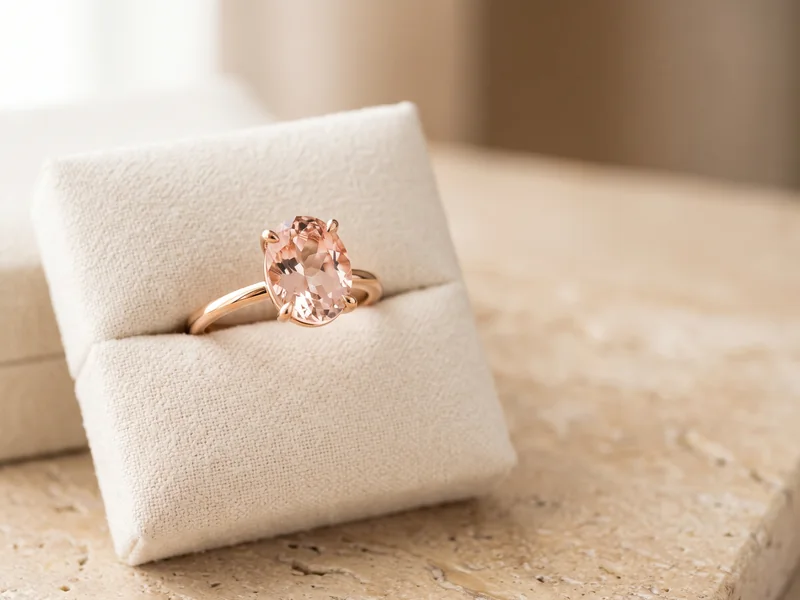
Yes, with sensible expectations. At 7.5–8 Mohs, morganite resists scratching from everyday dust, and its clean crystals and soft colour suit rose and yellow gold especially well. Three things to plan for:
- Facet wear: over years of daily wear, facet edges can abrade and lose crispness. A repolish restores them.
- Chipping: fair to good toughness means corners, points and the girdle (outer edge) need protection from knocks.
- Dirt shows: skin oil and lotion build up on the back of a light-coloured stone quickly and make it look grey and dull. Regular cleaning makes a big difference.
Settings that help: four or six claws rather than thin ones, a bezel or halo to guard the girdle, and oval, round or cushion shapes without sharp points. Avoid very low-profile designs that trap dirt you cannot reach. Our pros and cons of morganite engagement rings go into detail.
| Morganite | Pink sapphire | Spinel | Pink tourmaline | |
|---|---|---|---|---|
| Mohs hardness | 7.5–8 | 9 | 8 | 7–7.5 |
| Toughness | Fair to good | Excellent | Good | Fair |
| Typical colour | Pale to medium pink, peach | Light to vivid pink | Pastel to hot pink | Light to intense pink |
| Usually eye-clean | Yes | Often | Often | Often |
| Common treatment | Heating | Heating | Usually none | Sometimes heating or irradiation |
| Relative price | Lowest | Highest | Medium to high | Low to medium |
If daily durability is your priority, weigh morganite against pink sapphire before you choose.
Related guideMorganite vs Pink SapphireHow to clean and care for morganite: step by step
- Soak in warm soapy water. A few drops of mild dishwashing liquid in warm (not hot) water, for 10–15 minutes.
- Brush behind the stone. Use a soft toothbrush on the underside, where oil and lotion collect and dull the colour.
- Rinse and dry. Rinse in clean warm water and pat dry with a lint-free cloth.
- Check before ultrasonic; skip steam. Ultrasonic cleaners are usually fine for clean, untreated morganite, but avoid them if the stone is included, fracture-filled or coated. Steam cleaning is not recommended. If you are unsure, ask a jeweller.
- Avoid knocks and shocks. Take the ring off for the gym, gardening and heavy work, and avoid sudden temperature changes.
- Store it separately. Keep it away from diamonds and sapphires, which can scratch it, in a soft pouch or lined compartment.
- Have the claws checked. A jeweller's check every 12 months catches worn claws and facet wear early.
Free consultation
Talk to a gemologist
Compare stones in person or online with Raj Sood, Graduate Gemologist (GIA), AJP (GIA).
Book a consultationShop this shape
FAQ
Common questions
Is morganite a real gemstone?
Yes. Natural morganite is a variety of the mineral beryl, the same species as emerald and aquamarine. Lab-created pink beryl and imitations also exist and must be disclosed as lab-created, synthetic or simulant.
Does morganite scratch easily?
Not easily. At 7.5–8 on the Mohs scale it resists everyday dust, which is mostly quartz at 7. Harder gems such as diamond and sapphire can scratch it, and facet edges can wear over many years.
Why does my morganite look dull or cloudy?
Almost always it is dirt. Skin oil, soap and lotion build up on the back of the stone and grey out its light colour; a soak in warm soapy water and a soft brush usually restores it.
Is morganite heat treated?
Most is. Gentle heating removes a yellow component to leave a purer pink, and the result is stable and permanent. Unheated peach morganite is also widely available.
Is morganite cheaper than pink sapphire?
Yes, usually much cheaper per carat. Pink sapphire is also harder and tougher, though its higher price mainly reflects rarity and demand.
What metal suits morganite?
Rose gold is the most popular pairing because it warms and deepens the pink. Yellow gold suits peach tones, while white gold and platinum give pale pink a cooler, crisper look.

Ask a gemologist
Not sure which diamond to choose?
Raj Sood is a Graduate Gemologist (GIA) and master jeweller. Bring the stones you are considering, or send the reports, and he will tell you honestly which one is better and why.
Keep learning
Related guides
 GemstonesMorganite for Engagement Rings: Pros and Cons
 GemstonesMorganite vs Pink Sapphire
 GemstonesPink Sapphire
 GemstonesHeated vs Unheated GemstonesGemstonesGemstones | Coloured Gemstones, Birthstones and Custom Jewellery
 GemstonesNatural Garnet Gemstones and Custom Garnet Jewellery
 GemstonesGlass Filling and Fracture Filling Explained
 GemstonesNatural vs Lab-Grown Gemstones for Engagement Rings
Explore more
More guides on this topic
Education