
Gemstones
Imperial Topaz Guide: Colour, Origins, Durability and Care
Imperial topaz is the warm golden-to-pink colour of topaz that collectors prize, and the name is used loosely enough to cause confusion. Here is what the term really means, how hard-wearing it is, and what decides the price.
 Reviewed by Raj Sood, Graduate Gemologist (GIA), AJP (GIA)Master jeweller and Graduate Gemologist (GIA) · reviewed 4 November 2026
Quick answer
Imperial topaz is the most valued colour of natural topaz: golden orange, pinkish orange or reddish orange, mostly from Ouro Preto in Brazil. It rates 8 on the Mohs scale but has perfect cleavage, so it can split from a hard knock. It suits pendants and earrings well, and rings with a protective setting.
What is imperial topaz?
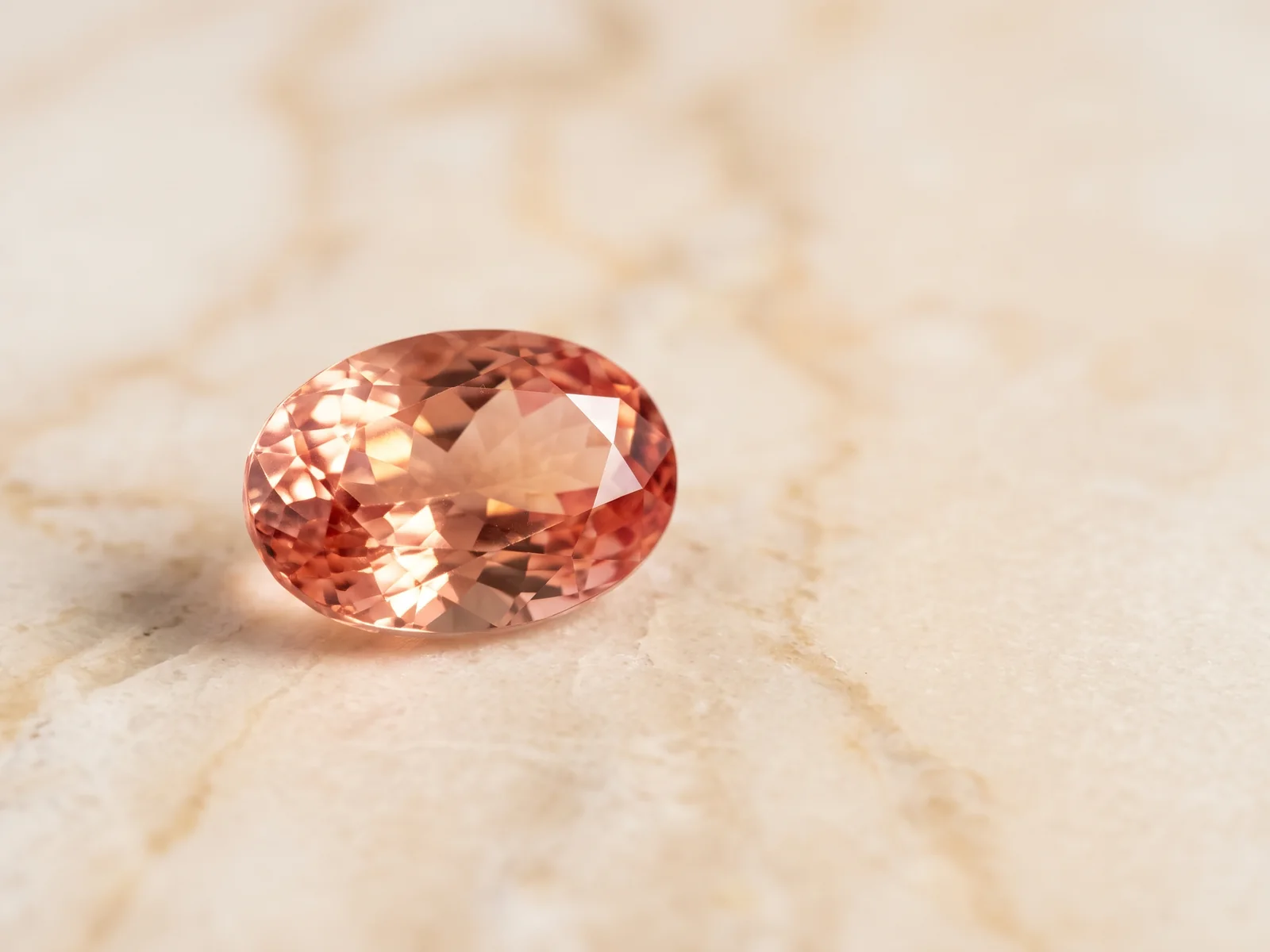
Topaz is an aluminium silicate mineral that contains fluorine and hydroxyl (chemical formula Al2SiO4(F,OH)2). Most topaz comes out of the ground colourless, pale blue or light brown. Imperial topaz is the trade name for its warmest, richest colours: golden orange, sherry, peach, pinkish orange and, rarely, reddish orange to red. It is one of the classic stones in our coloured gemstone guides, and alongside citrine it is the traditional November birthstone.
Gemmologically, imperial topaz is usually the hydroxyl-rich type of topaz, while colourless and blue topaz tend to be fluorine-rich. That small chemical difference gives imperial topaz slightly higher optical readings and a slightly lower density, and it is why the two types turn up in different deposits. The pinks and reds owe their colour to traces of chromium; the golden and orange tones come from colour centres, tiny defects in the crystal structure that absorb part of the light passing through.
There is no single, internationally agreed boundary for the name. Some sellers call any golden topaz imperial; stricter dealers and many gemmologists keep the term for orange with a distinct pink or red tone. When you see the word, ask what colour it actually describes. Older books also use precious topaz, a term coined to separate true topaz from citrine, which for decades was sold as 'topaz' or 'quartz topaz'. Any unfamiliar term in this guide is explained in our glossary of jewellery terms.
The name has two popular stories. One links it to the Russian tsars, whose pink topaz from the Ural Mountains was said to be reserved for the imperial family in the 19th century. The other credits a visit by Brazil's Emperor Pedro II to the mines at Ouro Preto. Neither can be proven, but both reflect how long this colour has been treated as something special.
What colour is imperial topaz?
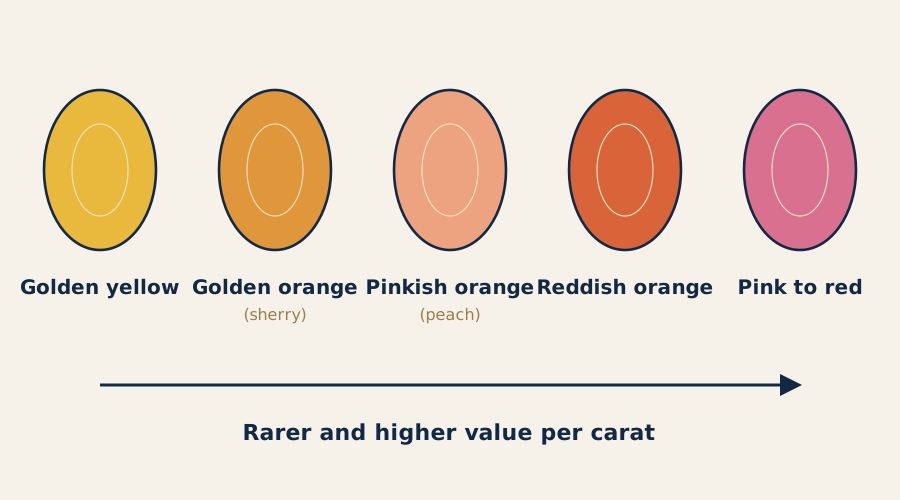
Imperial topaz covers a band of warm colour from golden yellow through orange into pink and red. Value climbs steeply as a pink or red tone appears, and as the colour becomes more saturated (more intense) without turning brown.
| Colour | How it looks | How the trade usually values it |
|---|---|---|
| Golden yellow to yellow-orange | Bright gold, sometimes with a light brownish cast | Entry level; often called imperial only loosely |
| Golden orange (sherry) | Warm orange like sherry or honey | The classic imperial colour; mid range |
| Pinkish orange (peach) | Orange with a clear pink secondary tone | Highly valued; many dealers' benchmark for true imperial |
| Reddish orange | Deep orange flashing red | Rare and much more costly per carat |
| Pink to red, violet-pink | Chromium pinks from Brazil and Pakistan | Rarest; often priced like fine pink gems |
Imperial topaz is strongly pleochroic: it shows different colours when you look at it from different directions. A single stone can show orange one way, yellow another and pink a third. Topaz crystals grow as long, pencil-like prisms, so cutters usually choose elongated shapes such as long ovals, pears and elongated cushions to save weight. In those shapes you will often see the colour deepen towards the ends, where light travels further through the stone.
Lighting matters too. Warm indoor light brings out the orange and gold; daylight shows the pink tones more honestly and reveals any brown. Look at a stone in both before deciding. Blue is the other well-known topaz colour, but almost all of it is treated colourless topaz, a very different stone in price and story; see our guide to blue topaz for that side of the family.
Where is imperial topaz found?
Most of the world's imperial topaz has come from one small region, which is part of why good stones are scarce.
- Ouro Preto, Minas Gerais, Brazil: the classic source, worked since the 18th century. The topaz is dug from weathered, clay-rich veins, and production is small and irregular. Nearly all the golden-orange to reddish-orange stones on the market come from here.
- Katlang, Mardan district, Pakistan: known for natural pink to violet-pink topaz coloured by chromium, usually in small sizes.
- Ural Mountains, Russia: the historic source of the pink topaz linked to the tsars; little new material reaches the market today.
- Other localities: warm-coloured topaz is also found in places such as Sri Lanka, Madagascar and parts of Africa, but rarely with the saturation of fine Ouro Preto stones.
What about Australian topaz? Australia has plenty of topaz: on Flinders Island in Tasmania (the clear pebbles once nicknamed 'Killiecrankie diamonds'), in the New England tin fields of New South Wales and in the granite country of south-east Queensland. Australian topaz is mostly colourless, pale blue or light brown, with occasional sherry tones. It is collected and cut by local faceters, but it is not a commercial source of imperial colours, so a stone sold as imperial topaz is almost always Brazilian or Pakistani.
How hard is imperial topaz, and is it tough enough for everyday wear?
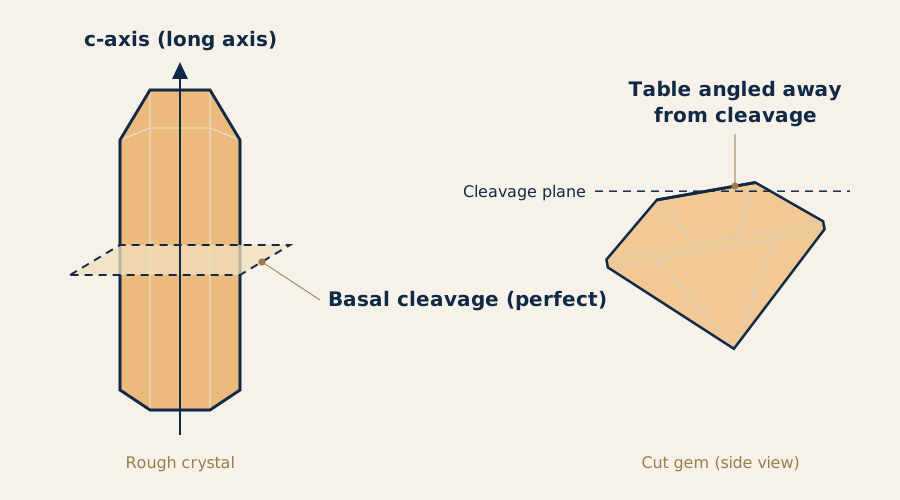
Topaz is 8 on the Mohs scale, harder than quartz (7) and household dust, so it resists scratching well and keeps a sharp polish. But hardness (resistance to scratching) is not the same as toughness (resistance to chipping and breaking). Topaz has perfect basal cleavage: a plane of weakness running straight across the crystal, at right angles to its length. A sharp knock in the wrong direction can split the stone cleanly along that plane, and extreme heat or sudden temperature change can do the same.
| Gem | Mohs hardness | Toughness | Cleavage | Daily ring wear |
|---|---|---|---|---|
| Diamond | 10 | Good | Four directions | Excellent |
| Sapphire | 9 | Excellent | None | Excellent |
| Chrysoberyl | 8.5 | Excellent | Weak | Excellent |
| Imperial topaz | 8 | Poor | Perfect, one direction | With a protective setting and care |
| Aquamarine | 7.5–8 | Good | Indistinct | Good |
| Citrine | 7 | Good | None | Good |
| Iolite | 7–7.5 | Fair | Distinct, one direction | With care |
| Jade (jadeite or nephrite) | 6–7 | Exceptional | None | Good |
| Kunzite | 6.5–7 | Poor | Perfect, two directions | Occasional wear |
| Moonstone | 6–6.5 | Poor | Perfect, two directions | Occasional wear |
So imperial topaz sits in a middle group: hard enough that it will not scuff like softer gems, but more prone to a sudden break than its hardness suggests. Compare it with chrysoberyl, which is both hard and tough, or with jade, which is softer but remarkably hard to break; our guide to jadeite and nephrite explains why. If you are weighing two pale stones, our comparison of aquamarine and topaz durability sets out the same trade-off in blue.
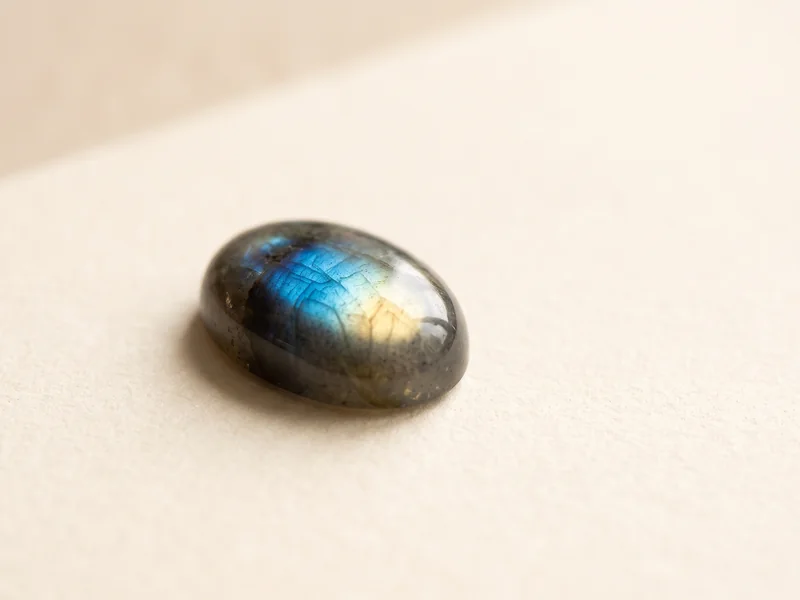
The gems that need even more care than topaz share the same weakness, cleavage. That includes kunzite, with two directions of perfect cleavage, and the feldspar family: moonstone and its blue sheen, labradorite with its flash of colour and glittering sunstone, all around 6 to 6.5 in hardness.
Not sure which one is right?
Send us the stones you are looking at and our gemologist will tell you which to choose and why.
Is imperial topaz treated?
Much imperial topaz is sold untreated, but several treatments and imitations exist, and a reputable seller should disclose any treatment.
- Heating ('pinking'): some orange to brownish-orange Ouro Preto topaz that contains chromium turns pink when heated, because heat removes the yellow colour centres and leaves the chromium pink. The result is stable, but it is usually very hard for a lab to prove, so pink topaz is often assumed to be heated unless shown otherwise.
- Irradiation: mainly used on colourless topaz to make blue. It is not a normal treatment for imperial colours.
- Surface coating: colourless topaz can be coated with a thin metal-oxide film to imitate orange, pink or rainbow colours. Coatings wear and scratch, and they show as a colour sitting on the surface rather than in the body of the stone.
- Imitations: citrine (including heated amethyst), orange sapphire, lab-created corundum, glass and coated topaz are all sold in imperial-like colours.
Synthetic topaz has been grown in laboratories, but it is rarely seen in jewellery, because natural topaz is plentiful in paler colours. A lab-created stone offered in an imperial colour is far more likely to be lab-created corundum (synthetic sapphire) or glass, and it must be described that way. Our A to Z of gemstone treatments explains how each treatment is done and disclosed, and our page on how blue topaz is irradiated and how to look after it covers the treated side of the topaz family.
How can you tell imperial topaz from citrine?
Imperial topaz vs citrine is the comparison most buyers need, because the two can look almost identical in a ring. A gemmologist separates them with a few simple measurements.
| Property | Imperial topaz | Citrine (quartz) | Orange sapphire |
|---|---|---|---|
| Mohs hardness | 8 | 7 | 9 |
| Refractive index | about 1.629–1.640 | 1.544–1.553 | 1.762–1.770 |
| Birefringence | 0.008–0.010 | 0.009 | 0.008 |
| Specific gravity (density) | about 3.53 | 2.65 | about 4.00 |
| Pleochroism | Distinct to strong | Weak to none | Moderate |
| Cleavage | Perfect, one direction | None | None (may part) |
| Typical inclusions | Long tubes and two-phase fluid inclusions along the length | Usually clean; colour zoning | Silk, colour bands |
In practice, the refractometer (an instrument that measures how strongly a gem bends light) settles it in seconds: topaz reads around 1.63, quartz around 1.54. Density helps too. Topaz is about a third heavier than quartz, so an 8 × 6 mm oval topaz weighs roughly 1.3–1.5 carats while a citrine the same size weighs closer to 1.1 carats. A dichroscope, a small tool that splits light to show pleochroic colours side by side, will show two clearly different colours in imperial topaz, much as it does in iolite, a gem known for its colour shifts, but little or nothing in citrine.
Under magnification, imperial topaz often shows fine growth tubes and fluid inclusions (tiny pockets of liquid, sometimes with a gas bubble) running parallel to the length of the crystal. Most faceted imperial topaz is eye-clean, meaning no inclusions are visible without magnification, so visible inclusions lower the price noticeably. If you are paying imperial prices, ask for an independent lab report that confirms natural topaz and states any detectable treatment.
What affects imperial topaz price in Australia?
Colour drives value far more than anything else. In rough order of importance:
- Colour: hue (pinkish to reddish orange is most valued), saturation and tone. Brown or grey undertones pull the price down.
- Size: fine colour is scarce above about 5 carats, so the price per carat rises with size.
- Clarity: buyers expect eye-clean stones; visible inclusions cut the value sharply.
- Cut: a well-proportioned stone shows even colour without a dull, see-through centre (called a window).
- Treatment: untreated, natural-colour pink and red stones are valued above heated pinks.
- Origin: documented Ouro Preto material carries some extra appeal for collectors.
| Quality (natural, eye-clean, 2–5 ct) | Approximate price per carat (AUD) |
|---|---|
| Golden yellow to yellow-orange | about $100–$500 |
| Golden orange (sherry) | about $400–$1,500 |
| Pinkish to reddish orange, fine colour | about $1,500–$4,000 |
| Exceptional red or natural-colour pink, larger sizes | about $4,000 and above |
These are broad ranges only; prices vary with the individual stone and the market. For comparison, treated blue topaz usually sells for tens of dollars per carat, which shows how much the imperial colours are worth. There is no meaningful lab-grown imperial topaz market, so any stone offered as imperial topaz should be natural, and its description should say so.
Browse natural gemstones
Is an imperial topaz ring a good choice for everyday wear?
An imperial topaz ring can be worn regularly if the setting and habits allow for its cleavage. Pendants and earrings are the easiest choice, because they rarely take hard knocks. For a ring, think about protection first:
- Bezel or half-bezel: a rim of metal around the edge absorbs side knocks and protects corners and points.
- Four or six claws, set low: a lower profile means fewer knocks than a tall setting; pears and marquise shapes need a V-claw over each point.
- Halo: a ring of small diamonds or sapphires frames the colour and shields the girdle (the stone's outer edge).
- Metal colour: yellow and rose gold deepen the orange and pink; white gold and platinum make golden stones look cooler and brighter.
Take a topaz ring off for gym sessions, gardening and heavy work, and avoid knocking it against hard benches or door frames. With those habits, a well-set imperial topaz will keep its polish for decades.
How do you choose and care for imperial topaz? Step by step
- Pin down the colour. Ask whether the stone is golden, sherry, peach or reddish orange, and view it in daylight as well as warm light.
- Confirm it is topaz. Ask for a refractive index reading or an independent lab report, so you are not paying topaz prices for citrine or glass.
- Ask about treatment. Check whether pink tones are natural or heated, and rule out surface coating.
- Check clarity and cut. Look for an eye-clean stone with even colour and no washed-out window in the centre.
- Compare millimetres, not only carats. Topaz is dense, so it looks a little smaller than citrine of the same weight.
- Choose a protective setting. A bezel, halo or low claws for rings; any style works for pendants and earrings.
Caring for imperial topaz is simple if you remember its cleavage and heat sensitivity:
- Clean it with warm, soapy water and a soft brush, then rinse and dry.
- Avoid ultrasonic and steam cleaners; vibration and heat can open cleavage or stress fluid inclusions.
- Keep it away from sudden temperature changes, such as moving from a hot kitchen to cold water.
- Store it apart from softer stones. At 8 on the Mohs scale, topaz will scratch turquoise, lapis lazuli and opal if they share a pouch.
- Have claws checked every year or two, and before any jewellery repair mention that the stone is topaz.
Free consultation
Talk to a gemologist
Compare stones in person or online with Raj Sood, Graduate Gemologist (GIA), AJP (GIA).
Book a consultationShop this shape
FAQ
Common questions
What is the difference between imperial topaz and regular topaz?
Imperial topaz is the trade name for topaz in golden orange, pinkish orange and reddish orange colours, usually the hydroxyl-rich type from Brazil. Regular topaz is most often colourless, pale blue or light brown, and blue topaz is usually treated.
Is imperial topaz rare?
Fine imperial topaz is rare. Most comes from a small mining area around Ouro Preto in Brazil, and saturated pinkish to reddish stones over about 5 carats turn up only occasionally.
Is imperial topaz treated?
Many stones are untreated, but some pink imperial topaz is heated to remove its yellow tone, and colourless topaz can be coated to imitate imperial colours. Ask the seller to disclose any treatment, and get a lab report for valuable stones.
Can you wear an imperial topaz ring every day?
Yes, with care. Topaz is hard (Mohs 8) but has perfect cleavage, so choose a bezel, halo or low claw setting and take the ring off for heavy work and sport.
How do I know if my topaz is real or citrine?
A gemmologist can tell in seconds with a refractometer: topaz reads about 1.63 and citrine about 1.54. Topaz is also heavier for its size and shows stronger pleochroism.
Is imperial topaz found in Australia?
Australia has topaz deposits in Tasmania, New South Wales and Queensland, but the stones are mostly colourless, pale blue or light brown. Imperial colours on the market come almost entirely from Brazil and Pakistan.

Ask a gemologist
Not sure which diamond to choose?
Raj Sood is a Graduate Gemologist (GIA) and master jeweller. Bring the stones you are considering, or send the reports, and he will tell you honestly which one is better and why.
Keep learning
Related guides
Explore more
More guides on this topic
Education