
Gemstones
Moissanite Gemstone: A Gemologist's Complete Guide
The moissanite gemstone looks like a diamond across the room but behaves differently under a loupe, in the light and on the price tag. Here is what it is, where it comes from and how it holds up in a ring you wear every day.
 Reviewed by Raj Sood, Graduate Gemologist (GIA), AJP (GIA)Master jeweller and Graduate Gemologist (GIA) · reviewed 4 November 2026
Quick answer
A moissanite gemstone is silicon carbide, almost always lab-created because natural crystals are microscopic and rare. It rates 9.25 on the Mohs scale, has good toughness and shows more fire than diamond (dispersion 0.104 vs 0.044). It suits everyday rings, costs far less than diamond, and is identified by doubled facet edges and electrical conductivity.
What is a moissanite gemstone?
Moissanite is the mineral name for silicon carbide (SiC), a compound of silicon and carbon. The moissanite you see in jewellery is lab-created moissanite: grown in a furnace, then cut and polished like any other gem. It is not a diamond, not glass and not cubic zirconia. It is its own material with its own optical and physical properties, and it sits in our wider guide to coloured and colourless gemstones.
Two terms matter here. A synthetic or lab-created gem has the same chemistry and crystal structure as a natural mineral, but it was made by people. A simulant only imitates the look of another gem. Lab-created moissanite is a synthetic version of natural moissanite, and it is also used as a diamond simulant because it looks similar face-up. Our overview of man-made gemstones explains how these categories differ, and the jewellery glossary defines each term.
Gem-quality lab-created moissanite reached the jewellery market in the late 1990s. Most stones today are cut as round brilliants, ovals, cushions and other diamond-style shapes, and sold by millimetre size rather than carat weight, because moissanite is lighter than diamond for the same dimensions.
Is moissanite natural or lab-created?
Natural moissanite exists, but you will almost certainly never see a natural moissanite gemstone in a ring. The French chemist Henri Moissan found it in 1893 in material from the Canyon Diablo meteorite crater in Arizona, confirmed it as silicon carbide in 1904, and the mineral was later named after him. Since then, natural silicon carbide has been reported as tiny grains in meteorites, in some kimberlites (the volcanic rock that carries diamonds) and in a few other unusual geological settings. These grains are usually well under a millimetre.
There is no commercial source of natural gem moissanite anywhere in the world, including Australia. We are not aware of any facetable Australian moissanite, so unlike Australian sapphire from Queensland and New South Wales, there is no local origin story to trace. Every moissanite in the jewellery trade should be described as lab-created or synthetic, and a seller should say so plainly.
Because there is no natural material to compare, origin work for moissanite is simply confirming that the stone is moissanite at all. For natural coloured stones, labs go much further, and how gem labs determine origin covers the inclusion and trace-element evidence they use.
Lab-created moissanite is often confused with lab-grown diamond, but they are different materials. A laboratory-grown diamond is pure carbon with the same crystal structure as a natural diamond; lab-created moissanite is silicon carbide. Our comparison of lab-grown diamond and moissanite sets the two side by side.
How does moissanite compare with diamond and other colourless gems?
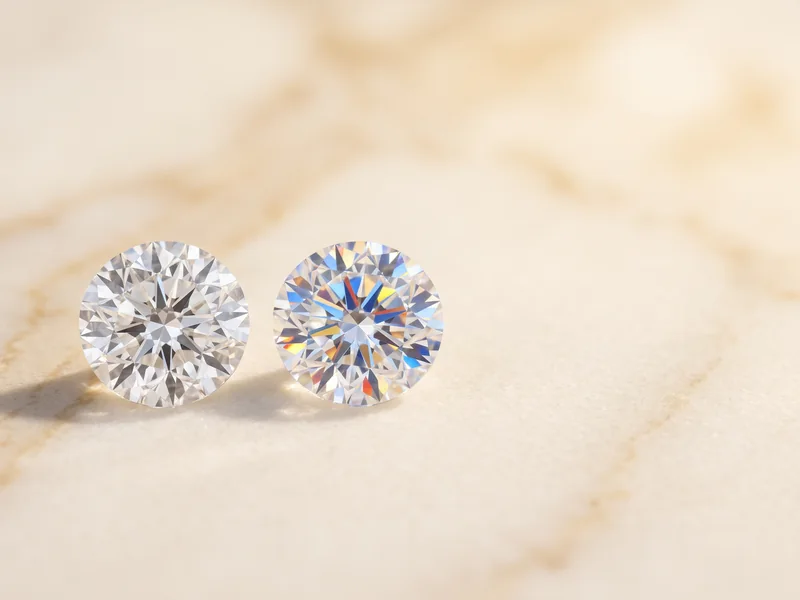
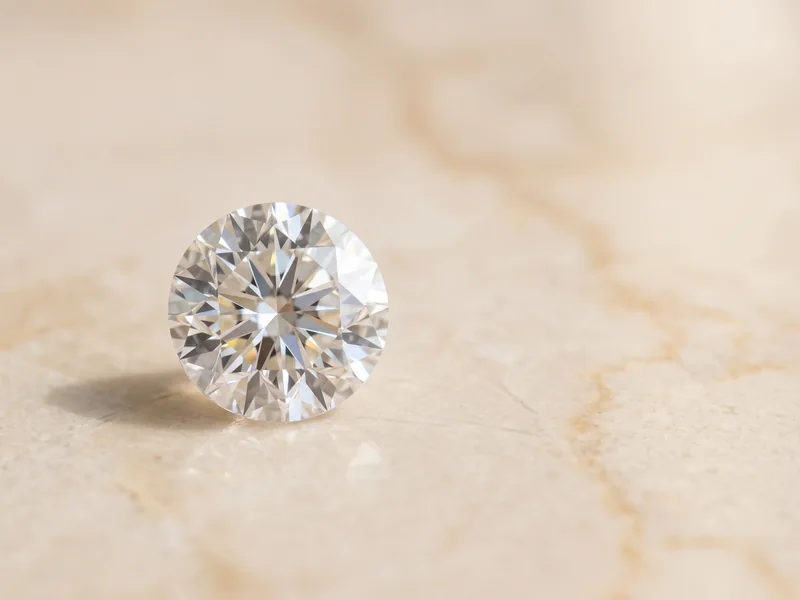
Face-up, lab-created moissanite looks like a well-cut diamond at a glance. Up close, it shows noticeably more fire: flashes of spectral colour caused by dispersion, the way a gem splits white light into its colours. It also has a higher refractive index (how strongly it bends light), which gives it a bright, glassy-sharp look.
| Property | Lab-created moissanite | Diamond | Cubic zirconia | Colourless sapphire |
|---|---|---|---|---|
| Chemistry | Silicon carbide (SiC) | Carbon (C) | Zirconium dioxide (ZrO2) | Aluminium oxide (Al2O3) |
| Mohs hardness | 9.25 | 10 | 8–8.5 | 9 |
| Refractive index | 2.65–2.69 | 2.42 | 2.15–2.18 | 1.76–1.77 |
| Dispersion (fire) | 0.104 | 0.044 | 0.060 | 0.018 |
| Single or double refraction | Double (birefringence 0.043) | Single | Single | Double (0.008) |
| Specific gravity | 3.22 | 3.52 | 5.6–6.0 | 4.00 |
| Thermal tester reading | Reads as diamond | Diamond | Not diamond | Not diamond |
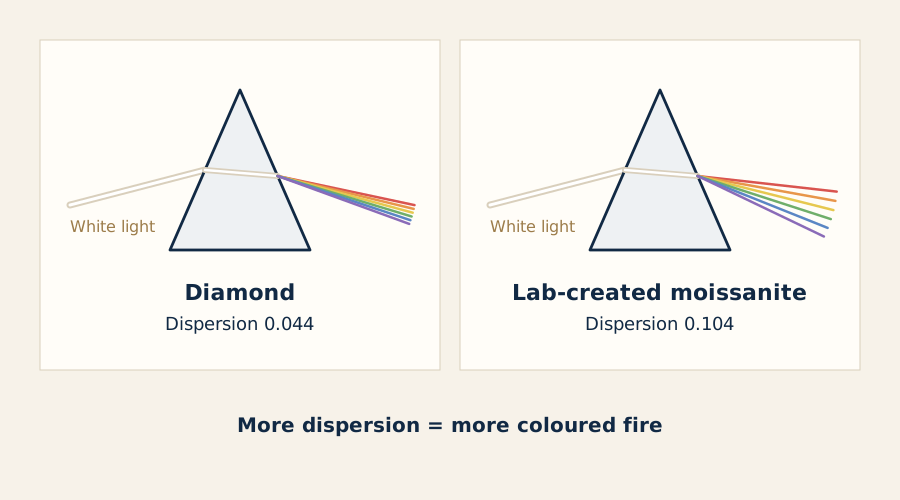
That extra fire is the main visual difference. Some people love it; others find it reads as "too colourful" in sunlight, especially in stones above about 7 mm. Our moissanite vs diamond guide goes through appearance, durability and price in detail, and moissanite vs cubic zirconia explains why CZ, at 8–8.5 on the Mohs scale and much denser, scratches and clouds faster.
What colours does moissanite come in?
Silicon carbide can grow in many colours, and the moissanite colour range is wider than most people expect. The jewellery market is dominated by colourless stones, but you will also find yellow, green, blue, grey and black moissanite.
| Colour type | What you see | How it is achieved | Notes for jewellery |
|---|---|---|---|
| Colourless | No visible body colour face-up | Controlled growth with very low impurities | Usually described as D–F equivalent; the main product today |
| Near-colourless | A faint warm or greenish tint, mainly side-on | Growth with slightly more impurities | Often described as G–I equivalent; earlier stones from the late 1990s and 2000s were often warmer still, around J–K equivalent |
| Faint yellow or green | Visible tint face-up | Nitrogen and other trace elements in the crystal | Lower priced; can suit yellow gold |
| Fancy colours (blue, green, yellow, pink) | Saturated colour | Some grown coloured; many are surface-coated | Ask whether the colour is a coating |
| Black / grey | Opaque or very dark | Grown dark or treated | Popular in men's rings; check durability of any coating |
There is no single independent grading standard for moissanite the way GIA grades diamond. Producers grade on their own scales, usually expressed as diamond-style equivalents. Clarity is generally high, often VS equivalent or better, and the typical inclusions are fine, needle-like growth tubes running parallel to the crystal's main axis. Our guide to moissanite colour and clarity grades explains what each producer grade means in practice.
One unusual trait: lab-created moissanite is thermochromic. Under strong heat, such as a jeweller's torch, it temporarily turns yellowish, then returns to its normal colour as it cools. This is harmless, but it is a useful reminder to tell any jeweller what your stone is before repairs.
Not sure which one is right?
Send us the stones you are looking at and our gemologist will tell you which to choose and why.
Is a moissanite gemstone hard enough for an everyday ring?
Yes. Lab-created moissanite is one of the more durable stones you can set in a ring. Durability has three parts, and moissanite does well in all of them:
- Hardness (resistance to scratching): 9.25 on the Mohs scale. Household dust contains quartz at about 7, so a moissanite will not be dulled by everyday grit the way softer stones are.
- Toughness (resistance to chipping and breaking): good, with no easy cleavage plane. Diamond is harder but has perfect cleavage, so a hard knock at the wrong angle can chip it.
- Stability (resistance to heat, light and chemicals): very good. It is not affected by normal household chemicals, sunlight or body heat.
| Gem | Mohs hardness | Toughness | Everyday ring verdict |
|---|---|---|---|
| Diamond (natural or lab-grown) | 10 | Good; perfect cleavage | Excellent, protect edges and points |
| Lab-created moissanite | 9.25 | Good; no easy cleavage | Excellent |
| Sapphire and ruby | 9 | Excellent | Excellent |
| Spinel | 8 | Good | Very good |
| Cubic zirconia | 8–8.5 | Good | Fair; scratches and dulls in time |
| Emerald | 7.5–8 | Poor to good; usually fractured and oiled | Needs a protective setting and gentle wear |
| Morganite / aquamarine | 7.5–8 | Good | Good with care |
Mohs is a ranking, not a linear scale, so the gap between 9 and 10 is much bigger than the gap between 7 and 8. Our full gemstone hardness guide explains the scale, and how durable different gems are in everyday rings covers toughness and settings together. Compared with an emerald, which is often filled and easily chipped, moissanite asks very little of its owner.
Settings work the same way as for diamond. Claws, bezels and halos all suit moissanite, and because it tolerates heat well, sizing and claw re-tipping are generally straightforward, provided the jeweller knows what the stone is.
Is moissanite treated or coated?
Colourless lab-created moissanite is generally not treated after growth; its colour and clarity come from how the crystal was grown. Coloured moissanite is different. Many vivid blue, green, pink and some black stones get their colour from a thin surface coating rather than from the crystal itself.
Coatings matter because they sit on the outside of the stone. Abrasive cleaners, ultrasonic machines, harsh chemicals and years of wear can scratch or thin them, leaving patchy colour that cannot be polished back. A stone with colour grown into the crystal does not have this problem. Ask the seller directly whether a coloured moissanite is coated, and expect the answer in writing. If you want lasting colour in a ring, a natural sapphire or spinel, or a lab-created gem with colour throughout, is usually the more durable route; see engagement rings with coloured gemstones for options.
How do gemologists identify moissanite?
Identifying moissanite is one of the first things a gemologist checks when a colourless stone comes in. The key tests:
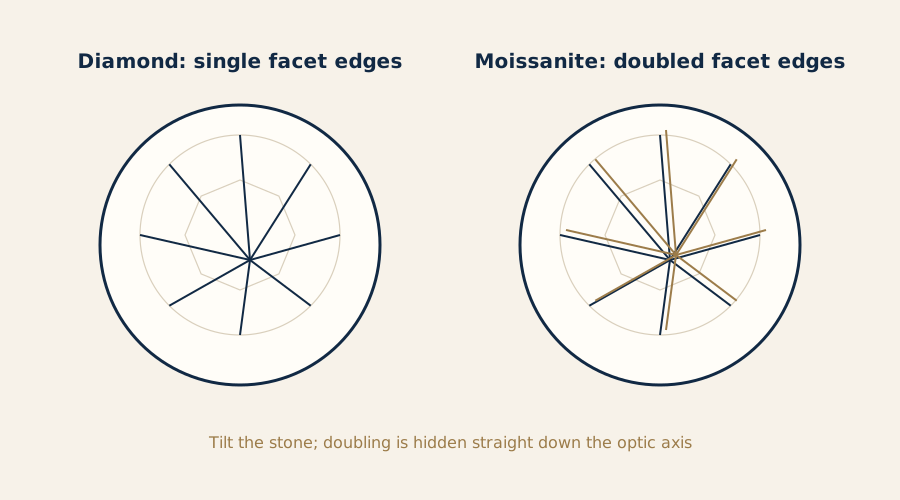
- Doubling: moissanite is doubly refractive, so light splits into two rays. Viewed at an angle through the crown, the back facet edges appear doubled. Cutters orient the table perpendicular to the optic axis to reduce doubling face-up, so you must tilt the stone to see it.
- Inclusions: fine, straight, parallel needles or growth tubes, unlike the crystals and feathers typical in diamond.
- Electrical conductivity: most moissanite conducts a small current; most diamonds do not. Multi-testers use this.
- Specific gravity: at 3.22, moissanite is about 9% lighter than diamond, so a loose stone weighs less than a diamond of the same size.
- Lab spectroscopy: Raman and infrared spectra confirm silicon carbide beyond doubt.
A basic thermal diamond tester measures how fast a stone conducts heat, and moissanite conducts heat almost as well as diamond, so it often reads as diamond. That is why whether moissanite passes a diamond tester depends entirely on the type of tester. For the instruments and methods labs use, see our scientific guide to gemstone identification.
Related guideMoissanite vs DiamondWhat affects the price of moissanite in Australia?
Lab-created moissanite costs a small fraction of a natural diamond of the same look, and usually less than a laboratory-grown diamond too. It has no rarity value and a limited resale market, so it is best chosen as a stone you love wearing, not as a store of value. Within moissanite, price is driven by:
- Size in millimetres: the biggest factor. Price climbs steeply from about 7 mm upward.
- Colour grade: colourless (D–F equivalent) costs more than near-colourless.
- Cut quality and shape: precise, well-proportioned cutting costs more; fancy shapes can vary.
- Producer and warranty: branded material with documentation often costs more than unbranded stones.
- Coating: coated fancy colours are usually lower priced than colourless stones of the same size.
| Round diameter | Looks like a diamond of about | Moissanite weight (approx.) | Loose stone, approx. AUD |
|---|---|---|---|
| 5.0 mm | 0.50 ct | 0.40–0.45 ct | $150–$500 |
| 6.5 mm | 1.00 ct | 0.85–0.90 ct | $300–$1,000 |
| 7.5 mm | 1.50 ct | 1.30–1.40 ct | $500–$1,500 |
| 8.0 mm | 2.00 ct | 1.60–1.80 ct | $600–$2,000 |
For comparison, a natural 1 carat diamond of good colour and clarity generally costs many thousands of dollars, and a 1 carat lab-grown diamond typically costs more than a 6.5 mm moissanite. If you are weighing these options, our range of natural and lab-created gemstones includes natural colourless and coloured stones as alternatives.
Browse natural gemstones in our stock
How to choose and care for a moissanite gemstone: step by step
Moissanite is low-maintenance, but like diamond it attracts skin oils and lotion, which dull the sparkle. A quick clean brings it back. Follow these steps when choosing and looking after one:
- Confirm it is lab-created moissanite. The listing or certificate should name it as lab-created or synthetic moissanite, never just "diamond alternative".
- Check the colour grade and lighting. View the stone side-on against white paper; near-colourless stones show warmth or a green tint there first.
- Ask about coatings on coloured stones. Get it in writing if the colour is a surface coating, and avoid ultrasonic cleaning if so.
- Choose a secure setting. Four or six claws, a bezel or a halo all work; check the claws every year or two.
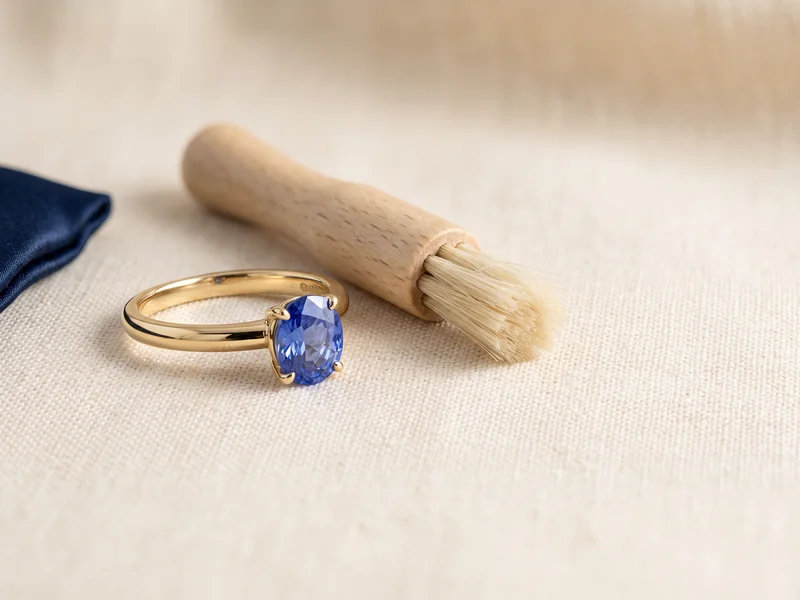
- Clean it at home. Soak in warm water with a drop of mild dishwashing liquid, brush under the stone with a soft toothbrush, rinse and dry with a lint-free cloth.
- Tell your jeweller what it is. Before resizing or repairs, say it is moissanite so the jeweller expects the temporary colour change under heat.
Uncoated colourless moissanite tolerates ultrasonic and steam cleaning, but the metal and any other stones in the ring may not. Our stone-by-stone care guide lists safe cleaning for every common gem, which helps if your ring mixes moissanite with softer stones.
Free consultation
Talk to a gemologist
Compare stones in person or online with Raj Sood, Graduate Gemologist (GIA), AJP (GIA).
Book a consultationShop this shape
FAQ
Common questions
Is moissanite a real gemstone?
Yes. Moissanite is a real mineral, silicon carbide, first found in 1893. The stones used in jewellery are lab-created moissanite, a synthetic version of that mineral, and should always be sold as lab-created.
Is moissanite a fake diamond?
No. Lab-created moissanite is its own material with different chemistry and optics. It is used as a diamond alternative, but it is not a diamond and should never be sold as one.
Does moissanite get cloudy over time?
Uncoated lab-created moissanite does not cloud or change colour with wear. If it looks dull, it is almost always a film of skin oil or soap, which a gentle clean removes.
Is moissanite good for an engagement ring?
Yes. At 9.25 on the Mohs scale with good toughness, lab-created moissanite handles everyday wear well. The main question is whether you like its stronger rainbow fire compared with diamond.
Can a jeweller tell moissanite from diamond?
Yes. A gemologist with a loupe can usually see the doubled facet edges, and an electrical multi-tester or lab spectroscopy confirms it. A basic thermal tester alone can be fooled.
Why is moissanite sold in millimetres instead of carats?
Moissanite is about 9% lighter than diamond, so a stone with the face-up size of a 1 carat diamond weighs less. Millimetres describe the size you actually see.

Ask a gemologist
Not sure which diamond to choose?
Raj Sood is a Graduate Gemologist (GIA) and master jeweller. Bring the stones you are considering, or send the reports, and he will tell you honestly which one is better and why.
Keep learning
Related guides
 Lab-Grown DiamondsMoissanite vs DiamondLab-Grown DiamondsLab-Grown Diamond vs Moissanite
 Lab-Grown DiamondsMoissanite Colour and Clarity GradesLab-Grown DiamondsDoes Moissanite Pass a Diamond Tester?GemstonesGemstones | Coloured Gemstones, Birthstones and Custom JewelleryLab-Grown DiamondsMoissanite vs Cubic Zirconia
 GemstonesGemstone Hardness Guide
 GemstonesGemstone Care by Stone
Explore more
More guides on this topic
Education