
Gemstones
Chrysoberyl and Cat's-Eye Guide: Colours, Durability, Origins and Value
Chrysoberyl is one of the hardest coloured gems you can wear, and the source of the true cat's-eye. Here is how to judge its colour and eye, spot imitations and choose a setting that suits everyday wear.
 Reviewed by Raj Sood, Graduate Gemologist (GIA), AJP (GIA)Master jeweller and Graduate Gemologist (GIA) · reviewed 4 November 2026
Quick answer
Chrysoberyl is a beryllium aluminium oxide gemstone, 8.5 on the Mohs scale, found mostly in yellow, greenish-yellow and honey-brown. Its two famous varieties are cat's-eye chrysoberyl, which shows a sharp band of light across a cabochon, and colour-change alexandrite. It is usually untreated, tough enough for everyday rings, and valued on colour, eye sharpness and size.
What is chrysoberyl?
Chrysoberyl (say KRIS-oh-berr-il) is a gemstone made of beryllium aluminium oxide, BeAl2O4. Despite the name, it is not a kind of beryl, the family that includes emerald, aquamarine and morganite; the two simply share the element beryllium. The name comes from the Greek word chrysos, meaning golden, plus beryl, a nod to its usual yellow colour. It sits in our wider guide to coloured gemstones and birthstones alongside sapphire, spinel and garnet.
Three things make chrysoberyl stand out. It is hard: 8.5 on the Mohs scale, which puts it third among common gems behind diamond (10) and corundum, the ruby and sapphire family (9). Its refractive index (how strongly it bends light) of about 1.74–1.76 is high for a coloured stone, so faceted chrysoberyl looks bright and lively. And it forms two prized varieties: cat's-eye chrysoberyl, also called cymophane, and alexandrite, which changes from green in daylight to red or purple under warm incandescent light.
| Property | Chrysoberyl |
|---|---|
| Composition | Beryllium aluminium oxide, BeAl2O4 |
| Crystal system | Orthorhombic; often twinned into flat, six-sided 'trillings' |
| Mohs hardness | 8.5 |
| Toughness | Good to excellent; no easy cleavage |
| Refractive index | about 1.746–1.755 |
| Birefringence | about 0.008–0.010 |
| Specific gravity | about 3.70–3.75 (usually 3.73) |
| Lustre | Vitreous (glassy) to slightly greasy on fractures |
If a few of those words are new, our plain-English jewellery glossary explains each one. The short version: chrysoberyl is hard, heavy for its size, bright and durable, which is why gem dealers have prized it for centuries even though few shoppers know the name.
What colours does chrysoberyl come in?
Most chrysoberyl owes its colour to small amounts of iron, which gives the familiar range of yellow, greenish-yellow, golden and brown. Chromium produces alexandrite's colour change, and vanadium gives a vivid green in some stones, notably from Tanzania, sometimes sold as 'vanadium chrysoberyl'. Near-colourless chrysoberyl exists but is rare and little used in jewellery.
- Yellow and greenish-yellow: the most common faceted colours, from lemon to a lively lime or chartreuse.
- Honey and golden brown: the classic body colour of cat's-eye cabochons.
- Brown: common and lower in value, especially when dark or muddy.
- Green: coloured by vanadium or chromium; without a real colour change it is green chrysoberyl, not alexandrite.
- Alexandrite: green to bluish green in daylight, red to purplish red under incandescent light.
- Cat's-eye alexandrite: rare stones that show both the eye and the colour change.
For faceted stones, a bright, saturated greenish-yellow without brown is the most sought after. For cat's-eye, buyers traditionally favour a warm honey or greenish-yellow, because it gives the strongest contrast against the white line. Deep browns can still show a good eye but usually cost less.
If you like warm browns but chrysoberyl is outside the budget, smoky quartz in coffee and cognac tones gives a similar look at a much lower price, though it is softer at 7 on the Mohs scale and has a lower refractive index of about 1.54, so it looks less bright.
What makes a cat's eye chrysoberyl?
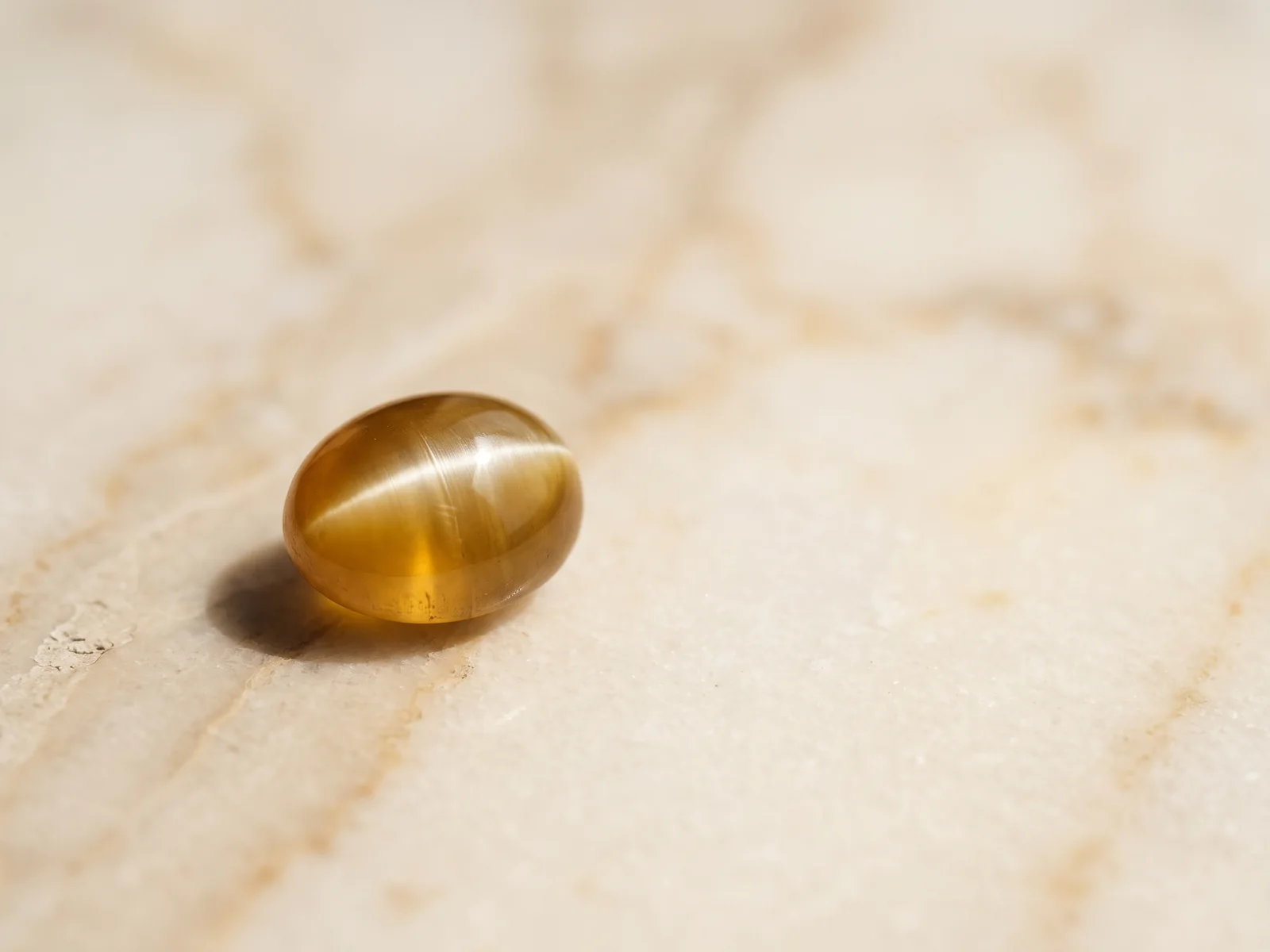
The cat's-eye effect is called chatoyancy, from the French word chat, cat. It is caused by thousands of fine, parallel, needle-like inclusions or hollow growth tubes running in one direction through the crystal. Gemmologists call these inclusions silk. When the stone is cut as a domed cabochon (a smooth, unfaceted top) with its base lying parallel to the silk, light reflects off the needles as one thin bright line running across the dome, at right angles to the silk.
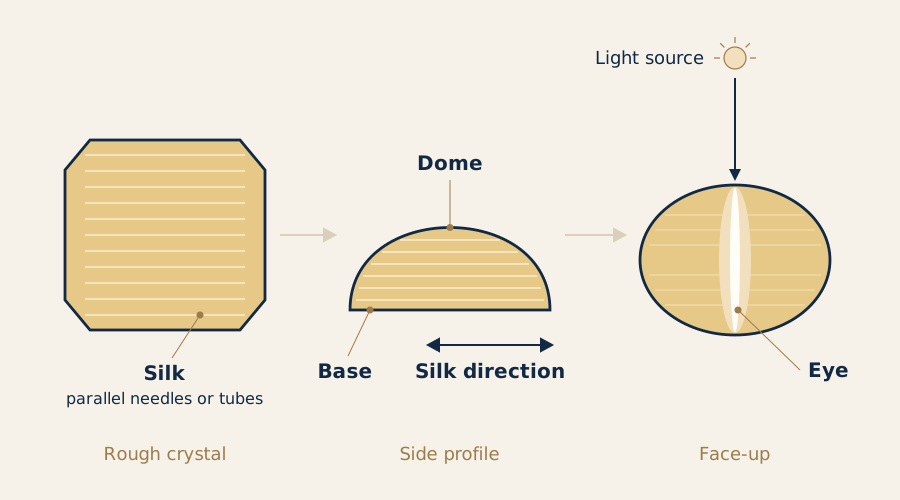
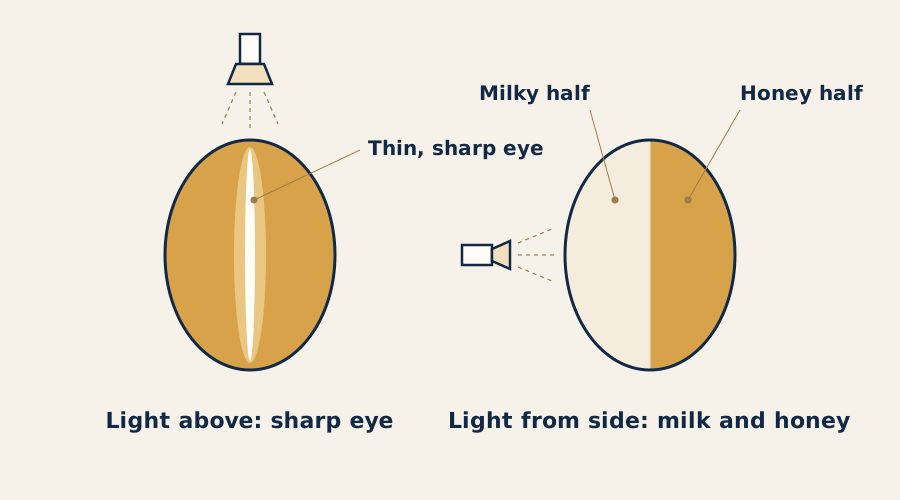
Fine cat's-eye chrysoberyl also shows the milk and honey effect. Shine a light from one side and the half of the stone nearest the light shows its honey body colour while the other half turns milky white. Turn the stone and the eye seems to open and close. This contrast is much stronger in chrysoberyl than in most look-alikes, and it is one of the first things a gemmologist checks.
In the trade, 'cat's-eye' on its own traditionally means chrysoberyl. Other chatoyant stones should be named in full, such as cat's-eye quartz, cat's-eye tourmaline or cat's-eye apatite. In India and Sri Lanka the stone is also known as lehsunia or vaidurya and is linked to Ketu in Vedic astrology, which keeps demand strong in those markets.
Cutters often leave a heavy, rounded base on cat's-eye cabochons to keep weight and support the eye. Ask for a side view before you buy: a deep belly can sit high in a ring and makes the stone look smaller for its carat weight. Our guide to how cabochon, faceted and carved cuts differ shows good and poor profiles side by side.
Related guideGemstone Cuts: Cabochon, Faceted and CarvedIs chrysoberyl hard enough for an engagement ring?
Yes. Two properties matter for a ring. Hardness is resistance to scratching. Household dust contains quartz, which is 7 on the Mohs scale, so any gem softer than 7 slowly dulls; chrysoberyl at 8.5 shrugs it off. Toughness is resistance to chipping and breaking. Chrysoberyl rates good to excellent and has no easy cleavage (a plane along which a crystal splits cleanly), so it handles everyday knocks better than topaz or emerald.
| Gem | Mohs hardness | Toughness | Everyday ring? |
|---|---|---|---|
| Diamond | 10 | Good (has cleavage) | Yes |
| Ruby and sapphire | 9 | Excellent | Yes |
| Chrysoberyl and alexandrite | 8.5 | Good to excellent | Yes |
| Spinel | 8 | Good | Yes |
| Topaz | 8 | Poor (easy cleavage) | With a protective setting |
| Morganite | 7.5–8 | Good | Yes, with some care |
| Emerald | 7.5–8 | Poor to good (fractures) | With care and a protective setting |
| Quartz (rose, smoky) | 7 | Good | Occasional wear; will scuff over years |
| Amber | 2–2.5 | Poor | Pendants and earrings, not rings |
That makes chrysoberyl a sound choice for a coloured engagement ring. It is a little softer than sapphire, which our morganite and pink sapphire comparison uses as the durability benchmark, but much harder than rose quartz, which suits occasional wear and far tougher than amber, an organic gem best kept to pendants. Faceted chrysoberyl can still chip at sharp corners if it takes a hard knock, and diamond will scratch it, so store it apart from diamond jewellery.
Settings: a cat's-eye cabochon is usually set in a bezel (a rim of metal around the edge) or with four to six claws, keeping the dome low enough not to catch. A faceted chrysoberyl suits claws, a bezel or a halo just like a sapphire. Cat's-eye cabochons have a long history in signet and gypsy rings, where the stone sits flush in a heavy shank; see our guide to men's engagement ring styles for that look.
Not sure which one is right?
Send us the stones you are looking at and our gemologist will tell you which to choose and why.
Is chrysoberyl treated, and is there lab-created chrysoberyl?
Most chrysoberyl on the market is untreated, which is part of its appeal. Heating does little to improve its colour, so it is not routine the way it is for sapphire; our page on what heating does and does not change explains why that matters for value. Some cat's-eye chrysoberyl has been irradiated to deepen a pale colour towards honey or brown, and this can be hard to detect without a laboratory. Stones with surface-reaching cracks are sometimes filled with oil or resin to make them less visible.
Fillings are less stable than the stone itself and can be damaged by ultrasonic cleaners, heat and solvents. Our explainer on fracture and glass filling covers how to spot them, and the full A to Z of gemstone treatments lists every treatment and how it must be disclosed.
Lab-created chrysoberyl also exists. Lab-created alexandrite has been grown by the flux and Czochralski (pulled-crystal) methods since about the 1970s, and lab-created cat's-eye chrysoberyl and cat's-eye alexandrite have been produced too. They have the same chemistry, hardness and refractive index as natural stones, cost much less, and must always be sold as lab-created or synthetic. The choice between them is covered in our guide to natural and lab-created gems for engagement rings.
- Is the stone natural or lab-created?
- Has it been irradiated, heated, oiled or filled?
- Is there a report from an independent laboratory, especially for fine cat's-eye or alexandrite?
Where is chrysoberyl found?
Chrysoberyl forms in granite pegmatites (coarse-grained igneous rock) and in mica schists, where beryllium-rich fluids meet aluminium-rich rock. Because it is hard and heavy, it survives weathering and collects in river gravels, so much gem chrysoberyl is mined from alluvial deposits alongside sapphire, spinel and garnet. Sri Lanka's gem gravels, around Ratnapura and Elahera, have supplied fine cat's-eye for centuries; our guide to Ceylon, Burma, Madagascar and other origins explains what each name means.
| Origin | Known for |
|---|---|
| Sri Lanka | Cat's-eye, yellow faceted stones, alexandrite |
| Brazil (Minas Gerais, Espírito Santo, Bahia) | Yellow-green faceted stones, cat's-eye, alexandrite |
| India (Odisha, Andhra Pradesh, Kerala) | Cat's-eye and alexandrite, often commercial grades |
| Madagascar | Yellow and greenish-yellow, some cat's-eye |
| Tanzania (Tunduru and other areas) | Vanadium green chrysoberyl, alexandrite |
| Russia (Ural Mountains) | Historic alexandrite, discovered in the 1830s |
| Myanmar | Yellow and cat's-eye chrysoberyl |
| Zimbabwe | Small, strongly coloured alexandrite |
Chrysoberyl has been recorded in small amounts in Australia, but there is no commercial production of gem-quality material here, so stones sold in Australia are imported, mostly from Sri Lanka, Brazil, India and East Africa. For yellow chrysoberyl and cat's-eye, origin rarely changes the price much; quality matters far more. Origin carries more weight for alexandrite, where Russian and Brazilian stones attract interest.
How do you tell cat's eye chrysoberyl from quartz and glass?
Several cheaper materials show a cat's-eye, and a few are made to imitate chrysoberyl. A gemmologist separates them with a refractometer (which measures refractive index), a specific gravity test, a spectroscope and magnification. Iron-bearing chrysoberyl usually shows a strong absorption band at about 445 nm in the spectroscope, and its specific gravity of about 3.73 makes it noticeably heavy in the hand.
| Material | Refractive index | Specific gravity | Eye and clues |
|---|---|---|---|
| Cat's-eye chrysoberyl | about 1.74–1.76 | about 3.73 | Sharp, thin eye; strong milk and honey effect; very fine silk |
| Cat's-eye quartz | about 1.54–1.55 | about 2.65 | Broader, softer eye; coarser fibres; feels light; Mohs 7 |
| Tiger's-eye (quartz) | about 1.54 | about 2.64–2.71 | Opaque, banded gold and brown stripes rather than one line |
| Cat's-eye tourmaline | about 1.62–1.64 | about 3.06 | Coarser tubes; eye often broad and patchy |
| Cat's-eye apatite | about 1.63–1.64 | about 3.18–3.22 | Good eye but soft at Mohs 5; scratches easily |
| Fibre-optic glass | Varies | Varies | Eye too perfect, sometimes several; honeycomb pattern visible from the side |
Fibre-optic glass is the most common imitation in souvenir jewellery. It shows an almost too-strong eye, and under a loupe the side of the stone reveals a honeycomb of tiny fibre bundles. Glass is also used to imitate diamond, as covered in our page on CZ, YAG, GGG and glass simulants.
For clarity, faceted yellow-green chrysoberyl is usually treated as a Type I coloured gem, meaning it is often eye-clean (alexandrite is Type II, normally with a few small inclusions); see how gemstone clarity types I, II and III work. Aim for a faceted stone that is eye-clean, the same idea we use in our explanation of eye-clean diamonds: no inclusions visible without magnification at normal viewing distance. Cat's-eye is the reverse, because the silk is what creates the eye.
How much is chrysoberyl worth in Australia?
For cat's-eye chrysoberyl, the eye matters most. Dealers look for:
- Sharpness: a thin, bright, well-defined line, not a broad blur.
- Position: straight and centred across the dome, running from edge to edge without breaks.
- Movement: an eye that glides across the stone and opens and closes in side light.
- Body colour: honey to greenish-yellow; dark brown costs less.
- Transparency: semi-transparent stones with a glowing body rank above opaque ones.
- Size and cut: fine eyes in stones over about 3 carats are scarce, and a heavy base adds weight without adding face-up size.
For faceted chrysoberyl, value follows colour first (bright greenish-yellow without brown), then clarity, cut and size. Because chrysoberyl is less known than sapphire, a fine faceted yellow often costs less than a yellow sapphire of similar look.
| Type | Approximate price per carat (AUD) |
|---|---|
| Commercial faceted yellow or brown, 1–5 ct | about $50–$300 |
| Fine faceted greenish-yellow, 1–5 ct | about $200–$800 |
| Commercial cat's-eye, weaker eye or brownish | about $100–$600 |
| Fine honey cat's-eye, sharp eye, 3 ct+ | about $1,000–$5,000 or more |
| Natural alexandrite, fine colour change, 1 ct+ | about $5,000–$30,000 or more |
| Lab-created chrysoberyl or alexandrite | A small fraction of natural; varies with grower and size |
These are broad ranges only; individual stones vary widely and the market moves. A small number of exceptional cat's-eyes sell well above these figures. To compare chrysoberyl with other coloured stones across the range, explore our gemstone guides by colour and type.
Browse natural gemstones
How do you choose and care for chrysoberyl? Step by step
- Confirm what it is. Ask whether the stone is natural or lab-created chrysoberyl, and whether it has been irradiated, oiled or filled.
- Judge the eye or the colour. For cat's-eye, use a single light and check the line is sharp, straight, centred and unbroken; for faceted stones, look for bright greenish-yellow without brown.
- Check the profile. Ask for a side view and the millimetre measurements, not just the carat weight, so a heavy base does not surprise you.
- Plan the setting. Choose a bezel or secure claws and a moderate dome height for rings worn every day.
- Clean gently. Use warm water, a drop of mild detergent and a soft toothbrush, then rinse and dry with a lint-free cloth.
- Use machines with care. Ultrasonic and steam cleaning are usually safe for untreated, uncracked stones; skip them for filled or fractured stones.
- Store and check. Keep it in a separate pouch away from diamonds, remove it for heavy work, and have claws or the bezel checked about once a year.
Free consultation
Talk to a gemologist
Compare stones in person or online with Raj Sood, Graduate Gemologist (GIA), AJP (GIA).
Book a consultationShop this shape
FAQ
Common questions
Is chrysoberyl a rare gemstone?
Chrysoberyl is less common than quartz or garnet but not extremely rare. Fine cat's-eye with a sharp eye and good colour, and fine natural alexandrite, are genuinely scarce.
Is chrysoberyl good for an engagement ring?
Yes. At 8.5 on the Mohs scale with good to excellent toughness, it suits daily wear better than most coloured gems except sapphire and ruby. A bezel or secure claws help protect it.
What is the difference between chrysoberyl and alexandrite?
Alexandrite is a variety of chrysoberyl coloured by chromium, which makes it change from green in daylight to red or purple under warm light. Ordinary chrysoberyl is yellow, green or brown and does not change colour.
How can I tell if a cat's-eye is real chrysoberyl?
Look for a sharp, thin eye and a strong milk and honey effect in side light, and a stone that feels heavy for its size. Confirmation needs a gemmologist's refractive index and specific gravity tests, which separate it from quartz, glass and other chatoyant stones.
Is chrysoberyl usually treated?
Most chrysoberyl is untreated. Some cat's-eye has been irradiated to deepen its colour, and fractured stones may be oiled or filled, so ask for disclosure or a laboratory report on valuable stones.
Can you get lab-created chrysoberyl?
Yes. Lab-created alexandrite and lab-created cat's-eye chrysoberyl are produced with the same chemistry and hardness as natural stones. They cost much less and must be sold as lab-created or synthetic.

Ask a gemologist
Not sure which diamond to choose?
Raj Sood is a Graduate Gemologist (GIA) and master jeweller. Bring the stones you are considering, or send the reports, and he will tell you honestly which one is better and why.
Keep learning
Related guides
 GemstonesGemstone Cuts: Cabochon, Faceted and Carved
 GemstonesGemstone Treatments A to Z
 GemstonesNatural vs Lab-Grown Gemstones for Engagement Rings
 GemstonesGemstone Origins: Ceylon, Burma, Kashmir, Madagascar, MozambiqueGemstonesGemstones | Coloured Gemstones, Birthstones and Custom Jewellery
 Diamond 4Cs & GradingEye Clean Diamonds
 Engagement Rings & SettingsMen's Engagement Rings
 GemstonesDiamond Simulants: CZ, YAG, GGG and Glass
Explore more
More guides on this topic
Education