
Gemstones
Jade Guide: Jadeite vs Nephrite, Colour, Toughness, Treatments and Value
Two different minerals are sold under the one word jade, and they differ in rarity, colour and price. Knowing jadeite vs nephrite, and how to spot treated jade, is the most useful thing you can learn before you buy a jade ring, pendant or bangle.
 Reviewed by Raj Sood, Graduate Gemologist (GIA), AJP (GIA)Master jeweller and Graduate Gemologist (GIA) · reviewed 4 November 2026
Quick answer
Jadeite vs nephrite comes down to two different minerals sold as jade. Jadeite is a pyroxene, slightly harder (Mohs 6.5–7), denser and rarer, and produces the vivid imperial green. Nephrite is an amphibole, a little softer (6–6.5) but tougher, usually spinach green, white or black. Both suit careful everyday wear in a protective setting.
Jadeite vs nephrite: what is the difference?
Jade is a trade name, not a single mineral. It covers two different materials that look alike once polished: jadeite and nephrite. In 1863 the French mineralogist Alexis Damour showed they were chemically distinct, although carvers in China and Mesoamerica had worked jade for thousands of years, and Māori in New Zealand for centuries, before anyone gave the two minerals separate names. Jade sits alongside the other stones in our guide to coloured gemstones and birthstones.
Jadeite is a pyroxene, a sodium aluminium silicate (NaAlSi2O6). Nephrite is an amphibole from the tremolite–actinolite series, a calcium magnesium iron silicate. Neither is a single crystal like a sapphire. Each is an aggregate: millions of tiny crystals packed together. In jadeite they are mostly small interlocking grains; in nephrite they are fine fibres matted together like felt. That structure is why both are so hard to break, and why nephrite, with its woven fibres, is usually the tougher of the two.
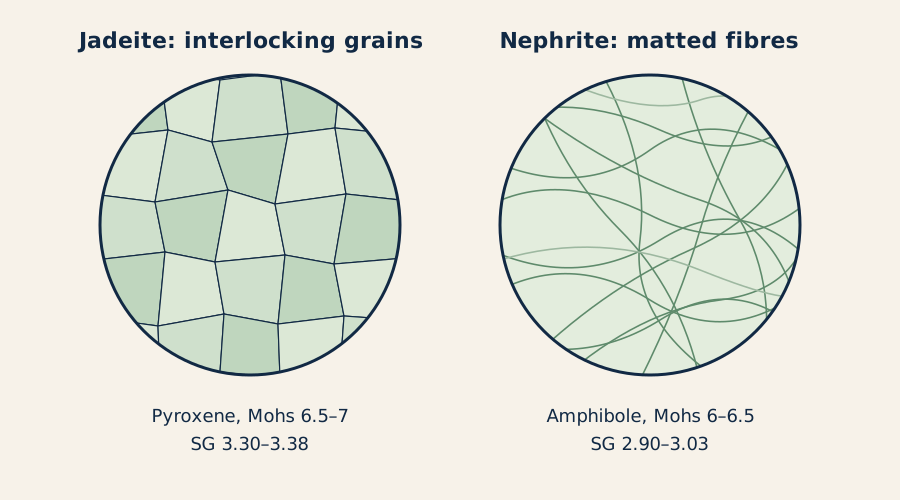
| Property | Jadeite | Nephrite |
|---|---|---|
| Mineral group | Pyroxene | Amphibole (tremolite–actinolite) |
| Mohs hardness | 6.5–7 | 6–6.5 |
| Toughness | Exceptional | Exceptional, usually the tougher |
| Refractive index (spot reading) | about 1.66 | about 1.61 |
| Specific gravity | about 3.30–3.38 | about 2.90–3.03 |
| Lustre when polished | Glassy to slightly greasy | Greasy to waxy |
| Colour range | Very wide: green, lavender, white, yellow, orange, red, black | Narrower: green, white, cream, grey, black |
| Main gem sources | Myanmar; also Guatemala, Japan, Russia | Canada, China, New Zealand, Russia, Australia |
| Relative value | Rarer; fine pieces far more expensive | More common; usually more affordable |
Be careful with the word on its own. Many green stones are sold as some kind of jade without being either mineral. The best-known local example is chrysoprase, often called Australian jade, which is actually a nickel-coloured chalcedony (a form of quartz). If a term here is new to you, our plain-English jewellery glossary explains it.
Related guideChrysoprase (Australian Jade)What colours does jade come in?
Green is the colour everyone pictures, but the two jades reach it differently and offer quite different palettes.
- Jadeite green: ranges from pale apple green to the intense, even, slightly bluish green called imperial jade, coloured by chromium. Imperial green looks almost like emerald, but with a soft glow rather than sparkle.
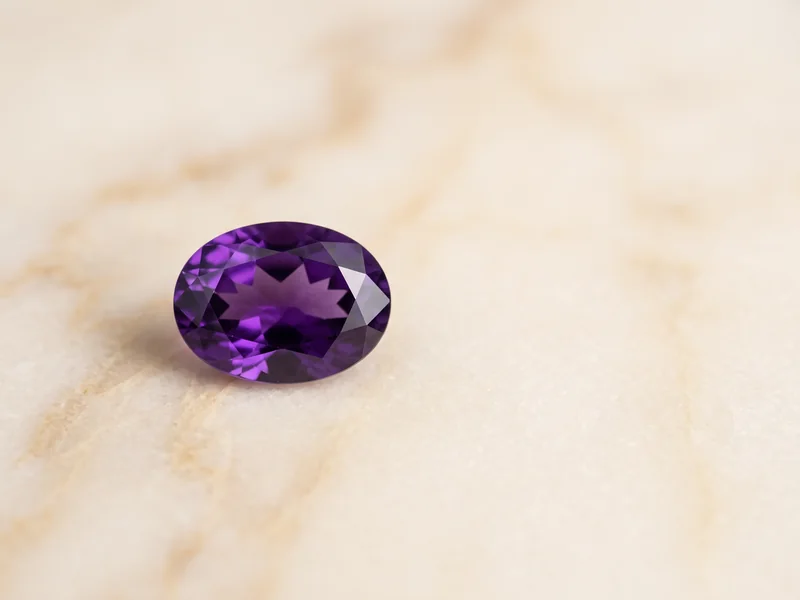
- Lavender jadeite: pale lilac to purple, linked to trace elements such as manganese and iron. It is softer in tone than purple amethyst and rarely as saturated.
- Other jadeite colours: white, yellow, orange to red (coloured by iron oxides in the outer skin of boulders), grey and black. Some pieces show several colours in one carving.
- Nephrite green: usually a deeper, more muted spinach green, coloured by iron, often with small black spots of other minerals.
- White and black nephrite: the creamy white Chinese material called mutton fat is the most prized; black nephrite, mined in Australia among other places, takes a high polish and suits men's jewellery.
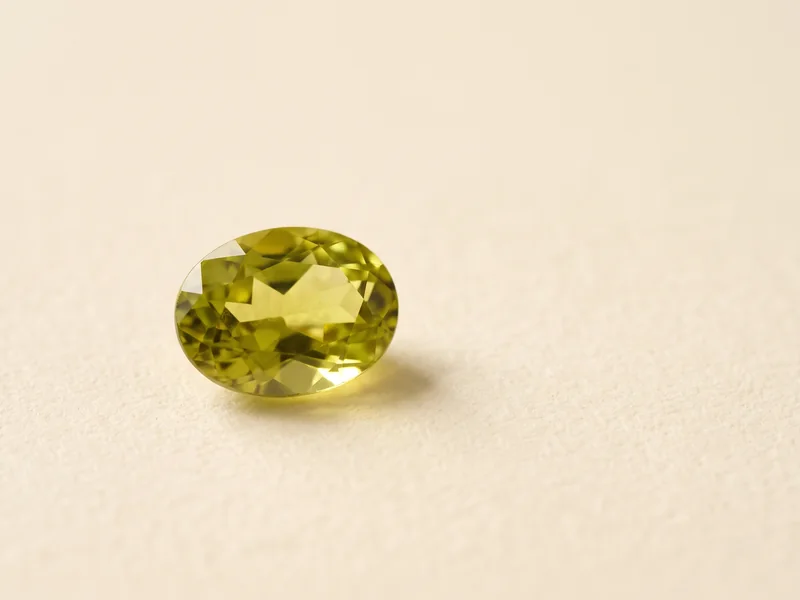
Colour in jade is judged on three things: hue (the colour itself), saturation (how strong it is) and evenness (whether it is spread uniformly or in patches and veins). An even, saturated green across a whole cabochon is far rarer than green veins through white. Nephrite's spinach green sits closer to the olive tones of yellowish green peridot than to jadeite's emerald-like green, which is one quick visual hint when you compare pieces side by side, though never a reliable test.
Jade colour is also tied to translucency, which traders call water. Light passing a few millimetres into the stone makes the colour glow; an opaque piece of the same hue looks flat and duller. Translucency matters most in jadeite and is a large part of its value.
Is jadeite or nephrite harder? Jade hardness and toughness
Two different properties decide how a gem survives daily life. Hardness is resistance to scratching, measured on the Mohs scale from 1 (talc) to 10 (diamond). Toughness is resistance to chipping and breaking when knocked. Jade is only moderately hard, so household dust (largely quartz, Mohs 7) can slowly dull its polish. But its toughness is exceptional: nephrite is among the toughest natural gem materials, and both jades resist breaking far better than many harder gems with cleavage (a tendency to split along flat planes).
| Gem | Mohs hardness | Toughness | Everyday ring wear |
|---|---|---|---|
| Jadeite | 6.5–7 | Exceptional | Good, in a protective setting |
| Nephrite | 6–6.5 | Exceptional | Good, in a protective setting |
| Chrysoprase | 6.5–7 | Good | Good |
| Amethyst and citrine (quartz) | 7 | Good | Good |
| Iolite | 7–7.5 | Fair (cleavage) | With care |
| Peridot | 6.5–7 | Fair | With care |
| Zircon | 6–7.5 | Fair (facet edges chip) | Occasional wear |
| Imperial topaz | 8 | Poor (perfect cleavage) | Protective setting essential |
| Kunzite | 6.5–7 | Poor (perfect cleavage) | Pendants and occasional rings |
| Moonstone, labradorite, sunstone | 6–6.5 | Fair to poor (cleavage) | With care |
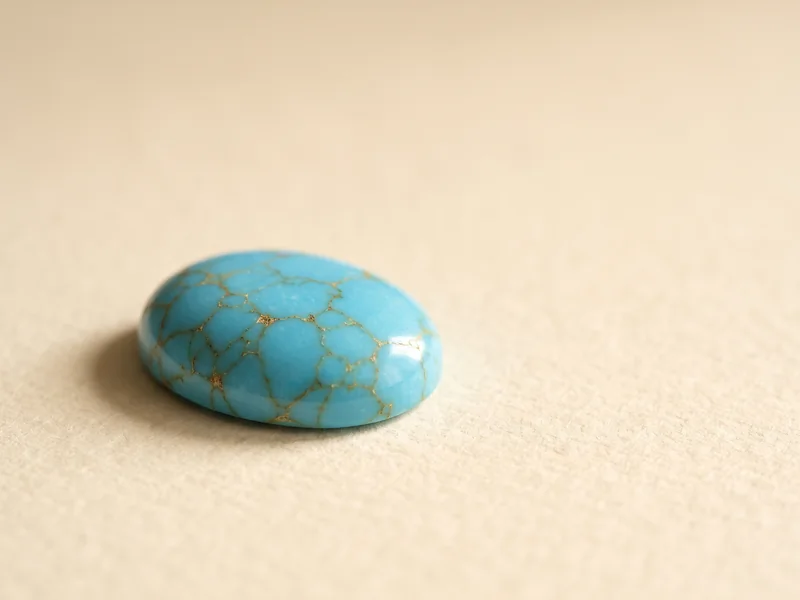
| Turquoise | 5–6 | Fair, porous | Occasional wear |
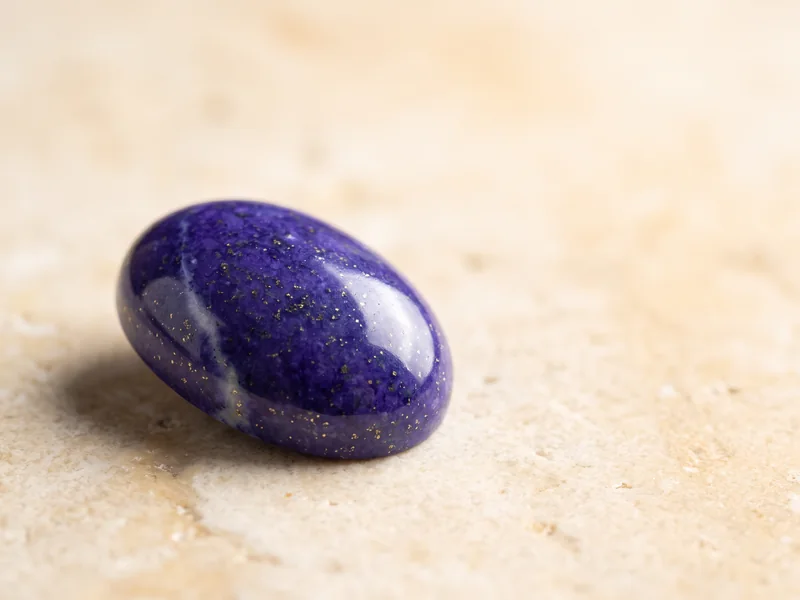
| Lapis lazuli | 5–5.5 | Fair | Occasional wear |
The table shows why jade has been used for tools, axes and bangles for millennia. Compare it with imperial topaz, harder but prone to cleavage, or kunzite and its perfect cleavage: both match or outscore jade on the Mohs scale but can split from a single sharp knock. Faceted zircon, which chips at its facet edges, is similar. Jade cannot cleave, because its crystals point every which way.
At the softer end, porous turquoise and deep blue lapis lazuli scratch more easily than jade and are better kept for occasional rings. The feldspar group, including moonstone with its floating blue sheen, has cleavage that jade lacks. For a harder transparent stone, violet-blue iolite is harder than jade, though it does have one cleavage direction to respect.
What are Type A, B and C jade treatments?
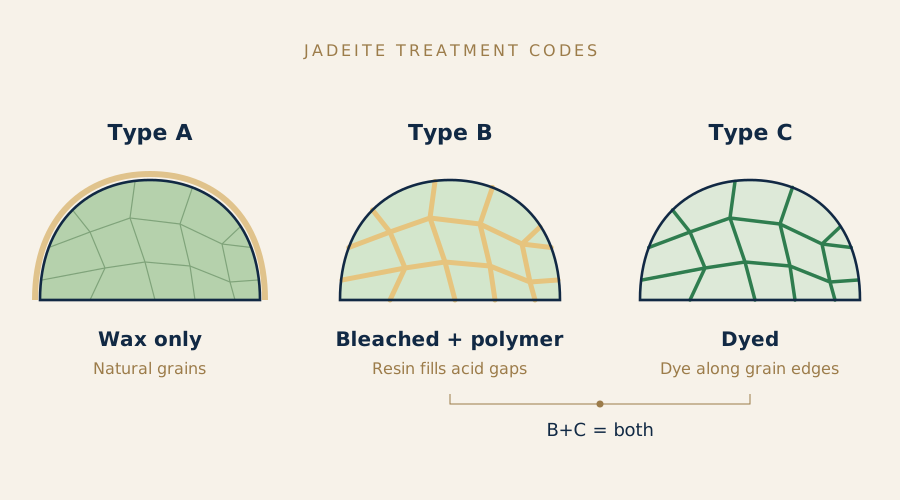
Treatment is the single biggest issue in jadeite, and the trade uses a simple letter code. You will see it on labels in Asian markets and on laboratory reports worldwide.
- Type A jade: natural jadeite that has only been cleaned and coated with wax, a traditional finish that improves lustre. This is the most valued material in the trade.
- Type B jade: jadeite bleached in acid to remove brown staining, then impregnated with a polymer (resin) to fill the gaps the acid left. It looks cleaner and more translucent at first, but the polymer can yellow, crack or loosen over years, and the stone is weaker.
- Type C jade: jadeite dyed to add or improve colour, usually green or lavender. Dye can fade in sunlight and may concentrate along grain boundaries.
- Type B+C jade: bleached, impregnated and dyed. Much of the bright, inexpensive green jade sold to tourists falls here.
Nephrite is treated less often, but it can be waxed, dyed or heated to darken or change colour, and it is sometimes stabilised with resin. Disclosure is what matters. Treated jade is perfectly wearable as costume or fashion jewellery if it is priced as such; problems arise only when a B or C piece is sold as natural.
Not sure which one is right?
Send us the stones you are looking at and our gemologist will tell you which to choose and why.
How to tell real jade: what does a gemmologist check?
Folk tests, such as scratching with a knife, holding a stone to see if it stays cold, or tapping a bangle to hear it ring, cannot tell jadeite from nephrite, natural from treated, or jade from good imitations. A gemmologist uses a short series of instrument checks instead.
- Refractive index: a spot reading on a refractometer gives about 1.66 for jadeite and about 1.61 for nephrite. Serpentine, a common imitation, reads about 1.56; quartzite and chalcedony about 1.54.
- Specific gravity: weighing the stone in air and in water. Jadeite (about 3.33) sinks in heavy liquids where nephrite (about 2.95) and serpentine (about 2.6) behave differently.
- Spectroscope: jadeite shows a characteristic absorption line at about 437 nanometres; chromium-coloured green jadeite also shows lines in the red. Dyed green jade shows a broad band in the red instead.
- Magnification: a loupe or microscope shows grainy or fibrous texture, dye collecting in cracks, or the etched, honeycomb-like surface typical of acid-bleached Type B jade.
- Laboratory testing: infrared spectroscopy (FTIR) detects polymer in Type B jade, which cannot be confirmed reliably by eye. Any significant jadeite purchase should come with a report from an independent laboratory.
Common imitations include serpentine (sometimes sold as new jade), dyed quartzite, green aventurine quartz, hydrogrossular garnet, prehnite, glass and plastic. Laboratory-grown jadeite has been produced experimentally, but it is very rarely seen in the jewellery market; if any is offered, it must be described as lab-created or synthetic jadeite.
Where does jade come from, including nephrite jade in Australia?
Jadeite forms under high pressure and low temperature, conditions found in only a few places on Earth. Almost all gem-quality jadeite comes from northern Myanmar (Burma), around Hpakant in Kachin State. Smaller sources include Guatemala, the historic source for Mesoamerican carvings, Japan, Russia and Kazakhstan. Guatemalan jadeite is often darker green or bluish and less translucent than fine Burmese material.
Nephrite is far more widespread. The main sources include British Columbia in Canada, which supplies much of the world's green nephrite; the Hetian region of Xinjiang in China, home of white mutton fat nephrite; Siberia in Russia; Taiwan; and New Zealand, where nephrite is known as pounamu and carries deep cultural significance for Māori.
Australia has its own nephrite. The best-known deposit is near Cowell on South Australia's Eyre Peninsula, mined since the 1970s and known for green and fine black nephrite. Smaller occurrences are recorded in New South Wales and elsewhere. Australia is also a major source of chrysoprase from Queensland and Western Australia, which is why that stone took on the Australian jade nickname. Australia produces other gems sold beside jade too: feldspars related to labradorite and its flashes of colour and glittering sunstone occur here, though most jewellery-grade material is imported.
Origin affects value mainly through reputation and typical quality. Fine Burmese jadeite and white Hetian nephrite carry premiums, but a lab report confirming the mineral and the absence of treatment matters far more than a claimed source.
What affects the value of jadeite vs nephrite?
Jade is not graded on the four Cs used for diamonds. Dealers and laboratories judge it on these factors, roughly in order of importance:
- Mineral and treatment: natural Type A jadeite sits at the top; nephrite is generally lower; Type B and C jadeite are worth a small fraction of comparable Type A.
- Colour: an even, saturated, slightly bluish green (imperial) is the most valued in jadeite. Strong lavender and fine red also command premiums. In nephrite, pure white and even deep green are favoured.
- Translucency: semi-transparent jadeite with a glowing look is worth many times more than an opaque piece of similar colour.
- Texture: fine, even grain gives a smooth, glassy polish. Coarse grain looks granular and lowers value.
- Clarity: cracks, dark spots and cloudy patches reduce value, and cracks reduce durability.
- Cut and size: high-domed cabochons, matched sets and whole bangles from one piece of fine material use a lot of rough and cost more. Carving quality matters in nephrite especially.
| Type of piece | Approximate price range (AUD) |
|---|---|
| Treated jadeite (Type B or C), cabochon or bangle | about $20–$300 |
| Nephrite cabochon for a ring | about $50–$500 |
| Nephrite bangle, good colour | about $150–$2,000 |
| Type A jadeite, commercial green cabochon | about $300–$3,000 |
| Type A jadeite, fine translucent green cabochon | about $5,000–$50,000 or more |
| Imperial jadeite, top quality | well beyond this; record pieces have sold at auction for millions |
These are very broad ranges only. Jade prices vary more than almost any other gem, because colour and translucency are judged by eye and the finest material is traded mainly in Asian markets. Unlike quartz gems such as golden citrine or two-toned ametrine, which blends amethyst and citrine, where price follows colour fairly predictably, two jadeite cabochons that look similar in a photo can differ in price by ten times or more.
Browse natural gemstones
Is jade good for rings and everyday wear?
Yes, with sensible choices. Jade's toughness means a well-set cabochon (a smooth, domed stone with no facets) is unlikely to break, and many people wear jade rings daily for decades. The main risk is gradual scratching of the polish rather than chipping, plus cracks in pieces that already have fractures.
- Bezel settings: a rim of metal around the cabochon protects the edge and suits jade's soft, rounded look.
- Claw settings: four or six claws let more light into translucent jadeite. Keep the claws sturdy and check them regularly.
- Low profile: a stone sitting close to the finger takes fewer knocks than one set high.
- Carved jade bands: rings cut from a single piece of jade are traditional, but a hard knock against stone or tiles can crack them, and they cannot be resized.
- Inlays and signets: nephrite, especially black nephrite, works well as a flat inlay in a men's signet ring.
Yellow gold is the classic partner for green jadeite, deepening the green. White gold and platinum suit lavender and white jade. Remove jade rings for gardening, gym work and cleaning with chemicals, as you would any softer gem.
How do you choose and care for jade? Step by step
- Confirm the mineral. Ask whether the piece is jadeite, nephrite or another stone sold as jade.
- Ask about treatment. For jadeite, ask whether it is Type A; for any valuable piece, request an independent laboratory report.
- Judge colour and translucency together. Look at the piece in daylight and against a light; even colour with a soft glow is the goal.
- Check for cracks. Use a loupe or strong light to look for fine lines, especially in bangles and carved rings.
- Choose a protective setting. A bezel or sturdy claws, set fairly low, for a ring you will wear often.
- Clean gently. Use warm water, mild soap and a soft brush, then dry with a soft cloth. Avoid ultrasonic and steam cleaners, especially for treated or waxed jade.
- Store it separately. Keep jade in a soft pouch away from diamonds, sapphires and other harder gems that can scratch it, and take bangles off before hard work.
Avoid acids, bleach and solvents, which can damage wax finishes and the polymer in Type B jade. Sunscreen and perfume can dull the surface over time, so put jewellery on last. A jeweller can repolish scratched jade and check settings when you bring a piece in.
Free consultation
Talk to a gemologist
Compare stones in person or online with Raj Sood, Graduate Gemologist (GIA), AJP (GIA).
Book a consultationShop this shape
FAQ
Common questions
Which is more valuable, jadeite or nephrite?
Fine jadeite is generally far more valuable because it is rarer and can show imperial green and high translucency. Fine white or even green nephrite is still valued, but most nephrite costs less than comparable Type A jadeite.
What does Type A jade mean?
Type A jade is natural jadeite that has only been cleaned and waxed, with no bleaching, polymer or dye. Type B is bleached and polymer-impregnated, and Type C is dyed.
How can I tell if my jade is real?
Home tests such as scratching or feeling for coldness are not reliable. A gemmologist checks refractive index, specific gravity and the absorption spectrum, and an independent lab can detect polymer with infrared testing.
Is jade good for an engagement ring?
Jade is very tough, so a jade cabochon in a bezel or sturdy claw setting can be worn daily. It scratches more easily than sapphire or diamond, so expect to have the polish refreshed over the years.
Is chrysoprase the same as Australian jade?
No. Chrysoprase is a green chalcedony (quartz) coloured by nickel, and it is sometimes called Australian jade only as a trade nickname. Australia does have true nephrite jade, notably from near Cowell in South Australia.
Can jade be lab-grown?
Jadeite has been made in laboratories experimentally, but lab-created jadeite is very rarely seen in jewellery. The jade you are likely to meet is either natural or a treated or imitation material.

Ask a gemologist
Not sure which diamond to choose?
Raj Sood is a Graduate Gemologist (GIA) and master jeweller. Bring the stones you are considering, or send the reports, and he will tell you honestly which one is better and why.
Keep learning
Related guides
Explore more
More guides on this topic
Education