
Gemstones
Aquamarine Engagement Ring Guide: Colour, Durability, Settings and Price
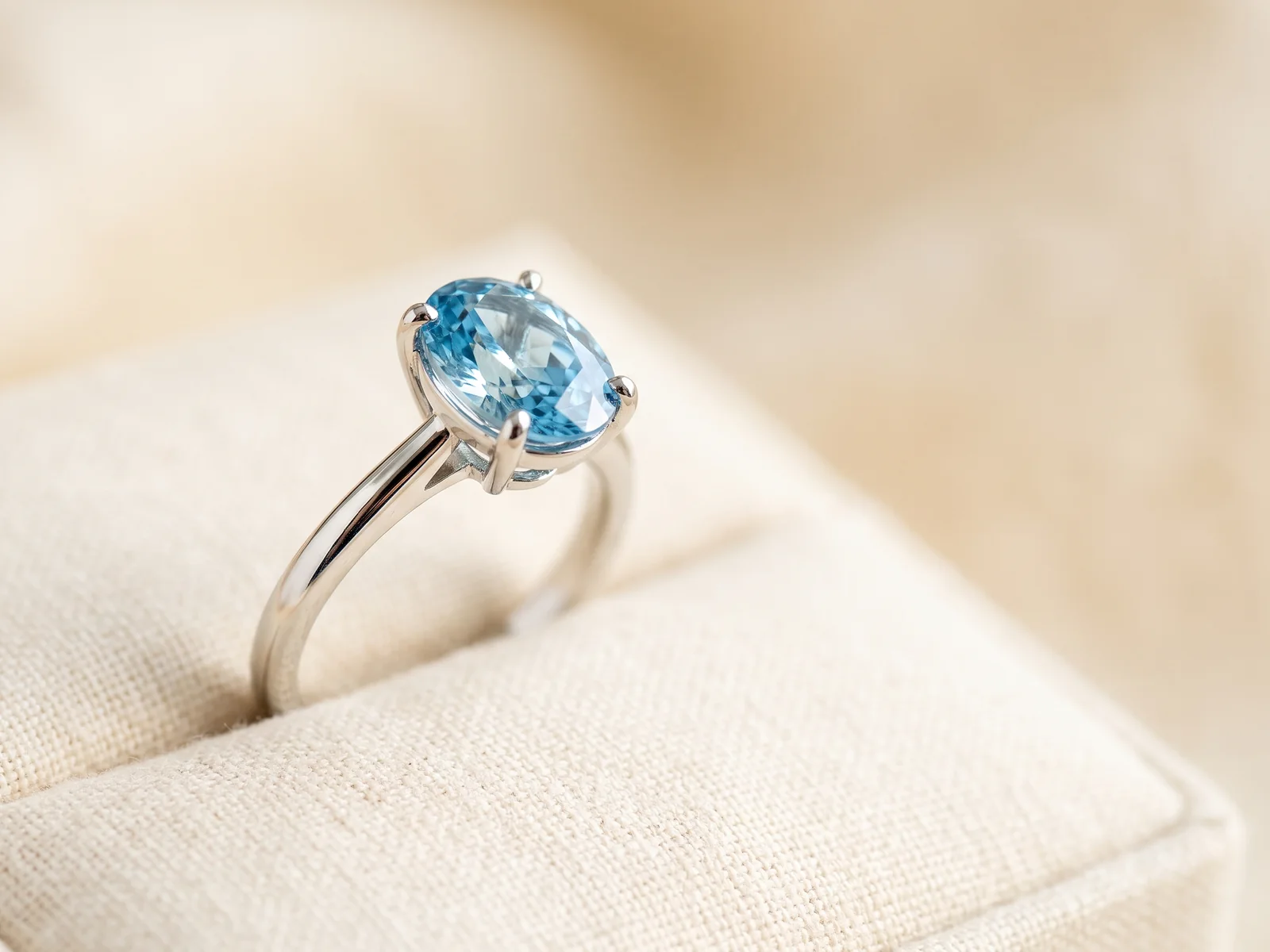
An aquamarine engagement ring gives you a clear, cool blue at a fraction of the price of a sapphire of the same size. It is also softer than sapphire, so colour, cut and setting matter more than usual.
 Reviewed by Raj Sood, Graduate Gemologist (GIA), AJP (GIA)Master jeweller and Graduate Gemologist (GIA) · reviewed 4 November 2026
Quick answer
Yes, aquamarine makes a good engagement ring with sensible care. It is a blue beryl, 7.5–8 on the Mohs scale with good toughness, so it handles daily wear better than emerald or opal but scratches more readily than sapphire or diamond. Choose a saturated blue, eye-clean stone of about 1 carat or more, in a protective setting.
What is an aquamarine engagement ring?
An aquamarine engagement ring is set with the blue variety of the mineral beryl, a beryllium aluminium silicate (Be3Al2Si6O18). Beryl is a family of gems: green beryl coloured by chromium or vanadium is emerald, pink beryl is morganite, yellow is heliodor, and pale blue to greenish blue is aquamarine. The blue comes from small traces of iron in the crystal. Because it shares its mineral with emerald, its better-known beryl sister, aquamarine has the same hardness, but it usually has far fewer inclusions (internal features), which makes it noticeably tougher in a ring.
The name comes from the Latin for 'sea water', and the colour runs from a barely-there pale blue to a deep, slightly greenish ocean blue. It is the traditional gem for March, which we cover in our page on aquamarine as the March birthstone, but most people who choose it for an engagement ring do so for the colour itself: a cool, clear blue that is lighter and softer than a sapphire.
Aquamarine grows as long six-sided crystals, sometimes very large ones, so clean stones of several carats are available at prices that would be out of reach in sapphire or emerald. It sits alongside the other coloured stones in our guide to coloured gemstones, and any term below that you have not met before is explained in our glossary of jewellery terms.
Is aquamarine good for an engagement ring?
For a ring worn every day, three properties matter. Hardness is resistance to scratching, measured on the Mohs scale. Toughness is resistance to chipping and breaking when the stone is knocked. Stability is how well the stone copes with heat, light and chemicals. Aquamarine scores reasonably on all three, which is why it is one of the more practical coloured stones for an engagement ring.
Ordinary household dust contains quartz, which is 7 on the Mohs scale. Anything softer than 7 is slowly scratched just by being wiped or worn. Aquamarine at 7.5–8 sits above that line, so it resists everyday scuffing, but only just. Over years of daily wear the sharp facet edges can soften and the surface can pick up fine scratches, especially on the table (the large top facet). That is normal and can be polished out by a jeweller.
| Gem | Mohs hardness | Toughness | Everyday-wear notes |
|---|---|---|---|
| Diamond | 10 | Good (can cleave if struck on a thin edge) | Hardest natural material; protect points and corners |
| Sapphire and ruby | 9 | Excellent | The toughest common coloured stones for rings |
| Aquamarine | 7.5–8 | Good | Practical for daily wear; facet edges may wear over many years |
| Morganite | 7.5–8 | Good | Same beryl family; similar care to aquamarine |
| Emerald | 7.5–8 | Poor to good | Often has fissures, many filled with oil or resin; needs a protective setting |
| Blue topaz | 8 | Poor (perfect cleavage) | Hard but splits easily along one direction if knocked |
| Tanzanite | 6–7 | Fair to poor | Scratches and chips readily in a ring |
| Opal | 5.5–6.5 | Poor to fair | Soft; best in a bezel and worn with care |
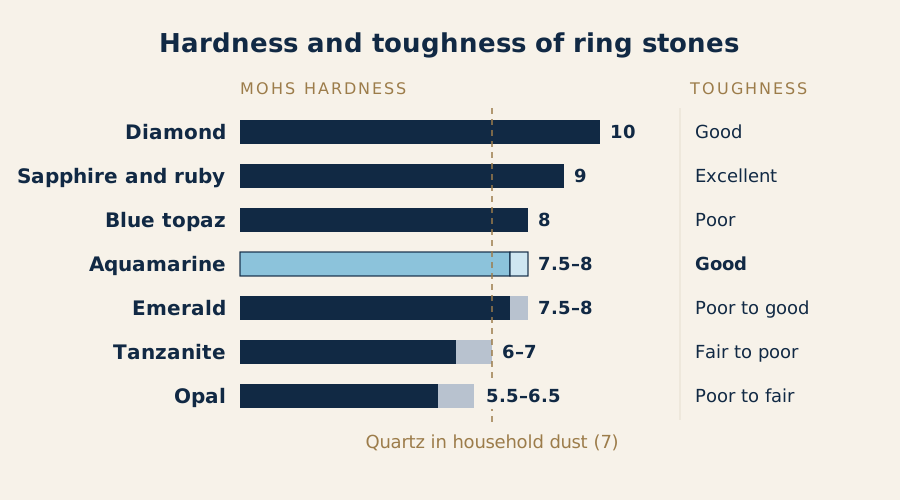
Aquamarine's cleavage (a tendency to split along a flat plane) is poor, meaning it is not easily triggered, so a well-set aquamarine rarely chips from a light knock the way blue topaz can. It is not in the same league as corundum, though; sapphire's hardness and toughness are a step above, and our guide on how diamond and sapphire compare for daily wear shows the gap. At the softer end, why opal needs more care than harder gems explains what life is like below 7 on the scale.
The one stability point to know: aquamarine can crack if a stone with large liquid inclusions meets sudden heat, such as a jeweller's torch during resizing or a jump from hot to cold water. Eye-clean stones are far less at risk, which is one more reason to buy clean.
What colour aquamarine is most valuable?
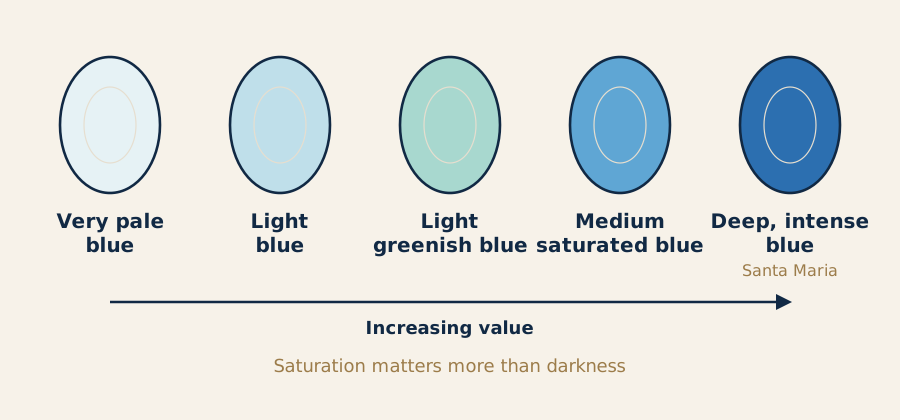
Gemologists describe colour in three parts. Hue is the basic colour (blue, greenish blue). Tone is how light or dark it is. Saturation is how strong or pure the colour is, as opposed to greyish or washed out. In aquamarine, value rises with saturation and with a purer blue hue. A medium to medium-dark, strongly saturated blue sits at the top; light greenish blue sits in the middle; very pale, almost colourless stones sit at the bottom.
- Very pale blue: attractive in small accent stones, but can look like glass or colourless quartz in a centre stone.
- Light blue: the classic 'sea water' look; the most common colour in commercial jewellery.
- Light greenish blue: popular with people who like a beachy, natural tone; usually priced below pure blue.
- Medium saturated blue: clearly blue from across a room; the colour most people picture.
- Deep, intense blue: often called 'Santa Maria' colour, after a Brazilian mine that produced it; the rarest and dearest.
Colour also depends on size. Aquamarine is a lightly coloured gem, so a small stone simply has less material for light to travel through. Under about 0.5 carat many aquamarines look pale; from about 1 carat the blue usually reads clearly; at 3 carats and above even a medium stone can look rich. The stone is also dichroic, meaning it shows two colours in different directions, typically blue one way and near-colourless or slightly greenish the other. A good cutter orients the rough so the stronger blue faces up, which is one reason aquamarines are often cut long, as ovals and emerald cuts.
Heat treated aquamarine is the norm, not the exception. Much of the world's aquamarine is gently heated, typically somewhere around 375–450 °C, to remove a yellowish component and turn greenish stones a purer blue. The result is permanent and stable, is generally not detectable, and is accepted across the trade; it should still be disclosed. The treatment to watch for is different: deep blue Maxixe-type beryl, whose colour is produced or enhanced by irradiation and fades in sunlight. A gemmological report or a qualified gemologist can tell the two apart.
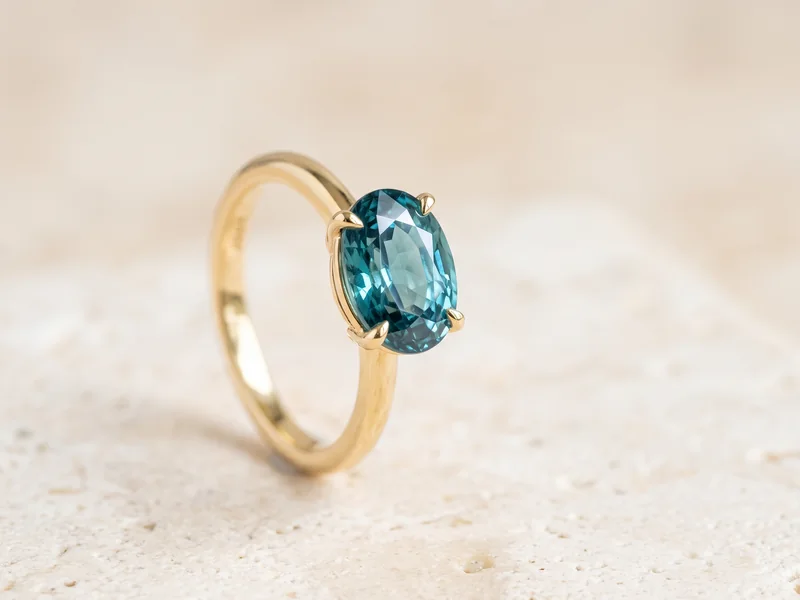
If you love the greener end of the range but want a harder stone, teal sapphire engagement rings give a similar blue-green mood at 9 on the Mohs scale.
Which cut and size suit an aquamarine ring?
Aquamarine is what gemologists call a Type I coloured stone: it usually forms with few inclusions, so eye-clean stones (no inclusions visible without magnification at normal viewing distance) are the standard expectation. Typical inclusions, when present, are liquid 'fingerprints', fine parallel hollow tubes sometimes called rain, and small mineral crystals. A tiny inclusion away from the edge is fine. Avoid any fracture that reaches the surface, especially near a corner or the girdle (the outer edge), where it can weaken the stone.
Aquamarine's refractive index of about 1.57–1.58 is far lower than diamond's 2.42, so it bends light less and will never sparkle like a diamond. What it does well is a clear, glassy, watery brightness. Step cuts such as the emerald cut, with long parallel facets, show off that clarity and even colour and are the classic aquamarine cut. Ovals, cushions and pears cut in a brilliant style add more sparkle and can make a paler stone look livelier. Whatever the shape, tilt the stone and check for a window: a washed-out, see-through patch in the centre caused by a shallow pavilion (the lower half). A large window makes the stone look pale and lifeless.
Aquamarine is lighter than diamond (specific gravity about 2.72 against 3.52), so the same millimetre size weighs less, although coloured stones are often cut deeper to hold colour. These are typical face-up sizes and weights:
| Shape and size | Approximate aquamarine weight |
|---|---|
| Round, 6.5 mm | about 0.9–1.0 ct |
| Oval, 8 × 6 mm | about 1.0–1.3 ct |
| Oval, 9 × 7 mm | about 1.6–2.0 ct |
| Emerald cut, 8 × 6 mm | about 1.3–1.7 ct |
| Cushion, 8 × 8 mm | about 2.0–2.4 ct |
| Emerald cut, 10 × 8 mm | about 2.5–3.2 ct |
For an engagement ring, most people land between about 8 × 6 mm and 10 × 8 mm. Compare stones by their millimetre measurements, not just carat weight, because depth varies more in coloured stones than in diamonds.
Not sure which one is right?
Send us the stones you are looking at and our gemologist will tell you which to choose and why.
Where does aquamarine come from, and is there Australian aquamarine?
Aquamarine forms in pegmatites, coarse-grained granite-like rocks where large crystals have room to grow. Brazil, particularly Minas Gerais, has long been the best-known source and gave us the Santa Maria trade name for deep blue material. Today a large share of fine aquamarine also comes from Africa, including Mozambique, Madagascar, Nigeria and Zambia, with further sources in Pakistan and Afghanistan, and historic production in Russia's Ural Mountains.
Origin matters less for aquamarine than for some gems. Labs can give an origin opinion, but most aquamarine is valued on colour, clarity, cut and size. A trade name like Santa Maria now usually describes the colour rather than the mine, so ask whether it refers to origin or just appearance.
Australian aquamarine does exist. Beryl, including aquamarine, has been recorded in pegmatites in several states, with the Harts Range in the Northern Territory and parts of the New England region of New South Wales among the better-known localities. Most of it is specimen or fossicking material rather than a steady commercial supply of facet-grade stones, so an Australian aquamarine for a centre stone is a special find rather than something you can order by size and colour. If an Australian-mined stone matters to you, sapphires mined in Queensland and New South Wales are a far more reliable local option, and Australian opal is another.
How can you tell real aquamarine from blue topaz or glass?
Light blue stones are easy to imitate, so it helps to know what a gemologist checks. By eye, aquamarine tends to be a softer, slightly greyish or greenish blue, while treated blue topaz is usually a brighter, more electric blue. Eye judgement is not proof, though; identification needs instruments.
| Stone | Refractive index | Specific gravity | Key clues |
|---|---|---|---|
| Natural aquamarine | about 1.57–1.58 (double refractive, birefringence about 0.005–0.009) | about 2.68–2.74 | Distinct dichroism (blue and near-colourless); liquid inclusions or parallel tubes |
| Blue topaz | about 1.61–1.63 | about 3.53 | Noticeably heavier for its size; colour almost always from irradiation plus heat |
| Synthetic spinel imitation | about 1.73 (single refractive) | about 3.6 | No dichroism; often very clean; sometimes sold as 'aqua spinel' |
| Glass | varies, often 1.50–1.70 (single refractive) | varies | Gas bubbles, swirl marks, rounded facet edges; feels warmer to the touch |
| Lab-created aquamarine | close to natural | close to natural | Hydrothermal growth patterns under magnification; uncommon in jewellery |
Lab-created (synthetic) aquamarine is grown hydrothermally, in hot water under pressure, and has the same chemistry as natural aquamarine. Because it is not much cheaper to grow than a commercial natural stone is to mine, it is rarely seen; imitations such as synthetic spinel and glass are far more common. Any laboratory-made stone must be described as lab-created or synthetic aquamarine, never just 'aquamarine'. For the full point-by-point comparison, read aquamarine vs blue topaz side by side.
Related guideAquamarine vs Blue TopazWhat is the best setting for an aquamarine engagement ring?
The setting has two jobs: protect a stone that is softer than sapphire, and let in enough light to show a colour that is fairly delicate. The common aquamarine engagement ring settings:
- Four claws: show the most stone and let in the most light; best for ovals and rounds worn by someone who is fairly gentle on their hands.
- Six or double claws: more security, and on an emerald cut, claws placed on each corner protect the cut corners, the most vulnerable points.
- Bezel or half-bezel: a rim of metal around the girdle. The most protective option for active hands, though it hides a little of the outline.
- Diamond halo: a ring of small natural or lab-grown diamonds around the aquamarine. The halo adds the sparkle aquamarine lacks, frames a pale colour and guards the edge.
- Three-stone: diamonds or white sapphires either side give contrast and protect the sides of the centre stone.
- East-west: an oval or emerald cut set sideways across the finger, which sits lower and catches less.
Metal colour changes how the blue reads. White gold and platinum keep aquamarine cool and crisp. Yellow gold warms the stone and can push a greenish aquamarine further towards green, which some people love and others do not. Rose gold gives a soft contrast with light blue. Keep the profile reasonably low, because a tall setting takes more knocks, and choose an open gallery (the metal under the stone) so light can enter from the sides. Much of the protective thinking used for settings used for emerald engagement rings applies here too, although aquamarine is usually more forgiving.
Aquamarine vs sapphire, emerald and diamond: which suits an engagement ring?
| Aquamarine | Blue sapphire | Teal sapphire | Emerald | Blue topaz | Diamond | |
|---|---|---|---|---|---|---|
| Mohs hardness | 7.5–8 | 9 | 9 | 7.5–8 | 8 | 10 |
| Toughness | Good | Excellent | Excellent | Poor to good | Poor | Good |
| Typical colour | Pale to medium blue, sometimes greenish | Medium to deep blue | Blue-green | Green | Bright sky to deep blue | Colourless, or fancy colours |
| Usual treatment | Heating (stable) | Heating common | Heating common | Oil or resin filling | Irradiation and heat | Natural usually untreated; lab-grown may be treated after growth |
| Clean stones over 3 ct | Readily available | Uncommon and costly | Uncommon | Rare | Readily available | Costly in natural |
| Relative cost, similar size | Moderate | High | Moderate to high | High | Low | Highest in natural; much lower in lab-grown |
Choose aquamarine if you want a large, clear, light blue stone and are happy to treat the ring with some care. If you want blue for life with less maintenance, blue sapphire engagement rings are tougher and harder, and our teal versus classic blue sapphire comparison helps if you are torn between shades. Weighing up the other big coloured stones, see ruby vs sapphire for an engagement ring and the emerald versus sapphire durability guide.
Blue topaz is the closest look-alike for much less money, but its perfect cleavage makes it a riskier centre stone for daily wear. Diamond, natural or lab-grown, is the most durable choice but gives a colourless look unless you choose a fancy blue.
How much does an aquamarine engagement ring cost in Australia?
Aquamarine is priced per carat, and the per-carat price rises steeply with colour. Size matters too: for the finest colours, larger stones cost more per carat, but commercial-quality material stays fairly flat in price as it gets bigger. These are broad loose-stone ranges for eye-clean, well-cut natural aquamarine:
| Colour (eye-clean, well cut) | Approximate price per carat (AUD) |
|---|---|
| Very pale or greyish blue | about $50–$200 |
| Light blue or light greenish blue | about $200–$500 |
| Medium, well-saturated blue | about $500–$1,000 |
| Deep, intense blue (Santa Maria colour) | about $1,000–$2,500 or more |
So a 1.5 carat aquamarine of good medium blue might cost roughly $750–$1,500 as a loose stone. The setting then adds the rest: a simple 18ct gold or platinum solitaire setting is often in the region of $1,500–$3,500, and a diamond halo or side stones add more depending on whether the diamonds are natural or lab-grown. Many finished aquamarine engagement rings land somewhere around $2,000–$6,000, with deep-colour stones over 3 carats well above that. Prices move with the market and the exact stone, so treat these as a guide only.
Aquamarine is also popular in right-hand rings, pendants and studs, often bought as birthstone jewellery made in Melbourne for a March birthday, where smaller paler stones work well because they are seen up close.
Browse natural gemstones
How do you choose and care for an aquamarine engagement ring?
- Set your colour first. Decide between pale, greenish and saturated blue, and view stones in daylight and warm indoor light.
- Check it is eye-clean. No visible inclusions, and no surface-reaching fractures near corners or the girdle.
- Look for a window. Tilt the stone; the centre should stay coloured, not go see-through.
- Compare millimetres. Aim for about 8 × 6 mm or larger in a centre stone so the blue reads clearly.
- Confirm identity and treatment. Ask whether it is natural or lab-created, and that any heating is disclosed; avoid Maxixe-type irradiated beryl.
- Choose a protective setting. Corner claws for emerald cuts, six claws, a bezel or a halo if you are hard on your hands.
- Clean it gently. Warm water, a little dishwashing liquid and a soft brush; avoid steam cleaners and avoid ultrasonic cleaning if the stone has visible inclusions.
- Take it off for heavy work. Gardening, gym weights and cleaning products are the usual culprits for knocks and grime.
- Have the claws checked yearly. And if the ring needs resizing, ask whether the stone will be removed or protected from the torch's heat.
Free consultation
Talk to a gemologist
Compare stones in person or online with Raj Sood, Graduate Gemologist (GIA), AJP (GIA).
Book a consultationShop this shape
FAQ
Common questions
Is aquamarine durable enough to wear every day?
Yes, with sensible care. At 7.5–8 on the Mohs scale with good toughness, it handles daily wear better than emerald, opal or topaz, but it will show fine wear sooner than sapphire or diamond, so a protective setting and the occasional polish help.
Does aquamarine fade over time?
Natural aquamarine, including heat treated aquamarine, keeps its colour permanently. The exception is irradiated Maxixe-type blue beryl, which fades in sunlight; a gemologist or lab report can identify it.
Why does my aquamarine look cloudy?
Usually it is a film of soap, hand cream or skin oil on the back of the stone, which blocks light and makes the colour look dull. A soak in warm soapy water and a gentle brush underneath normally brings it back.
Is aquamarine or blue topaz better for an engagement ring?
Aquamarine is the more durable choice because blue topaz has perfect cleavage and can split if knocked. Blue topaz is much cheaper and usually a brighter blue, so it suits occasional-wear jewellery well.
Can an aquamarine engagement ring be resized?
Usually yes. The jeweller should check the stone for inclusions first and either remove it or protect it from heat, because sudden heat can crack an included aquamarine.
Is lab-created aquamarine available?
It exists, grown by the hydrothermal method, but it is uncommon in jewellery because commercial natural aquamarine is not expensive. Any laboratory-made stone must be sold as lab-created or synthetic aquamarine.

Ask a gemologist
Not sure which diamond to choose?
Raj Sood is a Graduate Gemologist (GIA) and master jeweller. Bring the stones you are considering, or send the reports, and he will tell you honestly which one is better and why.
Keep learning
Related guides
 GemstonesAquamarine vs Blue Topaz
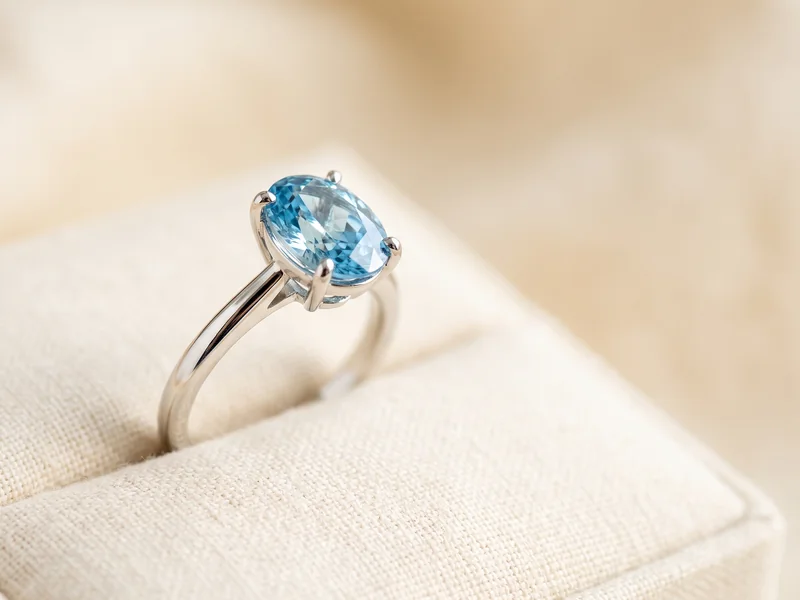 GemstonesMarch Birthstone: Aquamarine
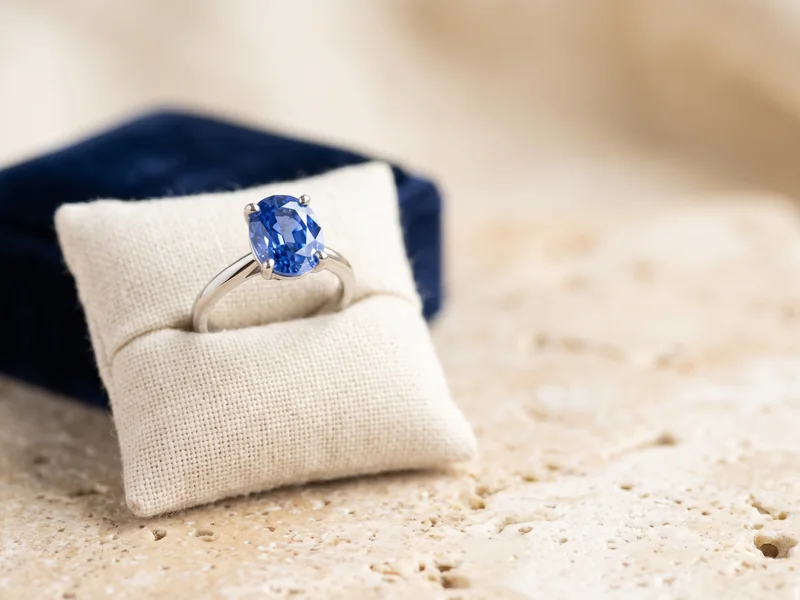 GemstonesSapphire Engagement Rings in Melbourne
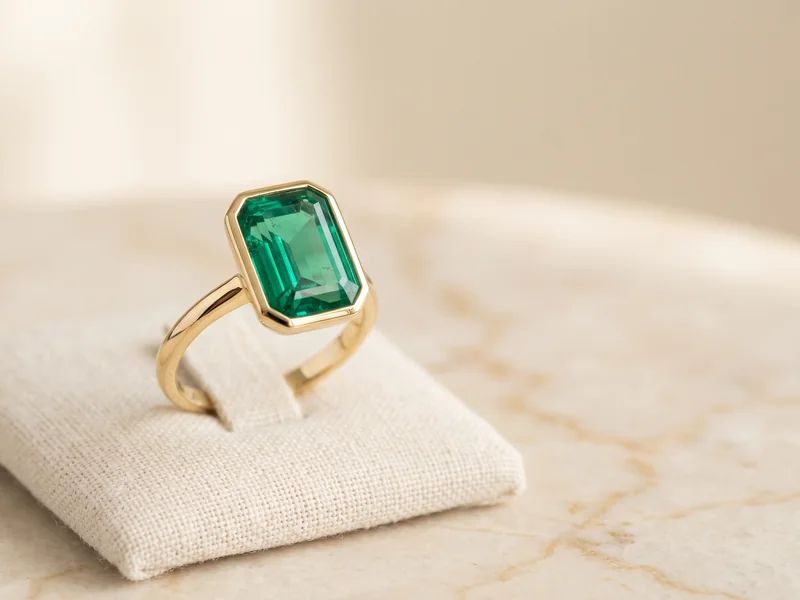 GemstonesEmerald Engagement RingsGemstonesGemstones | Coloured Gemstones, Birthstones and Custom Jewellery
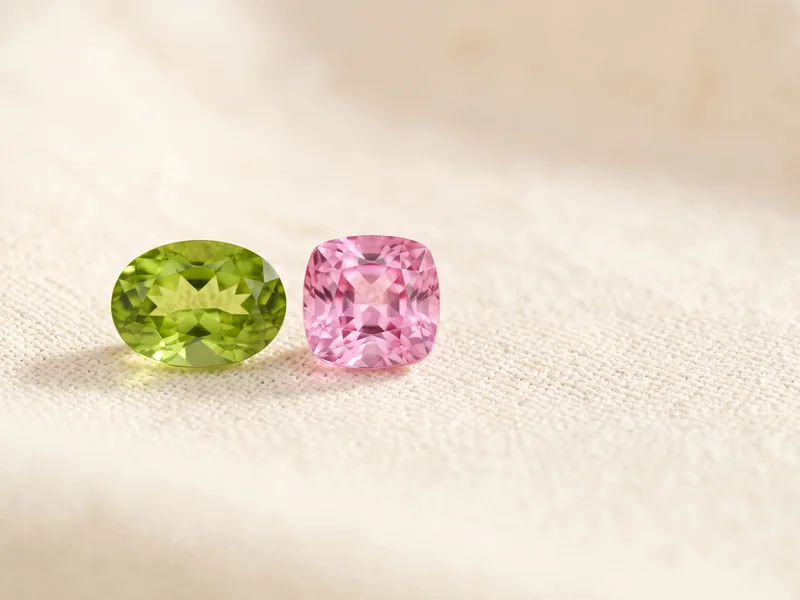 GemstonesRuby vs Sapphire Engagement Rings
 GemstonesSapphire Gemstones
 GemstonesTeal Sapphire Engagement Rings
Explore more
More guides on this topic
Education