
- Education
- Engagement Rings & Settings
- Engagement Ring Settings for Active Hands: What Lasts and Why
Engagement Rings & Settings
Engagement Ring Settings for Active Hands: What Lasts and Why
If you work with your hands, lift weights, garden or chase small children, the setting matters as much as the stone. Here is how engagement ring settings for active hands are built, how each style wears over the years, and what we see most often on the repair bench.
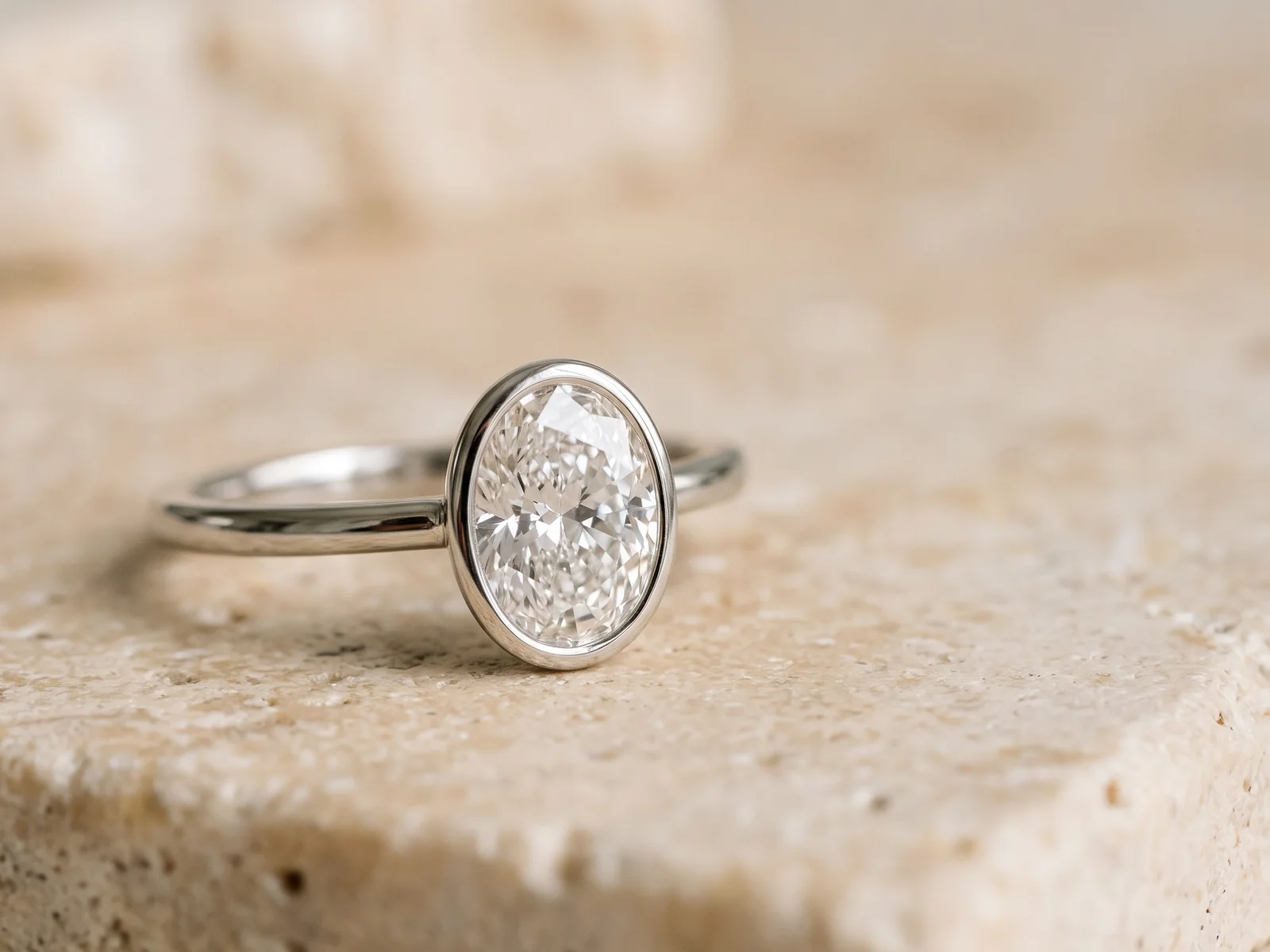
 Reviewed by Raj Sood, Graduate Gemologist (GIA), AJP (GIA)Master jeweller and Graduate Gemologist (GIA) · reviewed 4 November 2026
Quick answer
The most practical engagement ring settings for active hands keep the stone low and its edges covered. A full or half bezel, a flush (gypsy) setting or a low-profile setting with four or six thick claws in platinum or 18 carat gold is the most secure choice. Avoid high cathedral claws, thin bands and tension settings.
What makes engagement ring settings for active hands different?
Active hands are hard on rings in three ways. There are knocks against benches, car doors, gym equipment and shopping trolleys. There are snags on jumpers, gloves, hair and bedding. And there is slow wear: friction from tools, handles and a wedding band rubbing against the engagement ring, day after day for decades.
Most people worry about the diamond, but the diamond is rarely the weak point. Diamond is 10 on the Mohs scale (a 1–10 scale of scratch resistance), so very little in daily life will scratch it. Hardness is not the same as toughness, though. Diamond can chip along its cleavage planes if a thin edge, a sharp corner or a pointed tip takes a hard knock at the wrong angle. The metal holding it is softer again, and that metal is where most problems start.
From the repair side, the same jobs come across our bench again and again: claw tips worn thin or bent back, small stones missing from pavé bands, bands squeezed out of round from gripping, and shanks (the band of the ring, especially the part under the finger) worn paper-thin after 15 to 20 years. A setting chosen for an active life is simply one that reduces those risks. If you want the full range of designs first, see every engagement ring setting style explained, and any term here you have not met is in our glossary of jewellery terms.
Which engagement ring settings for active hands are most secure?
Here is how the main setting styles compare for protection, snagging and long-term wear. The ratings reflect how each design behaves in daily use, not how well a particular ring has been made; a well-made claw setting will outlast a poorly made bezel.
| Setting | Stone protection | Snag risk | How it wears over years | Upkeep |
|---|---|---|---|---|
| Full bezel | Very high; edge fully wrapped in metal | Very low | Rim can dent but rarely releases the stone | Polish; check rim every few years |
| Half bezel | High at the sides | Low | Open ends show more stone; sides take the knocks | As for bezel |
| Flush (gypsy) | Very high; stone sits level with the band | Very low | Metal around the stone wears slowly | Low |
| Low-set 4 claw | Moderate | Moderate | Claw tips thin and need retipping | Check every 6–12 months |
| Low-set 6 claw or double claw | Moderate to high; one lost claw still leaves the rest | Moderate | As for 4 claw, with more claws to check | Check every 6–12 months |
| Channel | High for small stones | Low | Walls can thin or spread after a hard knock | Check walls when cleaned |
| Pavé / micro-pavé | Low for the small stones | Low to moderate | Tiny metal beads wear and stones work loose | One of the most frequent repairs |
| High cathedral or tall basket | Low; stone exposed on all sides | High | Claws take direct knocks | Frequent checks |
| Tension | Variable; held by pressure only | Low | A hard knock can shift or release the stone; hard to resize | Specialist work |
| Halo | Centre stone shielded by the halo | Moderate | Halo stones get knocked out instead of the centre | Check halo claws |
The pattern is simple. The lower the stone sits and the more of its edge is covered, the safer it is. Every setting relies on careful hand work at the bench to grip the stone properly, and our guide to how stones are set by hand at the bench shows what a good seat looks like. A secure setting also needs to be checked: no design is maintenance-free.
Is a bezel setting engagement ring good for an active lifestyle?
A bezel setting surrounds the stone's girdle (its outer edge) with a thin wall of metal that is pushed over and burnished down against the stone. Because the whole edge is covered, there is nothing to catch on fabric and no single claw to wear through. For nurses, tradies, chefs, vets, climbers and anyone who reaches into tight spaces, a bezel is the design we suggest looking at first.
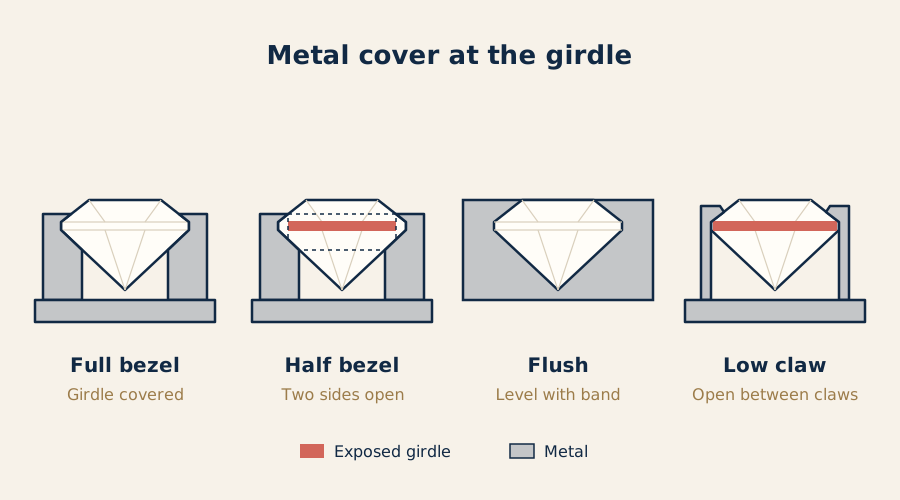
A half bezel covers two sides and leaves the other two open. It shows a little more of the stone and lets in more light, while still guarding the sides that take most knocks when your hand is flat on a surface. It suits oval, emerald and elongated shapes well.
The common worry is that a bezel makes a diamond look smaller or less bright. It does hide the girdle, so a 1 carat stone can look marginally smaller face-up, and it blocks a little light from the sides. In practice most light enters through the top, so a well-cut stone still sparkles. Two practical notes: a yellow gold bezel will warm the look of a white diamond, and a bezel wall that is too thin can dent, so ask for a substantial rim. Compare bezel, halo and solitaire styles side by side to see how each looks on the hand.
Can you have a claw setting if you work with your hands?
Yes, and many people with active jobs wear claw settings for decades. The difference is in the details. A claw (also called a prong) is a small post of metal bent over the stone's edge. Claws are easy to see and easy to repair, which is an advantage, but they are also the part of a ring that wears fastest.
- Keep it low. A low-profile engagement ring sits the stone roughly 5–6 mm above the finger rather than 7–9 mm for a tall cathedral, so it takes fewer direct hits.
- Choose six claws or double claws. If one claw bends or breaks, the stone is still held while you get it repaired.
- Ask for thicker claws. A claw that starts out about 1.0–1.3 mm across at the tip has more metal to lose before it needs retipping.
- Rounded or flat-topped claw heads snag less than fine pointed tips.
- Protect points and corners with V-claws or tab claws that wrap the corner rather than sit beside it.
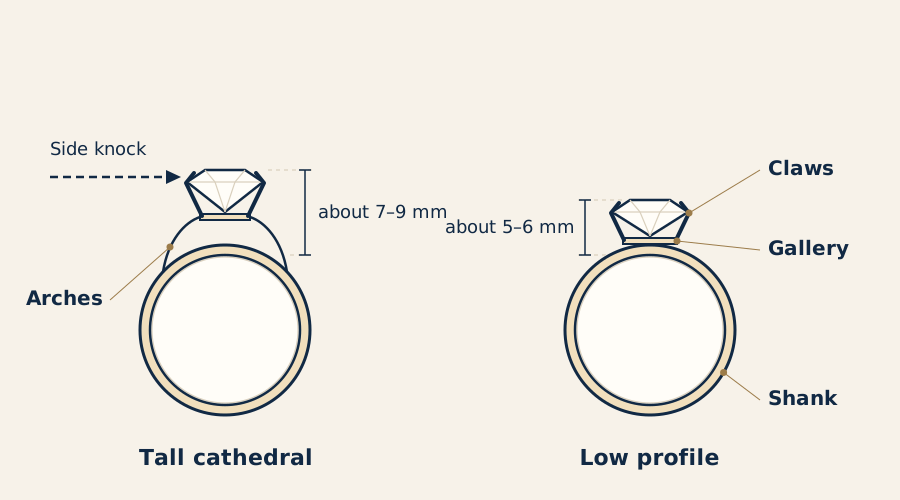
Metal matters here too. Platinum claws tend to bend rather than snap and hold their shape well over time, which is why they are popular for active wearers. For round stones in particular, our page on setting options for a round brilliant shows low four and six claw designs alongside bezels.
Not sure which one is right?
Send us the stones you are looking at and our gemologist will tell you which to choose and why.
Which diamond shapes are safest for active hands?
Shape decides where the stone is vulnerable. Rounded outlines have no thin points to chip; shapes with sharp corners or tips need those areas covered. You can wear any shape on active hands, but the setting has to match. For a tour of every outline before you decide, see an overview of all the main diamond shapes.
| Shape | Weak point | How to protect it |
|---|---|---|
| Round, oval | None; smooth outline | Any low setting; bezel for maximum protection |
| Cushion | Soft corners | Claws at each corner or a bezel |
| Emerald, Asscher | Cut corners (usually clipped) | Corner claws or a bezel |
| Princess | Four sharp corners | V-claws on every corner or a bezel |
| Pear, heart | One point (and the cleft on a heart) | V-claw over the point, bezel or halo |
| Marquise | Two points | V-claws on both points or a bezel |
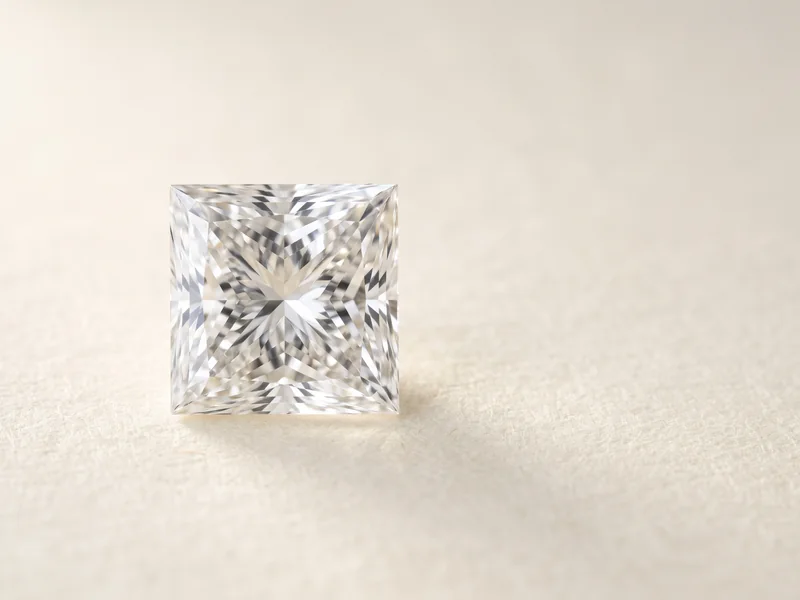
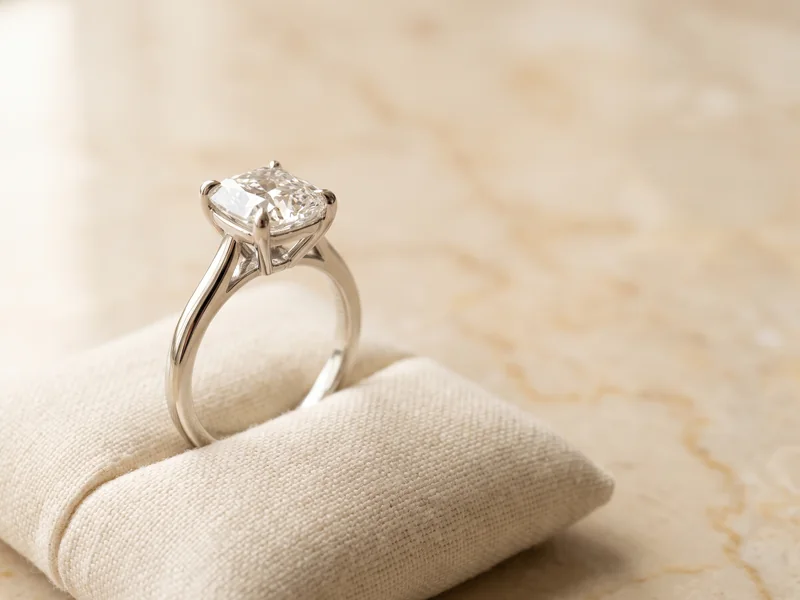
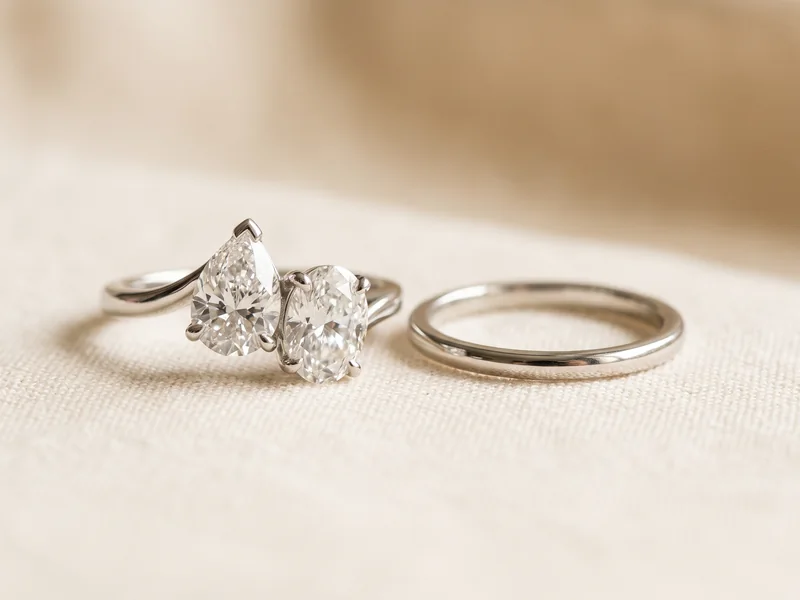
A princess cut is the one we are most careful with, because its four sharp corners are thin and exposed; see protecting a princess cut's four corners. A pear has one tip that needs covering, and our V-claw and bezel ideas for pear diamonds show the options. A heart has both a point and a cleft to guard, covered in heart diamond settings that shield the point, while the marquise, with a point at each end, needs two V-claws or a bezel. Step-cut stones show chips and scuffs more clearly because of their large flat facets, so settings that guard an emerald cut's corners are worth reading if you love that look. Cushions are more forgiving; cushion cut setting choices cover the main styles.
If you want an elongated look with no points at all, oval diamonds are among the easiest shapes to live with on busy hands. Shape also changes how a ring feels on the hand. A large or elongated stone sits over more of the finger and is more likely to hit things. Our guide to which shapes flatter your finger length helps you balance looks and practicality.
Platinum vs gold: which engagement ring metal is most durable?
Both platinum and gold make long-lasting engagement rings; they simply wear differently. When platinum is scratched, most of the metal is pushed aside rather than lost, leaving a soft grey satin look called a patina that can be polished back to a shine. Gold loses a tiny amount of metal with each scratch and polish, so over many years a gold shank slowly thins.
| Metal | Pure metal content | How it wears | Upkeep |
|---|---|---|---|
| Platinum 950 | 95% platinum | Develops a patina; claws hold well; heaviest to wear | Polish when you want the shine back |
| 18 carat white gold | 75% gold | Hard-wearing; usually rhodium plated for a brighter white | Replating about every 1–2 years for heavy wear |
| 18 carat yellow or rose gold | 75% gold | Rich colour; shows scratches but polishes easily | Polish as needed |
| 14 carat gold | 58.5% gold | Generally harder than 18 carat; slightly paler colour | Polish as needed |
| 9 carat gold | 37.5% gold | Hard-wearing and lower cost; can tarnish slightly over time | Clean and polish as needed |
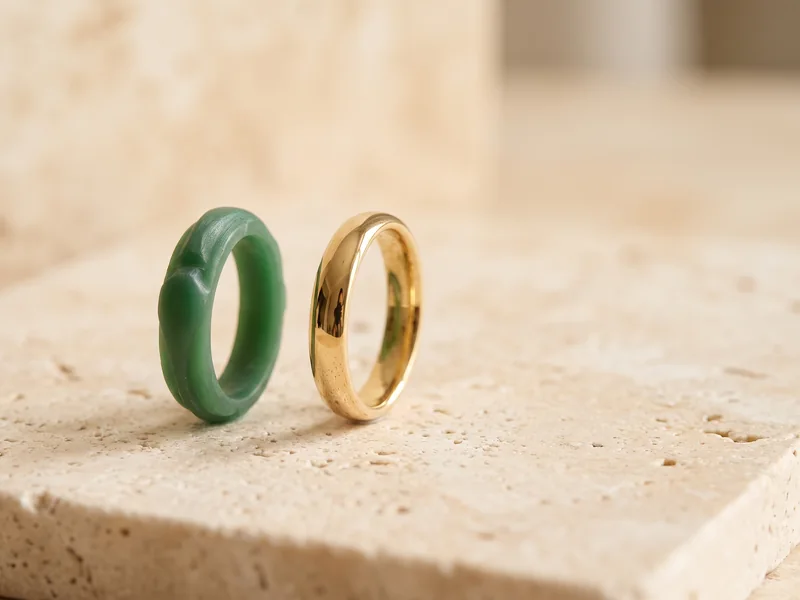
Rhodium plating is a thin layer of a bright white metal applied over white gold. On active hands it wears first on the underside of the band and on the claws, where a warmer tone can show through. That is cosmetic, not structural. How a ring is made also affects its strength: our page on the difference between cast and hand-fabricated rings explains why the method matters for long-term wear.
How thick should an engagement ring band be for active hands?
The band does more work than people expect. Gripping a barbell, a steering wheel or a heavy bag squeezes a ring, and a thin band slowly bends out of round. Once it is oval, the setting is under stress and claws can loosen. For an engagement ring for working with hands, look for a band about 2.5 mm wide or more and about 1.6–2.0 mm deep (the thickness from the inside of the band to the outside). Very fine bands under 2 mm look delicate but are the ones we most often reshape and rebuild.
- Comfort fit: a slightly rounded inside edge makes a thicker band feel lighter and slip on more easily.
- Plain bands outlast stone-set bands: pavé down the shank looks bright but every tiny stone is held by small beads of metal that wear.
- Flush-set accents are a sturdier alternative: the stones are sunk into the band so their tops sit level with the metal.
- Pair the wedding band well: two rings rubbing together wear each other; a band shaped to sit flush, or soldered to the engagement ring, reduces that friction.
A flush set diamond ring is one of the toughest designs there is, and it is common in men's rings for that reason. Our guide to flush, channel and pavé setting techniques shows how each one grips its stones. If you want the strongest possible shank, ask whether it can be made from worked metal; see why a hand-fabricated shank resists bending.
Which gemstones hold up to everyday knocks?
If you are considering a coloured stone, hardness matters even more than it does with diamond. Softer stones scratch and dull from ordinary dust, which contains quartz (Mohs 7), so anything below 7 will lose its polish on a ring worn every day.
| Stone | Mohs hardness | Everyday wear on active hands |
|---|---|---|
| Diamond (natural or lab-grown) | 10 | Excellent; protect thin edges and points |
| Moissanite (lab-created) | 9.25 | Excellent |
| Sapphire and ruby (natural or lab-created) | 9 | Excellent |
| Spinel | 8 | Good with a protective setting |
| Aquamarine, morganite | 7.5–8 | Fair; scratches over years; bezel suggested |
| Emerald | 7.5–8 | Fragile; often included and oil-treated; bezel and care needed |
| Tanzanite | 6–7 | Poor for daily hard wear |
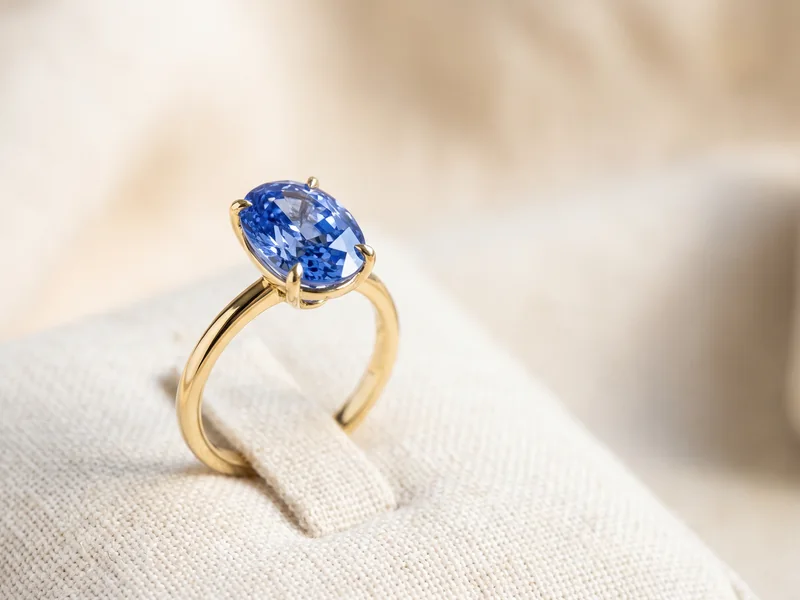
| Opal | 5.5–6.5 | Poor for daily hard wear; better on a right hand or pendant |
Lab-grown diamonds are real diamond with the same hardness as natural diamond, so for durability the two behave the same. The choice between them comes down to budget and preference, not toughness.
Should you take your engagement ring off at the gym or at work?
Even the most durable engagement ring setting is not designed for every job. A few situations are worth taking the ring off for:
- Weights and climbing: gripping bars and holds bends bands and crushes claws against the stone.
- Heavy manual work: concrete, bricks and tools cause hard knocks; machinery also creates a real risk of ring injuries.
- Pools and spas: chlorine can attack gold alloys over time and weaken solder joints.
- Cleaning products and hand sanitiser: they leave a film that dulls the stone and can wear rhodium plating faster.
- Clinical work: many Australian hospitals have bare-below-the-elbows rules in clinical areas, so an engagement ring for nurses often needs a plan for safe storage during shifts.
Some people keep a plain band or a silicone ring for training and work, and wear the engagement ring at other times. Others move a favourite ring to the other hand on heavy days; our page on wearing a ring on the right hand instead covers the traditions and the practical side.
Related guideDiamond & Gemstone Setting GuideHow to choose engagement ring settings for active hands: step by step
- Be honest about your week. List your job, sport and hobbies, and where your hands take the most knocks.
- Choose the setting style. Start with a bezel, half bezel or flush setting; if you prefer claws, choose a low profile with six claws or double claws.
- Match the shape. If your stone has corners or points, make sure every one is covered by a V-claw, tab claw or bezel.
- Pick the metal. Platinum or 18 carat gold for the setting, with claws of generous thickness.
- Check the band. Aim for about 2.5 mm wide or more and a comfortable depth; keep stone-set shanks to a minimum.
- Review the CAD render. Look at the side profile for height, and at the claws and rim for thickness, before the ring is made.
- Plan maintenance. Book a claw and setting check every 6–12 months, and more often if you work with your hands.
A custom design lets you set the stone height, claw thickness and band size to suit your life, rather than adapting to a stock design. You can explore low settings like low-set round solitaire designs for ideas, then see each option as a CAD render before anything is cast.
Explore ring settings and create your ring
Free consultation
Talk to a gemologist
Compare stones in person or online with Raj Sood, Graduate Gemologist (GIA), AJP (GIA).
Book a consultationShop this shape
FAQ
Common questions
What is the most durable engagement ring setting?
A full bezel or a flush setting, because the stone's edge is covered by metal and there is nothing to snag. A low-profile six claw setting in platinum is a durable choice if you prefer the look of claws.
Are bezel settings less sparkly?
Slightly, because the metal rim blocks a little light from the sides and hides the girdle. Most light enters through the top of the stone, so a well-cut diamond in a bezel still sparkles clearly.
Is platinum or gold better for an active lifestyle?
Both work well. Platinum develops a patina and loses very little metal over time, while 18 carat gold is lighter, holds claws well and polishes back easily but slowly thins with years of wear.
How often should I get my engagement ring claws checked?
Every 6–12 months for most people, and more often if you work with your hands or train regularly. A check takes minutes and catches worn or lifted claws before a stone is lost.
Can I wear a pavé band if I am active?
You can, but pavé stones are held by tiny beads of metal that wear and loosen with knocks. Expect to have small stones tightened or replaced over the years, or choose a plain or flush-set band instead.
Are tension settings safe for everyday wear?
They are not ideal for active hands. The stone is held only by pressure from the metal, so a hard knock can shift or release it, and tension rings are difficult to resize.

Ask a gemologist
Not sure which diamond to choose?
Raj Sood is a Graduate Gemologist (GIA) and master jeweller. Bring the stones you are considering, or send the reports, and he will tell you honestly which one is better and why.
Keep learning
Related guides
 Engagement Rings & SettingsDiamond & Gemstone Setting GuideEngagement Rings & SettingsBest Settings for Round Diamonds
 Buying Knowledge & Custom ProcessCast vs Hand-Fabricated Jewellery
 Engagement Rings & SettingsBest Settings for Princess Diamonds
 Engagement Rings & SettingsRight-Hand Rings Explained
 Engagement Rings & SettingsBest Settings for Cushion Diamonds
 Engagement Rings & SettingsBest Settings for Pear Diamonds
Explore more
More guides on this topic
Education