
- Education
- Engagement Rings & Settings
- Best Setting for a Cushion Cut Diamond: Claws, Halo, Bezel and Bands
Engagement Rings & Settings
Best Setting for a Cushion Cut Diamond: Claws, Halo, Bezel and Bands
A cushion's soft corners and deep pavilion change how it should be held. This guide sets out the best setting for a cushion cut diamond, from where the claws sit to whether a halo helps and which wedding band will sit flush.
 Reviewed by Raj Sood, Graduate Gemologist (GIA), AJP (GIA)Master jeweller and Graduate Gemologist (GIA) · reviewed 4 November 2026
Quick answer
The best setting for a cushion cut diamond is four claws, or four double claws, placed inside each rounded corner, in a mount tall enough for the cushion's deep pavilion. Add a halo if you want more face-up size, a bezel for active hands, and choose a low or hidden-halo design so a straight wedding band sits flush.
What is the best setting for a cushion cut diamond?
No single setting suits every cushion, but there is a clear pattern. A cushion cut is a square or slightly rectangular diamond with rounded corners and gently curved sides, almost always faceted as a brilliant. Its ancestor is the antique old mine cut, and you can trace that family line in our comparison of the old mine cut and the modern cushion. Most cushions are held in claws (the small metal tips that grip the stone, called prongs in the US), though halos, bezels and three-stone designs are all common.
With a cushion, the setting has three jobs. It must hold the four rounded corners securely, sit high enough to clear the stone's deep pavilion (the lower, cone-shaped half of the diamond), and frame the soft outline without hiding it. How each style handles those three jobs is what this guide compares. If you want to understand the stone itself first, start with our cushion brilliant and cushion modified buying guide; for the general vocabulary of mounts, see every engagement ring setting style explained.
- Four claws at the corners: the classic solitaire. Open, simple and lets the most light into the stone.
- Four double claws: eight tips in pairs, one pair at each corner. More grip and a slightly vintage look.
- Halo: a ring of small diamonds around the cushion. More face-up size and sparkle; adds about 2–3 mm to the overall width.
- Hidden halo: the small diamonds sit under the girdle, seen mainly from the side, so the top view stays a clean solitaire.
- Bezel: a thin rim of metal around the edge. The most protective option, with a modern look.
- Three-stone: the cushion flanked by two smaller side stones.
Any unfamiliar word on this page is explained in our full jewellery glossary.
How does the cushion shape change the setting choice?
Corners. A cushion's corners are rounded, so they are far less likely to chip than the sharp points of a princess cut. That gives you more freedom: you do not strictly need V-shaped claws or a bezel to protect them. Compare the advice on settings that shield a princess cut's sharp points and you will see the cushion is the more forgiving of the two. The corners are still the natural place for claws, because the girdle (the thin outer edge) curves there and a claw can grip both sides of the curve. Cushions sit within the wider square and cushion family of cuts, and that rounded corner is what sets them apart.
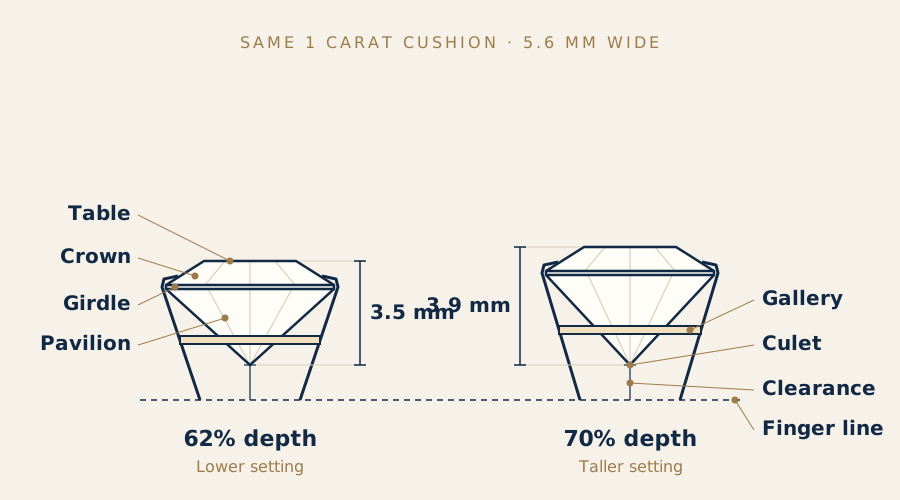
Depth. Cushions are often cut deep, with total depth commonly around 61–68% of the width and some antique-style stones above 70%. A 1 carat cushion about 5.6 mm across might be 3.5–4 mm deep. That extra depth needs a taller basket or gallery (the metal structure under the stone), or the culet (the bottom tip) can sit too close to the finger. Our guide to how cushion depth hides weight below the girdle explains why a deep stone can also look smaller face-up than its carat weight suggests, which is one reason halos are so popular on cushions.
Facet style. A cushion brilliant has larger, bolder facets and shows broad flashes of light. A cushion modified brilliant has extra facets on the pavilion that break light into a finer, busier sparkle often called crushed ice. The difference, explained in chunky antique facets versus crushed ice, affects the setting: chunky facets suit clean claws and bezels that let you see the pattern, while crushed-ice stones pair naturally with a halo's extra glitter.
Colour. Cushions tend to hold and show warm body colour, especially in the corners. Our page on why cushions show more body colour than rounds covers the optics. In practice, the metal next to the stone matters: white metal makes a warm tint easier to see, while yellow or rose gold disguises it.
Which claw setting is best for a cushion cut diamond?
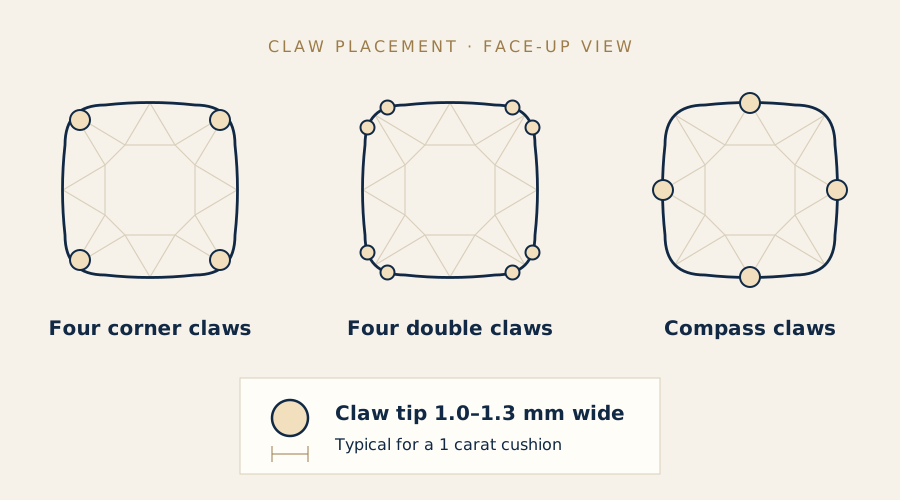
Claws are the most common way to hold a cushion, and the details of cushion diamond claw placement make more difference than most people expect. The main options:
- Four single claws at the corners: the cleanest look, with the least metal over the stone. Each claw grips the curve of a corner, so the stone is held at four strong points.
- Four double claws: two slimmer claws at each corner, eight tips in all. If one tip wears or bends, the other still holds that corner. A double claw cushion setting also frames the corners and reads as slightly more vintage.
- Compass claws: four claws placed at the middle of each side instead of the corners, like the points of a compass. Less common, it leaves the rounded corners fully visible but less protected.
- Six or more claws: rarely used on cushions, as extra claws on the straight sides crowd the outline.
| Claw style | Grip | Look | Upkeep |
|---|---|---|---|
| Four corner claws | Good for most daily wear | Open, classic solitaire | Check yearly; a single worn claw loosens a corner |
| Four double claws | Very good; built-in backup at each corner | Framed corners, vintage feel | Check yearly; more tips to inspect |
| Compass claws | Good, but corners exposed | Corners fully visible, modern | Corners can take knocks |
| Claw tip: round | Smooth, comfortable | Soft and traditional | Wears gradually |
| Claw tip: pointed or tab | Firm over the corner curve | Crisper, more tailored | Can catch on fabric |
Claw size matters too. For a 1 carat cushion, finished claw tips are typically around 1.0–1.3 mm wide in platinum or 18ct gold, a little more for larger stones or softer metals. Too thin and they wear through in a few years; too thick and they cover the corners you are paying for. Platinum claws tend to wear by moving metal rather than losing it, while gold claws wear down slowly over time, which is why any claw setting should be checked by a jeweller about once a year.
Should a cushion diamond have a halo?
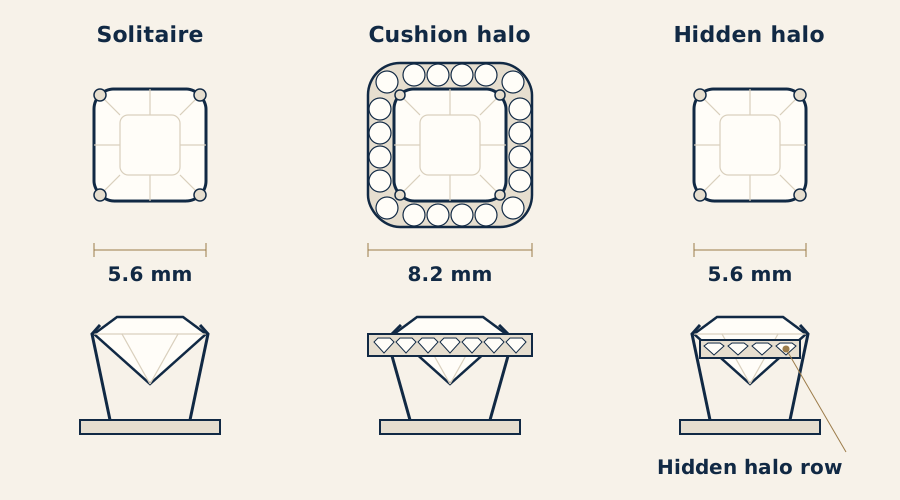
A cushion halo engagement ring is one of the most popular designs there is, and for good reason. The halo adds sparkle around the edge, makes the centre look larger and offsets the size a deep cushion loses below the girdle. Halo diamonds are usually about 1.0–1.5 mm each, set in a single row, which adds roughly 1.0–1.5 mm on each side of the centre stone.
- Cushion halo: follows the cushion's outline. The most common choice, and it makes the centre read clearly as a cushion.
- Round halo: a circular halo around a cushion softens the shape and gives a vintage look.
- Double halo: two rows of small diamonds for maximum face-up size; adds about 4–5 mm overall.
- Hidden halo: a row of small diamonds under the girdle, visible from the side. A hidden halo cushion ring keeps a clean solitaire look from above with a flash of sparkle in profile.
| Centre cushion | Typical stone size | With a single halo |
|---|---|---|
| 0.50 ct | about 4.6 × 4.6 mm | about 7.0 mm across |
| 0.75 ct | about 5.2 × 5.2 mm | about 7.6 mm across |
| 1.00 ct | about 5.6 × 5.6 mm | about 8.2 mm across |
| 1.50 ct | about 6.5 × 6.5 mm | about 9.0 mm across |
| 2.00 ct | about 7.2 × 7.2 mm | about 9.8 mm across |
A halo is not right for everyone. It adds many small stones to maintain, and a tiny stone can loosen after years of knocks. It also raises the head of the ring and widens it, which affects which wedding band will sit beside it. And if you have chosen a stone with bold, chunky facets for their broad flashes, a halo can compete with them. A cushion modified stone with crushed ice faceting, on the other hand, often looks its fullest inside a halo.
Not sure which one is right?
Send us the stones you are looking at and our gemologist will tell you which to choose and why.
Are bezel and three-stone settings good for cushion diamonds?
Bezel. A bezel set cushion diamond is surrounded by a thin wall of metal that follows the curved sides and rounded corners. It is the most protective setting, with nothing to catch on clothing, which suits nurses, tradies, gardeners and anyone hard on their hands. A full bezel covers about 0.3–0.5 mm of the stone's edge, so the cushion faces up slightly smaller and a touch less light enters from the sides. A half-bezel covers only two opposite sides, a compromise between protection and openness. In yellow gold, a bezel also warms the stone's colour, which is worth remembering with cushions.
Three-stone. A cushion three stone ring sets the centre between two smaller stones. Side stones that work well with a cushion include:
- Trapezoids or half-moons: straight inner edges that sit tight against the cushion's sides for a continuous outline.
- Smaller cushions: a matching, vintage-style trio.
- Pears: points facing outward, softening the look.
- Rounds: simple and bright, often each about a third to half the centre's carat weight.
Other details. A pavé band (tiny diamonds set along the shoulders) adds sparkle without a halo. A split shank divides the band into two strands near the head and suits larger cushions. A cathedral setting lifts the head on arches of metal, which helps give a deep cushion its clearance, though it raises the ring's profile.
How do cushion cut engagement ring settings compare?
Here are the main cushion cut engagement ring settings side by side, judged on what matters day to day.
| Setting | Security | Face-up size | Light into stone | Straight band fits flush? | Upkeep |
|---|---|---|---|---|---|
| Four claws | Good | True size | Most | Usually, if set low | Low |
| Four double claws | Very good | True size | Most | Usually, if set low | Low |
| Cushion halo | Very good | Much larger | Good | Sometimes; may need a contoured band | Medium |
| Hidden halo | Very good | True size | Good | Often, if the halo sits above the band | Medium |
| Bezel | Highest | Slightly smaller | Less from the sides | Usually | Lowest |
| Three-stone | Good | Wider overall look | Good | Depends on side stone height | Medium |
If you are still deciding on the shape itself, these comparisons show how a cushion's setting needs differ from its neighbours: radiant against cushion, from corners to sparkle, how a cushion compares with a round brilliant and choosing between an Asscher and a cushion. A radiant's cropped corners and an Asscher's step facets each change where the claws should go.
How should you set an elongated cushion?
A square cushion has a length-to-width ratio of about 1.00–1.05. An elongated cushion runs from about 1.15 to 1.35 or more, closer to a soft rectangle. Our guide to elongated cushion proportions and ratios covers how to choose one; for settings, the main points are:
- Claws: four claws or four double claws at the corners still work well. Compass claws on an elongated stone sit at the middle of the long and short sides, which can emphasise the length.
- Orientation: north-south (long side along the finger) lengthens the hand; east-west (long side across the finger) is a more unusual, modern look.
- Halo: a cushion halo on an elongated stone exaggerates the length; a round halo would fight the shape and is rarely used.
- Side stones: tapered baguettes or trapezoids continue the stone's lines along the band.
Whether square or elongated suits you better is partly a matter of finger length and partly taste; our square versus elongated cushion comparison shows both on the hand at several carat weights.
Related guideSquare vs Elongated Cushion DiamondsWhich metal and wedding band suit a cushion engagement ring?
Metal. Platinum (usually 95% pure, marked Pt950) is dense and holds claws well, and it stays white without plating. 18ct white gold is 75% gold alloyed with whiter metals and is usually rhodium plated, which wears and needs renewing every year or two. 18ct yellow and rose gold warm the look of the stone. Because cushions show colour readily, many people choose G–H colour or better for platinum or white gold, while I–K can look pleasingly warm and even in yellow gold. A popular approach is white claws on a yellow or rose band, which keeps the stone looking white while the band stays warm.
Wedding band. Before you choose the setting, think about the wedding band for a cushion engagement ring. A straight band sits flush only if the head and any halo or gallery sit above the band line. Low-set solitaires and many hidden-halo designs allow this; a full halo or a three-stone setting often needs a contoured or notched band. Our guide to wedding bands that pair neatly with a cushion shows which combinations sit flush. If you already own a cushion diamond, perhaps an heirloom, see resetting a loose diamond into a ring you already own to understand what can be adapted.
How do you choose a setting for a cushion diamond? Step by step
The stone and the setting should be chosen together. Natural and lab-grown cushions look identical to the eye and are both real diamond, with the same hardness (10 on the Mohs scale) and refractive index (about 2.42). Lab-grown diamonds are grown in a laboratory rather than mined and cost much less, which lets some people put more of the budget into the setting. As a broad guide, a plain 18ct gold claw solitaire setting typically costs about AUD $1,200–$3,000, with halos, pavé and platinum adding more.
Browse cushion diamonds: natural and lab-grown
- Read the report. Note the measurements, depth %, colour and whether the diamond is natural or lab-grown.
- Work out the ratio and depth. Divide length by width; check the depth so the setting has enough height underneath.
- Decide on claws, halo or bezel. Weigh face-up size and sparkle against upkeep and your daily activities.
- Place the claws. Corner claws or double claws for most cushions; ask how thick the finished tips will be.
- Match the metal to the colour. White metal for G–H or better; yellow or rose gold can flatter warmer stones.
- Check the band fit. Make sure the wedding band you want will sit flush, or plan a contoured band.
- Review a CAD render. See your actual stone's measurements in each setting, from above and the side, before anything is made.
Free consultation
Talk to a gemologist
Compare stones in person or online with Raj Sood, Graduate Gemologist (GIA), AJP (GIA).
Book a consultationFAQ
Common questions
What is the most secure setting for a cushion cut diamond?
A full bezel is the most secure, because a rim of metal surrounds the whole edge. Four double claws are the most secure claw option, as each corner has a backup tip.
Do cushion diamonds need four or six claws?
Four claws, one at each corner, is standard and suits the shape. Six claws are rarely used on cushions because the extra claws crowd the straight sides.
Does a halo make a cushion diamond look bigger?
Yes. A single halo of 1.0–1.5 mm diamonds adds roughly 2–3 mm to the overall width, so a 1 carat cushion of about 5.6 mm can read at about 8 mm across.
Will a straight wedding band sit flush with a cushion halo ring?
Only if the halo sits above the band line. Many full halos need a contoured or notched band, while low-set solitaires and hidden halos often sit flush with a straight band.
Which metal suits a cushion cut diamond?
Platinum or white gold suits colourless stones of about G–H or better, while yellow or rose gold flatters warmer stones because cushions show colour readily. White claws on a coloured band are a common compromise.
Can I put my existing cushion diamond in a new setting?
Usually, yes. A jeweller will measure the stone's width, length and depth, check it for chips, then make or adapt a setting to fit those exact measurements.

Ask a gemologist
Not sure which diamond to choose?
Raj Sood is a Graduate Gemologist (GIA) and master jeweller. Bring the stones you are considering, or send the reports, and he will tell you honestly which one is better and why.
Keep learning
Related guides
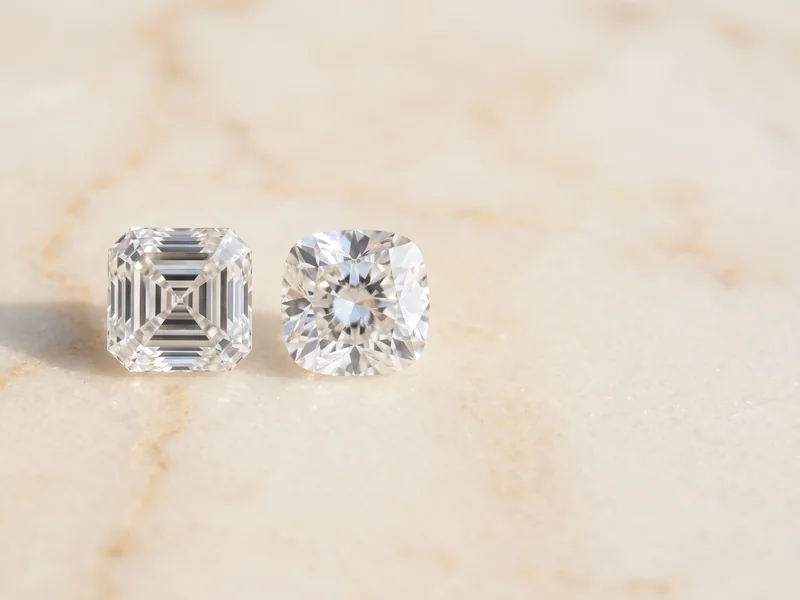 Diamond ShapesCushion Cut Diamonds: Brilliant, Modified & Buying Guide
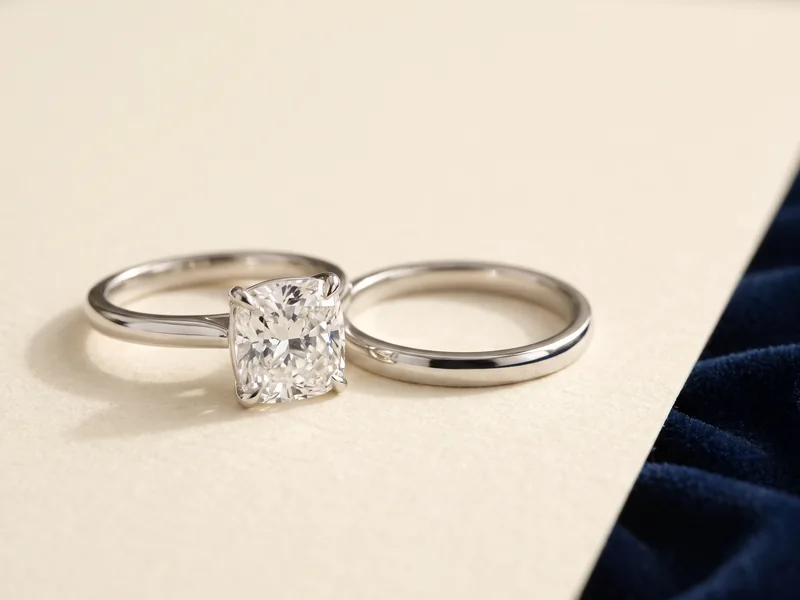 Wedding Bands & EternityBest Wedding Band for Cushion Engagement RingsEngagement Rings & SettingsEngagement Ring Setting Styles GuideDiamond ShapesElongated Cushion Cut DiamondsDiamond ShapesRadiant vs Cushion Cut DiamondsDiamond ShapesCushion Diamond Chunky Facets vs Crushed IceDiamond ShapesWhy Cushion Diamonds Can Show More Body ColourDiamond ShapesRound vs Cushion Cut Diamonds
Explore more
More guides on this topic
Education