
- Education
- Engagement Rings & Settings
- Pear Diamond Setting Guide: Claws, Halos, Bezels and Bands
Engagement Rings & Settings
Pear Diamond Setting Guide: Claws, Halos, Bezels and Bands
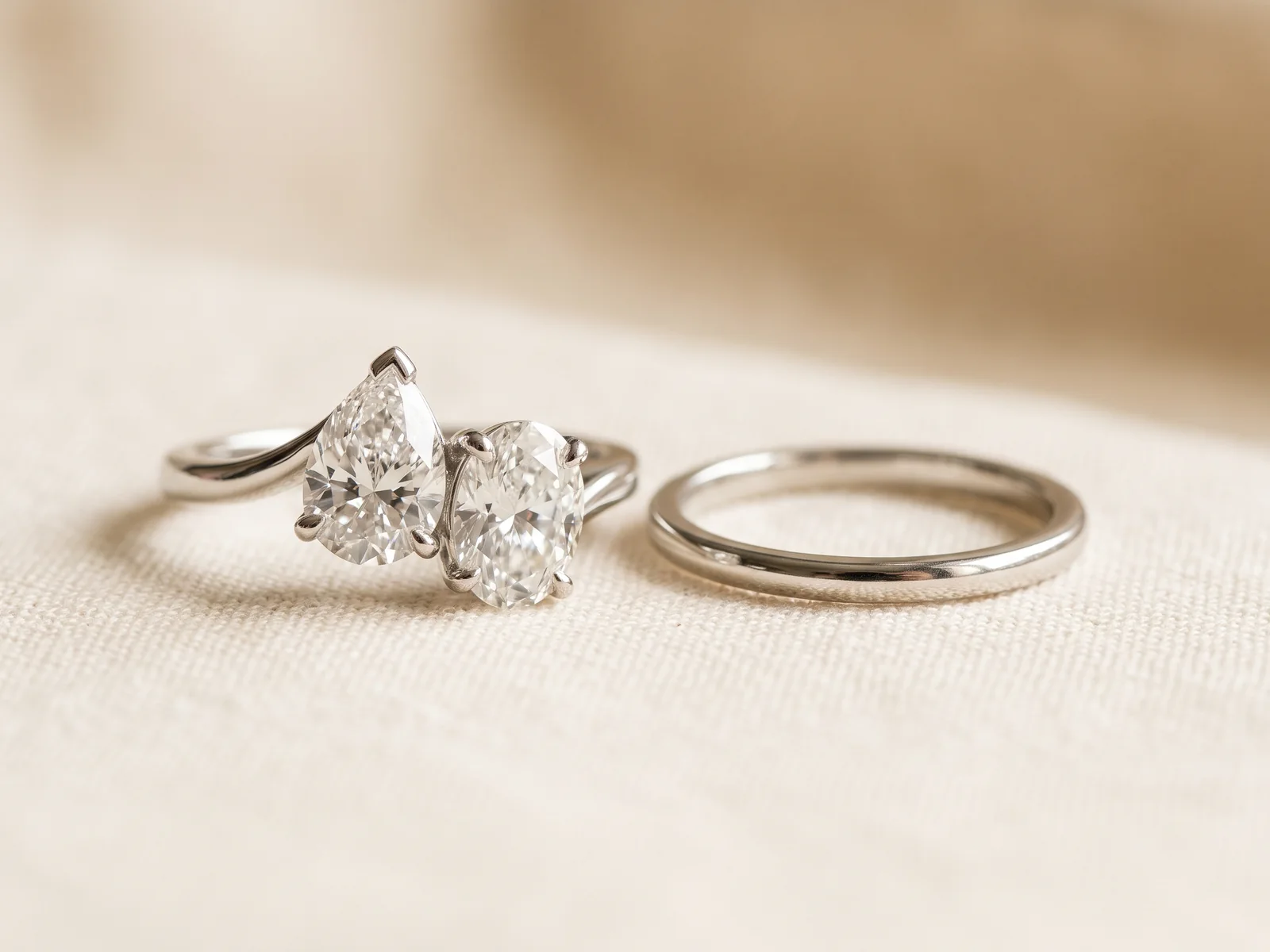
A pear diamond setting has two jobs: hold the stone securely and protect its fragile point. The setting you choose decides how safe the diamond is, how big it looks, and whether a wedding band will sit beside it.
 Reviewed by Raj Sood, Graduate Gemologist (GIA), AJP (GIA)Master jeweller and Graduate Gemologist (GIA) · reviewed 4 November 2026
Quick answer
The most reliable pear diamond setting has five claws: a V-claw wrapping the point and four claws spaced around the rounded end. A bezel or half-bezel suits active hands, a halo adds face-up size and edge protection, and a contoured or notched band sits flush beside it. Most people wear the point towards the fingertip.
What makes a pear diamond setting different?
A pear diamond, also called a pear shape or teardrop, is a modified brilliant cut: the triangular and kite-shaped facets of a round brilliant rearranged into an outline with one rounded end and one point. Most pears have around 56–58 facets. For everything about the stone itself, from cut to colour, start with our complete pear cut diamond guide. This page is about the metal that holds it.
Jewellers describe a pear in five parts: the head (the rounded end), the shoulders (where the head curves into the sides), the wings (the long sides), the belly (the widest part, just below the head) and the point. A setting has to respect all five. Claws placed on the shoulders hold the head; claws at the belly stop the stone rocking; and the point needs its own protection.
Diamond is 10 on the Mohs hardness scale, with a refractive index of about 2.42, which, together with a good cut, is where its brilliance comes from. But hardness only measures resistance to scratching. Toughness, resistance to chipping, is a separate property, and diamond can split along its cleavage planes (natural weak directions in the crystal) if a thin edge takes a sharp knock. The point of a pear is the thinnest edge on the stone, so a good setting puts metal between that point and the world.
The other job is about looks. A pear is symmetrical side to side but not end to end, so a claw slightly out of place or a halo that drifts from the outline shows immediately. A well-proportioned stone with matched shoulders is far easier to set evenly; see the ideal pear proportions chart and our guide to judging pear symmetry before it is set. Any unfamiliar word on this page is in our plain-English jewellery glossary.
Where should the claws go on a pear diamond?
Claw placement (called prong placement in some countries) is the single biggest decision in a pear setting. Every layout below assumes the stone sits point down, with the head at the top.
| Layout | Where the claws sit | Strengths | Watch for |
|---|---|---|---|
| 3 claws | V-claw at the point, one claw on each shoulder | Shows the most diamond; very clean outline | The head relies on two claws; suits smaller stones or careful wear |
| 5 claws | V-claw at the point, two at the belly, two around the head | Balanced security and outline; the most common choice | Claws at the belly must be level so the stone does not look tilted |
| 6 claws | V-claw at the point, two at the belly, three around the head (one at the top centre) | Very secure; good for larger stones | The top claw breaks the curve of the head |
| Double claws | Pairs of thin claws at each position | Vintage look; if one claw lifts, its partner still holds | More metal, more to check and more to clean |
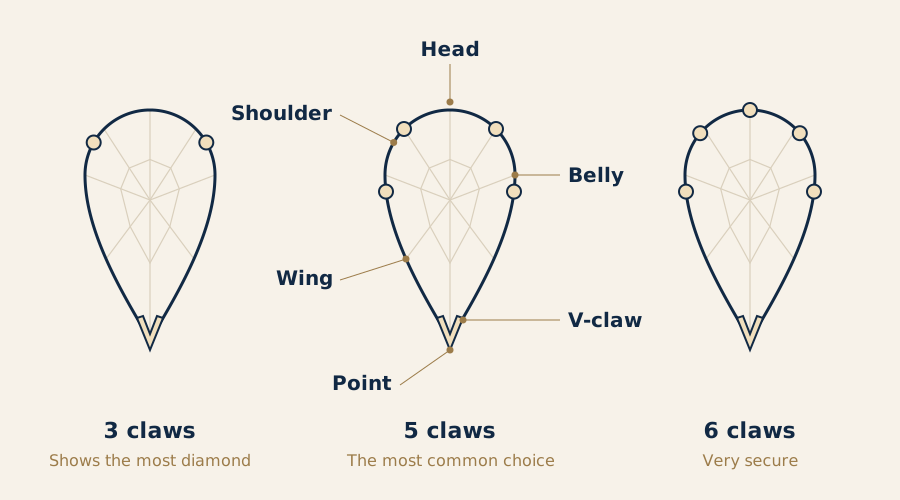
A V-claw is a claw folded into a V shape that wraps both sides of the point, so the tip sits inside metal rather than resting against a single round claw. Some jewellers use a flat-ended claw or a small bezel cup at the point instead, and both work if they cover the tip completely. Leaving the point bare is rarely a good idea, which is why layouts with four claws on the head and nothing at the tip are uncommon for pears. Our page on every way to protect a pear's point compares the options in close-up.
Claw size matters too. On a 1 carat pear, claw tips are often around 1.0–1.3 mm across. Thicker claws hold better and last longer; finer claws show more diamond and look lighter. Claws wear down with daily wear, so have them checked about once a year and re-tipped when they thin.
What is the best pear diamond setting for everyday wear?
There is no single answer; it depends on your hands, your work and the look you want. This comparison shows how the common pear shaped engagement ring settings trade security against sparkle and size.
| Setting | Point protection | Light and sparkle | Face-up size | Snag risk | Suits |
|---|---|---|---|---|---|
| Five-claw solitaire | Good, with a V-claw | Very high | True size | Moderate | Most hands and most stones |
| Three-claw solitaire | Good at the point; head less secure | Highest | True size | Moderate | Smaller stones, careful wearers |
| Full bezel | Excellent | Slightly less light from the sides | Looks a touch smaller | Low | Active hands, healthcare, trades, gym |
| Partial bezel (point and head covered, sides open) | Excellent | High | Close to true size | Low to moderate | A middle path between claws and bezel |
| Halo | Very good | High, plus small-stone sparkle | Noticeably larger | Moderate | A bigger look for the carat weight |
| Three-stone | Depends on the centre claws | High | Wider overall | Moderate | A fuller, more traditional ring |
A pear diamond bezel setting wraps a thin rim of metal around the whole girdle (the outer edge of the stone). It covers perhaps a few tenths of a millimetre of the outline, so the stone looks very slightly smaller, but nothing can catch the point. Because a diamond gathers most of its light through the crown (the top), a well-made bezel costs less sparkle than many people expect. A partial bezel covers only the point and the head and leaves the sides open, which keeps more of the outline visible.
Tension settings, which hold a stone between two ends of the band with no claws, are a poor match for pears because the point is left exposed. If you are still weighing up styles in general, see every engagement ring setting style explained, and if you work with your hands, our guide to settings for people who work with their hands goes further.
Height matters as much as style. A low-set head sits close to the finger and catches less; a taller cathedral setting, where the shoulders of the band sweep up to the stone, lets more light in from the side and leaves room for a band underneath, but it is more exposed to knocks.
Does a pear diamond setting look better with a halo?
A halo is a ring of small diamonds, usually around 1.0–1.3 mm each, set around the centre stone. With a pear, a single halo typically adds about 2–3 mm to both the length and width of what you see. A 1 carat pear of roughly 9 × 6 mm can read closer to 11 × 8 mm once haloed.
The detail to check is the point. A good pear diamond halo follows the outline exactly and comes to a crisp point of its own, often finished with a single small diamond or a metal V at the tip. If the halo rounds off at the bottom, the whole ring starts to look like an oval. A halo also makes a slim pear look wider, so a stone near 1.70 in ratio can look closer to 1.55 once framed; our guide to how ratio changes a pear's look shows the effect.
- For: a larger face-up look, extra protection around the girdle, and a white diamond frame that can make a slightly warm centre stone look whiter by contrast.
- Against: dozens of small stones that can work loose over the years, more places for soap and lotion to build up, a wider head that makes band pairing harder, and more limits on resizing.
- Hidden halo: a row of small diamonds under the girdle, seen only from the side. It adds sparkle in profile without changing the face-up outline.
Not sure which one is right?
Send us the stones you are looking at and our gemologist will tell you which to choose and why.
Which side stones suit a three stone pear engagement ring?
Side stones change the character of a pear ring more than any other choice. Because the pear points in one direction, the stones beside it either echo that direction or balance it.
- Pear side stones: two smaller pears, points facing outward or inward. Points outward gives a fanned, floral look; points inward draws the eye to the centre. Each side pear needs its own V-claw.
- Trilliants: triangular stones that sit neatly against the belly and give a crisp, modern line.
- Tapered baguettes: step-cut stones that narrow towards the band, giving a clean, architectural look.
- Round side stones: simple and forgiving, and easy to match in colour.
- Pavé band: small diamonds set into the band itself, adding sparkle without competing with the outline.
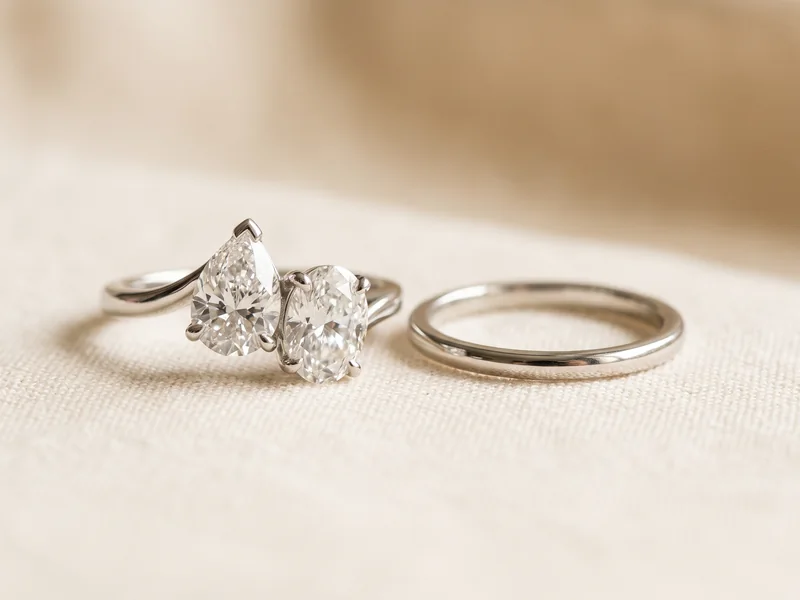
- Toi et moi: French for 'you and me', two centre stones set side by side, often a pear with an oval or round.
As a rough guide, the side stones together usually weigh about a quarter to a half of the centre stone, so the pear stays the focus. Our comparison of trilliant or pear side stones shows both with the same centre. If you are still choosing the centre shape itself, see heart and pear shapes side by side.
Related guideTrilliant vs Pear Side StonesWhich way should a pear diamond point, and which metal suits it?
Most people wear a pear point down, towards the fingertip. The taper leads the eye along the finger and makes it look longer and slimmer. Point towards the wrist is less common but entirely a personal choice; some people simply prefer how it looks to them when they glance down. A third option is east-west, with the stone set sideways across the finger, which gives a low, modern look but puts the point on the side that knocks into door frames.
That elongating effect is strongest with slimmer stones above about 1.65 in ratio. If length on the finger is what you want most, compare the oval vs pear comparison and the marquise and pear differences; a marquise has two points to protect instead of one.
For metal, platinum (usually 95% pure) is dense and when a claw wears the metal tends to move rather than wear away, which makes it a common choice for claws. 18ct white gold is usually rhodium plated for a bright white finish and needs re-plating every year or two. 18ct yellow and rose gold suit warmer diamonds: pears tend to show body colour at the point, so in white metal most people prefer G–H colour or better, while in yellow or rose gold an I–J can look just as white. A popular mix is white claws on a yellow gold band.
What wedding band goes with a pear engagement ring?
A pear is widest at the belly and overhangs the band at both ends. If the setting sits low, a straight wedding band cannot slide right up against the engagement ring, and you are left with a gap. Deciding on the band before the engagement ring is finished solves most of this.
| Band style | How it sits | Notes |
|---|---|---|
| Straight plain band | Flush only if the setting's gallery sits high enough to clear it | Simplest option; plan the setting height for it |
| Contoured or curved band | Follows the curve of the head or the point | Usually made to match the engagement ring |
| Notched band | A small cut-out for the point or V-claw | Subtle; keeps a mostly straight look |
| Chevron or V band | Points towards or away from the pear | Echoes the pear's taper |
| Pavé or eternity band | Sits beside or around the pear | Check that its stones do not rub on the pear's claws |
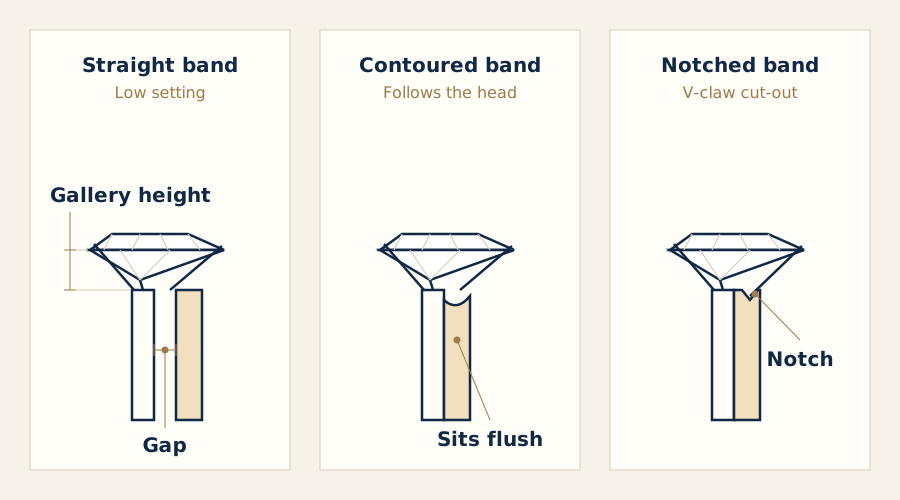
For a 1 carat pear, a band of about 1.8–2.5 mm usually looks in proportion. Match the metals where you can, because a harder metal worn against a softer one slowly wears the softer one down. Our guide to wedding bands made to sit beside a pear shows each style next to the same ring.
How do pear settings compare with round, cushion and princess settings?
Every shape has its own weak spot, and the setting is built around it. A round has no points at all, so four or six claws are mainly a matter of look; see setting choices for round diamonds. A cushion has softened corners, usually held by four claws or double claws at each corner, covered in how cushion diamonds are usually set. A princess has four sharp corners, each needing a V-claw, which is why our guide to protecting a princess cut's corners reads much like this one.
The pear sits between them: one sharp point like a single princess corner, and one rounded end that sets much like a round or oval. That mix is why a five-claw layout, with one V-claw and four round claws, is the usual starting point.
How much does a pear diamond ring cost, natural or lab-grown?
The total is the stone plus the setting. Pears are cut from both natural and laboratory-grown diamond, and the two look the same to the eye. Lab-grown diamonds are real diamond, grown in a laboratory rather than mined, and cost much less; natural pears are rarer. Both should come with an independent grading report, for example from GIA or IGI, stating clearly whether the stone is natural or lab-grown.
| Item | Approximate price range (AUD) |
|---|---|
| 1 ct pear diamond, G–H, VS, lab-grown | about $1,000–$3,000 |
| 1 ct pear diamond, G–H, VS, natural | about $6,000–$14,000 |
| Five-claw solitaire setting, 18ct gold | about $1,500–$3,500 |
| Five-claw solitaire setting, platinum | about $2,500–$5,000 |
| Halo setting, 18ct gold | about $2,500–$6,000 |
These are broad ranges only. Stone prices move with the market and the exact grades; setting prices move with metal prices, the number of small diamonds and how much hand finishing is involved.
Shop pear diamonds and ring settings: natural and lab-grown
How to choose a pear diamond setting: step by step
- Choose the stone first. Check the report for ratio, symmetry and whether it is natural or lab-grown, and look at the point under magnification.
- Decide how you live. Hands in gloves, water or tools every day point towards a bezel or partial bezel; lighter wear suits claws.
- Pick the claw layout. Five claws with a V-claw is the usual starting point; three for a lighter look, six for a larger stone.
- Decide on a halo. Check that any halo keeps a crisp point and does not turn the outline oval.
- Choose the orientation. Point to the fingertip is most common; east-west is a deliberate style choice.
- Plan the band now. Pick a straight, contoured or notched band and set the gallery height to match.
- Check a render or model. Ask to see the setting drawn around your actual stone's measurements before it is made, paying attention to the point; see our notes on point protection options.
Free consultation
Talk to a gemologist
Compare stones in person or online with Raj Sood, Graduate Gemologist (GIA), AJP (GIA).
Book a consultationFAQ
Common questions
How many claws should a pear diamond have?
Five is the most common: a V-claw over the point and four claws around the rounded end and belly. Three claws show more diamond but hold the head less securely, and six suit larger stones.
Does a pear diamond need a V-claw?
The point is the thinnest and most chip-prone part of a pear, so it needs covering. A V-claw is the usual choice, though a bezel cup or full bezel protects it just as well.
Which way should a pear diamond point on an engagement ring?
Most people wear it point down, towards the fingertip, which makes the finger look longer. Point towards the wrist or sideways (east-west) are personal style choices.
Is a halo a good idea for a pear diamond?
A halo makes a pear look noticeably larger and protects its edge, but it adds small stones to maintain and widens the ring. Make sure the halo keeps a sharp point so the outline still reads as a pear.
Can a straight wedding band sit flush with a pear engagement ring?
Only if the setting sits high enough for the band to slide underneath the stone. Otherwise a contoured or notched band is the usual answer.
Is a bezel setting safe for a pear diamond?
Yes, a full bezel is one of the most protective settings for a pear because metal surrounds the whole edge, including the point. It makes the stone look very slightly smaller face-up.
Terms in this guide

Ask a gemologist
Not sure which diamond to choose?
Raj Sood is a Graduate Gemologist (GIA) and master jeweller. Bring the stones you are considering, or send the reports, and he will tell you honestly which one is better and why.
Keep learning
Related guides
 Diamond ShapesProtecting the Point of a Pear Diamond
 Wedding Bands & EternityBest Wedding Band for Pear Engagement RingsDiamond ShapesPear Cut DiamondsEngagement Rings & SettingsEngagement Ring Setting Styles GuideDiamond ShapesPear Diamond Length-to-Width Ratio GuideDiamond ShapesOval vs Pear Diamonds
 Diamond ShapesMarquise vs Pear DiamondsDiamond ShapesHow to Judge Pear Diamond Symmetry
Explore more
More guides on this topic
Education