
- Education
- Diamond Shapes
- Briolette Cut Diamond Guide: Facets, Ratio, Settings and Price
Diamond shapes
Briolette Cut Diamond Guide: Facets, Ratio, Settings and Price
A briolette cut diamond is made to hang and move, not to sit face-up in a ring. Here is how it is faceted, what proportions and grades to look for, how it is set safely and what it costs in Australia.
 Reviewed by Raj Sood, Graduate Gemologist (GIA), AJP (GIA)Master jeweller and Graduate Gemologist (GIA) · reviewed 4 November 2026
Quick answer
A briolette cut diamond is a teardrop-shaped stone covered all over in small triangular facets, with no table and no culet, so it sparkles from every side. Look for a length-to-width ratio of about 1.5–2.5, even facet rows meeting neatly at the tip, and an eye-clean stone, set as a drop in earrings or pendants.
What is a briolette cut diamond?
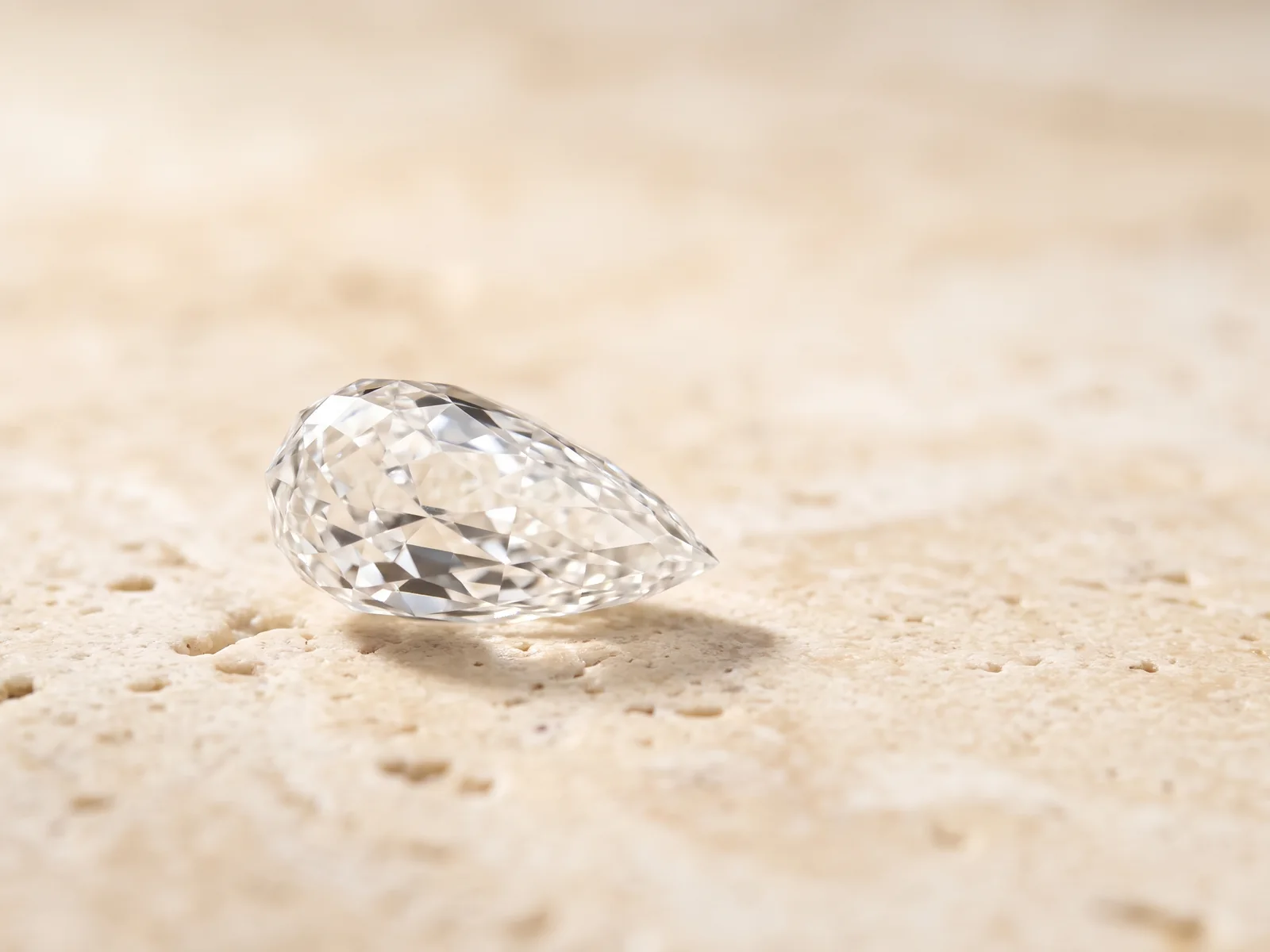
A briolette cut diamond is a drop-shaped stone faceted all the way around, usually with rows of small triangular facets. Unlike almost every other diamond cut, it has no table (the large flat facet on top of a round or oval) and no culet (the point or tiny facet at the bottom of a brilliant). There is no front or back. The stone is meant to be seen from every side as it swings.
That makes the briolette different in kind, not just in outline. A pear or oval is cut to be looked at face-up, from above, in a ring. A briolette is cut to hang: from an earring, a pendant or a necklace, where it turns and catches light from all directions. It is one of the rarest shapes on the market, and it sits among the less common styles in our guide to all 34 diamond cuts. For the bigger picture, our page on how diamond shapes differ explains why outline and facet pattern matter.
Diamond is 10 on the Mohs hardness scale and has a refractive index of about 2.42, so even a small briolette gives strong flashes of light. Hardness is not toughness, though. Diamond can split along its cleavage planes (natural planes of weakness in the crystal) if a thin area takes a hard knock, and a briolette has a slender top end. Any unfamiliar term here is also explained in our plain-English jewellery glossary.
Where did the briolette cut come from?
The briolette is an old cut. Faceted drops appear in Indian and European jewellery for several centuries, and the style was especially popular in Georgian and Victorian pieces, where diamond drops hung from girandole and chandelier earrings. The origin of the name is uncertain; one common explanation links it to an old French word for a kind of dried plum, but that is tradition rather than settled fact.
Early briolettes were cut by hand on a wheel, with facets placed by eye, so older stones often have uneven rows and a slightly lopsided profile. They belong to the same world as other antique diamond cuts such as the old mine and rose. Like the flat-based rose cut, the briolette relies on triangular facets rather than the precise angles of a modern brilliant, and its light is softer and more flickering than the bright, organised sparkle of a round.
If you are looking at antique jewellery, you may see briolettes alongside the cushion-like old mine cut in the same piece. Modern briolettes are cut with better tools and are far more symmetrical, but the basic idea has not changed: a faceted drop with no table or culet.
How is a briolette cut diamond faceted?
Picture a teardrop that has been wrapped in small triangles. A classic briolette has a rounded bottom (the belly) that tapers to a point at the top (the apex). Its facets are arranged in tiers, rows that circle the stone's long axis, each row meeting the next in a zigzag. All the rows converge at the apex and at the bottom of the belly.
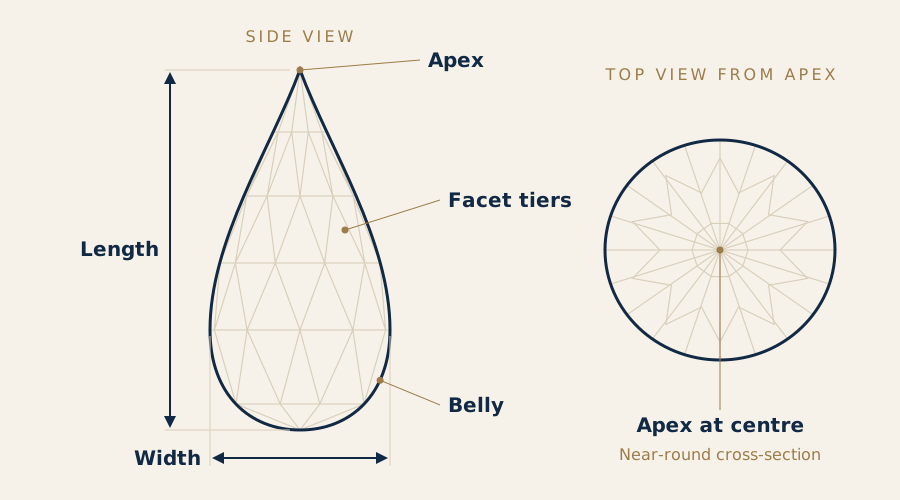
Most briolettes have somewhere between about 48 and 84 facets, and larger stones can carry more. Some cutters use small rectangular facets in the middle rows instead of triangles, which gives a more banded look. The count matters less than how evenly the rows are spaced and how cleanly they close at each end.
Because light enters and leaves through so many small, steep facets, a briolette does not show the bright, organised pattern of a round brilliant. Instead it gives quick flashes, or scintillation, as it moves. Our comparison of how rose and brilliant faceting handle light explains the difference in more detail. Briolettes share that many-small-facets character with the many-faceted Portuguese cut, though the Portuguese is still a face-up stone with a table.
- Full briolette: round or nearly round in cross-section, faceted all around. The traditional form.
- Flat briolette: oval or flattened in cross-section, so it looks wide from the front and slim from the side. Cut to save weight from flatter rough.
- Pendeloque: a related faceted pear drop that does have a table. It is sometimes confused with a briolette, so check the description.
What is the ideal briolette diamond ratio and proportions?
The length-to-width ratio compares the stone's length (from apex to the bottom of the belly) with its widest point. Divide the length by the width. Most briolettes sit somewhere between about 1.5 and 2.5, and the right number is a matter of taste and of how the stone will be worn.
| Ratio | How it looks | Suits |
|---|---|---|
| Below 1.4 | Short and plump, close to a faceted bead | Small drops, charms, clusters |
| 1.4–1.8 | The classic teardrop | Drop earrings and pendants |
| 1.8–2.5 | Long and slender | Chandelier earrings, longer necklaces |
| Above 2.5 | Very narrow, almost icicle-like | Statement pieces; check the apex is not too fragile |
There is no standard cut grade for briolettes. GIA and other labs give an overall cut grade only to round brilliants (and some labs to a few other shapes), so the words Ideal and Excellent you see on rounds do not apply here; see what Ideal and Excellent cut grades really mean. With a briolette you judge proportions by eye:
- Smooth profile: the curve from belly to apex should flow without bumps, flat spots or a pinched waist.
- Centred apex: the tip should sit directly above the centre of the belly, so the stone hangs straight.
- Even tiers: facet rows of consistent height that meet in neat points, with no wavy lines.
- Round cross-section (for a full briolette): looking down from the apex, the outline should be close to a circle, not lopsided.
If you like long, flowing outlines but want a stone you can wear face-up in a ring, our guide to other elongated diamond shapes covers the face-up options.
Not sure which one is right?
Send us the stones you are looking at and our gemologist will tell you which to choose and why.
How big is a briolette diamond for its carat weight?
A briolette carries its weight in three dimensions. A round brilliant puts much of its weight into a wide, shallow spread; a briolette is roughly as deep as it is wide, so it is longer but narrower than you might expect for its carat. Because you see it from the side, its length is what reads on the ear or neck.
| Carat weight | Approximate size (length × width) |
|---|---|
| 0.25 ct | about 5.7 × 2.8 mm |
| 0.50 ct | about 7.1 × 3.6 mm |
| 0.75 ct | about 8.2 × 4.1 mm |
| 1.00 ct | about 9.0 × 4.5 mm |
| 2.00 ct | about 11.3 × 5.7 mm |
These figures are rough estimates for a full briolette with a ratio of about 2.0 and a near-round cross-section. A flat briolette of the same weight will look wider from the front and thinner from the side. For comparison, a 1 carat round brilliant is about 6.4 mm across. Always compare the millimetre measurements on the report rather than relying on carat weight.
Small briolettes, from about 0.05 to 0.30 carat, are common in chandelier earrings and clusters, where several drops move together. Single briolettes over 1 carat are uncommon, because they need tall, well-shaped rough and the cutting loses a lot of weight.
What colour and clarity should a briolette diamond be?
Because a briolette has no table and is viewed from the side, you see more of the stone's body at once, and body colour shows more readily than in a face-up round. For a crisp white look in white gold or platinum, many people choose G–H colour or better. In yellow or rose gold, I–J often looks white enough. Coloured diamonds suit the cut well: just as heart shaped diamonds are often cut in pink, briolettes are cut in yellow, champagne, cognac and pink, where the many facets spread the colour evenly.
Clarity works differently too. With no table to look into, small inclusions (internal features) are often hidden among the facets, but a briolette is seen from every angle, so there is no back to tuck a dark crystal away. Aim for an eye-clean stone, meaning nothing you can see without magnification at normal distance. VS2 to SI1 is usually enough. Many small briolettes in fashion jewellery are lower clarity, or deliberately included "salt and pepper" diamonds, which gives a softer, more rustic look at a lower price.
- White metal: G–H colour, VS2–SI1 eye-clean.
- Yellow or rose gold: I–J colour, VS2–SI1 eye-clean.
- Avoid: feathers (small internal cracks) near the apex or a drill hole, where the stone is thinnest.
How are briolette diamond earrings and pendants set?
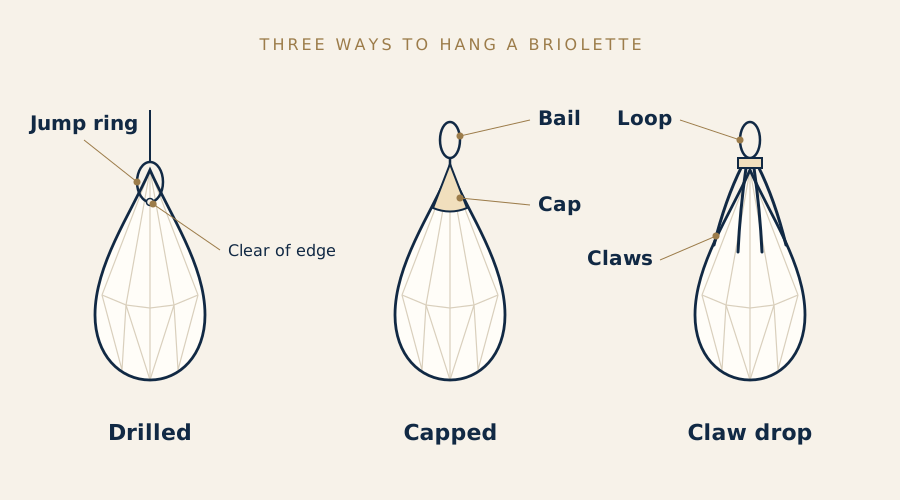
A briolette is held at its apex, so the setting has one job: secure that narrow end without stressing it. There are three main approaches.
- Drilled: a fine hole is laser-drilled across the apex and the stone hangs from a jump ring or wire. Light and simple, but the hole must sit well clear of the edge. A drilled briolette diamond should be described as drilled.
- Capped: a small metal cap fits over the apex and is attached to a bail (the loop that connects to the chain or earring). No hole needed, and the cap protects the tip.
- Claw or bezel drop: fine claws or a collar grip the upper part of the stone. Secure, though it covers more of the top facets.
Note that a hole drilled for hanging is not the same as laser drilling used as a clarity treatment, where tiny channels are burned in to reach and lighten a dark inclusion. Both should be disclosed, and a report will note a clarity treatment.
Briolettes are rarely used in engagement rings because the apex snags and the stone sits high. Where they are used in a ring, they usually lie on their side in a bezel, or sit in an east-west setting with small bullet cut side stones pointing towards them. A briolette ring is best paired with a separate plain or slightly curved band rather than a band that touches the stone, so nothing rubs the facets.
Briolette cut vs pear cut and other shapes: how do they compare?
| Briolette | Pear | Rose cut | Marquise | Round brilliant | |
|---|---|---|---|---|---|
| Viewed | From every side | Face-up | Face-up | Face-up | Face-up |
| Table | None | Yes | None (domed top) | Yes | Yes |
| Typical ratio | 1.5–2.5 | 1.45–1.75 | Varies | 1.85–2.10 | 1.00 |
| Light | Flashes all around | Brilliance and fire | Soft glow | Brilliance, bow-tie possible | Strongest brilliance |
| Typical use | Drops, pendants | Rings, pendants | Rings, antique styles | Rings | Everything |
| Availability | Rare | Common | Uncommon | Common | Most common |
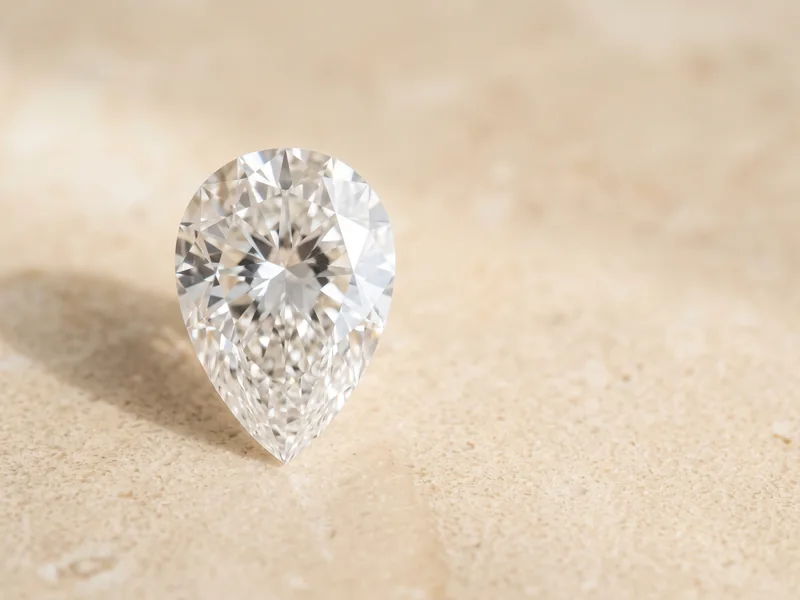
The pear is the face-up cousin of the briolette. If you like the teardrop outline but want it in a ring, read our pear cut guide for face-up drops. For a pointed, boat-shaped outline see the marquise cut; for a smooth outline with no points at all see oval diamonds, and for something in between, the moval, a marquise and oval hybrid.
If your interest is in old-world character rather than shape, the briolette sits comfortably beside the Old European cut with its chunky facets in vintage-style jewellery.
Related guideAntique Diamond Cuts: Old Mine, Old European and RoseHow much does a briolette cut diamond cost in Australia?
Briolettes are cut from both natural and laboratory-grown diamond. Lab-grown diamonds are real diamond, with the same hardness and refractive index, grown in a laboratory rather than mined; they cost much less than natural. A lab-grown briolette diamond is less common than lab-grown rounds or ovals, because few cutters make them, but they can be sourced.
| Briolette | Approximate price range (AUD) |
|---|---|
| Small natural, 0.10–0.30 ct, commercial or salt-and-pepper | about $150–$1,000 each |
| Natural 1 ct, G–H, eye-clean | about $5,000–$15,000 |
| Lab-grown 1 ct, G–H, eye-clean | about $800–$3,000 |
These are broad ranges only, and briolette prices vary more than most shapes because so few are traded. They often cost more per carat than a pear of similar grade, because the cutting is slow and a lot of rough is lost to the rounded, faceted form. Matched pairs for earrings add a further premium, as both stones need the same size, ratio, colour and clarity. Face-up shapes such as the square princess cut keep far more of the rough, which is one reason they sit at the other end of the price-per-carat scale.
Browse all diamonds (no briolettes in stock right now)
How do you choose a briolette cut diamond? Step by step
- Confirm what it is. Check the description and report say briolette (not pendeloque or pear), and whether it is natural or lab-grown.
- Ask how it will hang. Drilled, capped or claw-set. If drilled, ask where the hole sits and check for cracks around it.
- Work out the ratio. Divide length by width; about 1.5–2.5 covers most tastes.
- Check the profile and tiers. A smooth curve, a centred apex and even facet rows meeting cleanly.
- Look from all sides. Watch a 360° video or turn the stone, since there is no hidden back for inclusions.
- Match pairs carefully. For earrings, compare length, width, colour and how each stone hangs side by side.
Free consultation
Talk to a gemologist
Compare stones in person or online with Raj Sood, Graduate Gemologist (GIA), AJP (GIA).
Book a consultationShop this shape
FAQ
Common questions
Can a briolette diamond be used in an engagement ring?
It can, but it is uncommon. The narrow apex can snag and the stone sits high, so it is usually set on its side in a bezel. Most briolettes are worn as earrings or pendants.
Is a drilled briolette diamond weaker?
A drill hole creates a thin area, so the hole must be placed well away from the edge and the stone hung so metal does not grind against it. Capped or claw-set briolettes avoid the hole altogether.
What is the difference between a briolette and a pear cut diamond?
A pear has a table and is cut to be seen face-up, usually in a ring. A briolette has no table, is faceted all the way around and is made to hang and be seen from every side.
Do briolette diamonds sparkle?
Yes, but differently from a round brilliant. The many small facets give quick flashes as the stone moves rather than a steady, bright face-up pattern.
Are lab-grown briolette diamonds available?
Yes, though fewer cutters make them than rounds or ovals. They are real diamond, cost much less than natural briolettes and should come with a grading report stating they are lab-grown.
Why are briolette diamonds rare?
They need tall, well-shaped rough, the cutting is slow and a lot of weight is lost. Demand is also mostly for earrings and pendants, so fewer are cut.

Ask a gemologist
Not sure which diamond to choose?
Raj Sood is a Graduate Gemologist (GIA) and master jeweller. Bring the stones you are considering, or send the reports, and he will tell you honestly which one is better and why.
Keep learning
Related guides
 Diamond ShapesPear Cut Diamonds
 Diamond ShapesRose Cut Diamonds
 Diamond ShapesAntique Diamond Cuts: Old Mine, Old European and Rose
 Diamond ShapesElongated Diamond Cuts: Oval, Pear, Marquise, Moval and MoreDiamond ShapesUnderstanding Diamond Shapes
 Diamond ShapesAll 34 Diamond Cuts: Every Shape Explained and Compared
 Diamond ShapesOval Diamonds
 Diamond ShapesMarquise Cut Diamonds Melbourne
Explore more
More guides on this topic
Education