
Gemstones
Gemstone Treatments A to Z: What They Are and Why They Matter
Most coloured gemstones sold today have been treated in some way, and that is normal. Knowing which gemstone treatments are permanent, which need gentle care and which should lower the price helps you buy with your eyes open.
 Reviewed by Raj Sood, Graduate Gemologist (GIA), AJP (GIA)Master jeweller and Graduate Gemologist (GIA) · reviewed 4 November 2026
Quick answer
Gemstone treatments are processes, such as heating, oiling, fracture filling, irradiation, diffusion and dyeing, that improve a natural stone's colour or clarity after mining. They are common and acceptable when disclosed. What matters is whether the treatment is stable, how it changes care and repairs, and how it affects price compared with an untreated stone.
What are gemstone treatments?
A gemstone treatment is any process, other than cutting and polishing, that changes how a stone looks, how durable it is or what it is worth. The trade often uses the softer word enhancement for the same thing. Heating a sapphire to deepen its blue, filling the cracks in an emerald with oil and irradiating colourless topaz to turn it blue are all treatments.
A treated natural stone is still a natural stone. A heated Sri Lankan sapphire is natural sapphire that grew in the earth and was then improved. That is quite different from a lab-created (synthetic) sapphire, which has the same chemistry but was grown in a factory; our page on lab-created and imitation gemstones explains that difference. Diamonds can be treated too, natural and laboratory-grown alike, which we cover in post-growth treatment in lab-grown diamonds.
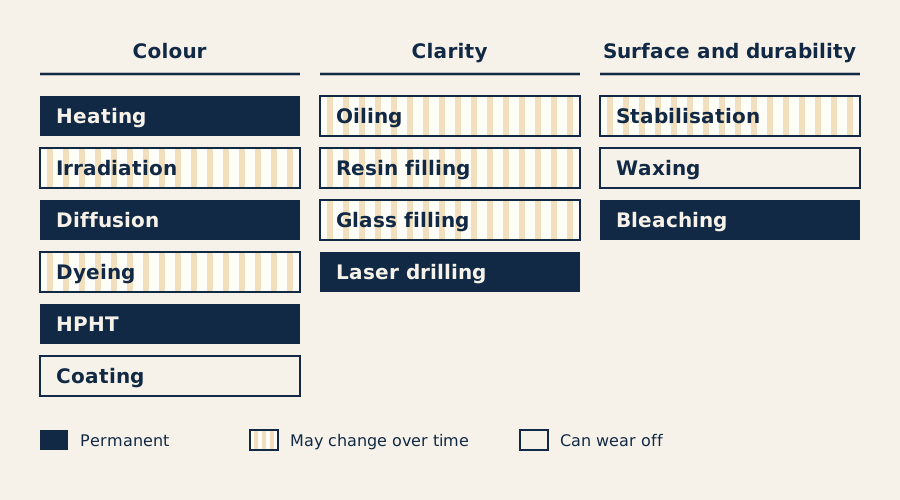
People have oiled emeralds and heated stones for centuries, so treatment is nothing new. What has changed is the technology. Modern furnaces, chemical diffusion and glass filling can transform low-grade rough, and modern laboratories can usually detect what was done. It helps to sort treatments into three groups:
- Colour treatments: heating, irradiation, diffusion, dyeing, HPHT (high pressure, high temperature) and coating.
- Clarity treatments: oiling, resin or glass filling and laser drilling, which make inclusions (internal features) less visible.
- Durability and surface treatments: stabilisation with resin, waxing and bleaching, mostly on porous stones like turquoise and jade.
Every technical term on this page is also defined in our jewellery glossary of gem and trade terms.
Do gemstone treatments have to be disclosed in Australia?
Yes. There is no separate gemstone law in Australia, but the Australian Consumer Law prohibits misleading conduct, and selling a treated stone without mentioning a treatment that affects its value or care can be misleading. International trade guidelines, such as the CIBJO Blue Book used by jewellery associations worldwide, also say treatments should be disclosed at every step of the sale. For a gem bought for a ring, such as one of the engagement rings with a coloured centre stone, disclosure is what tells you how to look after it for decades.
Good disclosure covers more than a single word on a tag. You should be told:
- What was done: for example 'heated', 'clarity enhanced with oil' or 'lead-glass filled'.
- How much: labs often describe emerald enhancement as minor, moderate or significant.
- Whether it is stable: heating is permanent; oil can dry out; coatings can wear.
- Any special care: such as no ultrasonic cleaning, no steam and no jeweller's torch near the stone.
- Whether the stone is natural or lab-created: treatment and synthetic origin are separate questions.
If a seller cannot say whether a sapphire is heated, assume it is, and price it that way. Our side-by-side guide to treated versus untreated stones goes further into how each is described and valued.
Related guideTreated vs Untreated GemstonesGemstone treatments A to Z: which methods are used?
Here are the main treatments in alphabetical order, the stones you will usually find them in and what each means for wear and care.
| Treatment | What it does | Common in | Stable? | Care notes |
|---|---|---|---|---|
| Bleaching | Lightens or evens out colour | Cultured pearls, jade, coral | Usually | Avoid harsh chemicals |
| Coating | Thin film adds colour or a rainbow effect | 'Mystic' topaz, some quartz | No, can wear off | No ultrasonic, no abrasive polishes |
| Diffusion | Heat drives elements such as beryllium or titanium into the crystal | Sapphire, some ruby | Colour stays, but titanium colour may be only skin-deep | Recutting can remove surface colour |
| Dyeing | Colour soaks into pores or cracks | Jadeite, agate, quartzite, lapis lazuli, pearls | Can fade or bleed | Avoid solvents such as acetone |
| Fracture filling (glass) | Glass fills surface-reaching cracks | Ruby (lead glass), some diamonds | Can be damaged | No heat, acids or ultrasonic |
| Heating | Changes or evens colour, dissolves fine needles | Sapphire, ruby, tanzanite, aquamarine, zircon, citrine | Yes, permanent | Normal care for the stone |
| HPHT | High pressure and temperature change colour | Natural and lab-grown diamond | Yes | Normal care |
| Impregnation / stabilisation | Resin or polymer fills and hardens porous material | Turquoise, jadeite ('B jade'), matrix opal | Fairly | Avoid heat and solvents |
| Irradiation | Radiation alters colour centres in the crystal | Blue topaz, diamond, some tourmaline | Usually; a few colours fade in light | Depends on the stone |
| Laser drilling | Tiny channel used to bleach a dark inclusion | Diamond | Yes | Channel is sometimes filled |
| Oiling / resin | Colourless oil or resin fills fractures | Emerald, some ruby | Oil can dry or seep | No ultrasonic, steam or solvents |
| Smoke / sugar-acid | Carbon darkens the body to show more play-of-colour | Some Ethiopian opal, Andamooka matrix opal | Mostly | Gentle care, avoid heat |
| Waxing | Wax fills surface pores | Turquoise, jade, lapis | Temporary | Keep away from heat |
A treatment rarely changes a stone's hardness. A heated sapphire is still 9 on the Mohs scale and a dyed agate is still about 7, so our Mohs hardness of each gemstone page still applies. What changes is the material in the fractures or on the surface: oil, resin, glass and coatings are far softer and less heat-resistant than the gem around them.
Treatments can also create or remove optical effects. Heating dissolves the fine rutile needles (called silk) that make a star sapphire, and some stars are produced by diffusing titanium into the surface. If you are drawn to these effects, read our guide to star, cat's-eye and colour-change effects before you buy one.
Which gemstones are usually treated, and which are not?
Some gem species are treated almost every time; others are usually sold just as they came from the ground. This table covers the stones Australians most often choose for jewellery.
| Gemstone | Mohs | Usual treatment | How often | What it means for you |
|---|---|---|---|---|
| Sapphire | 9 | Heat; sometimes beryllium diffusion | Most are heated | Heated stones are robust and stable |
| Ruby | 9 | Heat, flux healing; lead-glass filling in low grades | Most are heated | Glass-filled rubies need very careful handling |
| Emerald | 7.5–8 | Oil or resin | Most are clarity-enhanced | Gentle cleaning; avoid ultrasonic and steam |
| Tanzanite | 6–6.5 | Heat (brownish to blue-violet) | Almost all | Colour is stable; stone is soft and can cleave |
| Blue topaz | 8 | Irradiation then heat | Nearly all | Stable colour; topaz can split with a hard knock |
| Aquamarine | 7.5–8 | Heat to remove green | Common | Stable |
| Morganite | 7.5–8 | Heat to remove yellow | Common | Stable |
| Citrine | 7 | Usually heated amethyst | Most on the market | Stable |
| Tourmaline | 7–7.5 | Heat; irradiation for some pinks and reds | Sometimes | Stable |
| Opal | 5.5–6.5 | Smoke, sugar-acid; also assembled as doublets and triplets | Some | Soft; keep away from heat |
| Turquoise | 5–6 | Stabilisation, dye, wax | Most | Very gentle care |
| Pearl | 2.5–4.5 | Bleaching, dyeing | Common | Very gentle care |
| Spinel | 8 | Rarely treated | Usually untreated | Robust |
| Garnet | 6.5–7.5 | Rarely treated | Usually untreated | Fine for most jewellery |
There are useful Australian examples. Many sapphires from central Queensland and the New England region of New South Wales are dark, inky blue, and heat is often used to lighten them. Australian opal is usually sold untreated as a solid, but thin slices are commonly made into doublets (opal glued to a dark backing) or triplets (with a clear quartz or glass cap). These are assembled stones rather than treated ones, and they must be described as such.
Blue topaz shows how a treatment can make a gem widely available: colourless topaz is irradiated and heated to produce Sky, Swiss and London blue. Our guide to how blue topaz gets its colour and how to care for it covers it in detail. At the other end, spinel and many garnets are usually untreated, which is one reason they appear among rare collector stones valued by people who prefer a gem as nature made it.
Not sure which one is right?
Send us the stones you are looking at and our gemologist will tell you which to choose and why.
How does heat treatment change a sapphire or ruby?
Sapphire and ruby are both corundum, aluminium oxide, and heat is the most common treatment applied to them. Stones are heated in controlled furnaces to anywhere from about 800 °C to 1,900 °C, depending on the result wanted. At high temperatures, fine rutile needles (titanium dioxide) dissolve back into the crystal. The released titanium pairs with iron to create blue in sapphire, and the stone looks clearer because the needles that scattered light have gone.
Heat can also lighten an overly dark sapphire, remove a purplish tint from ruby and even out patchy colour. A heated sapphire is permanently changed; normal wear, cleaning and jewellery repairs will not undo it. That is why the trade has accepted heated sapphire and ruby for decades, and why a report will simply note 'indications of heating'. Our sapphire colour and quality guide explains how colour, tone and saturation affect the stone you choose.
Two variations deserve closer attention:
- Flux healing: rubies heated with a borax-type flux can have fractures partly healed, leaving glassy residue inside. Some labs grade how much residue remains, and stones with a lot of residue are worth less.
- Beryllium diffusion sapphire: since the early 2000s, some corundum has been heated with beryllium, which travels through the whole crystal and can turn pink sapphire orange or lighten dark blue. It is stable, but it is a very different product from a simply heated stone and should be priced far lower.
Beryllium cannot be seen with a microscope. Detecting it needs chemical analysis such as LA-ICP-MS (laser ablation inductively coupled plasma mass spectrometry), one of the methods in our scientific tests used to identify gems. Unheated sapphires and rubies of fine colour are rarer, and they command a clear premium over comparable heated stones.
Why are emeralds oiled, and what is a fracture filled ruby?
Almost every emerald has fractures, many of them reaching the surface. The trade calls the pattern of inclusions in emerald its jardin (French for garden). For centuries cutters have soaked emeralds in colourless oil, traditionally cedarwood oil, which has a refractive index (how much it bends light) of about 1.51, close to emerald's 1.57–1.58. When a crack is filled with something that bends light almost the same way, light passes through instead of bouncing off, and the crack nearly disappears. Modern alternatives include resins such as Opticon.
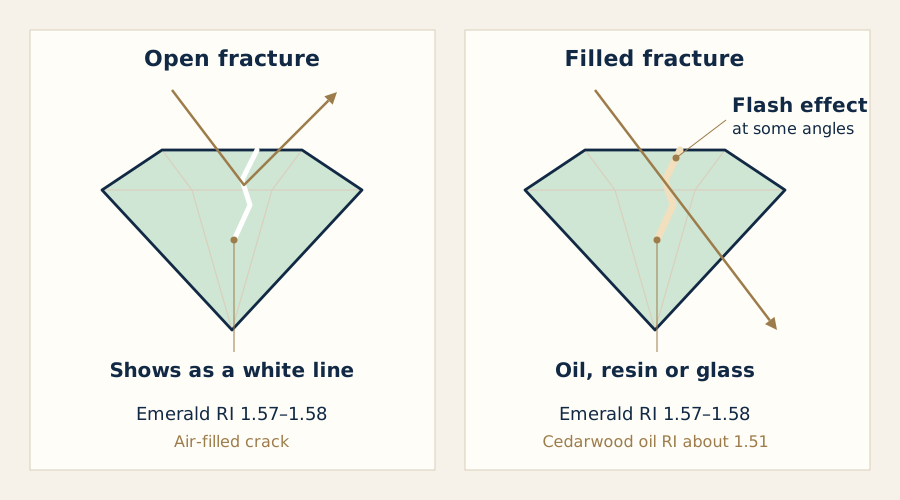
Emerald oil treatment is accepted, but it is not permanent. Oil can slowly dry or seep, and ultrasonic cleaners, steam, hot water and solvents can draw it out, making old cracks reappear. An emerald can usually be cleaned and re-oiled by a specialist. Our emerald quality and colour guide covers how the degree of enhancement affects appearance, and the cleaning advice for each gemstone explains what is safe at home.
A fracture filled ruby is a much stronger treatment. Heavily cracked, low-grade corundum is filled with lead-glass, which has a refractive index close to ruby's and hides the fractures. In some stones the glass makes up a large part of the material, which is why some labs call them 'composite ruby' or 'lead-glass filled ruby' rather than ruby. They cost a small fraction of a heated ruby. The glass can be damaged by the heat of a jeweller's torch and by acids, including the pickle solution used after soldering, so a jeweller must know before any repair.
Diamonds can also be fracture filled with glass and laser drilled to reach and bleach dark inclusions. A filled diamond often shows a flash effect, a blue or orange flicker along the crack as the stone moves, which is one of the tell-tale signs a gemmologist looks for.
How can you tell if a gemstone is treated?
In most cases you cannot tell by eye, and neither can a jeweller without the right tools. Knowing how to tell if a gemstone is treated is a matter of laboratory evidence, built up from several tests:
- Microscope: heated stones show altered inclusions, such as melted crystals with disc-shaped stress fractures around them. Filled stones show the flash effect, trapped gas bubbles or glassy texture in cracks.
- Immersion: placing a stone in liquid shows colour concentrated at facet edges, a sign of surface diffusion.
- Ultraviolet light: some oils and resins glow under UV, revealing filled fractures in emerald.
- FTIR spectroscopy: infrared light identifies resins and polymers, and helps detect HPHT in diamond.
- Raman and UV-Vis-NIR spectroscopy: measure how a stone absorbs and scatters light to identify fillers and colour causes.
- LA-ICP-MS: measures trace elements, the main way to detect beryllium diffusion.
The same equipment is used to estimate where a gem was mined, so a treatment report often comes alongside an origin opinion. Our page on how labs determine where a gem was mined explains what those opinions can and cannot tell you. Laboratories such as GIA, the Australian Gemmological Laboratory and the Swiss labs issue reports that state both.
Do treatments lower a gemstone's value? Untreated, treated and lab-created compared
Treatment is not a bad thing in itself. A heated sapphire is a beautiful, durable natural gem. But untreated gemstones of the same colour and clarity are rarer, and price follows rarity. The stronger the treatment, the further the price falls. Here is how the main categories compare for a 1 carat blue sapphire of good colour.
| Untreated natural | Heated natural | Beryllium-diffused natural | Lab-created | |
|---|---|---|---|---|
| What it is | Mined, only cut and polished | Mined, then heated | Mined, heated with beryllium | Grown in a factory |
| Rarity | Rare in fine colour | Widely available | Common | Unlimited |
| Approximate price, 1 ct (AUD) | about $3,000–$10,000+ | about $1,500–$6,000 | about $200–$1,000 | about $50–$500 |
| Durability | Mohs 9 | Mohs 9 | Mohs 9 | Mohs 9 |
| Report wording | No indications of heating | Indications of heating | Heated with beryllium | Synthetic / lab-created |
These are broad ranges only; colour, size, origin and cut move the price a great deal. The point is the pattern: simple heat is priced as normal, while diffusion, glass filling and heavy resin are priced much lower, and lab-created stones lower again. None of these is 'fake'. A lab-created sapphire is real corundum; it is simply not natural, and it must always be called lab-created or synthetic.
When you browse the coloured gemstones we work with, the description should show whether each stone is natural or lab-created and, for natural stones, what treatment it has had.
Shop natural gemstones
How do you buy a treated gemstone with confidence? Step by step
- Ask what was done. Get the treatment named in writing, for example 'heated' or 'minor oil', not just 'natural sapphire'.
- Ask for a report on valuable stones. For coloured gems over about a carat, a recognised lab report confirms the species, natural or lab-created, and the treatment.
- Check whether the treatment is stable. Heat and irradiation are usually permanent; oil, wax and coatings are not.
- Match the stone to how you will wear it. Check our guide to which gems survive daily wear in a ring; a filled or soft stone suits a pendant better than a daily ring.
- Plan the setting and future repairs. Tell your jeweller about the treatment before resizing, retipping claws or soldering, so heat and chemicals are kept away from the stone.
- Compare the price with the treatment. A lightly treated stone priced like an untreated one, or a heavily filled stone priced like a heated one, is a reason to ask more questions.
Treatment knowledge matters most at the bench. A stone that is perfectly safe for years of wear can still be damaged in minutes by a torch, an ultrasonic bath or acid if no one knows what is in its fractures. Keep the report and the treatment details with your ring's paperwork, and pass them on whenever it is cleaned, repaired or reset.
Free consultation
Talk to a gemologist
Compare stones in person or online with Raj Sood, Graduate Gemologist (GIA), AJP (GIA).
Book a consultationShop this shape
FAQ
Common questions
Are treated gemstones fake?
No. A treated natural gemstone is still natural; it has simply been improved after mining, for example by heating. A fake is an imitation such as glass, and a lab-created stone is a separate category that must be disclosed as synthetic.
Is a heat treated sapphire worth less than an unheated one?
A heated sapphire usually costs less than an unheated sapphire of the same colour and clarity, because unheated fine stones are rarer. Heat is permanent and widely accepted, so a heated sapphire is still a durable natural gem.
How can I tell if my emerald is oiled?
Assume it is, because most emeralds are clarity-enhanced. A gemmologist can confirm the type and degree with a microscope, UV light and infrared spectroscopy, and a lab report will describe it as minor, moderate or significant.
Is irradiated blue topaz safe to wear?
Yes. Treated topaz is held until any residual radioactivity has decayed to safe levels before it is sold, and the blue colour is stable in normal wear.
Can I clean treated gemstones in an ultrasonic cleaner?
Not if they are oiled, resin-filled, glass-filled, coated, dyed or stabilised, as the vibration and heat can damage the filler or surface. Heated sapphire and ruby without fillers are usually fine; when unsure, use warm soapy water and a soft brush.
Are lab-grown diamonds treated?
Many are. Some laboratory-grown diamonds receive HPHT or other post-growth treatment to improve colour, and a grading report will normally note it.

Ask a gemologist
Not sure which diamond to choose?
Raj Sood is a Graduate Gemologist (GIA) and master jeweller. Bring the stones you are considering, or send the reports, and he will tell you honestly which one is better and why.
Keep learning
Related guides
 GemstonesTreated vs Untreated Gemstones
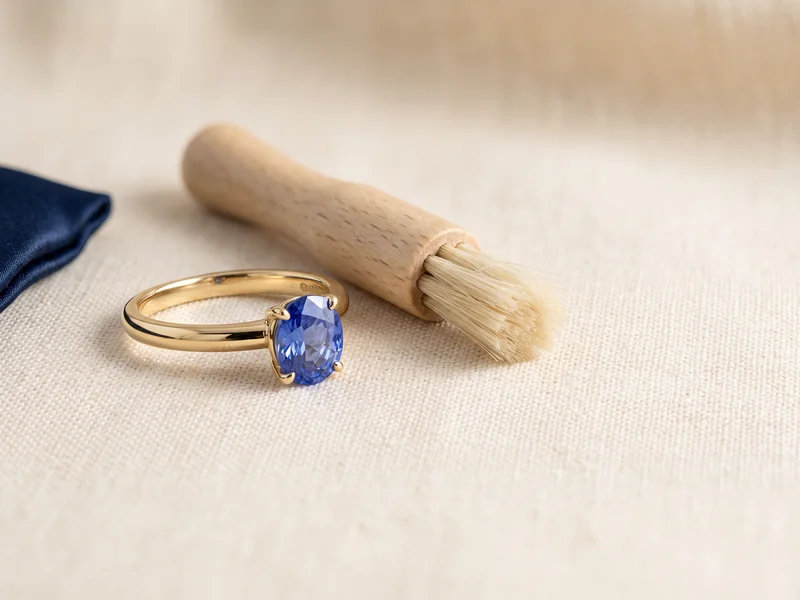 GemstonesGemstone Care by Stone
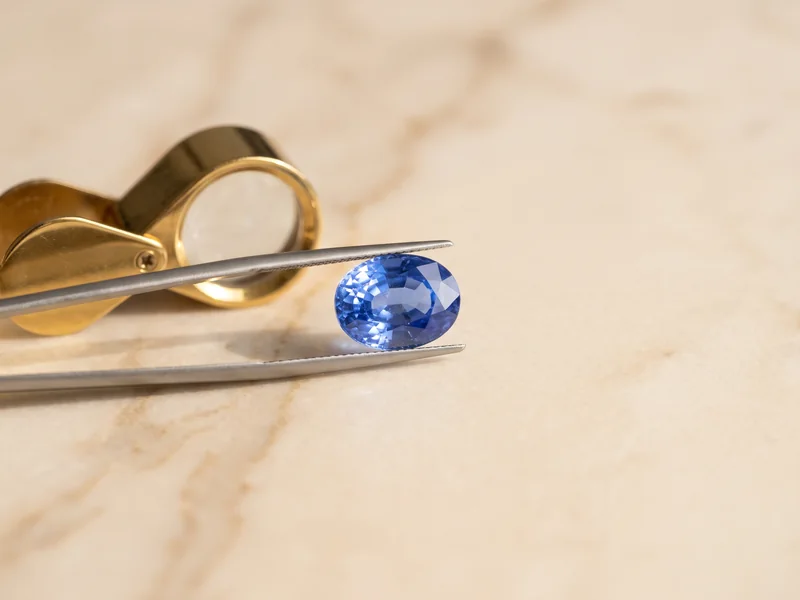 GemstonesGemstone Identification Scientific Guide
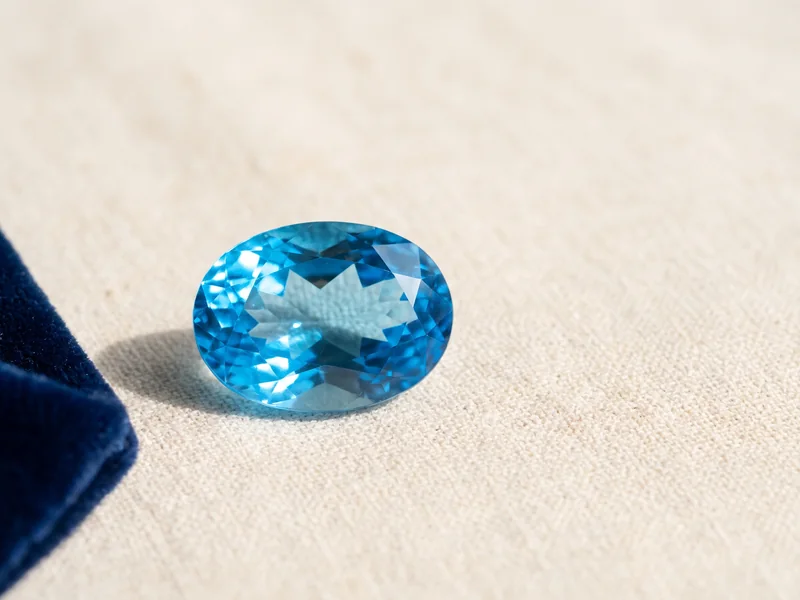 GemstonesBlue Topaz Jewellery: Treatment and CareGemstonesGemstones | Coloured Gemstones, Birthstones and Custom Jewellery
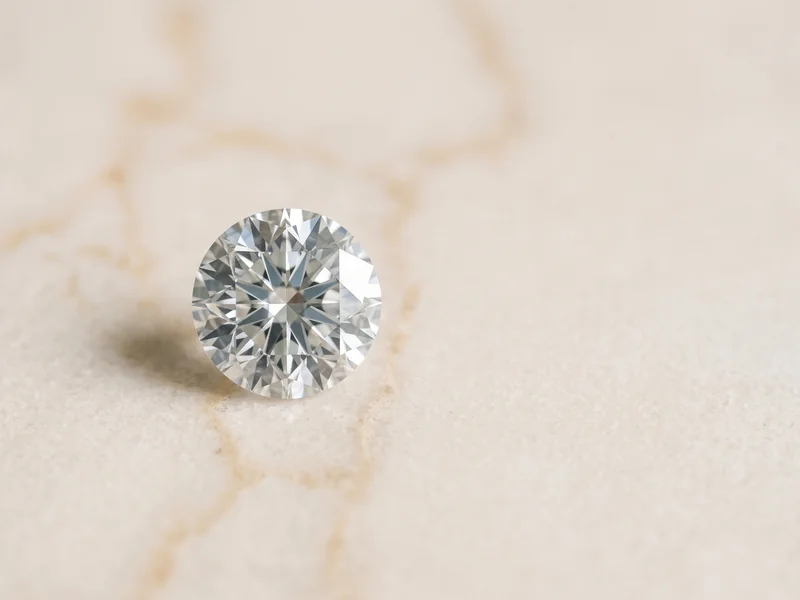 Lab-Grown DiamondsWhat Is Post-Growth Treatment in a Lab-Grown Diamond?
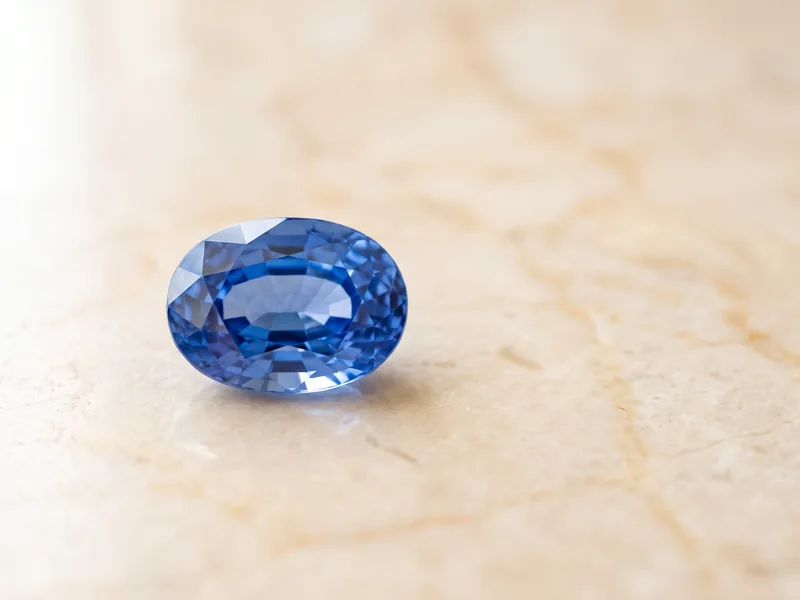 GemstonesGemstone Hardness Guide
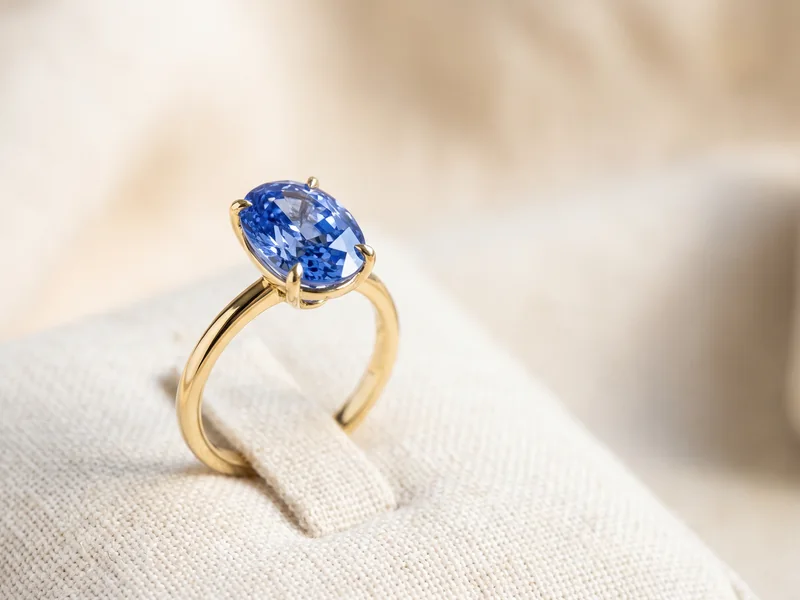 GemstonesEngagement Rings with Colour, Meaning and Personal Gemstone Choice
Explore more
More guides on this topic
Education