
Gemstones
November Birthstone: Topaz and Citrine Guide to Colours, Durability and Settings
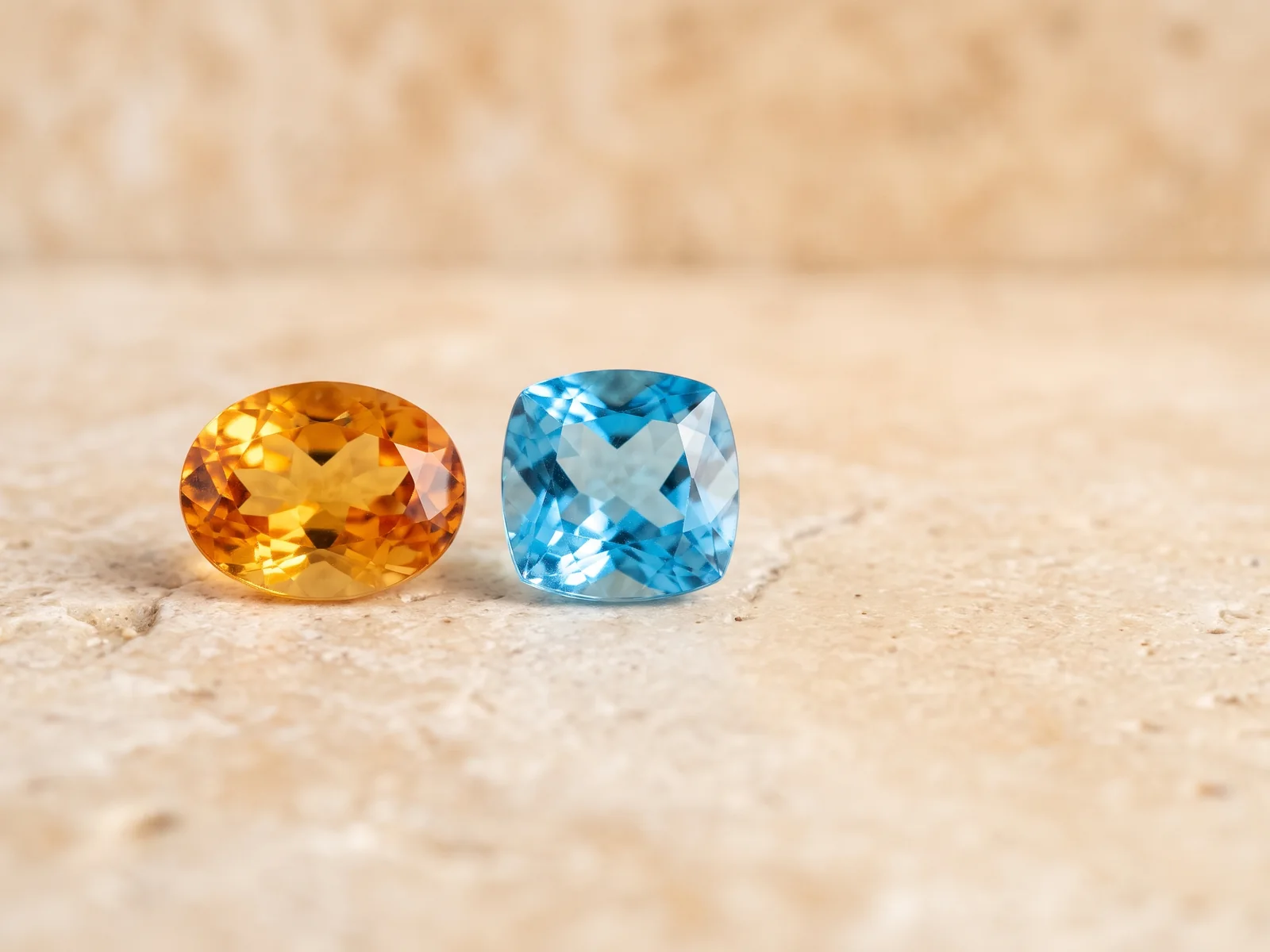
The November birthstone is really two different gems that share a warm golden colour. Knowing which is which, and how each one wears, decides whether a November ring still looks good in twenty years.
 Reviewed by Raj Sood, Graduate Gemologist (GIA), AJP (GIA)Master jeweller and Graduate Gemologist (GIA) · reviewed 4 November 2026
Quick answer
November has two birthstones: topaz and citrine. Topaz is a harder mineral (Mohs 8) found in colourless, blue, golden and rare imperial orange-pink, but it can split along one cleavage direction. Citrine is yellow to orange quartz (Mohs 7), usually heated amethyst, with no cleavage. Both suit rings in a protective setting such as a bezel.
What is the November birthstone?
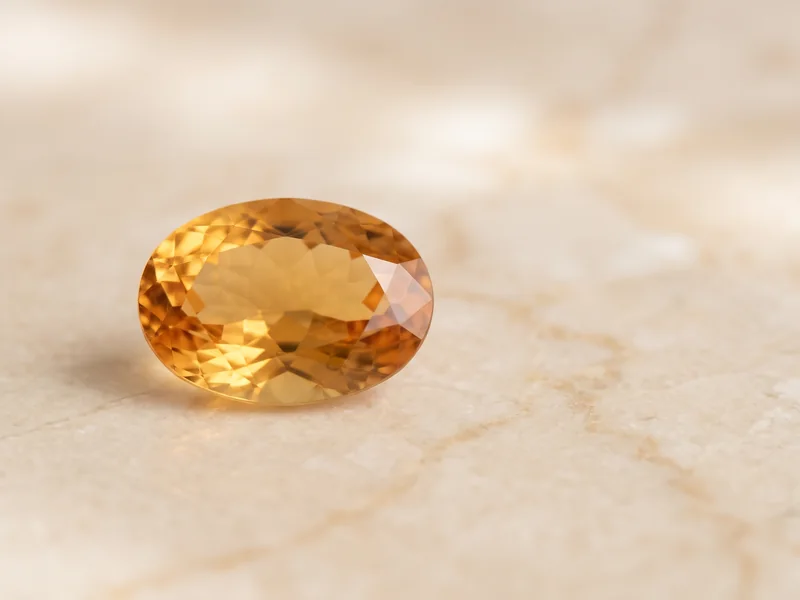
The November birthstone is topaz, with citrine as the official alternative. They often look alike, golden yellow to warm orange, but they are completely different minerals. Topaz is an aluminium silicate containing fluorine, Al2SiO4(F,OH)2. Citrine is a yellow to orange variety of quartz, silicon dioxide, SiO2, the same mineral as amethyst and rock crystal.
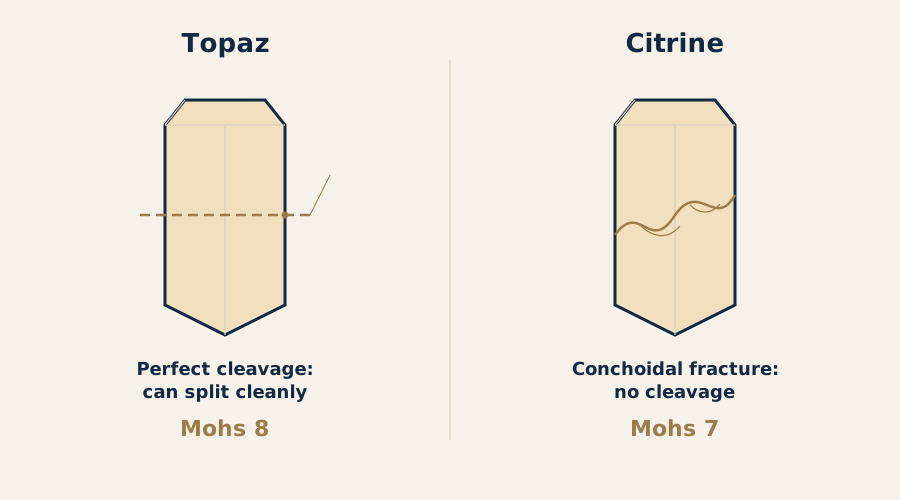
That difference matters more than most people realise. Topaz is harder but has a weakness called cleavage (a direction along which the crystal can split cleanly). Citrine is softer but tougher, with no cleavage at all. Topaz also comes in far more colours, including the blue most people picture when they hear the name, while citrine stays in the yellow-to-brownish-orange range.
For a long time the two were mixed up in the trade. Citrine was sold under names such as "Madeira topaz" or "gold topaz", and you can still see those labels on older jewellery. They are misleading: an honest description says citrine or citrine quartz. If you are comparing stones across our coloured gemstone guides or looking at birthstone jewellery for every month, check the mineral name, not just the colour. Any unfamiliar term here is explained in our plain-English jewellery glossary.
What is the history of the November birthstone?
The word topaz is old and its origin is uncertain. The Roman writer Pliny linked it to Topazios, an island in the Red Sea now called Zabargad, but the green stones mined there were almost certainly what we now call peridot. Another suggested root is the Sanskrit word for fire, though that is debated. Citrine is simpler: it comes from the French word "citron", meaning lemon, after its colour.
Before modern gem testing, almost any yellow or brown transparent stone could be called topaz. Only in the eighteenth and nineteenth centuries, as mineralogists learned to measure properties such as hardness and density, did topaz become one specific mineral. Around the same period, deposits near Ouro Preto in Brazil began producing the rich orange-pink stones now called imperial topaz. Stories about the name differ: some link it to the Russian tsars, others to the Brazilian emperor.
The modern birthstone list most jewellers follow was published in 1912 by the American National Association of Jewelers, and it gave November to topaz. Citrine was added as an alternative in 1952, partly because good golden topaz had become scarce and expensive while citrine was plentiful. Australian jewellers use the same list. One local quirk: November is autumn in the northern hemisphere, where the golden colours were chosen to suit the season, but here it is late spring.
What colours does topaz come in?
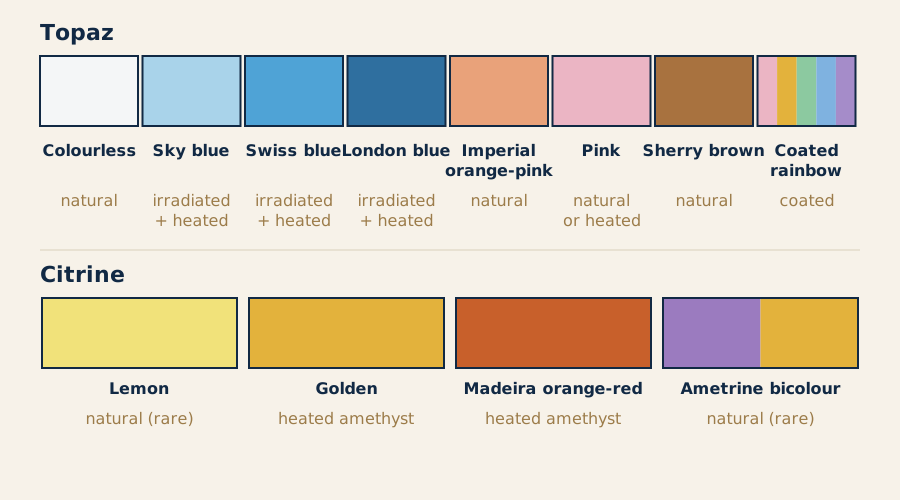
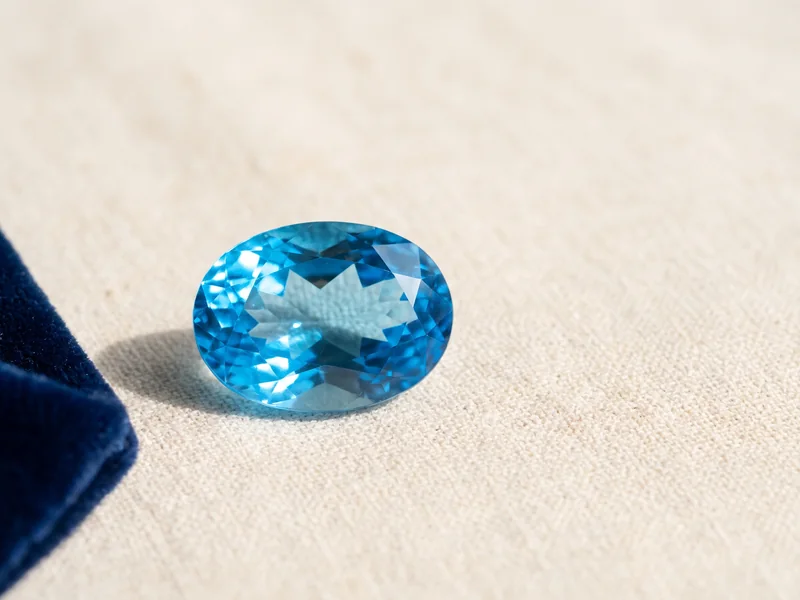
Pure topaz is colourless. Traces of other elements and natural radiation in the ground create its colours, and treatments create others. The November birthstone colour most people think of is golden, but in the shop window blue is far more common. Here is how the main colours compare:
| Topaz colour | Natural or treated | What to know |
|---|---|---|
| Colourless | Natural | Common and inexpensive; the starting material for most blue topaz |
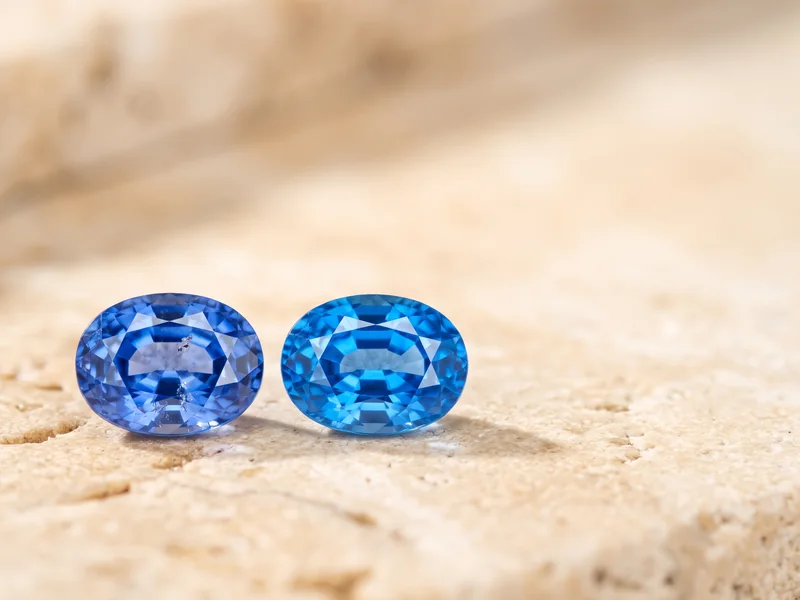
| Sky blue | Almost always irradiated and heated | Pale, light blue; natural pale blue exists but is uncommon |
| Swiss blue | Irradiated and heated | Bright, mid-tone blue |
| London blue | Irradiated and heated | Deep, slightly grey-blue; usually costs a little more |
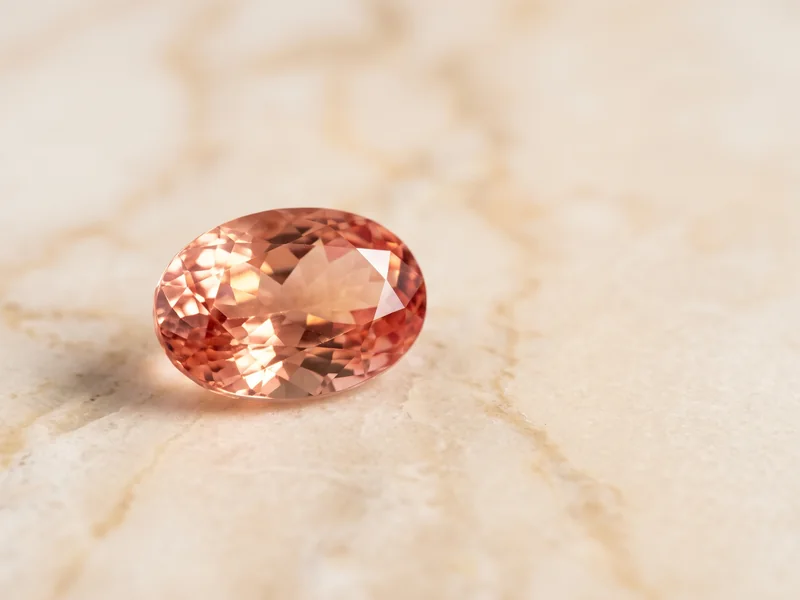
| Imperial (golden orange to pinkish orange) | Natural | The rarest and most valued topaz; mainly from Brazil |
| Pink | Natural or heated | Often produced by heating orange or brownish topaz |
| Sherry and brown | Natural | Some brown topaz can fade in strong sunlight |
| Mystic and other coated colours | Thin surface coating | Rainbow effect sits on the surface and can wear off |
Blue topaz is made by irradiating colourless topaz and then heating it. The colour is stable and permanent, and treated stones are held and checked for residual radioactivity before they are released for sale. Our guide to blue topaz colours from Sky to London compares the shades, and how blue topaz is treated and cared for explains the process in detail. Blue topaz is often confused with aquamarine, the March birthstone; aquamarine is a beryl, slightly lower in refractive index and usually a softer, greener blue.
Imperial topaz is the true golden November stone. Fine examples show a warm orange with pink or red flashes, and the best colours are rarely larger than a few carats. Read imperial topaz in depth for grading, origin and price.
Topaz has a refractive index of about 1.61–1.64, enough for good brightness, and a specific gravity (density compared with water) of about 3.5. That density means a 1 carat topaz is noticeably smaller than a 1 carat citrine, so always compare millimetre sizes rather than carat weights. Topaz is also usually very clean inside, which is why it suits step cuts such as the emerald cut that show everything.
Related guideAquamarine vs Blue TopazWhat is citrine, and is most citrine heated amethyst?
Citrine is quartz coloured by traces of iron. Natural citrine, coloured in the ground, is uncommon and tends to be pale lemon to light golden, sometimes with a faint smoky tint. Most of the citrine sold today is heated amethyst: purple quartz, mainly from Brazil, heated to roughly 400–550 °C until its colour turns yellow, orange or reddish orange. Some is heated smoky quartz.
Heating is a long-standing, routine and permanent treatment, and it should be disclosed. Heated amethyst often has a slightly redder, more orange tone than natural citrine, and the colour can sit in zones. That is not a defect, just a clue to its history. Because citrine and amethyst are the same mineral, our page on amethyst, the February birthstone is a useful companion read.
- Lemon citrine: pale, bright yellow; often the least expensive.
- Golden citrine: mid-tone yellow to yellow-orange, the classic November look.
- Madeira citrine: deep orange-red to brownish orange, named after Madeira wine; usually the most valued.
- Ametrine: amethyst and citrine zones in one crystal, mainly from the Anahí mine in Bolivia.
Citrine has a refractive index of about 1.54–1.55 and a specific gravity of about 2.65. It is plentiful in large, clean sizes, so a 10 carat citrine is realistic where a 10 carat imperial topaz would be exceptional. For grading tips, origins and cuts, see our full citrine guide.
Not sure which one is right?
Send us the stones you are looking at and our gemologist will tell you which to choose and why.
Topaz vs citrine: how do they compare?
| Topaz | Citrine | |
|---|---|---|
| Mineral | Aluminium fluorosilicate | Quartz (silicon dioxide) |
| Mohs hardness | 8 | 7 |
| Cleavage | One perfect direction | None (breaks with a curved, shell-like fracture) |
| Toughness | Poor to fair; can split if struck | Good |
| Refractive index | about 1.61–1.64 | about 1.54–1.55 |
| Specific gravity | about 3.5 | about 2.65 |
| Colour range | Colourless, blue, golden, orange, pink, brown | Pale yellow to deep orange-brown |
| Common treatments | Irradiation and heat (blue), heat (pink), coating | Heat (from amethyst or smoky quartz) |
| Main sources | Brazil, Sri Lanka, Nigeria, Pakistan, Australia | Brazil, Bolivia, Madagascar, Zambia |
| Relative price | Blue and colourless low; imperial high | Low to moderate |
Side by side, topaz is usually brighter because of its higher refractive index, and it holds a sharper polish over time. Citrine is the better choice if you want a large golden stone on a modest budget or a stone that shrugs off an accidental knock. If blue is what you are after, it is worth reading how aquamarine and blue topaz differ before you decide.
Is the November birthstone durable enough for an everyday ring?
Yes, with the right setting. Durability has two parts. Hardness is resistance to scratching, measured on the Mohs scale from 1 to 10. Toughness is resistance to chipping and breaking. A stone can be strong in one and weak in the other.
Ordinary household dust contains tiny grains of quartz, about 7 on the Mohs scale. Topaz, at 8, is harder than that dust, so its facets stay crisp for years. Citrine, at 7, is the same hardness as the dust, so in an everyday ring the facet edges slowly round off and the top facet can turn hazy. A jeweller can repolish it, but it is worth knowing before you choose citrine for a ring worn daily.
Topaz has the opposite problem. Its single perfect cleavage runs across the crystal, and a sharp knock at the wrong angle, on a bench top or a car door, can split the stone cleanly even though it is hard. Citrine has no cleavage, so it is more forgiving of knocks.
- Diamond (10): diamond, April's stone, the hardest choice for daily wear.
- Sapphire and ruby (9): September's sapphire and ruby for July are hard and tough.
- Topaz (8): hard, but needs protection from knocks.
- Emerald (7.5–8): May's emerald is often included and more fragile than topaz.
- Citrine (7): tough, but wears at the edges over years.
- Garnet (6.5–7.5): garnet for January sits close to citrine.
For engagement rings in particular, our guide to choosing a birthstone engagement ring for durability ranks every month's stone and the settings that suit each.
Is Australian topaz available, and where is it found?
Topaz is one of Australia's more widespread gem minerals, usually found in granite country alongside tin. Most Australian topaz is colourless to pale blue, occasionally pale golden or brownish. Known localities include:
- Flinders Island, Tasmania: colourless to pale blue topaz from around Killiecrankie Bay, locally called "Killiecrankie diamonds" (they are topaz, not diamond).
- North-east Tasmania: tin-mining districts that have produced topaz as well as sapphire.
- New England, NSW: the tin fields around Emmaville and Torrington, which also yield topaz.
- Stanthorpe, Queensland: the Granite Belt on the NSW border, a long-standing fossicking area for topaz.
Australian topaz is mostly a fossicking and collector stone rather than a large commercial supply, so stones big and clean enough for a ring centre are less common than imported blue topaz. Citrine is different: Australia produces very little gem citrine, and most on the market comes from Brazil, Bolivia, Madagascar and Zambia. If origin matters to you, ask what documentation is available for a specific stone, and remember that pale Australian topaz is natural colour, while bright blue topaz from anywhere is treated.
Which settings suit a November birthstone ring?
The right setting balances the stone's weak point. For topaz that means shielding the edge from knocks; for citrine it means keeping the top facet away from daily wear where you can.
- Bezel or half-bezel: a thin rim of metal around the stone. The most protective choice for topaz and a good daily option for citrine.
- Halo: small diamonds around the centre take knocks before the gem does and make a modest stone look larger.
- Six claws: more secure than four, and if a claw lifts the stone is still held.
- Lower profile: a stone that sits closer to the finger is struck less often.
- Avoid tension settings for topaz: constant pressure across the stone is risky for a gem with cleavage.
- Pendants and earrings: rarely knocked, so any November stone and any setting style works well.
Metal colour changes the look. Yellow and rose gold warm up citrine and imperial topaz and make pale stones look richer. White gold and platinum give blue topaz a cool, crisp frame. Cuts matter too: ovals and cushions suit citrine's colour, and clean topaz looks sharp in an emerald or step cut.
How much do topaz and citrine cost in Australia?
Both November stones are among the more affordable birthstones, with one big exception: fine imperial topaz. Loose stone prices vary widely with colour, size and cut quality, so treat these as broad guides only.
| Stone | Approximate loose price per carat (AUD) |
|---|---|
| Colourless topaz | about $5–$30 |
| Blue topaz (Sky, Swiss, London) | about $10–$60 |
| Golden and lemon citrine | about $10–$50 |
| Madeira and fine natural citrine | about $30–$150 |
| Imperial topaz, fine orange-pink | about $300–$2,000 or more |
For most topaz and citrine rings, the metal and the labour cost more than the stone itself. A gold setting with a halo can be many times the value of a blue topaz centre. Imperial topaz reverses that: a fine 2–3 carat stone can be the largest part of the price. Larger stones cost more per carat, and a precise cut with no windowing (a washed-out patch in the centre where light passes straight through) adds value in every colour.
Browse natural gemstones
How do you choose and care for November birthstone jewellery?
- Pick the stone first. Golden on a budget: citrine. Blue: blue topaz. The rare golden-pink: imperial topaz.
- Ask about treatment. Expect blue topaz to be irradiated and heated and most orange citrine to be heated amethyst; the seller should say so.
- Check the cut. Tilt the stone and look for windowing, and compare millimetre sizes rather than carats.
- Look near the edges. In topaz, avoid feathers (small internal cracks) running along the girdle, the thin outer edge.
- Choose a protective setting. For a daily ring, a bezel, halo or six claws, sitting low on the finger.
- Clean gently. Warm soapy water and a soft brush. Avoid ultrasonic cleaners and steam for topaz, and sudden heat for both stones.
- Store separately and check the claws. Keep pieces apart so harder gems do not scratch citrine, and have the setting checked about once a year.
Free consultation
Talk to a gemologist
Compare stones in person or online with Raj Sood, Graduate Gemologist (GIA), AJP (GIA).
Book a consultationShop this shape
FAQ
Common questions
What is the November birthstone?
November has two birthstones: topaz, the traditional stone, and citrine, added as an alternative in 1952. Both are best known in golden yellow to orange, although topaz also comes in blue and other colours.
Is topaz or citrine better for an engagement ring?
Topaz is harder (Mohs 8 vs 7) and keeps its polish longer, but it can split if knocked. Citrine is tougher but wears at the facet edges over years. Either works daily in a protective setting such as a bezel or halo.
Is blue topaz natural?
Blue topaz is natural topaz, but almost all of it gets its colour from irradiation and heating of colourless stones. The treatment is permanent and stable, and it should be disclosed.
Is citrine just heated amethyst?
Most citrine on the market is heated amethyst, which is still genuine quartz. Natural citrine coloured in the ground exists but is uncommon and usually paler.
Can you find topaz in Australia?
Yes. Topaz is found on Flinders Island and in north-east Tasmania, the New England region of NSW and around Stanthorpe in Queensland. Most is colourless to pale blue.
How do you clean topaz and citrine jewellery?
Use warm soapy water and a soft brush, then rinse and dry. Avoid ultrasonic cleaners and steam for topaz because of its cleavage, and keep both stones away from sudden heat.

Ask a gemologist
Not sure which diamond to choose?
Raj Sood is a Graduate Gemologist (GIA) and master jeweller. Bring the stones you are considering, or send the reports, and he will tell you honestly which one is better and why.
Keep learning
Related guides

Explore more
More guides on this topic
Education