
- Education
- Wedding Bands & Eternity
- High Polish Ring Finish: How It Looks, Wears and Gets Refinished
Wedding Bands & Eternity
High Polish Ring Finish: How It Looks, Wears and Gets Refinished
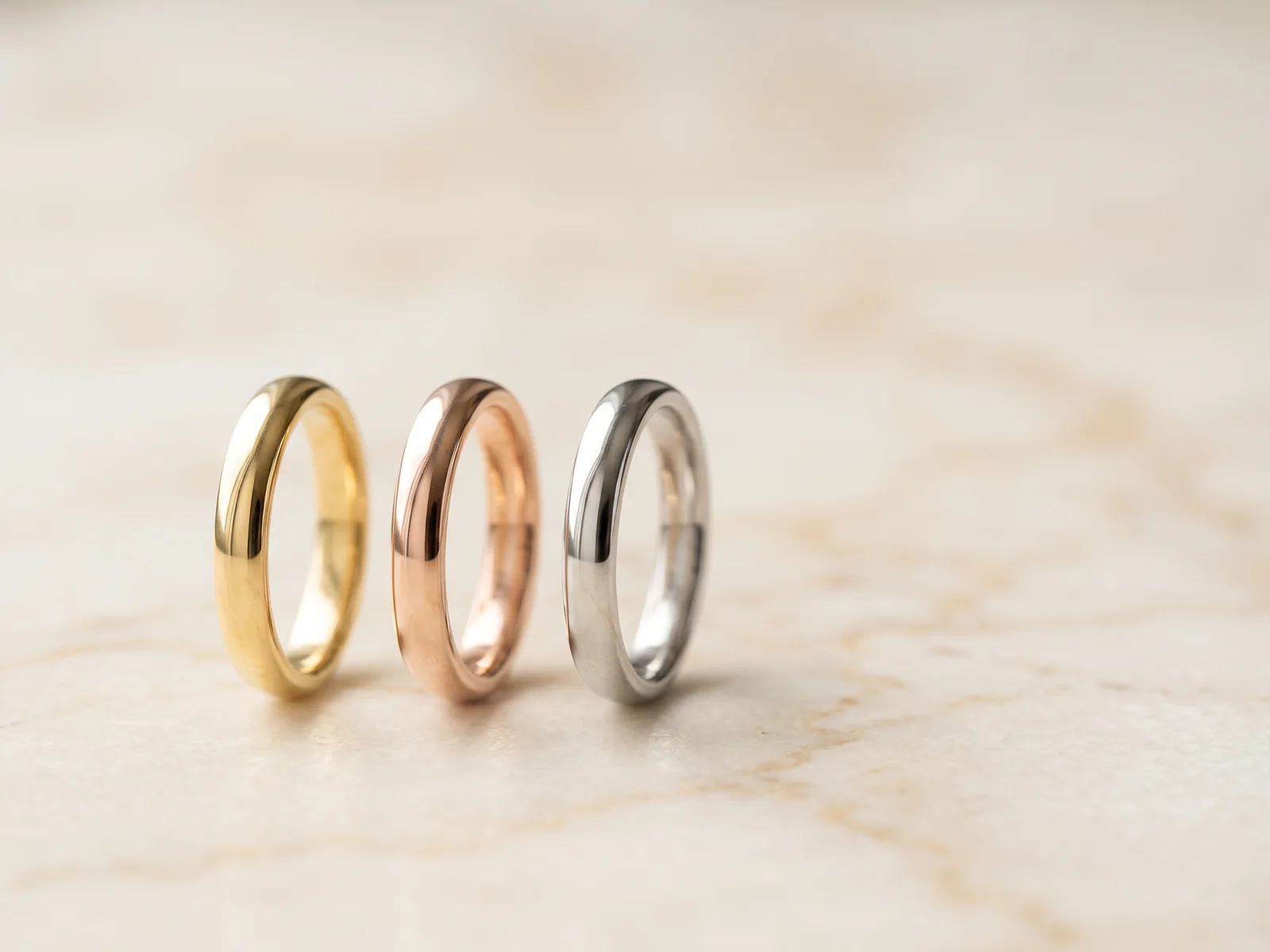
A high polish ring finish is the classic wedding band look: bright, reflective and easy to match. Here is how it looks on each metal, how it changes over months of wear, and what keeping or restoring the shine involves.
 Reviewed by Raj Sood, Graduate Gemologist (GIA), AJP (GIA)Master jeweller and Graduate Gemologist (GIA) · reviewed 4 November 2026
Quick answer
A high polish ring finish is a smooth, mirror-like surface made by sanding the metal with ever-finer abrasives and buffing it with polishing compounds. It shows the metal's full colour and shine but also shows scratches within weeks of daily wear. A jeweller can repolish it, usually for about AUD $50–$150 for a plain band.
What is a high polish ring finish?
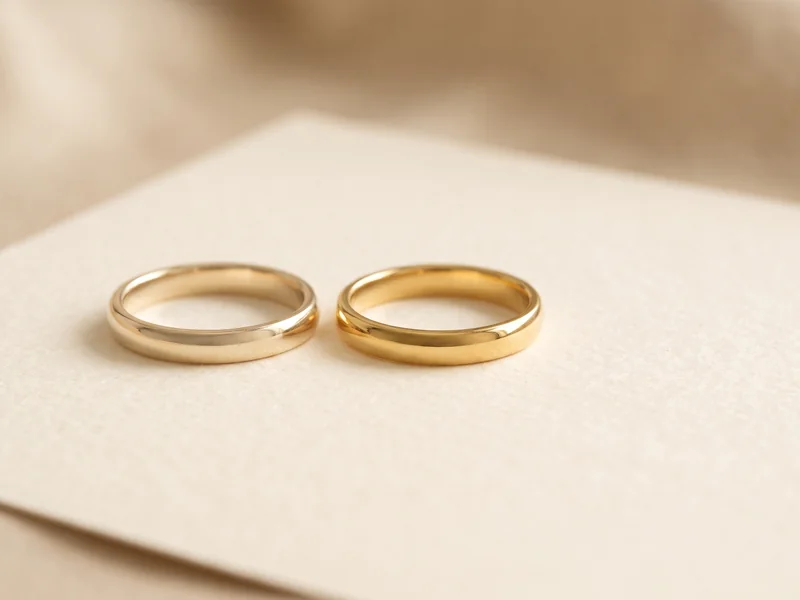
A high polish finish, also called a mirror or bright polish, is a metal surface smoothed so finely that it reflects light like a mirror. There is no visible texture. Under a loupe (a 10× jeweller's magnifier) a freshly polished band shows an almost unbroken surface, and in the hand you see clear reflections of whatever is around it: a window, your sleeve, the next ring along. It is the default finish on most plain wedding bands, engagement ring shanks (the band part of the ring) and eternity rings.
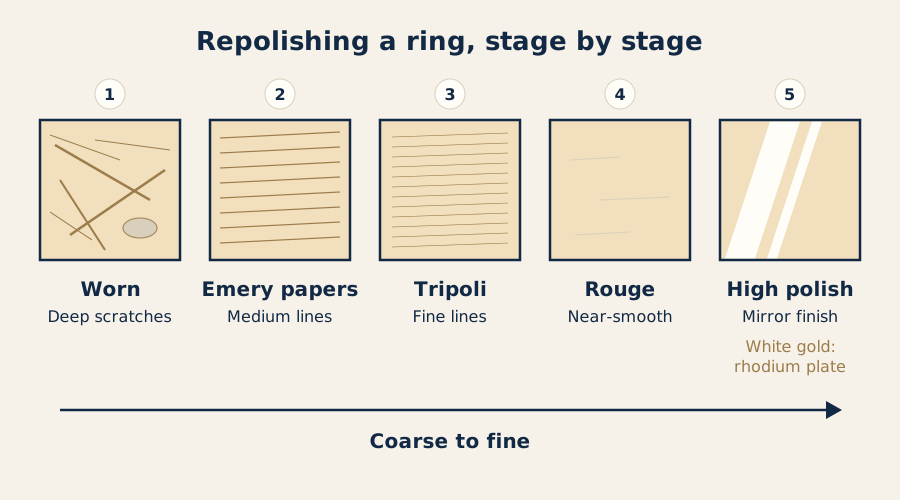
The shine comes from removing scratches step by step. A jeweller works from coarse to fine. Files and emery papers take out casting and tool marks, then a polishing compound called tripoli on a spinning mop removes the fine lines the papers leave. Finally rouge, a much finer polishing compound, on a soft cotton or felt mop brings up the mirror. Each stage swaps the previous scratches for smaller ones, until they are too small to scatter light and the surface looks perfectly smooth.
Some workshops also burnish the metal, rubbing it with a hardened, polished steel tool. Burnishing pushes the surface flat rather than cutting it away, and it is often used around stone settings and on platinum.
Don't confuse this with the polish grade on a diamond report. That grade describes how smooth a diamond's facets are, not the metal around it; see how polish is graded on a diamond report and what polish and symmetry grades tell you about a cut. For any other workshop words in this guide, our plain-English jewellery glossary has short definitions.
How does high polish compare with brushed, sandblasted and hammered finishes?
The finish changes how a ring reads on the hand as much as the metal does. A high polish band behaves like a curved mirror: it throws back bright highlights and dark reflections, which makes the edges look crisp and the metal colour look deep and saturated. Textured finishes break the light up into thousands of tiny reflections, so the band looks softer and more even, and the colour looks a touch paler.
| Finish | How it looks | How scratches show | Upkeep | Often chosen for |
|---|---|---|---|---|
| High polish | Mirror-bright, strong reflections, deepest colour | Fine scratches visible within weeks, especially on flat surfaces | Repolish every 1–3 years if you want it bright | Classic wedding bands, eternity rings, matching sets |
| Brushed / satin | Soft sheen with fine parallel lines or an even matte glow | Blend in at first; deep scratches still show | Texture is re-brushed, usually quickly | Men's bands, modern and two-tone designs |
| Sandblasted | Frosted, grainy matte, very little reflection | Shiny rub marks appear where the texture wears smooth | Re-blasted when the frost wears down | Contemporary bands, contrast against polished edges |
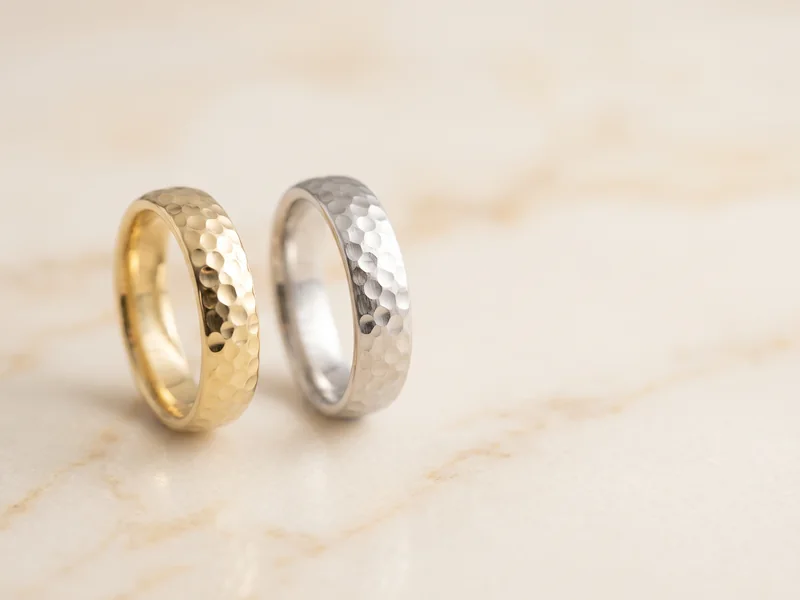
| Hammered | Faceted dimples that catch light in small flashes | Well hidden by the pattern | Pattern lasts; dimples soften over many years | Organic, handmade looks |
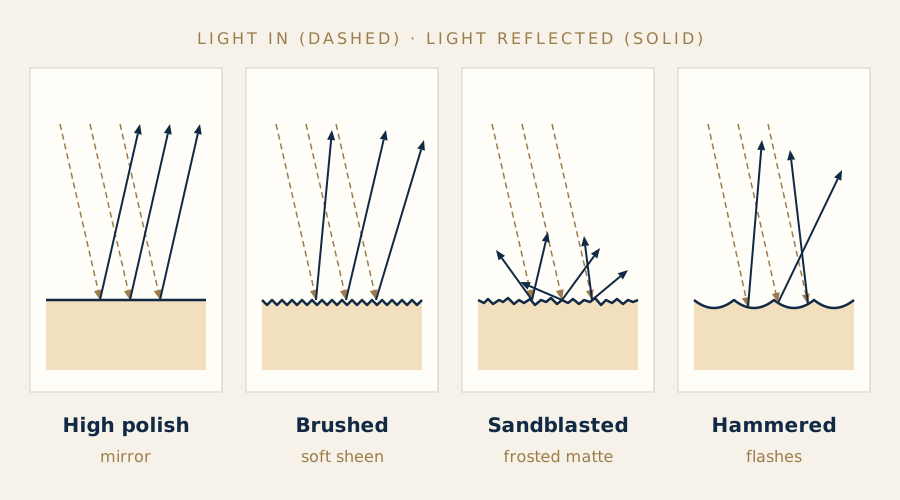
Many rings combine finishes: a brushed centre with high polish edges, or a polished band with a frosted inner stripe. If you are weighing a softer look, our guide to brushed and satin finishes covers how they wear, the frosted sandblasted texture page explains the matte option, and hand-hammered bands are the most forgiving of daily knocks. Decorative details like milgrain edges and engraved patterns usually sit on a polished surface, because the bright metal makes the beading or engraving stand out.
Related guideBrushed and Satin Ring FinishesDoes a high polish ring finish scratch easily?
Yes, and it is worth knowing that before you choose it. Gold is about 2.5–3 on the Mohs scale (a 1 to 10 scale of scratch resistance), and platinum about 4–4.5. Everyday grit is much harder: the quartz in sand and household dust is 7, and ordinary glass and steel sit around 5.5. So anything gritty that rubs the ring leaves a line. On a mirror surface those lines are easy to see because each one catches the light differently from the smooth metal around it.
On a ring worn every day, fine hairline scratches usually appear within the first few weeks, mostly on the palm side and the outer edges. After about a year, most high polish bands have a soft, slightly hazy sheen with a scattering of small marks and the odd tiny dent. Jewellers call this worn-in look a patina. Some people love it as a record of the ring being worn; others prefer to have the mirror restored.
The things that mark a polished band fastest:
- Gym equipment: barbells, kettlebells and rowing handles leave deep scuffs and can dent or bend a band.
- Sand, soil and grit: gardening, the beach and building work act like sandpaper.
- Hard handles and rails: car keys, door handles, shopping trolleys and stair rails.
- Other rings: an engagement ring and wedding band rub against each other constantly, leaving matching wear lines where they touch.
- Desks and laptops: resting your hand on a hard surface all day slowly dulls the palm side.
The band's shape changes how much you notice. A flat or wide profile has a large, even reflective area, so every scratch is visible; a domed (court) profile curves the reflections and hides light marks better. Width matters too, as covered in our guide on how band width changes the look on your hand. Wide flat bands, common in typical men's and women's band widths, tend to show scuffs soonest.
Which metals hold a high polish best?
Every metal can take a high polish, but they wear in different ways. The figures below are approximate; alloys vary between refiners.
| Metal | Approx. Mohs hardness | How the polish wears | Refinishing |
|---|---|---|---|
| 9ct yellow, white or rose gold | about 2.5–3 (alloy is often a little harder than 18ct) | Fine scratches within weeks; a soft glow after a year | Easy for any jeweller to repolish |
| 18ct yellow or rose gold | about 2.5–3 | Scratches like 9ct; rich colour still shows through the patina | Easy to repolish |
| 18ct white gold, rhodium plated | surface rhodium about 6 | Plating stays bright white for a while, then wears first on the palm side | Repolish and replate about every 12–24 months |
| Platinum 950 | about 4–4.5 | Scratches push metal aside rather than remove it; wears to a grey satin patina | Repolishing restores the mirror with very little metal lost |
| Palladium | about 4.75 | Wears to a patina similar to platinum | Most jewellers can polish it |
| Titanium | about 6 | Light scratches still show on a polish | Needs different compounds; not every jeweller does it |
| Tungsten carbide | about 8.5–9 | Holds a polish for a long time | Hard to refinish, can crack if struck, cannot be resized |
Gold loses a tiny amount of metal each time it is scratched and polished. You won't notice that over a few polishes, but over decades of frequent polishing a band slowly becomes thinner. Platinum behaves differently: a scratch mostly displaces the metal into small ridges either side, so the surface dulls to a grey sheen while the ring keeps its weight. That patina is why platinum can look less bright than new white gold after a year, even though it is the more durable metal.
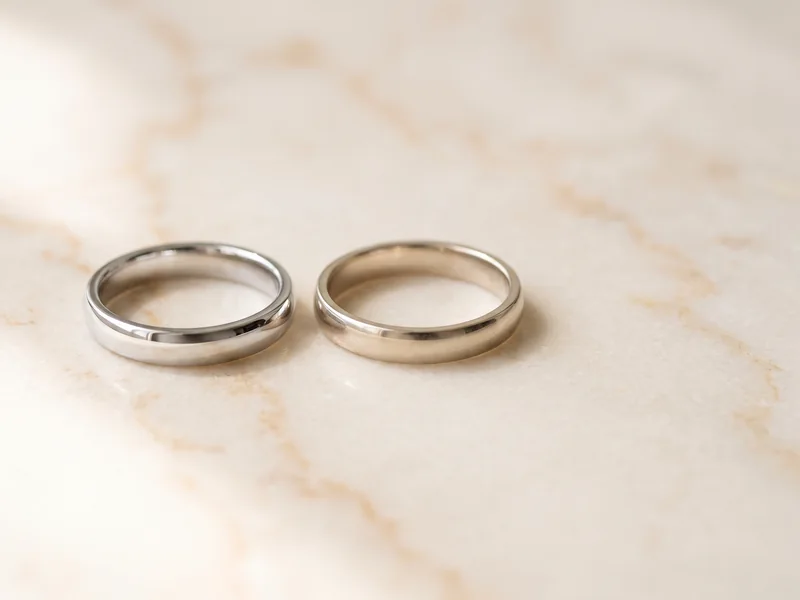
White gold is usually plated with rhodium, a hard, very white metal in the platinum family. The plating is extremely thin, often well under a micron, so as it wears the slightly warmer colour of the white gold alloy underneath shows through, typically on the palm side first. That is not a fault; it is simply time to replate.
Not sure which one is right?
Send us the stones you are looking at and our gemologist will tell you which to choose and why.
Should your wedding band match your engagement ring's finish?
Most bridal sets are high polish on both rings, and there is a practical reason. Two polished rings wear at the same rate and age into the same patina, so they keep looking like a pair. A polished engagement ring next to a brushed or sandblasted band is a deliberate contrast and can look very good, but the textured band will rub the polished ring, and the polished ring will slowly burnish shiny lines into the texture.
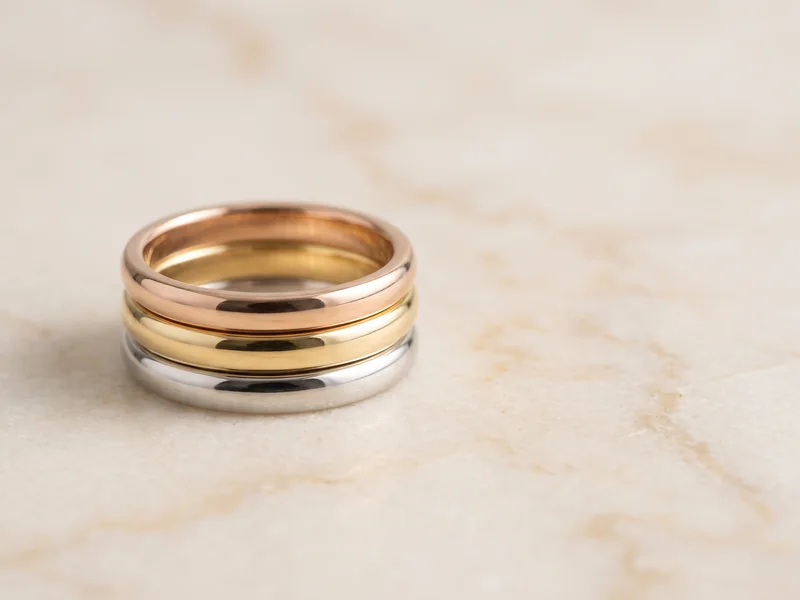
How the rings sit together matters as much as the finish. Our guide to stacking several rings on one finger covers order and spacing, and how setting height affects a band sitting beside it explains when a band rubs against the setting and when it sits clear.
Eternity rings are nearly always high polish, because bright metal frames a row of diamonds cleanly and reflects light back into them. Whether you choose half or full eternity designs, polishing a stone-set band takes more care than a plain one: the jeweller polishes around each claw or channel wall by hand and checks that no stone has loosened. Our overview of eternity and anniversary ring styles, the difference between an anniversary ring and an eternity ring and the guide to eternity stone sizes measured in points all help you plan a band that will sit well beside a polished engagement ring.
How do you look after a high polish ring at home?
You cannot stop a polished ring from scratching, but you can slow it down and keep it clean, which makes a big difference to how bright it looks. Grease and soap film dull a polish faster than scratches do.
- Take it off for rough work: the gym, gardening, beach days, moving house and cleaning with chemicals.
- Store rings apart: a soft pouch or a lined box with separate slots, so rings don't scratch each other.
- Clean gently: warm water, a drop of mild dishwashing liquid and a soft toothbrush, then rinse and dry with a lint-free cloth.
- Use a jeweller's polishing cloth sparingly: it lifts haze and tarnish from gold and platinum, but light use is enough, and frequent rubbing wears rhodium plating faster.
- Avoid chlorine: pool water and bleach can attack the other metals in gold alloys over time.
- Skip toothpaste and baking soda: both are abrasive and leave fine scratches of their own.
- Be careful with home ultrasonic cleaners: fine for a plain band, but vibration can loosen stones in a worn setting and can damage some gemstones.
A polishing cloth brightens the surface; it does not remove scratches. Only a jeweller's polishing removes them, because it takes the surface down to below the depth of the marks.
How is a ring repolished, and how often should you do it?
A professional repolish follows the same coarse-to-fine sequence used when the ring was made, scaled to how worn it is. For a plain band with light scratches the jeweller may go straight to tripoli and rouge. Deeper marks and dents need emery papers first, and a dented or slightly oval band is put on a steel ring mandrel (a tapered rod) and gently tapped back to round before polishing.
- Inspect: check claws, stones, thickness of the band and any engraving.
- Clean: ultrasonic or steam clean so grit doesn't scratch the ring during polishing.
- Pre-polish: emery papers or a mild compound remove deeper scratches.
- Polish: tripoli removes the remaining fine lines.
- Finish: rouge on a soft mop brings up the mirror.
- Plate if needed: white gold is cleaned thoroughly and rhodium plated.
- Final clean and check: stones and claws are checked again under magnification.
How often is a personal choice. Many people with a plain gold or platinum band have it polished every one to three years, or before an anniversary. Rhodium-plated white gold usually needs replating about every 12–24 months if worn daily. Every polish removes a very thin layer of metal, so there is a balance: polishing too often over many years thins a band, softens milgrain beading and makes engraving shallower. Letting a polished ring develop some patina between visits is perfectly fine, and having the claws checked each year matters more than the shine.
How much does it cost to repolish a ring in Australia?
Prices vary with the metal, the condition of the ring and how many stones it has. These are broad, approximate ranges only.
| Service | Approximate price range (AUD) |
|---|---|
| Clean and polish, plain gold band | about $50–$120 |
| Clean and polish, plain platinum band | about $70–$150 |
| Polish and rhodium plate, white gold ring | about $60–$150 |
| Polish, rhodium and claw check, stone-set or eternity ring | about $100–$250 |
| Dent removal, reshaping or rebuilding worn edges | quoted after inspection |
If a band has worn very thin after decades of wear, polishing alone won't help; it may need metal added, or remaking. For a wider look at choosing metal, width and profile with long-term wear in mind, our wedding ring buying guide walks through each decision.
Create your eternity ring or wedding band in a high polish finish
How do you choose and keep a high polish ring finish? Step by step
- Decide how you feel about patina. If fine scratches will bother you, plan regular repolishing or consider a brushed or hammered finish instead.
- Choose the metal. Platinum wears to a grey patina with little metal loss; gold keeps its colour but loses a little metal with each polish; white gold needs rhodium replating.
- Pick a profile. A domed or court profile hides light scratches better than a wide, flat band.
- Match your rings. If the band sits beside an engagement ring, keep both high polish so they age together.
- Clean at home monthly. Warm soapy water and a soft brush keep the shine brighter than any cloth.
- Book a check every year. Have claws and stones inspected, and polish both rings together when you want the mirror back.
Free consultation
Talk to a gemologist
Compare stones in person or online with Raj Sood, Graduate Gemologist (GIA), AJP (GIA).
Book a consultationShop this shape
FAQ
Common questions
Does a high polish ring scratch easily?
Yes. Gold and platinum are softer than the grit in everyday dust, so fine scratches usually appear within a few weeks of daily wear. They are surface marks and a jeweller can polish them out.
Is high polish or brushed better for a wedding band?
Neither is better; they suit different people. High polish is brighter and matches most engagement rings, while brushed hides light scratches but needs re-brushing when deep marks build up.
How often should a wedding ring be repolished?
Many people repolish a plain band every one to three years, and rhodium-plated white gold every 12–24 months. Polishing too often thins the band over decades, so some patina between visits is fine.
Does repolishing a ring make it thinner?
Each polish removes a very thin layer of metal, which is not noticeable after a few polishes. Over many years of frequent polishing a gold band can thin and lose milgrain or engraving detail; platinum loses less.
Why does my white gold ring look yellow?
White gold is usually plated with rhodium, a very white metal. When the thin plating wears, the slightly warmer colour of the gold alloy shows through, and replating restores the bright white.
Can a tungsten or titanium ring be repolished?
Titanium can be polished by jewellers with the right equipment. Tungsten carbide holds its polish well but is very hard to refinish and cannot be resized.

Ask a gemologist
Not sure which diamond to choose?
Raj Sood is a Graduate Gemologist (GIA) and master jeweller. Bring the stones you are considering, or send the reports, and he will tell you honestly which one is better and why.
Keep learning
Related guides
 Wedding Bands & EternityBrushed and Satin Ring Finishes
 Wedding Bands & EternityHammered Ring Finish
 Wedding Bands & EternitySandblasted Ring FinishWedding Bands & EternityWedding Ring Buying Guide
 Diamond 4Cs & GradingDiamond Polish Grades ExplainedDiamond 4Cs & GradingPolish and Symmetry
 Engagement Rings & SettingsLow-Profile vs High-Profile Engagement Rings
 Wedding Bands & EternityHow to Stack Rings
Explore more
More guides on this topic
Education