
- Education
- Buying Knowledge & Custom Process
- Custom vs Semi-Custom Engagement Rings: How They Differ, What They Cost and How to Choose
Buying Knowledge & Custom Process
Custom vs Semi-Custom Engagement Rings: How They Differ, What They Cost and How to Choose
Choosing between custom vs semi-custom engagement rings decides how much of the design is yours, how long you wait and what you pay. Here is how each works in Australia, including GST refunds and insurance, which most guides skip.
 Reviewed by Raj Sood, Graduate Gemologist (GIA), AJP (GIA)Master jeweller and Graduate Gemologist (GIA) · reviewed 4 November 2026
Quick answer
A semi-custom engagement ring starts from an existing setting design that you adjust: metal, centre stone, claws, band width or halo. A fully custom ring is designed from scratch for you, usually in CAD, then cast and hand-finished. Semi-custom is typically quicker (about 2–4 weeks) and cheaper; custom takes about 4–8 weeks and gives complete design freedom.
What is the difference between custom vs semi-custom engagement rings?
The difference is where the design starts. A semi-custom ring begins with a setting that already exists as a proven design: a solitaire, a halo, a three-stone or a bezel style. You then change the parts that matter to you, such as the metal, the centre diamond, the claw shape or the band width. A fully custom ring (sometimes called bespoke) starts with a blank page. A designer works from your ideas, sketches or reference photos, models the ring from scratch and makes it once, for you.
Both are made to order around your chosen stone, and both can look entirely individual on the hand. What changes is the amount of design work, the number of approval steps, the time involved and the risk of surprises. A ready-made ring sits at the other end of the scale; if you are still deciding whether you need any customisation at all, our guide on how custom compares with a ready-made ring covers that first step, and our complete engagement ring buying guide sets out the wider decisions.
- Ready-made: finished ring, usually with the stone already set. You choose a size and take it home.
- Semi-custom: an existing setting design, adjusted and made to fit your diamond.
- Fully custom: a new design, modelled and approved before any metal is cast.
A few technical words come up repeatedly in this guide. The setting or mounting is the metal part that holds the stone. The shank is the band that goes around the finger. CAD stands for computer-aided design, the 3D modelling software jewellers use. If you meet any other unfamiliar term, our plain-English jewellery glossary explains it.
What is a semi-custom engagement ring and what can you change?
A semi-custom engagement ring uses a design that has already been modelled, made and worn, so its proportions, claw strength and comfort are known. Because the core design is settled, the jeweller adjusts it rather than reinventing it. Typical changes include:
- Metal: 18ct yellow, white or rose gold, or platinum (usually 950 platinum, meaning 95% pure).
- Centre stone: shape and size, from about 0.30 carat to 3 carats or more, natural or lab-grown diamond, or a gemstone such as sapphire (9 on the Mohs hardness scale).
- Claws: four or six claws, rounded, pointed, tab or double claws, or a bezel (a thin metal rim around the stone).
- Band: width (commonly about 1.8–2.5 mm), plain or set with small diamonds, straight or slightly tapered.
- Gallery and profile: how high the stone sits and whether a wedding band can sit flush beside it.
- Extras: a hidden halo under the stone, side stones or an engraving inside the band.
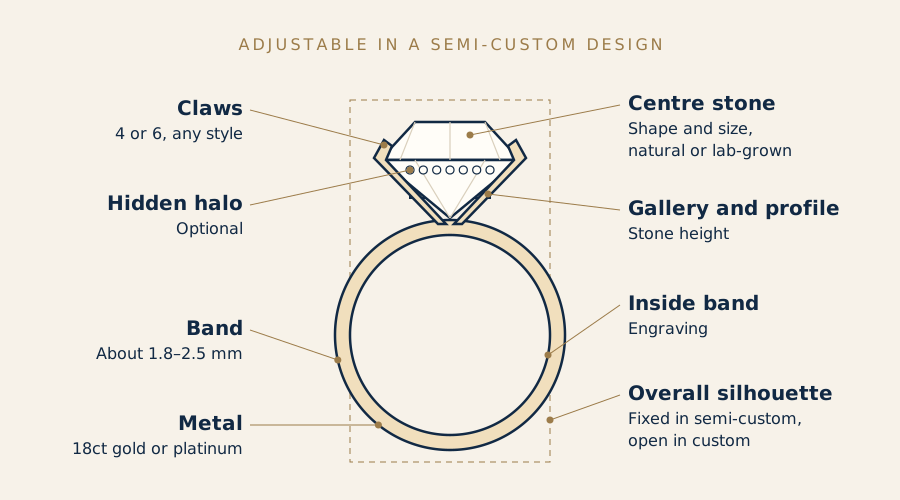
What you usually cannot change in semi-custom is the underlying architecture: the overall silhouette, the way the basket or gallery is built, or a completely new motif. Once a request starts to alter the structure, the ring is really becoming custom, and it should be quoted and timed that way. If you find you would not change anything at all, look at when a finished, off-the-shelf ring makes more sense.
One thing that still has to be exact in semi-custom work is the seat for the stone. Even a standard 1 carat round varies by a few tenths of a millimetre from one diamond to the next, so the claws or bezel are adjusted to the actual stone. Our article on why the setting must match the stone's exact measurements explains what goes wrong when it does not.
What does a fully custom engagement ring involve?
A fully custom ring follows a set sequence. It begins with a conversation about style, wear and budget; our guide to what happens in a first design consultation describes it in detail. The designer then turns your brief into a 3D model and shows you renders (realistic images) from several angles, with the measurements marked.
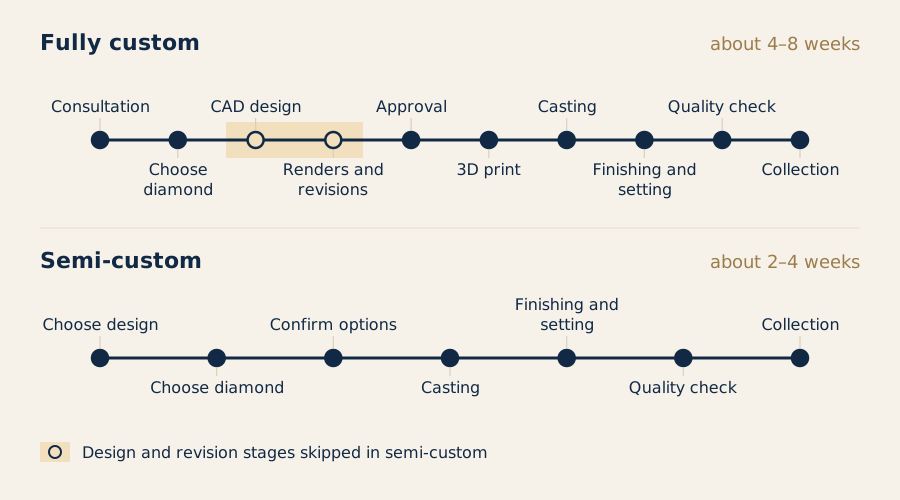
Once you approve the model, the file is 3D printed in resin or wax, and that model is used for lost-wax casting: the model is set in plaster-like investment, burnt out, and molten metal is poured into the space it leaves. The rough casting is then cleaned, filed, polished, set with stones and checked. Our pages on how CAD modelling shapes a custom design and the journey from CAD file to cast metal go through each stage.
Not every custom ring is made in CAD. Some designs, especially fine wirework, very thin profiles or certain antique-style details, are still built by hand from metal stock. The two methods suit different looks, and many rings combine them; see hand-fabricated versus CAD-designed rings for the trade-offs.
Custom work is also where the small personal touches are easiest to add, because nothing is fixed in advance: a birthstone set inside the band, a fingerprint engraving, or a profile shaped like a meaningful symbol. There are plenty of ideas in our guide to hidden details such as engraving or a secret stone.
Related guideWhat Happens at a Custom Engagement Ring Consultation?How do custom vs semi-custom engagement rings compare on cost, time and risk?
| Semi-custom | Fully custom | |
|---|---|---|
| Starting point | Existing, proven setting design | New design from your brief |
| Design freedom | Choose and adjust set elements | Almost anything structurally sound |
| Design approval | Usually one confirmation of options | Renders, revisions and sign-off |
| Typical timeframe | About 2–4 weeks | About 4–8 weeks |
| Design cost | Little or none on top of the setting | Design time is built into the price |
| Risk of surprises | Low: you can often see a sample | Higher: you approve from renders |
| Uniqueness | Your combination is personal; the base design is shared | One-off |
| Suits | Classic styles, tighter timelines | A specific vision or unusual stone |
The time gap comes mostly from design and revision, not from making the ring. Casting, finishing and setting take broadly similar time in both cases. That is also why a rushed custom ring is possible only up to a point: approvals can be quicker, but metal still needs to be cast, cleaned and set properly. Our page on which stages of a custom ring can be rushed goes through what can safely be compressed.
Risk works the other way. With semi-custom, you can usually try on a sample of the base design and see how it sits on your hand. With custom, you are approving a design on screen, so ask for renders with real measurements, a side profile showing the height off the finger, and if possible a printed resin model to try on before casting. Knowing what a 3D render can and cannot show you makes that approval step much easier.
Not sure which one is right?
Send us the stones you are looking at and our gemologist will tell you which to choose and why.
How much does a custom engagement ring cost in Australia?
The centre stone is usually the largest part of the cost, whichever route you choose. The setting adds a smaller amount that depends on metal, weight, complexity and the number of small diamonds. The ranges below are broad guides for the setting alone, in AUD, including GST.
| Setting (excluding centre stone) | Semi-custom, approx. AUD | Fully custom, approx. AUD |
|---|---|---|
| Simple solitaire, 18ct gold | $1,500–$3,000 | $2,500–$4,500 |
| Solitaire, platinum | $2,000–$3,500 | $3,000–$5,500 |
| Halo or pavé band, 18ct gold | $2,500–$4,500 | $3,500–$6,500 |
| Complex or sculptural design | Usually not offered | $5,000 and up |
For the centre stone, the big difference is natural versus lab-grown. A laboratory-grown diamond is real diamond with the same hardness (10 on the Mohs scale) and the same refractive index of about 2.42, grown in a laboratory rather than mined, and it costs much less than a natural diamond of the same grades. As a broad guide, a 1 carat round in G–H colour and VS clarity might be about $1,000–$3,000 lab-grown and about $7,000–$15,000 natural. Both should come with an independent grading report from a lab such as GIA or IGI that clearly states whether the stone is natural or lab-grown.
Gold and platinum prices move with the metals market, so a quote is usually tied to the metal price on the day you confirm the order. Custom quotes should list the design work, metal, estimated metal weight, small stones and setting, so you can see where the money goes; our checklist of what to ask about a custom quote and deposit helps you compare quotes line by line.
Explore custom jewellery, natural and lab-grown diamonds
Should you choose the diamond before the setting?
In most cases, yes. The setting is built around the stone, not the other way round. A claw has to land on the girdle (the thin outer edge of the diamond) at the right height, and a bezel needs to be cut to the stone's outline. Choosing the diamond first also keeps your budget honest, because the stone is where most of it goes.
For both routes, the jeweller works from the measurements on the grading report, for example 6.42 × 6.45 × 3.95 mm for a round of about 1 carat, and checks them against the stone itself. Fancy shapes such as ovals, pears and emerald cuts vary even more from stone to stone; our overview of the main diamond shapes and outlines shows how each one differs. Our explanation of measuring the diamond to a hundredth of a millimetre shows why a setting made for a nominal size can leave gaps or put pressure on the stone.
The exception is a design that depends on a particular outline, such as a very low bezel or a tight band of side stones. Then the stone and the design are chosen together, and the CAD model is finalised only once the stone is confirmed.
Can you claim GST back on an engagement ring with the Tourist Refund Scheme?
Prices in Australian jewellery stores include 10% GST (goods and services tax). The Tourist Refund Scheme (TRS), run by the Australian Border Force, lets travellers claim that GST back on goods they take out of Australia as hand luggage or wear on board. It applies to engagement rings, both custom and semi-custom, as long as the conditions are met.
| TRS condition | What it means for a ring |
|---|---|
| Spend AUD 300 or more (GST included) with one business | A ring easily qualifies; the invoices must be from the same ABN |
| Bought within 60 days before departure | The tax invoice date must fall inside that window |
| Goods carried or worn on board | The ring must be finished and in your hand when you fly |
| Original tax invoice | Must show the business's ABN, the item and the price, plus your name if the invoice is AUD 1,000 or more |
| Claim at the TRS facility before departure | Allow extra time at the airport; passport and boarding pass needed |
Custom work creates two timing traps. First, the ring must be finished, paid for and collected before you leave, so a 4–8 week custom timeline needs to fit before your flight, not after it; read how far a custom timeline can shrink before a flight if dates are tight. Second, if you paid a deposit long before the final invoice, ask how the invoice will be dated and what it will show, so it matches the TRS rules. These are good points to raise from our list of questions worth asking before you pay a deposit.
Australian residents can claim under the TRS too, for example before a proposal trip overseas. But if you bring the ring back into Australia, it may need to be declared, and GST can be payable on return if its value is above your duty-free allowance (currently AUD 900 per adult for general goods). In practice, the TRS mainly benefits visitors and people moving overseas. Buying a ring overseas and bringing it home works the same way in reverse: goods above certain values attract Australian GST, and sometimes duty, at the border.
How do you insure a custom or semi-custom engagement ring?
Insurance matters more for a made-to-order ring, because replacing it means remaking it. A standard home contents policy often limits any one unspecified piece of jewellery to a modest amount, so most engagement rings need to be listed as a specified item with their own value. Check your policy wording: limits and conditions vary a great deal between insurers.
Insurers usually ask for a written valuation for insurance, which states the replacement value (what it would cost to make the same ring again) in AUD. For a custom or semi-custom ring, a useful valuation includes:
- Centre stone: shape, carat weight, colour, clarity, measurements, report number, and whether it is natural or lab-grown.
- Small stones: number, total carat weight and approximate grades.
- Metal: type and purity (for example 18ct white gold or 950 platinum) and the weight in grams.
- Design: setting style, claw type, band width and any engraving or hidden details.
- Photos from the top and side.
- Maker and date, and a note that CAD files are held, if they are.
Ask your jeweller to keep the CAD file and ask your insurer whether a claim would be settled by replacement through a jeweller you choose, through the insurer's own supplier, or in cash. A remake by a different workshop may look close but not identical. Values change with gold, platinum and diamond prices, so many people have the ring revalued every 2–3 years. If a valuation term is unclear, the definitions of valuation and grading terms can help.
Your rights under Australian Consumer Law also apply to made-to-order rings. The ring must be of acceptable quality and match what was agreed, even though change-of-mind refunds are generally not offered on custom work. Get the agreed design, measurements, stone details and deposit terms in writing before work starts.
How do you choose between a custom and semi-custom engagement ring? Step by step
- Set your total budget and split it between the centre stone and the setting, remembering the stone usually takes the larger share.
- Collect references and note exactly what you like in each: the profile, the claws, the band, the overall shape.
- Try on existing designs close to your references. If one only needs small changes, semi-custom is likely enough.
- Choose the diamond, natural or lab-grown, and get its grading report and exact measurements.
- Check your timeline against a proposal date or a flight if you plan to use the Tourist Refund Scheme.
- Confirm the details in writing: design, renders or sample, metal, measurements, price, deposit and expected completion date.
- Arrange insurance with a valuation as soon as you collect the ring.
If you are still unsure whether made-to-order is right at all, compare it with whether a ready-made ring might suit you better, then come back to the wider step-by-step ring buying advice for choosing the stone itself.
Free consultation
Talk to a gemologist
Compare stones in person or online with Raj Sood, Graduate Gemologist (GIA), AJP (GIA).
Book a consultationShop this shape
FAQ
Common questions
Is a semi-custom engagement ring cheaper than a custom one?
Usually, yes. A semi-custom ring reuses an existing design, so there is little or no design time to pay for, while a custom ring includes design and revision work. The centre stone affects the total far more than the route you choose.
How long does a custom engagement ring take in Australia?
Typically about 4–8 weeks from your first consultation, depending on how many design revisions you need and whether the stone has to be sourced. Semi-custom rings usually take about 2–4 weeks.
Can I bring my own diamond for a custom or semi-custom ring?
Generally, yes. The jeweller will check the stone and its report and measure it so the setting fits exactly, and may ask about insurance while the stone is in their care.
Can tourists claim GST back on an engagement ring?
Yes, through the Tourist Refund Scheme, if you spend AUD 300 or more with one business within 60 days before departure and carry or wear the ring on board. The ring must be finished and in your hand when you fly.
Do I need a valuation to insure a custom ring?
Most insurers ask for one before they will specify a ring on your policy. For custom work it should describe the design, metal weight and stones in enough detail for the ring to be remade.
Can a semi-custom ring look unique?
Yes. The base design is shared, but your combination of stone, metal, claws, band and hidden details is personal to you.

Ask a gemologist
Not sure which diamond to choose?
Raj Sood is a Graduate Gemologist (GIA) and master jeweller. Bring the stones you are considering, or send the reports, and he will tell you honestly which one is better and why.
Keep learning
Related guides
 Buying Knowledge & Custom ProcessShould You Choose a Custom Engagement Ring or a Ready-Made Ring?Buying Knowledge & Custom ProcessHow CAD Is Used in Custom Engagement Ring Design
 Buying Knowledge & Custom ProcessQuestions to Ask Before Ordering a Custom Engagement RingBuying Knowledge & Custom ProcessFrom CAD to Casting: How a Custom Ring Is MadeBuying Knowledge & Custom ProcessEngagement Ring Buying Guide
 Buying Knowledge & Custom ProcessWhat Happens at a Custom Engagement Ring Consultation?Buying Knowledge & Custom ProcessRush Custom Engagement Rings: What Can and Cannot Be Rushed
 Buying Knowledge & Custom ProcessWhy Exact Diamond Measurements Matter in a Custom Setting
Explore more
More guides on this topic
Education