
- Education
- Buying Knowledge & Custom Process
- How CAD Is Used to Design the Perfect Engagement Ring
Buying Knowledge & Custom Process
How CAD Is Used to Design the Perfect Engagement Ring
Most custom engagement rings made in Australia now start on a screen. Knowing how CAD works, what to check in a render and how GST, the Tourist Refund Scheme and insurance apply lets you design the perfect engagement ring without surprises.
 Reviewed by Raj Sood, Graduate Gemologist (GIA), AJP (GIA)Master jeweller and Graduate Gemologist (GIA) · reviewed 4 November 2026
Quick answer
CAD (computer-aided design) lets a jeweller build your ring as a precise 3D model before any metal is used. To design the perfect engagement ring, you approve photo-realistic renders, can try on an optional 3D-printed resin model, then the design is printed in castable resin, cast in gold or platinum, finished and set. It usually takes about 4–6 weeks.
What is CAD in engagement ring design?
CAD stands for computer-aided design. In jewellery it means building a ring as an exact three-dimensional model in software such as Rhino, MatrixGold or ZBrush before anything is cast. The designer works in millimetres and sets the size of every claw, wire and gallery (the open metalwork under the centre stone), then fits a virtual copy of your actual diamond into the model. If any word here is new, our plain-English jewellery glossary explains it.
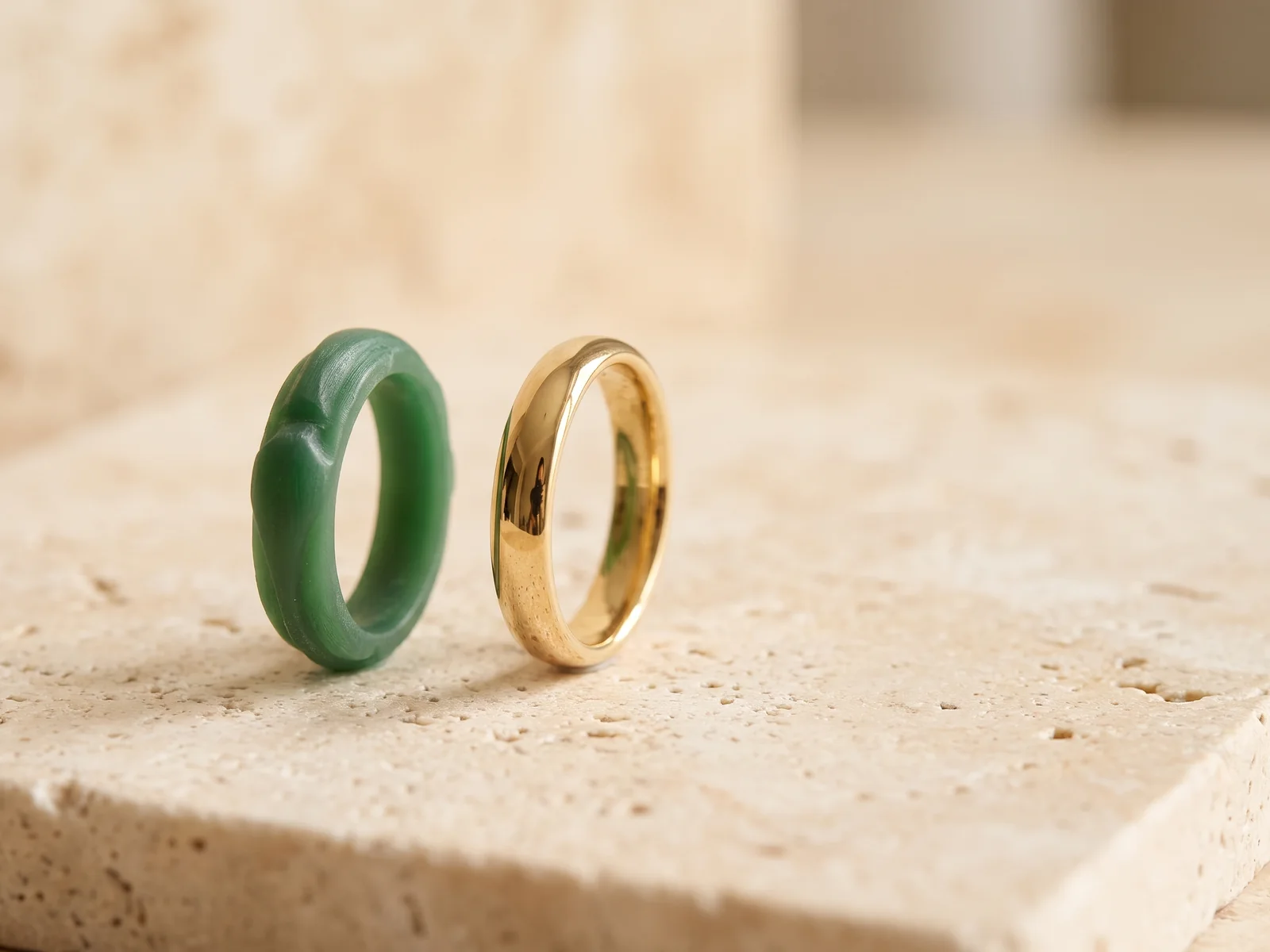
CAD has not replaced the jeweller's bench. It replaces the first stage of traditional work, where a ring was carved by hand in wax or built up from metal wire and sheet. The model still has to be printed, cast, filed, polished and set by hand, and a skilled jeweller decides how every claw is finally bent over the stone. Our comparison of hand-fabricated and CAD-designed rings explains where each method shines.
What makes CAD so useful for engagement ring design is that you can see the ring, change it and approve it before any gold or platinum is committed. Moving a claw half a millimetre, lowering the setting or tapering the band takes minutes on screen, not a remake at the bench. If you are still choosing a diamond shape or a metal, start with the complete engagement ring buying guide and come back here when you are ready to design.
How does CAD help you design the perfect engagement ring?
The custom engagement ring design process follows the same path at most Australian workshops. It begins with a conversation and ends with a finished, polished ring, and CAD sits in the middle, turning ideas into something you can check before it is made.
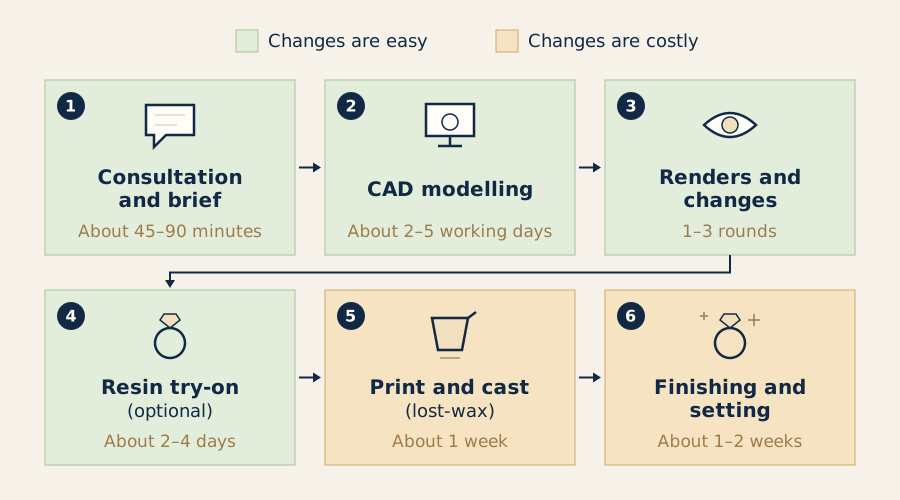
| Stage | What happens | Typical time |
|---|---|---|
| Consultation and brief | Ideas, budget, finger size, metal and centre stone agreed | One meeting, about 45–90 minutes |
| CAD modelling | Designer builds the model around the stone's measurements | About 2–5 working days |
| Renders and changes | You review photo-realistic images and ask for adjustments | 1–3 rounds, a few days each |
| Resin try-on (optional) | A 3D-printed plastic copy you can wear and check for scale | About 2–4 days |
| Print and cast | Model printed in castable resin, then cast in metal | About 1 week |
| Finishing and setting | Clean-up, polishing, stone setting and final checks | About 1–2 weeks |
The first meeting matters more than people expect. Our guide to what to expect at a custom ring consultation covers what to bring and what you will be asked. Arriving with photos, a budget range and a few notes on what you do not like saves at least one round of changes, and our page on writing a design brief a jeweller can actually use gives you a template.
Once the render is approved, the model is printed on a high-resolution 3D printer, usually in layers of about 25–50 microns (thousandths of a millimetre), in a special castable resin that burns away cleanly. That print is used in lost-wax casting: it is set in a plaster-like investment, heated until the resin burns out, and molten metal fills the cavity it leaves. Platinum melts at about 1,768°C, which is why it needs specialised casting equipment. The full sequence is set out in each step from CAD file to cast metal.
Why does a CAD engagement ring need your diamond's exact measurements?
A grading report lists the diamond's measurements to 0.01 mm. A typical 1 carat round brilliant, for example, might read 6.42 × 6.45 × 3.98 mm (diameter, diameter, depth). The CAD designer builds the seat, claws and gallery around those numbers, so the stone sits level and the claws meet the girdle (the thin outer edge) exactly where they should. A difference of just 0.1–0.2 mm can leave a claw short or force a stone to sit crooked. Our page on why a tenth of a millimetre matters in a custom setting shows what goes wrong when a model is built to an average size.
This is the same for natural and lab-grown diamonds. Both should come with an independent report from a lab such as GIA or IGI, and the report should clearly state whether the stone is natural or laboratory-grown. For coloured gems, which are often cut less precisely, the jeweller will usually measure the stone directly with a gauge before modelling.
CAD also lets the designer check the strength of the ring by the numbers rather than by eye. A render can make a 0.6 mm claw look perfectly fine, but it would wear thin within a few years of daily wear. These are typical working minimums many jewellers use:
| Part | Typical minimum | Why it matters |
|---|---|---|
| Claw tip (platinum or 18ct gold) | about 0.8–1.0 mm | Thinner claws wear through and can release the stone |
| Band width at the base | about 1.8–2.0 mm | Narrower bands bend out of round and are harder to resize |
| Band thickness (top to bottom) | about 1.5–1.8 mm | Keeps the ring rigid under the centre stone |
| Micro pavé stones | about 1.0–1.5 mm diameter | Smaller stones need very fine beads that wear quickly |
| Centre stone height above finger | about 5–8 mm for a solitaire | Lower is more practical; higher shows more of the stone |
How do you read an engagement ring CAD render?
A render is a photo-realistic image produced from the CAD model. You will usually see a top view, a side profile, an end-on view (looking along the band), a three-quarter view and sometimes a cut-through showing the gallery. The metal colour and diamond sparkle are simulated, so treat the render as an accurate guide to shape and proportion, not a photograph of the finished ring.
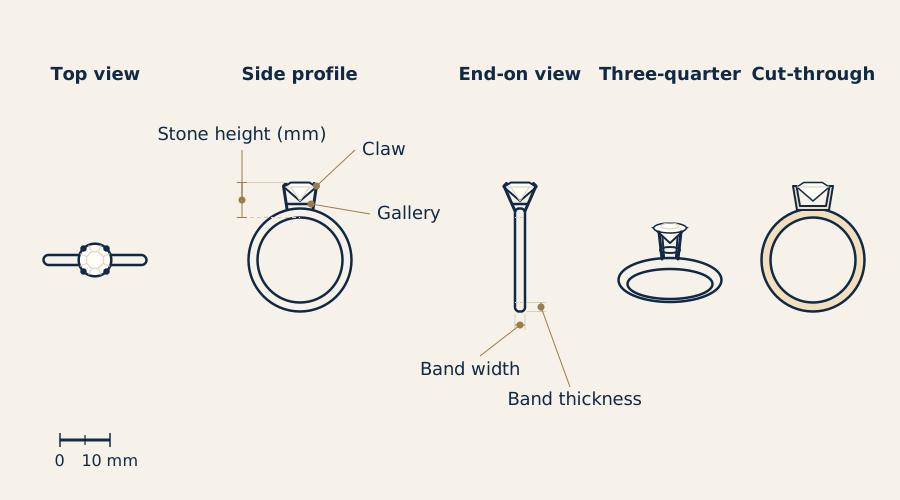
- Scale: screens enlarge everything. A 2 mm band can look as wide as your thumb on a laptop.
- Side profile: check how high the stone sits and whether the gallery is open or closed.
- Claws: count them, and check they sit evenly around the stone and meet the girdle.
- Band: look for even width, or a deliberate taper, and a smooth join where it meets the setting.
- Wedding band fit: ask for a render with your band beside the ring if you want them flush.
Our step-by-step guide to spotting problems in a CAD render before you approve it goes through each view with annotated examples. If you are unsure about scale, a resin try-on model costs little and removes the guesswork.
Related guideFrom CAD to Casting: How a Custom Ring Is MadeNot sure which one is right?
Send us the stones you are looking at and our gemologist will tell you which to choose and why.
Can you design the perfect engagement ring for your lifestyle with CAD?
This is where CAD earns its keep. Because every dimension is adjustable, the design can be tuned to how the ring will actually be worn. A nurse who wears gloves all day, a climber, a gardener and someone who mostly wears rings to the office need quite different engagement ring designs. Our guide to matching ring design to your work and hobbies covers this in detail.
- Lower profile: dropping the centre stone 1–2 mm makes the ring far less likely to catch on gloves, jumpers and hair.
- Bezel or half-bezel: a rim of metal around the stone protects the edge better than claws for very active hands.
- Thicker shank: a band of about 2.0–2.5 mm resists bending if you lift weights or carry heavy things.
- Comfort fit: a slightly rounded inside edge makes a wider band easier to slide over the knuckle.
- Flush fit: the setting can be raised or shaped so a straight wedding band sits snugly against it.
CAD also lets the wedding band be designed at the same time, built to the exact curve of the engagement ring. That is much harder to get right if the band is made years later from a finished ring with no file to work from.
Is a CAD engagement ring better than a handmade one?
Neither method is better in every case. They suit different designs, and many rings use both: a CAD-cast head with hand-made claws, for example. Here is how the main options compare:
| CAD custom | Hand-fabricated | Semi-custom | |
|---|---|---|---|
| How it starts | 3D model built around your stone | Metal wire and sheet shaped at the bench | An existing design adjusted |
| Preview before metal | Renders and a resin try-on | Sketches only | Photos of the base design |
| Changes | Easy before printing | Hard once metal is worked | Limited to set options |
| Fine detail | Excellent for pavé, galleries, filigree | Excellent for simple, strong forms | Depends on the base design |
| Metal density | Cast; small porosity possible | Worked metal, very dense | Usually cast |
| Typical lead time | About 4–6 weeks | About 4–8 weeks | About 2–4 weeks |
| Relative cost | Moderate | Usually highest (more bench hours) | Usually lowest of the three |
Porosity means tiny gas bubbles trapped in cast metal. Good casting practice keeps it to a minimum, and a careful jeweller will reject a casting that shows it during polishing. If you want an existing design changed rather than a ring from scratch, read about the difference between fully custom and semi-custom rings. If you are still deciding whether to go custom at all, our guide on choosing a custom ring or one off the shelf weighs both up honestly, and the pages on when a hand-forged ring is worth the extra bench time cover the strength question in more depth.
How long does a custom engagement ring take, and what does it cost?
Most CAD custom rings take about 4–6 weeks from the first meeting to collection. The biggest variable is you: each round of render changes adds a few days. Sourcing an unusual centre stone, or waiting on a grading report, can add more. Some stages can be shortened and some cannot, because metal needs time to cast, cool, finish and set properly; our page on which steps of a rush custom ring can be sped up explains where the time goes.
| Item | Approximate range (AUD) |
|---|---|
| CAD design and renders | often included, or about $150–$500 credited against the ring |
| Resin try-on model | often included, or about $50–$150 |
| Custom 18ct gold solitaire setting (no centre stone) | about $1,500–$3,000 |
| Custom platinum setting with halo or pavé (no centre stone) | about $2,500–$6,000 |
| 1 ct lab-grown round centre, G–H, VS | about $1,000–$3,000 |
| 1 ct natural round centre, G–H, VS | about $8,000–$18,000 |
These are broad ranges only. Metal prices move with world markets, and gold in particular has risen sharply in recent years, so the cost of the setting depends on its weight in grams as much as on the labour. A CAD model can report the exact metal volume before casting, which lets the jeweller quote the metal cost accurately rather than guessing.
The centre stone is usually the largest part of the cost. Natural and lab-grown diamonds look the same to the eye and are both real diamond; lab-grown diamonds are grown in a laboratory, cost much less and are easier to find in larger sizes, while natural diamonds are rarer. The CAD process is identical for both, as long as the exact measurements are known.
Explore our custom service and diamonds: natural and lab-grown
What Australian rules apply to a custom ring: GST, TRS and insurance?
GST. Prices quoted to consumers in Australia must include the 10% GST. If you have a ring designed and made overseas and shipped here, goods valued over A$1,000 are generally assessed at the border for GST, and import duty and processing charges may also apply. Below that threshold, many overseas sellers now collect GST at checkout. Compare quotes on a like-for-like, GST-included basis.
Tourist Refund Scheme (TRS). The TRS lets travellers leaving Australia, including Australian residents, claim back GST on goods they take with them. The main conditions: spend A$300 or more (including GST) with one business (same ABN), have the purchase on a tax invoice dated within 60 days before you leave, carry or wear the ring on board rather than packing it in checked luggage, and lodge your claim at the TRS facility at the airport or seaport. For a custom ring paid for in stages, ask how and when the tax invoice will be issued, and check the Australian Border Force rules for your situation before you travel.
Insurance. Most home contents policies limit cover for jewellery unless each piece is listed separately, so many people either specify the ring on their contents policy or take out a dedicated jewellery policy. Insurers usually ask for a valuation for insurance: a written estimate of what it would cost to replace the ring with one of the same quality. It is often higher than the price paid, because it reflects full retail replacement. Valuations should be updated every few years as metal and diamond prices change.
Custom rings have one real advantage here. If the ring is lost or stolen, the CAD file and renders let a jeweller remake the same design rather than something close to it. Keep this paperwork together, and see the paperwork and aftercare sections of our ring buying guide for more:
- The tax invoice, with the stone's report number on it.
- The diamond's grading report, including whether it is natural or lab-grown, and any laser inscription on the girdle.
- The approved renders and a note of where the CAD file is stored.
- A current valuation for insurance and clear photos of the ring.
How do you design your own engagement ring with CAD? Step by step
- Gather references and a budget. Save photos of rings you like and note what you dislike. Set a range that covers the stone and the setting.
- Write a short brief. Shape, metal, stone height, band width and lifestyle in one page; a simple brief template helps.
- Choose the centre stone. Get the grading report so the model can be built to the exact measurements.
- Book a consultation and get sized. Australian ring sizes use letters; measure at the end of the day when fingers are slightly larger.
- Review the renders. Check every view, the scale and the side profile, and ask for changes in writing.
- Try the resin model. Wear it for a few minutes and check height, width and how it sits with a wedding band.
- Approve the final design. Confirm metal, stone, size and price before printing; changes after casting are costly.
- Collect, check and insure. Inspect the claws and finish, arrange a valuation, and add the ring to your insurance straight away.
- Travelling soon? Keep the tax invoice and wear the ring through the airport if you plan to claim under the TRS.
Free consultation
Talk to a gemologist
Compare stones in person or online with Raj Sood, Graduate Gemologist (GIA), AJP (GIA).
Book a consultationShop this shape
FAQ
Common questions
How much does it cost to design your own engagement ring in Australia?
A custom setting usually costs about AUD $1,500–$6,000 depending on the metal and detail, plus the centre stone. CAD design and renders are often included or credited against the ring.
Can I change the design after approving the CAD render?
Small changes are possible until the model is printed. After casting, most changes mean a new print and a new casting, which adds cost and time.
Is a CAD engagement ring lower quality than a handmade one?
No. CAD is a design tool; the ring is still cast, finished and set by hand. Quality depends on the casting, the metal and the jeweller's finishing, whichever method starts the design.
Do I get to keep the CAD file for my engagement ring?
Policies vary between jewellers, so ask before you start. At the very least, keep the approved renders and know where the file is stored, because it lets the ring be remade for insurance.
Can I claim GST back on an engagement ring when I travel overseas?
Often, yes, under the Tourist Refund Scheme, if you spend A$300 or more with one business within 60 days of leaving and carry or wear the ring on board. Check the Australian Border Force conditions before you travel.
Does CAD work for lab-grown diamonds and coloured gems?
Yes. The model is built to the stone's exact measurements, whether it is a natural diamond, a lab-grown diamond or a coloured gem, so the stone needs to be chosen or measured before modelling.

Ask a gemologist
Not sure which diamond to choose?
Raj Sood is a Graduate Gemologist (GIA) and master jeweller. Bring the stones you are considering, or send the reports, and he will tell you honestly which one is better and why.
Keep learning
Related guides
 Buying Knowledge & Custom ProcessHandmade vs CAD Engagement RingsBuying Knowledge & Custom ProcessFrom CAD to Casting: How a Custom Ring Is Made
 Buying Knowledge & Custom ProcessHow to Read an Engagement Ring CAD RenderBuying Knowledge & Custom ProcessHow to Write a Clear Engagement Ring Design BriefBuying Knowledge & Custom ProcessEngagement Ring Buying GuideBuying Knowledge & Custom ProcessCustom vs Semi-Custom Engagement Rings
 Engagement Rings & SettingsHow Lifestyle Should Influence Engagement Ring DesignBuying Knowledge & Custom ProcessShould You Choose a Custom Engagement Ring or a Ready-Made Ring?
Explore more
More guides on this topic
Education