
- Education
- Buying Knowledge & Custom Process
- What Happens at a Custom Engagement Ring Consultation?
Buying Knowledge & Custom Process
What Happens at a Custom Engagement Ring Consultation?
A custom engagement ring consultation is where a ring stops being an idea and becomes a plan with a stone, a design, a price and a date. Knowing what happens, and the Australian rules on GST, the Tourist Refund Scheme and insurance, helps you walk in prepared and leave with fewer surprises.
 Reviewed by Raj Sood, Graduate Gemologist (GIA), AJP (GIA)Master jeweller and Graduate Gemologist (GIA) · reviewed 4 November 2026
Quick answer
At a custom engagement ring consultation, a jeweller talks through your budget, style and timeline, measures or estimates ring size, and helps you choose a natural or lab-grown diamond. Your ideas become sketches and a CAD model you approve before anything is made. Expect 45–90 minutes, a deposit, and 4–8 weeks from CAD approval to collection.
What is a custom engagement ring consultation?
A custom engagement ring consultation is a sit-down meeting with a jeweller to plan a ring made for you, rather than picked from a display case. It usually covers four things: the stone (diamond or gemstone), the design (setting style, band and metal), the budget and the timeline. By the end you should have a clear brief, a rough price range and a list of next steps.
It is not a sales pitch, and you are not committing to anything by turning up. Most first consultations take 45 to 90 minutes. Some people arrive with a finished sketch; others arrive with three photos from their phone and a feeling. Both are normal starting points.
Before you book, it helps to know whether you actually want a fully custom ring. If you are still weighing it up, start with deciding between custom and ready-made rings, then look at how fully custom differs from semi-custom, where you adapt an existing design instead of starting from a blank page. For the wider picture on stones, metals and budgets, our complete engagement ring buying guide covers the basics.
Related guideShould You Choose a Custom Engagement Ring or a Ready-Made Ring?What should you bring to a custom engagement ring consultation?
You do not need to know the jargon, but a little preparation makes the hour far more useful. Bring as much of this as you can:
- Reference photos: rings you like, and just as useful, rings you do not. Screenshots are fine.
- A budget range: a total figure for stone plus setting, even a wide one such as AUD 5,000–8,000. It lets the jeweller suggest realistic trade-offs.
- A ring size, or a clue to it: a ring your partner already wears on the same finger, or a sizing measurement. Australia uses letter sizes (for example J, M or P).
- Lifestyle notes: do they work with their hands, play sport, garden or wear gloves? This shapes setting height and claw style.
- Any stone or metal you already own: an heirloom diamond or old gold ring, if you want to reuse it.
- Your deadline: a proposal date, a trip or an event, so the timeline can be worked backwards.
If you are planning a surprise and cannot borrow a ring, say so. A jeweller can make the ring to an estimated size and resize it afterwards, but some designs, such as full eternity or heavy pavé bands (bands covered in tiny set diamonds), are hard or impossible to resize, so the design may need to allow for it.
Unfamiliar words will come up: shank, gallery, bezel, culet. Keep our plain-English jewellery glossary open on your phone, and jot down a few questions worth asking before you order so nothing is forgotten in the moment.
What happens during the consultation, step by step?
Every jeweller runs it slightly differently, but a typical first meeting moves through these stages:
| Stage | What happens | Typical time |
|---|---|---|
| Brief | You talk about style, budget, deadline and lifestyle; the jeweller asks questions | 10–15 min |
| Ring size | Measured with sizing rings, or estimated from a ring you bring | 5 min |
| Try-ons | You try sample settings and band widths to see what suits the hand | 10–20 min |
| Stone options | Diamonds or gemstones are shown or shortlisted, with grading reports | 15–30 min |
| Sketch | Rough hand sketches of the design and its proportions | 10–15 min |
| Quote and next steps | Price range, deposit, timeline and when you will see the CAD model | 5–10 min |
Try-ons matter more than people expect. A band that looks delicate on screen at 1.6 mm wide can feel flimsy on a larger hand, while a 3 mm band can overwhelm a slim finger. Most solitaire bands sit somewhere around 1.8–2.5 mm wide. Trying sample settings also tells you how high you like the stone to sit: a high setting shows off the diamond but catches more often on clothing and gloves.
How do you choose the diamond or gemstone at the consultation?
For most engagement rings the stone is the biggest part of the budget, so it is often chosen first and the setting is designed around it. A diamond is graded on the four Cs: cut (how well it returns light), colour (from D, colourless, downwards), clarity (how free it is of inclusions, which are tiny internal features) and carat (weight, where 1 carat = 0.2 grams). Ask to see the independent grading report from a lab such as GIA or IGI for any diamond you are considering.
Shape usually comes before grades. Our overview of every diamond shape and the full list of all 34 diamond cuts help you shortlist outlines before the meeting, and how price per carat changes between shapes shows where a budget stretches further.
| Natural diamond | Lab-grown diamond | Sapphire (natural or lab-created) | Moissanite | |
|---|---|---|---|---|
| What it is | Diamond formed in the earth | Real diamond grown in a laboratory | Corundum; lab-created versions are chemically the same | Silicon carbide, a different material |
| Mohs hardness | 10 | 10 | 9 | about 9.25 |
| Refractive index | about 2.42 | about 2.42 | about 1.76–1.77 | about 2.65 |
| Approx. 1 ct price (AUD) | about $6,000–$18,000 (round, G–H, VS) | about $800–$3,000 (round, G–H, VS) | wide range by colour and origin | about $400–$1,500 |
| Everyday wear | Excellent | Excellent | Very good | Very good |
Natural and lab-grown diamonds look the same to the eye and have the same hardness and sparkle. Lab-grown diamonds cost much less and are easy to find in larger sizes; natural diamonds are rarer. Neither choice is right or wrong, and a good consultation lays out both honestly so you can decide on your own priorities. Your grading report will always state whether a diamond is natural or laboratory-grown.
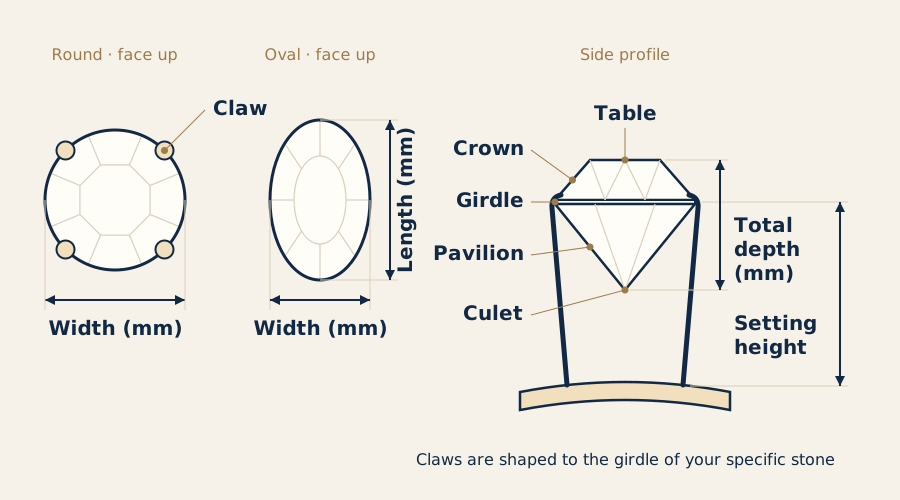
Once the stone is chosen, its exact millimetre measurements become the foundation for the design. Two 1 carat round diamonds can differ by 0.2 mm in width, and that is enough to change how the claws sit. Our page on why the stone's exact millimetre measurements matter explains why the setting should be modelled to your specific stone, not a generic one.
Explore our custom jewellery service, natural diamonds and lab-grown diamonds
Not sure which one is right?
Send us the stones you are looking at and our gemologist will tell you which to choose and why.
How is your design turned into a CAD model for approval?
After the consultation, the sketches and your stone's measurements are turned into a CAD model (computer-aided design), a precise 3D drawing of the ring. You usually receive renders (realistic images of the model) from several angles, often with key measurements such as band width, setting height and claw thickness. This is your chance to change things before any metal is used.
Common changes at the CAD approval stage include lowering the setting, thinning or thickening the band, adjusting claw shape, or moving the stone a fraction to sit flush with a wedding band. Most jewellers include one or two rounds of changes; ask how many before you start. Our guide to the way designers use CAD modelling shows what to look for in a render.
Some rings are made entirely by hand at the bench, without CAD. Both methods produce excellent rings, and each suits different designs; see handmade versus CAD-built rings for the trade-offs. Once you approve the CAD, the model is usually 3D printed in wax or resin and cast in metal, a process covered in the journey from CAD file to finished casting.
How much does a custom engagement ring cost in Australia?
The total is the stone plus the setting. The setting price depends on the metal, the weight of metal, the number of small diamonds and the hours of bench work. These are broad ranges only, and prices move with the gold and diamond markets:
| Setting style (excluding centre stone) | 18ct gold, approx. AUD | Platinum, approx. AUD |
|---|---|---|
| Simple solitaire, claw set | about $1,500–$3,000 | about $2,200–$4,000 |
| Solitaire with hidden halo or pavé band | about $2,500–$4,500 | about $3,500–$6,000 |
| Halo or three-stone design | about $3,000–$6,000 | about $4,000–$8,000 |
In Australia, 18ct gold is 75% pure gold, 14ct is 58.5% and 9ct is 37.5%. Platinum used in rings is usually 95% pure (marked 950 or PT950). Platinum is denser than gold, so the same ring uses more metal by weight, which is part of why it costs more.
Prices quoted to Australian consumers must include GST, the 10% goods and services tax. Overseas jewellers sometimes quote without it; if you import a ring worth more than AUD 1,000, GST and possibly duty are charged at the border, so compare like with like. To set a realistic total, see our advice on setting a realistic ring budget, and if the design fee is a concern, look at semi-custom options that need less design time.
Most jewellers ask for a custom ring deposit to start, often a third to a half of the total, with the balance paid at collection. Ask in writing what the deposit covers, whether it is refundable at each stage, and what happens if you change the design after CAD approval. Under the Australian Consumer Law, a custom ring still carries consumer guarantees: it must be of acceptable quality and match what was agreed. But a change of mind after work has begun is usually not grounds for a refund, which is why the written terms matter.
How long does a custom engagement ring take?
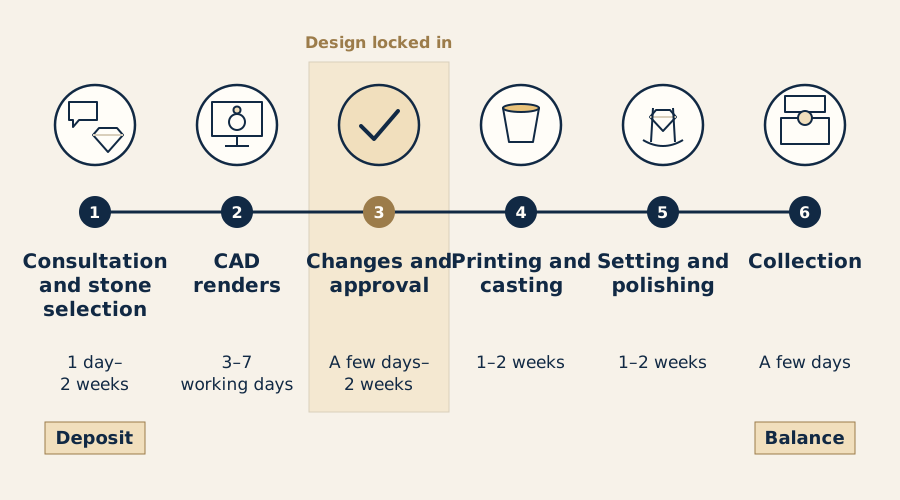
Most custom rings take about 4–8 weeks from CAD approval to collection, and longer if you are still choosing a stone or making several rounds of changes. A typical schedule:
| Stage | Typical time |
|---|---|
| Consultation and stone selection | 1 day to 2 weeks |
| First CAD renders | 3–7 working days |
| Changes and approval | a few days to 2 weeks |
| Printing and casting | 1–2 weeks |
| Setting, polishing and plating | 1–2 weeks |
| Final checks and collection | a few days |
If you have a proposal date, tell the jeweller at the start. Some stages can move faster with planning; others, such as casting quality and careful stone setting, should not be hurried. Our guide to which stages can and cannot be rushed goes through each one, and the casting, setting and polishing stages explains what happens at the bench while you wait.
Can you claim GST back on a custom ring under the Tourist Refund Scheme?
The Tourist Refund Scheme (TRS) lets travellers leaving Australia claim back the GST on goods bought here, which is one eleventh of a GST-inclusive price. It is run by the Australian Border Force, not by the jeweller. For a custom ring, timing is everything. The main conditions:
- You spend AUD 300 or more (including GST) with a single business that has an ABN.
- The goods are bought within 60 days before you depart.
- You have the original tax invoice showing the business, the goods and the GST.
- You wear the ring or carry it in hand luggage and show it with the invoice at the TRS facility in the international departure area.
- You claim before the cut-off, which at airports is 30 minutes before your scheduled departure. The TRS app lets you enter details in advance to save time.
Australian residents can use the TRS too, but there is a catch: if you bring the ring back into Australia, you must declare it as goods on which you claimed a refund, and you may have to repay the GST if it exceeds your duty-free allowance. For a ring you plan to wear at home, the TRS rarely helps residents. It is mainly useful for visitors and for Australians permanently moving overseas.
Because a custom ring can take two months, plan the payment and invoice dates with the jeweller so the final purchase falls inside the 60-day window and the ring is finished before you fly. Raise this at the consultation, not the week before you leave.
How do you insure a custom engagement ring in Australia?
Engagement ring insurance in Australia usually works one of two ways: listing the ring as a specified item on your home contents policy, or taking out a separate jewellery policy. Many contents policies cover unspecified jewellery only up to a modest limit per item, often around AUD 1,000–3,000, and some exclude loss away from home unless the item is specified. Check your own policy wording rather than assuming you are covered.
Insurers generally ask for an insurance valuation: a written description of the ring with the metal and its purity, the stone's shape, measurements, carat weight and grades, the grading report number, and a replacement value. Replacement value can be higher than what you paid, because it reflects what it would cost to make the same ring again at retail. Many insurers suggest updating a valuation every two to three years as metal and diamond prices change.
Two gaps are worth asking about at the consultation. First, who carries the risk while your stone or ring is in the workshop, especially if you supply an heirloom diamond. Second, when the insurance should start: arrange cover from the day you collect, not the day you propose. Add both to your checklist of questions for your jeweller.
How do you prepare for a custom engagement ring consultation? Step by step
- Set a total budget range. Decide on a figure for stone and setting combined, including GST.
- Collect reference photos. Save rings you love and rings you dislike, and note what you like about each.
- Find the ring size. Borrow a ring worn on the same finger, or plan to make it to an estimate and resize later.
- Decide natural or lab-grown, or stay open. Read up on the trade-offs so you can compare grading reports on the day.
- Work out your deadline. Count back at least 8–10 weeks from the proposal date, longer if you will claim the TRS.
- Ask about terms. Deposit, refund points, number of CAD revisions, resizing and workshop insurance, all in writing.
- Check the CAD against the stone. Make sure the model uses your stone's actual measurements; our guide to matching the setting to the stone's measurements explains why.
- Arrange insurance before collection. Have the valuation ready and the ring specified on a policy from day one.
If a term on your quote or valuation is unclear, look it up in our definitions of every ring term or ask the jeweller to explain it. A good consultation leaves you understanding every line.
Free consultation
Talk to a gemologist
Compare stones in person or online with Raj Sood, Graduate Gemologist (GIA), AJP (GIA).
Book a consultationShop this shape
FAQ
Common questions
Is a custom engagement ring consultation free?
Many jewellers offer the first consultation at no charge, while some charge a design fee once CAD work begins, often credited to the final price. Ask before you book so you know what is included.
How long does a custom engagement ring take in Australia?
Usually about 4–8 weeks from CAD approval to collection, plus time to choose the stone and finalise the design. Allow 8–10 weeks from your first consultation if you have a proposal date.
Do I need to know my partner's ring size before the consultation?
It helps, but it is not essential. A ring can be made to an estimated size and resized later, though full eternity and heavy pavé bands are hard to resize, so mention it at the start.
Can I use my own diamond or an heirloom stone?
Usually yes. The jeweller will check the stone for chips and measure it precisely so the setting fits, and you should ask how the stone is insured while it is in the workshop.
Can tourists get GST back on an engagement ring?
Yes, under the Tourist Refund Scheme, if you spend AUD 300 or more with one business within 60 days of departure, keep the tax invoice and carry or wear the ring when you leave. Australian residents who bring the ring home must declare it and may have to repay the GST.
Is a lab-grown diamond a real diamond?
Yes. A lab-grown diamond is real diamond with the same hardness and refractive index as natural, grown in a laboratory rather than mined. It costs much less, and its grading report states that it is laboratory-grown.

Ask a gemologist
Not sure which diamond to choose?
Raj Sood is a Graduate Gemologist (GIA) and master jeweller. Bring the stones you are considering, or send the reports, and he will tell you honestly which one is better and why.
Keep learning
Related guides
 Buying Knowledge & Custom ProcessCustom vs Semi-Custom Engagement RingsBuying Knowledge & Custom ProcessHow CAD Is Used in Custom Engagement Ring DesignBuying Knowledge & Custom ProcessFrom CAD to Casting: How a Custom Ring Is Made
 Buying Knowledge & Custom ProcessQuestions to Ask Before Ordering a Custom Engagement RingBuying Knowledge & Custom ProcessEngagement Ring Buying GuideBuying Knowledge & Custom ProcessShould You Choose a Custom Engagement Ring or a Ready-Made Ring?Buying Knowledge & Custom ProcessRush Custom Engagement Rings: What Can and Cannot Be Rushed
 Buying Knowledge & Custom ProcessWhy Exact Diamond Measurements Matter in a Custom Setting
Explore more
More guides on this topic
Education