
- Education
- Buying Knowledge & Custom Process
- Handmade vs CAD Engagement Rings: Which Method Is Right for You?
Buying Knowledge & Custom Process
Handmade vs CAD Engagement Rings: Which Method Is Right for You?
Weighing up handmade vs CAD engagement rings? The making method changes a ring's strength, fine detail, cost and timeline. Here is how each works, where each one does well, and the Australian rules on GST, the Tourist Refund Scheme and insurance that apply either way.
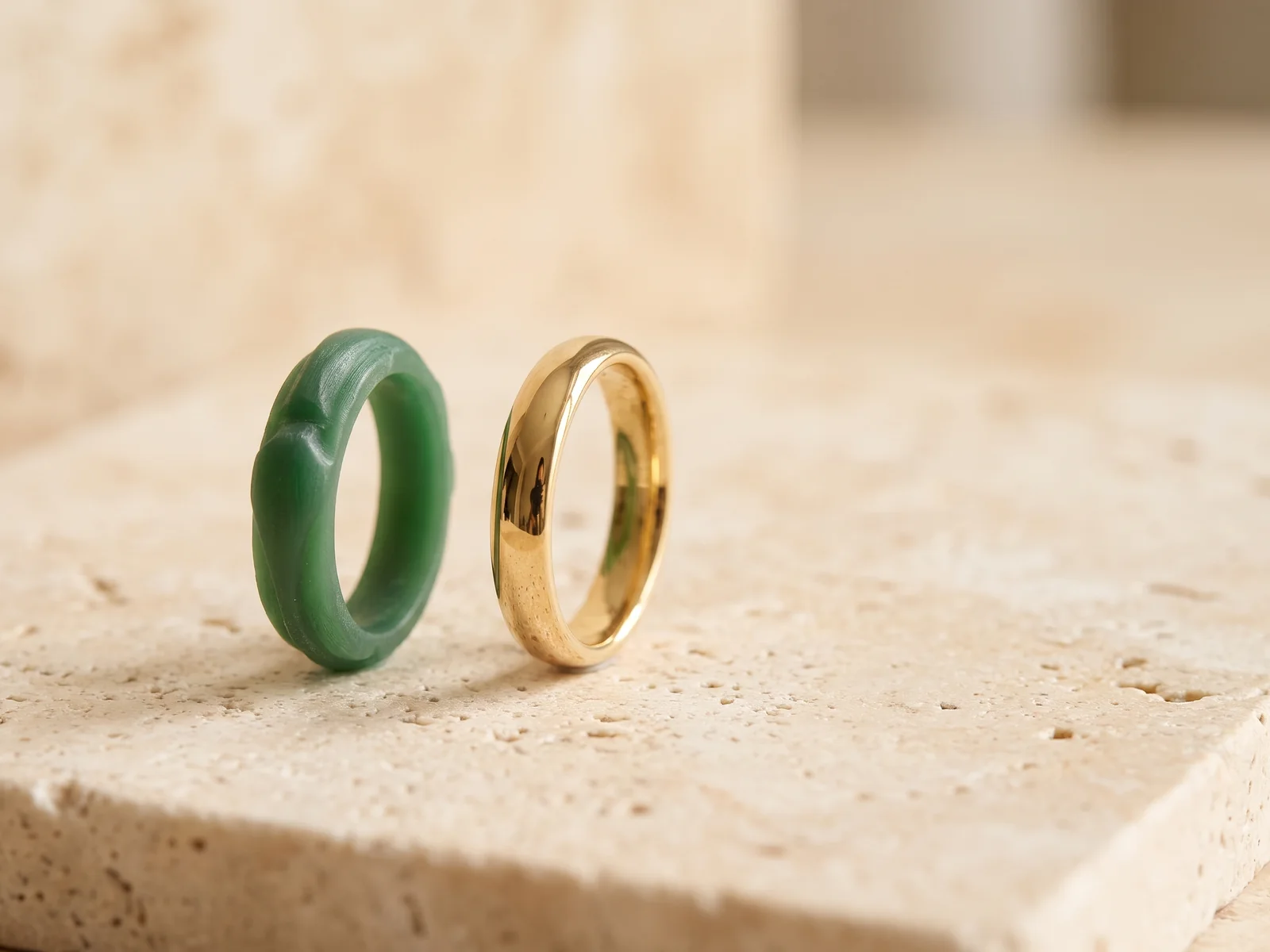
 Reviewed by Raj Sood, Graduate Gemologist (GIA), AJP (GIA)Master jeweller and Graduate Gemologist (GIA) · reviewed 4 November 2026
Quick answer
The difference is method, not quality. A handmade ring is formed by a jeweller from metal wire and sheet; a CAD ring is designed on computer, printed in resin or wax, cast, then hand-finished. Handmade suits dense, simple bands and one-off detail; CAD suits precise settings, halos and exact diamond fits. Many rings combine both.
Handmade vs CAD engagement rings: what is the difference?
Both kinds of ring end up as solid gold or platinum, finished and set by hand. The difference is how the metal gets its shape. A handmade (or hand-fabricated) ring is built by a jeweller at the bench from raw metal: an ingot is rolled into sheet or drawn into wire, then cut, bent, forged, soldered and filed into a band, a head (the part that holds the stone) and claws. A CAD ring starts as a 3D model in computer-aided design software. The model is printed in castable resin or wax, and that print is turned into metal by lost-wax casting.
The word handmade is used loosely in the trade. Some jewellers call any ring handmade because every cast ring is still cleaned, filed, polished and set by hand, and that bench work can take 10 to 20 hours on a detailed piece. In this guide, handmade means hand-fabricated from wire and sheet, and CAD means designed digitally and cast. Terms you meet along the way are explained in our plain-English jewellery glossary.
Neither method is automatically better. Most well-made rings today are a mix: a CAD head cast for a precise stone fit, sitting on a hand-forged band, or a cast ring refined for hours with files and gravers. Our guide on where CAD fits in custom ring design explains the digital side in more depth, and if you are still deciding whether to go custom at all, start with custom or ready-made: the trade-offs.
How is a handmade engagement ring made?
Hand fabrication is the oldest way of making a ring, and the process has changed little in a century. A typical sequence for a hand forged engagement ring with a solitaire head:
- Alloy and melt: fine gold is melted with silver, copper or palladium to make the alloy, for example 18 carat (75% gold), and poured into an ingot.
- Roll and draw: the ingot is passed through a rolling mill into a bar or sheet, and pulled through draw plates to make round wire for the claws.
- Forge and shape: the bar is hammered and bent around a ring mandrel (a tapered steel rod) to the finger size, then the join is soldered.
- Build the head: claws and a bearer (the rail the stone sits on) are cut, shaped and soldered together, then soldered onto the shank (the band).
- File, emery and polish: the ring is shaped with files, smoothed with abrasive papers and polished, then the stone is set.
Rolling and hammering compress the metal, which closes tiny voids and work-hardens it: the grain structure is squeezed finer, so the metal becomes denser and springier. The jeweller anneals it (heats it to soften it again) between stages so it does not crack. The result is a band that resists dents and wears slowly, which is why many jewellers still hand-forge plain wedding bands and simple solitaires.
The limits are time and fine detail. A hand-built halo of 1.2 mm diamonds, or a gallery (the side view under the stone) with intricate openwork, takes a great deal of skilled labour, and every piece varies slightly because it is shaped by eye. There is also a middle path: a jeweller can hand-carve the design in hard wax and cast it, which gives a hand-shaped look with a cast structure. Our page on whether you need a wax or resin model first covers when that makes sense.
How is a CAD engagement ring made?
A CAD engagement ring starts on screen. The designer builds a 3D model in jewellery software such as Rhino with a jewellery plug-in, setting every dimension to a hundredth of a millimetre: band width and thickness, claw diameter, the height of the stone above the finger, and the exact seat for each diamond. You then see it as a render, a photo-like image of the ring from several angles. Knowing how to read a CAD render properly matters, because renders are perfectly lit and enlarged on screen, which can make proportions look different from real life.
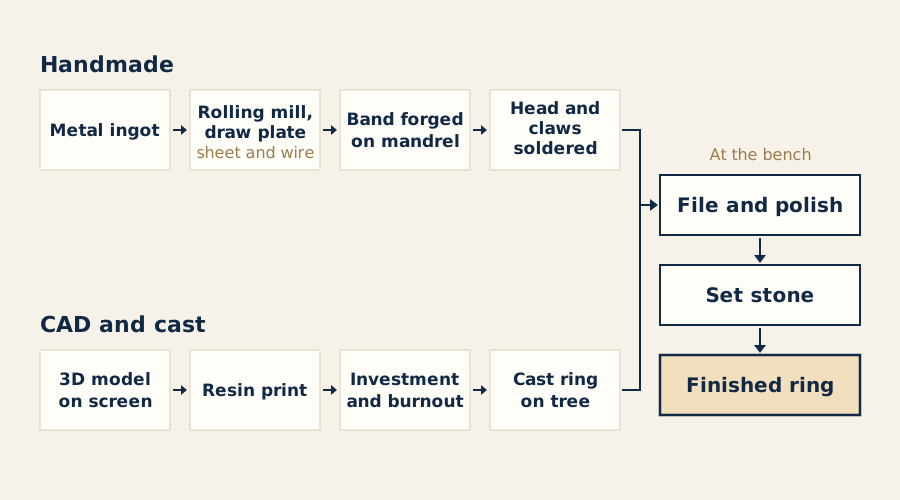
Once you approve the design, the file is printed on a high-resolution resin printer, typically in layers of about 25–50 microns (0.025–0.05 mm), and you can try the resin print on before anything is cast. The print is attached to a wax 'tree', set in plaster-like investment and heated in a kiln so the resin burns out, leaving a ring-shaped cavity. Molten metal is poured or vacuum-cast into that cavity, cooled, broken out, cut from the tree and handed to the bench jeweller to clean up, polish and set. The full sequence is laid out in each stage from CAD file to cast ring.
CAD's strengths are precision and preview. The setting can be modelled around the actual measurements of your diamond, which is why exact diamond measurements in a custom setting matter so much: a 0.1 mm error in a seat can mean a loose stone or a claw that will not close neatly. CAD also suits remodelling. An existing ring or loose stone can be 3D-scanned so a new design is built around it; see scanning stones and rings for remodelling.
Is a handmade ring stronger than a cast CAD ring?
Like for like, hand-forged metal is usually denser and harder than as-cast metal of the same alloy, because forging refines the grain and closes voids. Cast metal cools from liquid inside a mould, so it has a coarser grain and can contain porosity: tiny gas bubbles or shrinkage holes. Porosity shows up as pinholes when the ring is polished, and in a thin claw it can become a weak point.
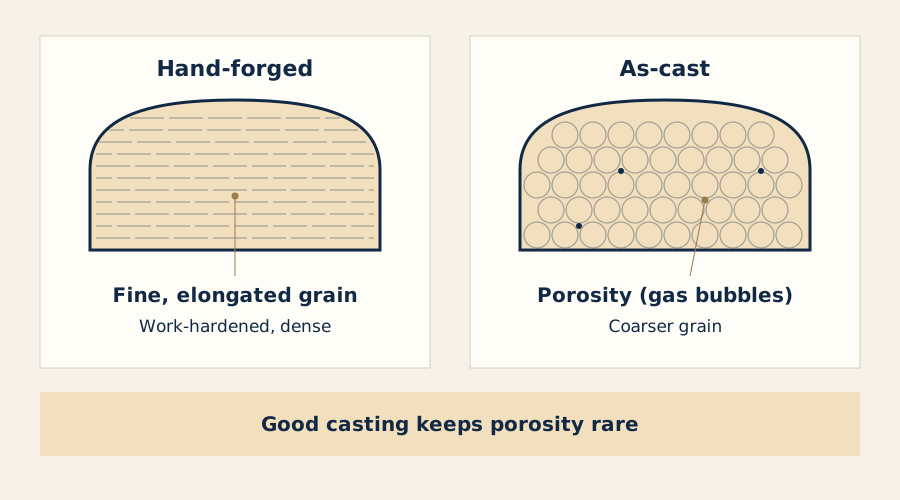
In practice, good casting narrows the gap a lot. Vacuum or centrifugal casting, clean metal, correct temperatures and a well-placed sprue (the channel the metal flows through) keep porosity rare, and a cast shank can be hardened afterwards by burnishing, tumbling or light hammering. What matters more than method is design: claws of roughly 0.8–1.0 mm or more on a 1 carat stone, a shank around 1.6–1.8 mm thick at the base, and solid support under the centre stone. A thin ring is fragile whichever way it was made.
| Handmade (hand-fabricated) | CAD and cast | |
|---|---|---|
| Starts as | Metal ingot, sheet and wire | 3D digital model |
| Preview before metal | Sketch and agreed dimensions, sometimes a hand-carved wax | Photo-like render and a resin try-on |
| Metal structure | Dense, work-hardened, fine grain | As-cast grain; small risk of porosity |
| Fine detail | Limited by hand tools; organic, slightly varied | Very fine and repeatable: pavé seats, filigree, galleries |
| Symmetry | Depends on the maker's eye | Mirror-exact |
| Changes | Hard once metal is cut | Easy until the print is approved |
| Suits | Plain bands, simple solitaires, heirloom one-offs | Halos, pavé, fancy-shape settings, exact stone fits |
| Replacing it | Hard to copy exactly | File can be re-cast |
Symmetry is the other big difference. CAD can mirror one side of a ring onto the other exactly, which matters in halos, split shanks and matching side stones. A handmade ring carries the small irregularities of hand work, which some people value and others notice.
Not sure which one is right?
Send us the stones you are looking at and our gemologist will tell you which to choose and why.
Which ring designs suit handmade, and which suit CAD?
The design usually decides the method. As a working guide, hand fabrication suits:
- Plain and comfort-fit wedding bands, where density and wear resistance matter most.
- Simple four- or six-claw solitaires with a plain, tapered or knife-edge shank.
- Heavy bezel or signet-style rings, where a forged band adds durability.
- Hand-hammered or textured finishes, where small variations are part of the look.
CAD and casting suit:
- Halos and pavé, where dozens of 1.0–1.5 mm diamonds each need an identical seat.
- Hidden halos, cathedral shoulders and detailed galleries.
- Fancy shapes such as pears, marquises and hearts, where claws must follow an exact outline.
- Matching sets, such as an engagement ring and a contoured band designed to sit flush.
Coloured diamonds raise their own questions. In handmade coloured diamond jewellery, a jeweller will often set a yellow diamond in yellow gold claws or a pink in rose gold, because the metal reflects into the stone and warms its colour. Natural fancy-coloured diamonds are rare and often cut with irregular proportions to save colour and weight, so a setting built around the real stone, by hand or in CAD from a scan, avoids forcing it into a stock head. Lab-grown coloured diamonds are more uniform and usually cost far less; the grading report will state the origin and whether the colour was treated. Either way, our complete engagement ring buying guide walks through the stone decisions before the setting.
Related guideCustom vs Semi-Custom Engagement RingsHandmade vs CAD engagement rings: which costs more?
For simple designs the difference is often small. A plain hand-forged band takes modest bench time, so it can be close in price to a cast one. For detailed designs the gap widens, because building a halo or pavé by hand takes many more hours than modelling, printing and casting it, and the CAD file does the precise work once.
| Setting only, 18ct gold, no centre stone | CAD and cast (approx. AUD) | Handmade (approx. AUD) |
|---|---|---|
| Plain 3–4 mm band | about $900–$2,000 | about $1,200–$2,500 |
| Simple claw solitaire | about $1,500–$3,000 | about $2,000–$4,500 |
| Halo or pavé setting | about $2,500–$5,000 | about $4,000–$8,000+ |
These are broad ranges only. Platinum costs more because it is denser (about 21.4 g/cm³, against roughly 15.5–16 for 18ct gold), so the same ring weighs more, and it is harder to work by hand. The metal price also moves with world markets. Some jewellers charge a separate CAD design fee, sometimes credited against the ring, so ask what is included: how many revision rounds, whether a resin try-on is part of it, and whether setting labour is separate. For custom engagement ring cost in Australia, remember that quoted prices include 10% GST.
How long does a handmade or CAD engagement ring take?
Allow about 4–8 weeks for a CAD ring and about 5–10 weeks for a handmade one, from the first consultation to collection. CAD puts more of the time into design and approval; handmade puts more of it at the bench.
| Stage | CAD route | Handmade route |
|---|---|---|
| Consultation and brief | 1 meeting, then a few days | 1 meeting, then a few days |
| Design | Render in about 3–7 days, revisions 1–2 weeks | Sketch and dimensions in about 2–5 days |
| Model | Resin print in about 1–3 days | Usually none (optional hand-carved wax) |
| Metal | Casting in about 3–7 days | Forging and fabricating, about 1–3 weeks |
| Finish and set | About 1–2 weeks | About 1–2 weeks |
| Typical total | About 4–8 weeks | About 5–10 weeks |
The design stage stretches most, usually because of extra revision rounds or waiting for the right diamond. Our step-by-step engagement ring timeline breaks each stage down, and if you have a fixed proposal date, read what can and cannot be rushed in a custom ring. Design decisions can be made faster; checking a stone's security and final polishing should not be hurried. The first meeting sets the pace, so it helps to know what happens at a custom ring consultation before you book.
Can overseas visitors claim GST back on a custom engagement ring?
Yes, if you are leaving Australia and take the ring with you. The Tourist Refund Scheme (TRS), run by the Australian Border Force (ABF), lets departing travellers claim back the GST (10%, which is 1/11 of a GST-inclusive price) on goods bought in Australia. It applies whether the ring is handmade or CAD. The main conditions:
- Spend at least A$300 (GST included) with one business, on one or more tax invoices with the same ABN.
- Buy within 60 days before you leave Australia.
- Keep the original tax invoice showing the item and the GST; for purchases of A$1,000 or more it must also show your name.
- Wear the ring or carry it in your hand luggage, and show it with the invoice at the TRS facility in the international departure area at least 30 minutes before your flight. You can enter the details in advance on the TRS app.
Custom rings add a timing wrinkle. A deposit may be paid weeks or months before the ring is finished, so check how the purchase date on your final tax invoice falls against the 60-day window, and ask the jeweller to issue an invoice the TRS will accept. Australian residents travelling overseas can claim too, but may have to declare the ring and pay GST on it when they return. Our guide to claiming the Tourist Refund Scheme on jewellery covers the details.
If instead the jeweller ships the ring to an overseas address, the sale is usually GST-free as an export, but your own country may charge import duty or tax when it arrives. These are general rules, not tax advice; check the ABF website or your own customs office before relying on them.
How do you insure a handmade or CAD engagement ring in Australia?
Arrange cover from the day you collect the ring; until then it is in the jeweller's care, so ask how it is covered while in the workshop. In Australia there are generally three options:
- Home and contents, unspecified: jewellery is often covered only to a low limit per item, commonly around $1,000–$2,500, and sometimes only inside the home.
- Home and contents, specified item: you list the ring and its value so it is covered for that amount, often away from home too, for an extra premium.
- Standalone jewellery insurance: policies that cover only jewellery, usually worldwide, often on an agreed value.
Two questions matter most. Is the cover agreed value (a set amount stated on the policy) or replacement (the insurer replaces the ring, sometimes through its own suppliers)? And can you choose who remakes it? For a custom ring, a replacement from a generic supplier may not match the original.
This is where the making method matters. Ask for a written valuation from a qualified valuer that records the metal and its weight, the method (hand-fabricated or cast from CAD), each stone with its grading report number, and the labour involved. A handmade one-off costs more to recreate, and the valuation should reflect that. A CAD ring has a practical advantage: the file can be re-cast, so keep the final render and the design file reference with your valuation. Update the valuation every two to three years as metal and diamond prices move. Our guide to how jewellery insurance works in Australia compares policy types in more detail.
How do you choose between handmade and CAD? Step by step
- Write a brief. Note the shape, metal, band width, height and how you use your hands day to day. Our guide to writing a clear ring design brief has a template.
- Choose the stone first. Build a focused diamond shortlist, natural or lab-grown, and check finalists using what to look for in a 360-degree video.
- Match the method to the design. Plain bands and simple solitaires can be hand-forged; halos, pavé and fancy-shape settings usually suit CAD. Ask whether a hybrid makes sense.
- Ask the right questions. Claw and shank dimensions, whether you get a render and resin try-on, how many revisions, the casting method, the timeline and what happens if porosity is found. Our list of questions before you order a custom ring covers the rest.
- Confirm the finger size. Get sized in person if you can, or follow measuring ring size at home; bands wider than about 4 mm often need a slightly larger size.
- Approve in detail. For CAD, check the millimetre measurements on the render and try the resin print; for handmade, agree the dimensions in writing before the metal is cut.
- Plan the paperwork. Keep the tax invoice, valuation and grading reports together, arrange insurance before you wear the ring, and check TRS timing if you are travelling.
Explore custom jewellery and diamonds: natural and lab-grown
Free consultation
Talk to a gemologist
Compare stones in person or online with Raj Sood, Graduate Gemologist (GIA), AJP (GIA).
Book a consultationShop this shape
FAQ
Common questions
Are CAD engagement rings handmade?
Partly. The design is digital and the metal is cast, but every CAD ring is still cleaned, polished and set by a jeweller by hand. Strictly, handmade means the metal itself was shaped from wire and sheet at the bench.
Is a hand forged engagement ring stronger than a cast ring?
Forged metal is usually denser and harder than as-cast metal of the same alloy. A well-cast ring with sensible claw and shank thickness is still durable for everyday wear.
Are handmade engagement rings more expensive in Australia?
For detailed designs such as halos and pavé, usually yes, because they take many more bench hours. For a plain band or simple solitaire the difference can be small.
Can I see my ring before it is made?
With CAD you usually see a photo-like render and can try on a resin print before casting. With a handmade ring you see sketches and agreed dimensions, and sometimes a hand-carved wax.
Can tourists claim GST back on a custom engagement ring?
Yes, through the Tourist Refund Scheme, if you spend A$300 or more with one business within 60 days of leaving and take the ring with you. Bring the tax invoice and the ring to the TRS facility at the airport.
Does it matter for insurance whether my ring is handmade or CAD?
It can. The valuation should record the making method, because a handmade one-off costs more to recreate, while a CAD ring can be re-cast from its file.

Ask a gemologist
Not sure which diamond to choose?
Raj Sood is a Graduate Gemologist (GIA) and master jeweller. Bring the stones you are considering, or send the reports, and he will tell you honestly which one is better and why.
Keep learning
Related guides
 Buying Knowledge & Custom ProcessHow CAD Is Used in Custom Engagement Ring DesignBuying Knowledge & Custom ProcessFrom CAD to Casting: How a Custom Ring Is MadeBuying Knowledge & Custom ProcessCustom vs Semi-Custom Engagement Rings
 Buying Knowledge & Custom ProcessWhat Happens at a Custom Engagement Ring Consultation?Buying Knowledge & Custom ProcessEngagement Ring Buying Guide
 Buying Knowledge & Custom ProcessHow to Read an Engagement Ring CAD RenderGemstonesGemstone and Ring Scanning for CAD RemodellingBuying Knowledge & Custom ProcessShould You Choose a Custom Engagement Ring or a Ready-Made Ring?
Explore more
More guides on this topic
Education