
- Education
- Buying Knowledge & Custom Process
- Custom vs Ready-Made Engagement Ring: Which Should You Choose?
Buying Knowledge & Custom Process
Custom vs Ready-Made Engagement Ring: Which Should You Choose?
The custom vs ready-made engagement ring decision shapes your budget, your timeline and what happens if the ring needs resizing later. Here is how each route works in Australia, including the consumer law, insurance and GST details most guides skip.
 Reviewed by Raj Sood, Graduate Gemologist (GIA), AJP (GIA)Master jeweller and Graduate Gemologist (GIA) · reviewed 4 November 2026
Quick answer
Choose a ready-made engagement ring if you like a design that exists, want it within days and prefer to try it on first. Choose a custom engagement ring if you want a specific design, an exact fit for your diamond or a matching band, and can allow about 4–8 weeks. Cost depends mostly on the metal and stones.
Custom vs ready-made engagement ring: what is the difference?
A ready-made engagement ring is a finished design you choose from a range. It may already hold a centre stone, or it may be a setting (the metal part that holds the diamond) waiting for one. Ready-made rings are usually produced in batches from the same model, often by casting metal into moulds, so many identical rings exist.
A custom engagement ring is made for one person. It starts from a brief, is usually modelled in CAD (computer-aided design, a 3D model you can view from every angle), and is then cast in metal, finished by hand and set with the stone you have chosen. Between the two sits semi-custom: an existing design changed in a few ways, such as the band width or the claw style. Our page on how semi-custom differs from fully custom covers that middle path in detail.
Neither route is better quality by default. A ready-made ring from a careful maker can be beautifully finished, and a custom ring can be badly made. What really changes is how much control you have, how long you wait, and how closely the ring fits your particular stone and hand. If you are earlier in the process, start with our complete engagement ring buying guide, and look up any unfamiliar word in the plain-English glossary of jewellery terms.
| Factor | Ready-made | Custom |
|---|---|---|
| Design | Chosen from an existing range | Designed from your brief |
| Try before you buy | Yes, on the finger | CAD renders, then an optional resin model |
| Typical time | Same day to about 2 weeks | About 4–8 weeks |
| Fit to your diamond | Setting made for a standard size range | Seat cut to your stone's exact millimetres |
| Matching wedding band | Often sold as a set, or a contoured band later | Designed together from the start |
| Change of mind | Depends on the store's policy | Usually no refund once production starts |
| Resizing later | Usually 1–2 sizes for a plain band | Made to size; same resizing limits later |
Custom vs ready-made engagement ring: which costs more?
In most engagement rings the centre diamond is the largest part of the price, and that does not change with the route you choose. A 1 carat diamond costs the same whether it goes into a ready-made setting or a custom one. The difference is in the setting, and it is usually smaller than people expect.
| Item | Ready-made (approx. AUD) | Custom (approx. AUD) |
|---|---|---|
| 18ct gold solitaire setting | 1,200–3,000 | 1,800–4,000 |
| Platinum solitaire setting | 1,800–4,000 | 2,500–5,500 |
| Halo or pavé setting | 2,500–5,500 | 3,000–7,000 |
| Design and CAD | Included | Often included; some jewellers charge 0–500 |
| Resizing later | about 60–250 | about 60–250 |
These are broad ranges only, and they vary a lot between jewellers. Custom work usually costs a little more because the design time, the CAD model and the hand finishing are spent on one ring instead of spread across hundreds. Ready-made rings from large brands can be cheaper at the entry level because the cost of the original model is shared across many copies.
Compare like with like. Batch-made rings are sometimes lighter, with thinner shanks (the part of the band that goes around the finger) and finer claws, which keeps the price down but wears faster. Ask for the metal weight in grams and the shank width in millimetres for both options. A band around 1.8–2.2 mm wide and at least 1.5 mm thick suits most solitaires; our guide to choosing a band width that lasts explains why. For the bigger picture of what to allocate across stone and setting, see setting a realistic engagement ring budget.
How long does a custom engagement ring take compared with ready-made?
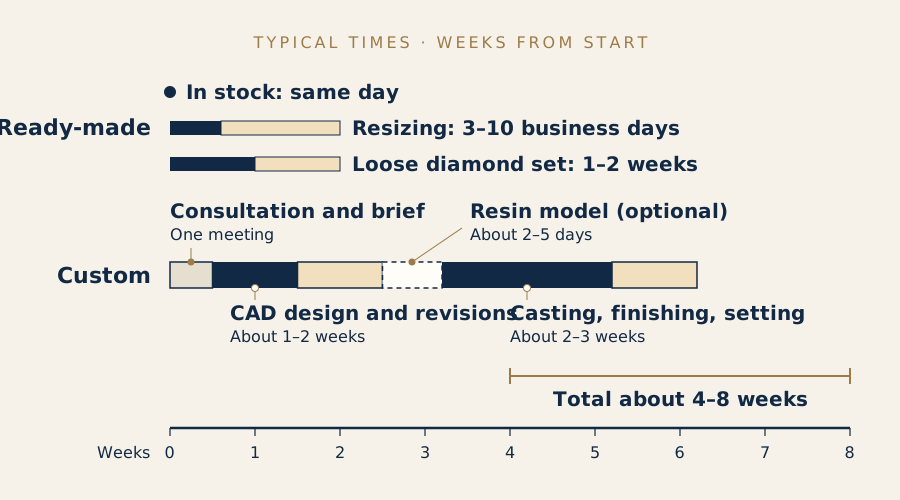
A ready-made ring in stock in your size can be in your hand the same day. If it needs resizing, allow about 3–10 business days. If you are choosing a loose diamond and having it set into a ready-made setting, allow about 1–2 weeks. A custom ring takes longer because each stage depends on the one before it.
| Custom stage | Typical time |
|---|---|
| Consultation and design brief | One meeting, plus any follow-up questions |
| CAD design and revisions | About 1–2 weeks, depending on changes |
| Resin or wax model (optional) | About 2–5 days |
| Casting, finishing and setting | About 2–3 weeks |
| Total | About 4–8 weeks |
The first step is a conversation about the stone, the style and how the ring will be worn; our page on what to expect at the first consultation walks through it. The design is then built as a 3D model, and you approve or adjust it, as explained in how CAD models are used and revised. Some people like to hold a printed model before casting, and whether a resin model is worth the extra days depends mainly on how unusual the design is.
After approval, the ring is cast, cleaned up, polished and set. Our step-by-step look at each stage from CAD to casting shows what happens at the bench. If your proposal date is close, read which steps can be rushed and which cannot before you commit: design decisions can be made faster, but setting a diamond safely cannot.
When does a ready-made engagement ring make sense?
A ready-made ring is often the simpler choice, and there is nothing second-rate about it. It tends to suit you if:
- You have seen the ring you want. If a design in the cabinet already feels right, changing it adds time without adding much.
- Your proposal is soon. A ring in stock removes weeks from the timeline.
- You want to try it on first. Seeing height, width and sparkle on the finger is easier than imagining it from a rendering.
- Your diamond is a common size and shape. Ready-made settings are made for standard sizes, such as a round of about 5.0–7.5 mm or an oval in common ratios.
- It is a surprise and you are guessing the size. A plain ready-made band can usually be resized up or down about 1–2 sizes afterwards. Australia uses letter sizes (such as L, M or N).
The limits show up when your stone is not standard. A ready-made setting has a seat (the cut-out where the stone sits) sized for a range of diamonds. A deep oval, an elongated cushion or an heirloom stone with older proportions may sit too high, rock in the seat, or need the claws bent further than they were designed to go. Our guide on why a setting must match your diamond's millimetres explains why a few tenths of a millimetre matter. If you are not planning a surprise, choosing the ring as a couple takes much of the guesswork out of either route.
Not sure which one is right?
Send us the stones you are looking at and our gemologist will tell you which to choose and why.
Is a custom engagement ring worth it?
A custom ring is worth the extra time when something about your stone, your hand or your plans does not fit a standard design. Common reasons include:
- An unusual stone: a family diamond, a fancy shape, a coloured gemstone or a diamond with non-standard depth.
- A practical profile: a low bezel (a rim of metal around the stone) for someone who wears gloves at work, or a higher setting for maximum light.
- A wedding band that sits flush: designing both rings together avoids gaps and awkward contoured bands later.
- Personal touches: engraving, a hidden gallery stone or a meaningful detail on the side profile.
- A design you cannot find: combining the shank of one ring with the head of another.
Our guide to hidden details such as engraving or a gallery stone collects ideas that suit everyday wear. The ring can be modelled in CAD or carved and built by hand; handmade versus CAD-made rings sets out the trade-offs. Whichever method is used, the result depends on how clear your brief is, so read writing a design brief a jeweller can work from before your first meeting.
Related guideCustom vs Semi-Custom Engagement RingsNatural or lab-grown diamond: does it change the decision?
Both routes work with either type of diamond. Natural diamonds formed in the earth over very long periods. Lab-grown diamonds are real diamond, grown in a laboratory, with the same hardness (10 on the Mohs scale) and refractive index (about 2.42). Lab-grown diamonds cost much less than natural diamonds of the same size and grade. Both should come with an independent grading report from a lab such as GIA or IGI, and the report states whether the stone is natural or lab-grown.
With a ready-made ring, ask exactly what is already set in it. Small side stones may be natural, lab-grown, or a simulant such as cubic zirconia, and each should be disclosed on the receipt. Coloured stones may be natural or lab-created; our guide to lab-created and synthetic gemstones explains the difference. With a custom ring, you usually choose the centre stone first and the setting is built around it, so the stone's report measurements become part of the design.
Choosing the stone is where many buyers get stuck. Our method for building a diamond shortlist without drowning in filters helps you narrow the field, and judging a diamond from a 360° video shows what to watch for when you cannot see the stone in person.
Browse natural and lab-grown diamonds, or start a custom design
What are your consumer rights on a custom or ready-made ring in Australia?
Under the Australian Consumer Law (ACL), goods you buy as a consumer come with automatic consumer rights. A ring must be of acceptable quality, fit for any purpose you made known, and match its description. These rights apply to both ready-made and custom rings, and a store warranty cannot take them away. What the ACL does not give you is a right to a refund because you changed your mind.
| Situation | Ready-made ring | Custom ring |
|---|---|---|
| You change your mind | No legal right; depends on the store's policy | No legal right; deposits are usually non-refundable once production starts |
| A defect appears in normal wear | Repair, replacement or refund depending on how serious the problem is | The same automatic consumer rights apply |
| The ring does not match what was agreed | Must match its description | Must match the agreed description, approved CAD and written specifications |
| Damage from an accident or a knock | Not covered by consumer rights; an insurance matter | Same |
For custom work, the written record is your protection. Before paying a deposit, make sure you have in writing the metal and its purity (for example 18ct white gold or 950 platinum), the approximate finished weight, the band width, the stone's report number and measurements, the total price, the deposit amount, what happens to the deposit at each stage, and the expected completion date. Keep the approved CAD images. Our list of questions to settle before you pay a deposit covers the details people most often forget.
If you are buying from an overseas online seller, the practical position is harder. Returns mean international shipping and insurance, and resizing or repairs mean sending the ring away again.
How do you insure a custom engagement ring versus a ready-made one?
Insurance works the same way for both, but custom rings need a little more paperwork. Most insurers ask for an insurance valuation: a written document from a qualified valuer describing the ring and estimating what it would cost to replace. In Australia, look for a valuer registered with the National Council of Jewellery Valuers (NCJV). A valuation is not a sale price; it is often higher than what you paid, because it reflects full retail replacement.
A good valuation should record:
- Metal type, purity and approximate weight in grams.
- Centre stone shape, measurements in mm, carat, colour, clarity, whether natural or lab-grown, and the grading report number.
- Number, size and total carat of side stones.
- Setting style, band width and any engraving or hidden details.
- Photographs of the ring from several angles.
Check your home contents policy carefully. Many cap jewellery at a set amount per item, often somewhere around AUD 1,000–3,000, unless you list the ring separately as a specified item. Also ask whether the policy pays an agreed value (a fixed amount set when you take out the cover) or lets the insurer replace the ring through its own suppliers. That second option is where custom rings can lose out: a supplier may not be able to recreate a one-off design. Keeping the CAD file reference and the jeweller's design record with your valuation makes like-for-like replacement far more realistic. Many valuers suggest updating the valuation every 2–3 years, as metal and diamond prices move.
Can you get a GST refund on an engagement ring through the TRS?
If you plan to propose overseas, the Tourist Refund Scheme (TRS) can refund the 10% GST on a ring bought in Australia, whether it is custom or ready-made. GST is one-eleventh of a GST-inclusive price, so on an AUD 11,000 ring the refund would be about AUD 1,000. The main conditions are:
- You spend AUD 300 or more (including GST) with one business, shown on one or more tax invoices with the same ABN.
- You buy the ring within 60 days before you leave Australia.
- You carry the ring with you as hand luggage or wear it on the flight; it cannot go in checked baggage.
- You claim at the TRS facility at the international airport, with your passport, boarding pass, tax invoice and the ring, allowing enough time before departure (the TRS app can speed this up).
Australian residents can claim the TRS too, but there is a catch. If you bring the ring back into Australia, you must declare it on your return, and you may have to repay the GST you were refunded. For a proposal overseas where the ring comes home on your partner's hand, that usually means the refund is a timing benefit at best, so check the current rules with the Australian Border Force before you plan around it.
Buying a ring online from overseas works the other way. Imports valued over AUD 1,000 generally attract GST at the border, and may also attract customs duty and processing charges, so the advertised price is rarely the final cost. Factor in shipping insurance and the cost of sending the ring back for resizing or repairs.
How do you choose between custom and ready-made? Step by step
- Set the budget. Decide the total, then roughly how much goes to the centre stone and how much to the setting.
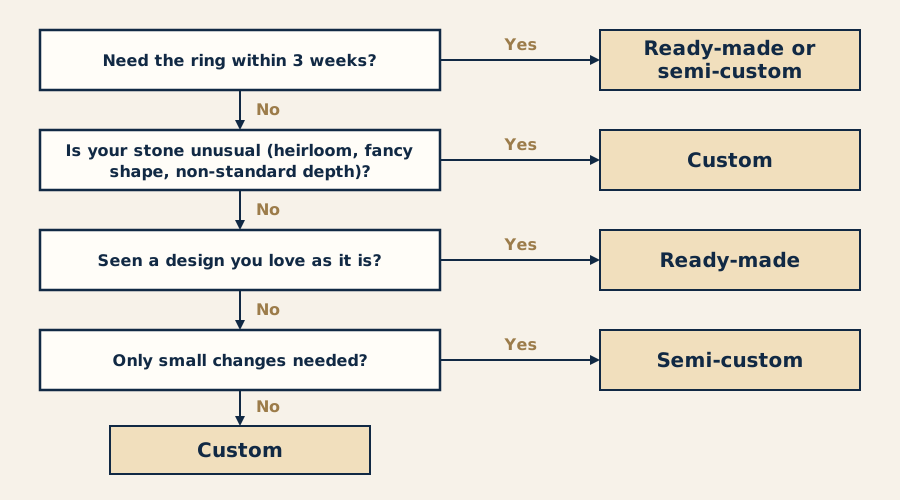
- Fix the date. If you need the ring within 3 weeks, a ready-made or semi-custom ring is the realistic choice.
- Try on real rings. Note the band width, setting height and claw style that feel right.
- Check your stone. If it is an heirloom, an unusual shape or non-standard depth, lean towards custom.
- Compare like with like. Ask for metal weight in grams, band width in mm and the stone report for each option.
- Get it in writing. Confirm price, deposit terms, specifications and completion date before you pay.
- Plan the paperwork. Book an insurance valuation, keep the CAD record, and check the TRS rules if you are travelling.
Free consultation
Talk to a gemologist
Compare stones in person or online with Raj Sood, Graduate Gemologist (GIA), AJP (GIA).
Book a consultationShop this shape
FAQ
Common questions
Is a custom engagement ring more expensive than a ready-made one?
Usually a little, because design time and hand finishing go into one ring. For a ring with a 1 carat or larger centre stone the difference is a small share of the total, since the diamond costs the same either way.
How long does a custom engagement ring take in Australia?
Typically about 4–8 weeks from the consultation to collection. Some stages can be shortened, but casting, finishing and setting the diamond safely still take a couple of weeks.
Can I get a refund on a custom engagement ring if I change my mind?
Australian Consumer Law does not require a change-of-mind refund, and custom deposits are usually non-refundable once production starts. Your automatic consumer rights still apply if the ring is faulty or does not match the agreed design.
Can a ready-made engagement ring be resized?
Most plain gold or platinum bands can be resized about 1–2 sizes up or down. Full eternity bands, tension settings and some pavé designs are hard or impossible to resize, so check before you buy.
Do I need an insurance valuation for an engagement ring?
Most insurers ask for one, especially if the ring is worth more than the jewellery limit in your contents policy. For a custom ring, keep the CAD record with the valuation so a like-for-like replacement is possible.
Can I claim GST back on an engagement ring before travelling overseas?
Yes, through the Tourist Refund Scheme, if you spend AUD 300 or more with one business within 60 days of departure and carry the ring with you. Australian residents who bring the ring back must declare it and may have to repay the GST.

Ask a gemologist
Not sure which diamond to choose?
Raj Sood is a Graduate Gemologist (GIA) and master jeweller. Bring the stones you are considering, or send the reports, and he will tell you honestly which one is better and why.
Keep learning
Related guides
 Buying Knowledge & Custom ProcessCustom vs Semi-Custom Engagement RingsBuying Knowledge & Custom ProcessFrom CAD to Casting: How a Custom Ring Is Made
 Buying Knowledge & Custom ProcessQuestions to Ask Before Ordering a Custom Engagement RingBuying Knowledge & Custom ProcessEngagement Ring Buying Guide
 Buying Knowledge & Custom ProcessWhat Happens at a Custom Engagement Ring Consultation?
 Engagement Rings & SettingsWhat Engagement Ring Band Width Should You Choose?Buying Knowledge & Custom ProcessHow CAD Is Used in Custom Engagement Ring Design
 Buying Knowledge & Custom ProcessShould Couples Choose an Engagement Ring Together?
Explore more
More guides on this topic
Education