
- Education
- Buying Knowledge & Custom Process
- Build Your Own Engagement Ring: How to Shortlist Diamonds Without Getting Lost in Filters
Buying Knowledge & Custom Process
Build Your Own Engagement Ring: How to Shortlist Diamonds Without Getting Lost in Filters
When you build your own engagement ring, the diamond search is where most people stall: thousands of listings and a dozen sliders. This guide gives you a filter order, sensible starting ranges and the Australian rules on GST, the Tourist Refund Scheme and insurance.
 Reviewed by Raj Sood, Graduate Gemologist (GIA), AJP (GIA)Master jeweller and Graduate Gemologist (GIA) · reviewed 4 November 2026
Quick answer
To build your own engagement ring without getting lost in filters, fix your total budget first, then set filters in order: shape, carat range, cut, colour band, clarity band and grading lab. Keep each filter a little wide so 20–40 diamonds remain, then compare reports, videos and face-up size to reach a shortlist of three to five.
How do you build your own engagement ring without getting lost in filters?
To build your own engagement ring means choosing the centre diamond and the setting (the metal mount that holds it) separately, then having the two made into one ring. It gives you far more control than buying a finished ring off a tray, but it also hands you a diamond search page with sliders for shape, carat, cut, colour, clarity, polish, symmetry, fluorescence, grading lab, depth, table and price. Move all of those at once and you can go from 4,000 results to zero, or from zero back to 4,000, without learning anything.
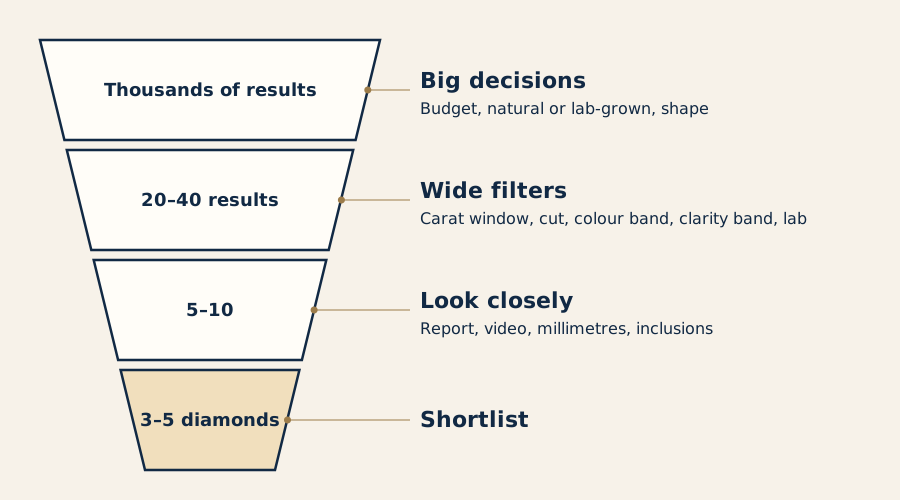
The fix is to treat the filters as a funnel. You make a few big decisions first, set each filter slightly wider than you think you need, and only then narrow down by looking at actual diamonds. Filters are good at removing stones that are clearly wrong; they are poor at choosing between stones that are all broadly right. That final choice is made with your eyes, the grading report and a video, not a slider.
If you are new to all of this, our complete diamond buying guide explains the 4Cs (cut, colour, clarity and carat) in detail, and the wider engagement ring buying guide covers settings, metals and styles. Any unfamiliar word on a diamond listing is also explained in our plain-English jewellery glossary. This page sits between those guides: it is about the process of getting from a huge list to a short one.
How much should you budget before you start filtering?
Set the budget before you touch a single filter, and set it for the whole ring, not just the diamond. A common mistake is to spend the full amount on the centre stone and then discover the setting, wedding band and insurance still need paying for. A realistic engagement ring budget in Australia includes:
- The centre diamond: usually the largest share, often 60–75% of the total for a solitaire.
- The setting: a plain 18ct gold or platinum solitaire mount is typically a few thousand dollars; halos, pavé (rows of tiny diamonds) and hand-made pieces cost more.
- Resizing and fitting: often free or low cost from the maker, but worth asking about.
- Insurance: an annual premium, plus a valuation document (more on this below).
- The wedding band: not needed straight away, but easier to plan for now if the engagement ring has an unusual shape.
There is no correct figure. The old idea that you should spend a set number of months' pay comes from twentieth-century advertising, not from any rule; our article on why the three-month salary rule is a myth traces where it came from. Decide what is comfortable, then put that number in the price filter as your ceiling for the diamond only, after subtracting the setting. If you are not sure whether the ring should be a surprise or a joint choice, engagement ring etiquette, including who pays and who chooses covers the conventions Australians actually follow.
Related guideProposal Ring vs Engagement RingWhat order should you set filters when you build your own engagement ring?
Order matters because each filter changes the price range of everything after it. Shape and origin (natural or lab-grown) move price the most, so decide those first; fine details such as fluorescence come last. If you have not settled on a shape yet, our overview of the main diamond shapes is a good place to narrow it to one or two. Here is a starting order with sensible first settings for a 1 carat-range solitaire:
| Order | Filter | Sensible first setting | Why |
|---|---|---|---|
| 1 | Price | Your diamond ceiling (total budget minus setting) | Stops you falling for stones you cannot buy |
| 2 | Natural or lab-grown | Choose one, or run two separate searches | The two sit in very different price bands |
| 3 | Shape | One or two shapes only | Each shape has its own proportions and pricing |
| 4 | Carat | A window, e.g. 0.90–1.20 ct | Wide enough to show price jumps at whole sizes |
| 5 | Cut grade (rounds) | Excellent (GIA) or Ideal/Excellent (IGI) | Cut drives sparkle more than any other grade |
| 6 | Colour | A three-grade band, e.g. E–G or G–I | One grade apart is hard to see face-up |
| 7 | Clarity | VS1–SI1, then check eye-clean | Higher grades cost more but often look the same |
| 8 | Grading lab | GIA or IGI | Consistent, comparable reports |
| 9 | Polish and symmetry | Very Good or Excellent | Removes poorly finished stones |
| 10 | Fluorescence | None to Medium to start | Strong fluorescence can occasionally look hazy |
After step 7, look at the result count. If you have more than about 60 diamonds, tighten one filter by one step. If you have fewer than 15, widen colour or clarity first, because those are the grades where the difference is least visible. Our guide to how each of the 4Cs affects price shows which grade changes cost the most for the least visible gain, and our page on how price per carat differs between shapes explains why a round costs more than most fancy shapes of the same weight.
For fancy shapes (anything that is not round), GIA does not give an overall cut grade. Skip step 5 and instead filter on length-to-width ratio, which is the stone's length divided by its width. For example, many people like oval diamonds in the 1.30–1.50 ratio range, and cushions around 1.00–1.10. Leave depth and table filters off until the culling stage; they remove too many good stones when used as hard limits.
Which carat and size filters actually matter?
Carat is a weight, not a size. What you see on the hand is the face-up size, measured in millimetres across the top of the stone, and two diamonds of the same weight can differ by a few tenths of a millimetre depending on how deeply they are cut. That is why a carat window, plus a quick check of the measurements, works better than a single exact weight.
| Carat weight (round) | Typical diameter | Notes |
|---|---|---|
| 0.50 ct | about 5.0–5.2 mm | Popular for slim, delicate settings |
| 0.70 ct | about 5.6–5.8 mm | Often good value below the 0.75 step |
| 0.90 ct | about 6.1–6.3 mm | Looks very close to a 1 carat |
| 1.00 ct | about 6.3–6.5 mm | Price per carat steps up here |
| 1.50 ct | about 7.3–7.5 mm | Shows the shape clearly in any setting |
| 2.00 ct | about 8.0–8.2 mm | Wider settings and claws needed |
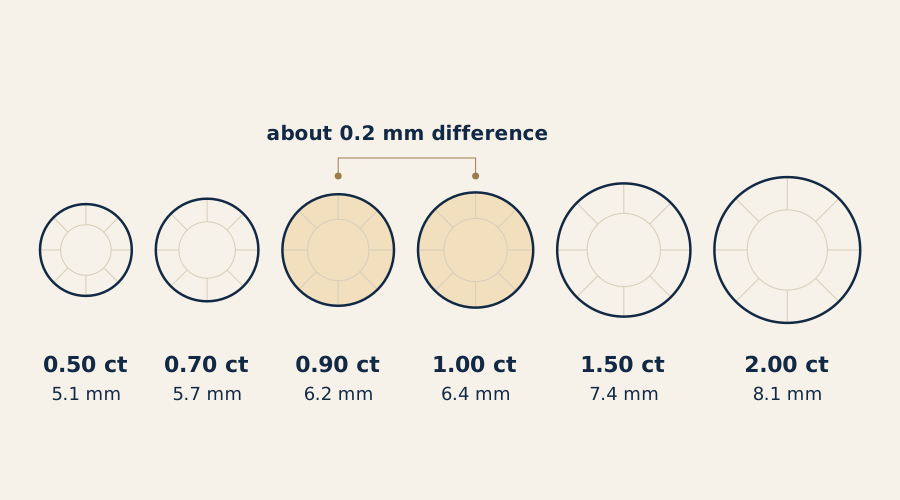
Prices step up at so-called magic sizes: 0.50, 0.70, 0.75, 0.90, 1.00, 1.50 and 2.00 carats. A diamond just under one of these weights, such as 0.95 ct instead of 1.00 ct, usually costs noticeably less per carat while looking almost identical once set. Starting your carat filter a little below the round number lets these stones appear in your results.
Shape changes the picture too. Ovals, pears and marquise cuts spread their weight over a longer outline, so they often look larger face-up than a round of the same weight; our comparison of which shapes look largest for their carat weight puts the numbers side by side. Before you lock in a carat range, try our diamond size visualiser by shape to see how different weights look on a finger.
Not sure which one is right?
Send us the stones you are looking at and our gemologist will tell you which to choose and why.
How wide should your colour, clarity and cut filters be?
The aim is to filter out stones that will look wrong, not to chase the top grade of every scale. A useful rule: if you cannot see the difference between two grades without a loupe (a 10× magnifier) side by side, do not pay for it. Start with these bands and adjust after you have seen real stones:
- Colour in white gold or platinum: E–H. Colour is graded D (colourless) to Z; most people cannot pick a G from an F once it is set.
- Colour in yellow or rose gold: H–J. The warm metal colours the diamond anyway, so higher grades are largely hidden.
- Clarity: VS1–SI1, then confirm each SI1 is eye-clean (no inclusions visible without magnification at normal viewing distance).
- Cut (rounds): Excellent on a GIA report, or Ideal or Excellent on an IGI report. Do not widen this one to save money; it controls brightness.
- Depth and table (rounds): as a guide, many well-cut rounds sit around 59–62.5% depth and 54–58% table, but use these to question a stone, not to exclude it automatically.
Step-cut shapes such as emerald and Asscher cuts have long, open facets that show inclusions more easily, so start clarity at VS2 or higher for those. Brilliant-cut shapes (round, oval, pear, cushion) hide small inclusions well, which is where SI1 can be good value. If a grading term on a report is unfamiliar, our glossary gives short definitions of terms like eye-clean and fluorescence.
Colour advice also depends on the setting, so check how metal colour changes the colour grade you need before you tighten this filter.
Should your shortlist be natural or lab-grown diamonds?
Decide this early, because natural and lab-grown diamonds sit in very different price ranges and mixing them in one search makes the price filter meaningless. Both are real diamond: the same carbon crystal, 10 on the Mohs hardness scale, with a refractive index of about 2.42. A lab-grown diamond (also called laboratory-grown) is grown in a controlled environment over weeks; a natural diamond formed underground over a very long time and was mined. They look the same to the eye and only lab equipment can reliably tell them apart.
| Natural diamond | Lab-grown diamond | |
|---|---|---|
| What it is | Formed in the earth and mined | Grown in a laboratory by CVD or HPHT |
| 1 ct round, G VS2, Excellent cut (approx.) | about AUD 7,000–14,000 | about AUD 1,000–3,000 |
| Common report labs | GIA, IGI | IGI, GIA |
| Report must state | Natural origin | Laboratory-grown origin |
| Larger sizes (2 ct+) | Rarer and much costlier | Widely available |
| Resale | Well below retail | Very limited resale market |
| Durability | Same hardness and toughness | Same hardness and toughness |
Neither choice is a financial investment, and neither is better as a diamond; it comes down to what matters to you about origin, size and budget. If you are torn, run two separate searches with identical filters apart from origin, and compare what the same money buys. Many couples find that a lab-grown diamond lets them move up in size, while others prefer a smaller natural stone for its geological story. Either way, the report should clearly state the origin, and if the stone has a laser inscription on the girdle (the thin outer edge), it should match the report number.
Browse natural and lab-grown diamonds
How do you cut 40 results down to a shortlist of three?
Once your filters leave roughly 20–40 stones, stop filtering and start looking. This is the stage most guides skip, and it is where you find the diamond that actually looks good, rather than the one with the neatest grades. Work through each stone in turn:
- Open the grading report. Check the measurements, the clarity plot (a map of where each inclusion sits) and comments such as 'clouds not shown' or 'additional twinning wisps'.
- Watch the 360° video at normal speed. Look for dark areas, a bow-tie (a dark band across the middle of ovals, pears and marquise cuts) that stays put, or a dull, milky look.
- Compare millimetres, not just carats. A 1.02 ct stone that measures 6.35 mm can look smaller than a 0.98 ct stone at 6.45 mm.
- Check where the inclusions are. A dark crystal under the table (the large top facet) shows more than a light feather near the edge, which a claw may cover.
- Note the price per carat. If one stone is much cheaper than similar ones, find out why before you get excited.
Cross off any stone you would not be happy to receive, and keep a simple list of the rest: report number, shape, carat, millimetres, colour, clarity and price. You want three to five finalists that you genuinely like, ideally with something different about each (one slightly larger, one slightly whiter, one cheaper) so the final choice is a real trade-off. Our article on comparing diamonds online and in person explains what a video can and cannot show you, and when seeing the stones side by side is worth the trip.
What do GST, the Tourist Refund Scheme and insurance mean for your shortlist?
These are the Australian details that overseas buying guides rarely mention, and they can change which diamond on your shortlist is actually the cheapest once everything is counted.
GST. Australian retail prices include 10% Goods and Services Tax. Overseas websites often show prices without it, which makes them look lower. If you buy from overseas, GST still applies: for goods valued at AUD 1,000 or less the seller generally collects it at checkout, and above AUD 1,000 it is usually collected at the border along with any customs duty and processing charges. Add those costs, plus international shipping insurance, before comparing an overseas stone with a local one. Resizing, warranty work and returns are also harder across borders; see the trade-offs of buying from overseas websites.
Tourist Refund Scheme (TRS). If you are leaving Australia, the TRS lets you claim back the GST on goods bought here, provided you meet the conditions:
- You spend AUD 300 or more (GST included) with one business, shown on one or more tax invoices with that business's ABN.
- You buy the goods within 60 days before you depart.
- You carry the ring as hand luggage or wear it through the airport, and show it with the original tax invoice at the TRS facility after passport control.
- The refund is the GST component, which is one-eleventh of the GST-inclusive price.
Australian residents can also claim under the TRS, but if you bring the ring back into Australia it must be declared, and you may have to repay the GST if it is over your duty-free allowance. In practice the TRS suits international visitors, or Australians proposing and living overseas, rather than people coming home. Check the current rules with the Australian Border Force before you plan around it.
Insurance. Most home contents policies cap cover for unspecified jewellery at a fairly low amount per item, so an engagement ring usually needs to be listed as a specified item or covered by a dedicated jewellery policy. Insurers generally ask for a written insurance valuation describing the diamond and setting in detail, often by a registered valuer. That valuation is a replacement figure, which can differ from what you paid. Ask whether the policy covers loss as well as theft, whether it covers you overseas, and whether it pays cash or replaces the ring. Plan to update the valuation every few years, and keep a copy of the grading report with it. Building insurance into the budget from the start avoids an unpleasant surprise after the proposal.
How do the setting and ring size fit into your shortlist?
When you build your own engagement ring, the setting can rule a diamond in or out. A low-set bezel suits a shallower stone; a tall six-claw solitaire shows off a well-cut round; a halo makes a smaller centre look larger. Choose the setting style before your final pick, and check that each finalist's millimetre measurements fit it. A setting made for a 6.5 mm round will not hold a 7.0 mm stone properly without changes.
Ring size matters for proportion as well as fit: a 2 carat stone looks very different on a size J finger than on a size S. Australia uses letter sizes, and our guide to Australian ring sizes, from F to Z shows how to measure without spoiling a surprise. If you have a US or European size, the ring size converter for US, UK and EU sizes translates it. If the size is a mystery, some people propose with a stand-in proposal ring and choose the final diamond together afterwards.
How to build your diamond shortlist: step by step
- Set the total budget. Subtract the setting, then use what is left as the price ceiling for the diamond.
- Choose natural or lab-grown. Or run two identical searches, one for each, and compare.
- Pick one or two shapes and a setting style. These decide the proportions and size you need.
- Set a carat window. Start just below a magic size, and compare face-up sizes on screen before you commit.
- Add cut, colour and clarity bands. Excellent cut for rounds, a three-grade colour band and VS1–SI1 clarity to start.
- Limit to GIA or IGI reports. Then add polish and symmetry of Very Good or better.
- Adjust to 20–40 results. Widen colour or clarity if you have too few; tighten one step if you have too many.
- Check reports and videos. Cross off stones with dark areas, visible inclusions or small millimetre measurements.
- Keep three to five finalists. Record report number, millimetres, grades and price for each.
- Add the Australian costs. Include GST on any overseas stone, shipping, and your insurance premium before choosing.
Free consultation
Talk to a gemologist
Compare stones in person or online with Raj Sood, Graduate Gemologist (GIA), AJP (GIA).
Book a consultationShop this shape
FAQ
Common questions
How many diamonds should be on a shortlist?
Three to five is a practical number. Fewer than three gives you no real comparison, and more than five usually means your filters are still too wide or you have not yet looked closely at the videos and reports.
Is it cheaper to build your own engagement ring?
It can be, because you choose where the money goes, for example a slightly lower colour grade and a better setting. The total depends on the diamond and setting you pick, so compare complete ring prices rather than assuming either route is cheaper.
What filters matter most when choosing a diamond online?
Price, natural or lab-grown, shape and carat range move the results most, followed by cut grade. Colour and clarity can be set as fairly wide bands, because one grade apart is rarely visible once the diamond is set.
Can I claim the GST back on an engagement ring under the Tourist Refund Scheme?
Yes, if you spend AUD 300 or more with one business within 60 days of leaving Australia and carry the ring with the tax invoice through the airport. Residents who bring the ring back may have to declare it and repay the GST, so check the current Border Force rules first.
Do I need separate insurance for an engagement ring in Australia?
Usually yes, or at least list it as a specified item on your contents policy, because unspecified jewellery cover is often capped at a low amount. Your insurer will normally ask for a detailed written valuation.
Should I buy a diamond just under 1 carat?
Often it is good value. A 0.90–0.99 carat diamond usually costs less per carat than a 1.00 carat and looks only a few tenths of a millimetre smaller face-up.

Ask a gemologist
Not sure which diamond to choose?
Raj Sood is a Graduate Gemologist (GIA) and master jeweller. Bring the stones you are considering, or send the reports, and he will tell you honestly which one is better and why.
Keep learning
Related guides
 Buying Knowledge & Custom ProcessDiamond Buying GuideBuying Knowledge & Custom ProcessEngagement Ring Buying Guide
 Buying Knowledge & Custom ProcessBuying an Engagement Ring Online vs In-Store
 Buying Knowledge & Custom ProcessDiamond Size Visualiser by Shape (Tool)
 Buying Knowledge & Custom ProcessEngagement Ring Etiquette
 Buying Knowledge & Custom ProcessThe Three-Month Salary Rule
 Buying Knowledge & Custom ProcessRing Size Converter (Tool)Buying Knowledge & Custom ProcessProposal Ring vs Engagement Ring
Explore more
More guides on this topic
Education