
- Education
- Buying Knowledge & Custom Process
- Engagement Ring Etiquette in Australia: Who Pays, Which Hand and How Much
Buying knowledge & custom process
Engagement Ring Etiquette in Australia: Who Pays, Which Hand and How Much
Engagement ring etiquette has relaxed a lot, but a few customs still matter to families, and a few practical rules save real money and heartache. Here is what Australians actually do, from who pays to what happens to the ring if plans change.
 Reviewed by Raj Sood, Graduate Gemologist (GIA), AJP (GIA)Master jeweller and Graduate Gemologist (GIA) · reviewed 4 November 2026
Quick answer
Engagement ring etiquette in Australia is simple: the ring goes on the left-hand fourth finger, the budget is whatever you can pay without debt (the three-month salary rule began as advertising), and either partner can buy or propose. Ask a parent's blessing if it matters to your family, get the size in Australian letters, and insure the ring.
What is engagement ring etiquette today?
Engagement ring etiquette is the set of customs around choosing, giving and wearing the ring: who buys it, whether you ask anyone first, which finger it goes on and what happens to it later. Most of these customs come from British and European tradition. Australia has kept the core of them and quietly dropped the strict parts, so couples now have far more room to decide for themselves.
It helps to split the rules into two kinds. Social customs, such as asking a parent's blessing or keeping the ring a surprise, matter only as much as they matter to the two of you and your families. Practical rules, such as getting the size right, keeping the grading report and insuring the ring, protect you whatever your values. This guide covers both. For the buying side in full, start with our complete engagement ring buying guide, and if a term here is new, the plain-English jewellery glossary explains it.
| Custom | Traditional version | What many Australians do now |
|---|---|---|
| Who buys | The man buys the woman's ring | Either partner, both, or a shared cost |
| Permission | Ask the bride's father | Ask or tell both families, or skip it |
| Surprise | Ring chosen in secret | Often chosen together, or redesigned after the proposal |
| Budget | Two or three months' salary | Whatever fits your savings without debt |
| Who wears one | The woman only | Either or both partners, including men's engagement rings |
Who pays for the engagement ring?
Traditionally the person proposing pays, because the ring is their gift. In some families the other partner returns the gesture later with a watch, cufflinks or a piece of jewellery of their own. That tradition is still common, but it is no longer a rule.
Many Australian couples already share a home and a bank account by the time they get engaged, so the ring often becomes a shared purchase. In same-sex couples both partners frequently wear an engagement ring, and men's engagement rings are now a normal request across the counter. There is also the old folk custom of a woman proposing on 29 February in a leap year; today anyone can propose on any day.
- Proposer pays: the classic gift, usually from savings set aside over months.
- Split the cost: common when you choose the ring together and want a larger stone or a custom design.
- Two rings: each partner buys one for the other, often at a similar budget.
- Family stone: an heirloom diamond is reset, so the cost is mainly the new setting and labour.
The one piece of etiquette that really matters here is financial: do not start a marriage paying off a ring. Credit card interest in Australia commonly runs around 20% a year, which can add hundreds or thousands of dollars to the real cost. Deferred-payment plans can carry late fees too, so read the terms closely.
Should you ask permission or choose the ring together?
Asking a parent for permission to propose has mostly become asking for a blessing: a courtesy that tells the family the news is coming, rather than a request that could be refused. Some people ask both families; some see it as outdated and skip it. The test is your partner's view, not tradition. If you are not sure how they feel, a close friend or sibling of theirs usually knows.
The bigger question is whether the ring is a surprise. A surprise ring is romantic, but the proposer is guessing on style, metal, stone shape and size all at once. Choosing together removes that guesswork, and many couples now do it, or use a halfway approach: propose with a simple ring or a loose diamond, then design the final ring as a pair. Our article on whether couples should choose the ring together sets out the trade-offs.
If you go custom, the design stage is where choosing together pays off. Comparing handmade and CAD-designed custom rings helps you decide how you want to see and approve the design before it is made.
Related guideShould Couples Choose an Engagement Ring Together?Which hand does an engagement ring go on in Australia?
In Australia the engagement ring goes on the left hand, fourth finger: the ring finger, between the middle finger and the little finger. The custom is often traced to the Roman idea of the vena amoris, the 'vein of love', said to run from that finger to the heart. It is a lovely story but not anatomy; every finger has similar veins.
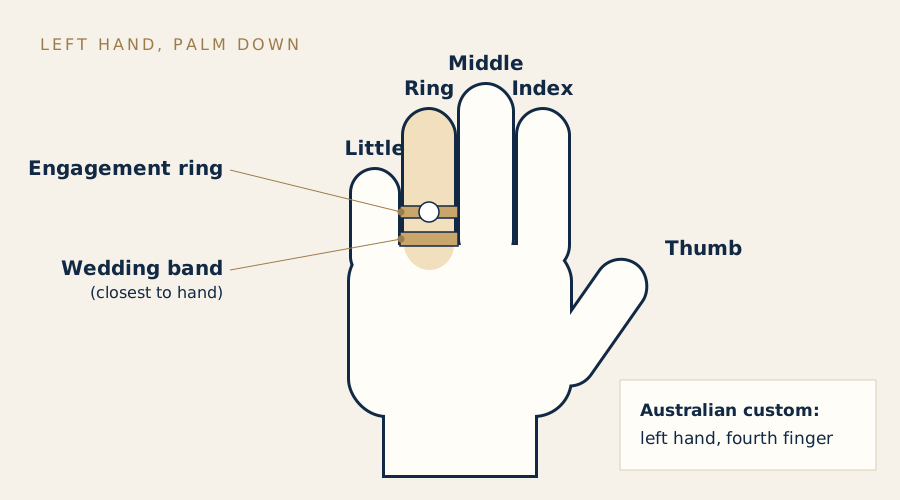
After the wedding, most people wear the band on the same finger, below the engagement ring so the band sits closest to the hand. Some move the engagement ring to the right hand for the ceremony so the band can go on first, then swap it back afterwards. Others wear only the band day to day. All of these are fine.
| Where | Usual hand | Notes |
|---|---|---|
| Australia, New Zealand, UK, USA, Canada | Left | Engagement ring and band on the same finger |
| Germany, Norway, Denmark, Poland, Russia | Often right | Mainly for wedding bands; customs vary by family |
| Greek and other Orthodox Christian traditions | Often right | Linked to the right hand's role in the ceremony |
| India | Varies | Depends on region, religion and family custom |
Practical exceptions are normal too. Left-handed people sometimes wear the ring on the right, and nurses, chefs, tradies and gym-goers often take it off at work. Removing a ring to protect it, or to protect your finger, is not bad etiquette.
Not sure which one is right?
Send us the stones you are looking at and our gemologist will tell you which to choose and why.
How much should you spend on an engagement ring in Australia?
There is no correct figure. The 'two or three months' salary' line came from diamond advertising in the twentieth century, not from any old custom; our page on where the three-month salary rule came from tells the story. The modern etiquette is simpler: spend what you can pay without debt, and do not let a number from an ad set your budget.
A sensible approach is to set a range before you look, then decide what matters most: size, colour, the metal, or a custom design. Our guide to setting a realistic engagement ring budget works through this, and the four Cs in our diamond buying guide shows where the money goes within a stone.
| Ring type | Approximate price range (AUD) |
|---|---|
| Lab-grown diamond solitaire, about 1 ct, 18ct gold or platinum | about $2,000–$5,000 |
| Natural diamond solitaire, about 0.50 ct, G–H, VS–SI | about $3,000–$7,000 |
| Natural diamond solitaire, about 1 ct, G–H, VS | about $8,000–$18,000 |
| Halo or three-stone, natural centre about 1 ct | about $10,000–$22,000 |
| Natural sapphire centre, about 1 ct, 18ct gold | about $2,500–$8,000 |
| Plain 18ct gold wedding band | about $800–$2,500 |
These are broad ranges only; prices move with the market and the exact grades. Two stones at the same price can look quite different, so comparing two diamonds side by side on their reports is worth the time, and the diamond size visualiser for each shape shows how a carat weight actually looks in millimetres.
Where you buy also shapes the real cost. Our guide to the pros and cons of buying online or in store covers returns, resizing and seeing the stone in person. If you are tempted overseas, read buying a diamond overseas versus at home first: jewellery over the AUD 900 duty-free allowance per adult must be declared when you come home, and 10% GST can apply. Visitors to Australia may be able to claim GST back when they leave; see how the Tourist Refund Scheme works on jewellery.
Is it OK to propose with a lab-grown diamond?
Yes. A lab-grown diamond (laboratory-grown diamond) is real diamond: the same carbon crystal, 10 on the Mohs hardness scale, with the same refractive index of about 2.42 that gives diamond its sparkle. It is grown in a laboratory over weeks rather than formed underground over a very long time, and it costs much less than a natural diamond of the same size and grade.
The etiquette is about honesty, not the stone's origin. A lab-grown diamond should be described as lab-grown, and its grading report, and usually a tiny laser inscription on its girdle (the thin outer edge), will say so. Presenting a lab-grown stone as natural is the real faux pas. Natural diamonds are rarer, and some people value that rarity and origin; others prefer a larger lab-grown stone for the same budget. Neither is a 'fake', and neither should be thought of as an investment.
- Natural diamond: formed in the earth, rarer, higher price per carat, graded by labs such as GIA.
- Lab-grown diamond: grown in a laboratory, same physical properties, much lower price, often graded by IGI or GIA.
- Both: should come with an independent grading report that states the origin.
Browse natural and lab-grown diamonds
How do you find out their ring size secretly?
Australia uses the letter scale shared with the UK, running from A upwards, with half sizes such as M½ and sizes beyond Z written as Z+1, Z+2 and so on. The US uses numbers instead, which is a common source of mix-ups when ordering online. Each full letter adds about 1.25 mm to the inside circumference.
| Australian size | Inside circumference | Inside diameter |
|---|---|---|
| J | about 49.3 mm | about 15.7 mm |
| L | about 51.9 mm | about 16.5 mm |
| M | about 53.1 mm | about 16.9 mm |
| N | about 54.4 mm | about 17.3 mm |
| P | about 57.0 mm | about 18.1 mm |
| R | about 59.5 mm | about 19.0 mm |
| T | about 62.1 mm | about 19.8 mm |
| V | about 64.6 mm | about 20.6 mm |
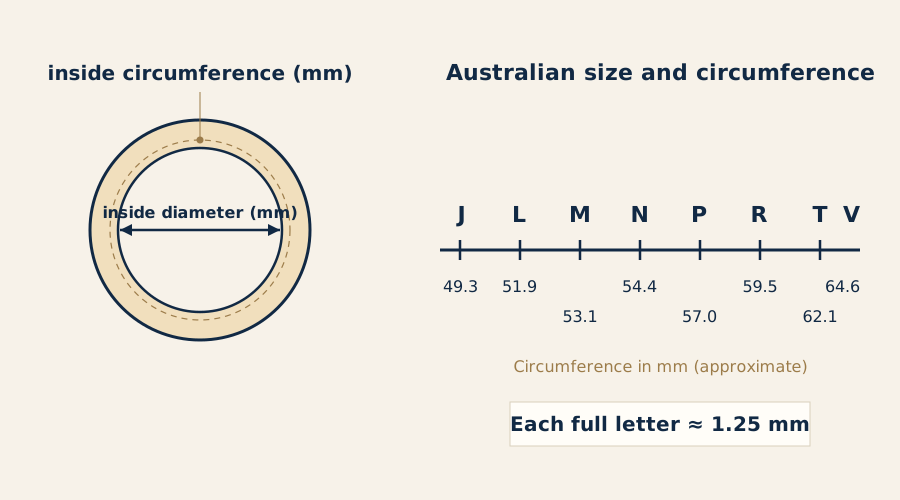
Many women's sizes fall roughly between J and P, and many men's between R and W, but hands vary too much to guess from that. Ways to find out without giving the game away:
- Borrow a ring they wear on the left ring finger, and have it measured on a ring stick (a tapered sizing rod).
- Trace or measure the inside of a ring on paper if you cannot take it away; note the inside diameter in millimetres.
- Ask an ally: a sibling or friend can suggest trying on rings together.
- Allow for the hand: a ring from the right hand is often about half a size larger, because the dominant hand is usually bigger.
Most solitaire and claw settings can be resized one or two sizes either way. Full eternity bands, channel settings and tension settings are much harder or impossible to resize, so they suit a confirmed size.
Do you need a ring to propose?
No. Proposing without a ring is increasingly common, especially when the couple wants to design the ring together. Some people propose with a simple placeholder ring, a family ring or a loose diamond in a box, then have the final setting made afterwards. Our page on how a proposal ring differs from the final engagement ring covers the options.
If you do want the real ring on the day, timing is the practical rule. A ready-made setting with a chosen diamond may take one to two weeks; a custom design usually takes around four to eight weeks once the design is approved; resizing often takes a week or so. Check how long each step of making a ring takes and work backwards from your date with a few weeks to spare.
What is engagement ring etiquette after the proposal, or if it ends?
Once the ring is on, a few practical habits matter more than any custom. Keep the receipt, the grading report and a written valuation together. Insure the ring straight away: many home contents policies cap a single item of jewellery at a modest amount unless it is listed separately, so read how jewellery insurance works in Australia and ask your insurer about specified items. Valuations are often updated every two to three years.
Plan the wedding band with the engagement ring in mind. Wide or low settings may need a contoured or slightly curved band to sit flush. Have the claws checked about once a year, since a worn claw is the usual reason a stone is lost.
If the engagement ends, there is no single rule in Australia. Many people return the ring, and an heirloom is generally expected to go back to the family it came from. Legally, outcomes depend on the circumstances, and courts have considered whether the ring was a gift conditional on marriage; for a valuable ring, get legal advice rather than relying on etiquette. If the ring is to be sold, set expectations first: what a diamond is realistically worth on resale is usually well below the retail price paid.
How do you plan an engagement ring the right way? Step by step
- Agree the approach. Decide whether the ring is a surprise, chosen together or a proposal ring followed by a custom design.
- Set a budget you can pay. Ignore salary rules; choose a range that needs no debt.
- Talk to the family if it matters. Ask for a blessing, or simply share the plan, in the way your partner would want.
- Find the size. Get an Australian letter size from a ring they wear on the left ring finger, or err half a size large.
- Choose the stone on its report. Confirm whether it is natural or lab-grown, and check the grades and measurements.
- Work back from the date. Allow four to eight weeks for custom work, plus time for resizing.
- Protect it. Insure the ring, store the report and valuation, and book a yearly claw check.
Free consultation
Talk to a gemologist
Compare stones in person or online with Raj Sood, Graduate Gemologist (GIA), AJP (GIA).
Book a consultationShop this shape
FAQ
Common questions
Who is supposed to pay for the engagement ring?
Traditionally the person proposing pays, as a gift. Today many Australian couples split the cost or each buy a ring for the other, and any of these is fine.
Which hand does the engagement ring go on in Australia?
The left hand, on the fourth finger. After the wedding, the band usually goes on the same finger below the engagement ring.
Do you have to spend three months' salary on an engagement ring?
No. The salary rule began as diamond advertising, not tradition. Spend what you can pay without going into debt.
Is it rude to propose with a lab-grown diamond?
Not at all. A lab-grown diamond is real diamond with the same hardness and sparkle; the only etiquette is to describe it honestly as lab-grown.
Do you give the ring back if the engagement is called off?
Many people do, and heirlooms are usually returned to the family. Legally there is no single rule in Australia, so get legal advice if the ring is valuable.
What if the engagement ring doesn't fit?
Most claw and solitaire rings can be resized one or two sizes, often within a week or so. Eternity, channel and tension settings are much harder to resize, so confirm the size first for those.

Ask a gemologist
Not sure which diamond to choose?
Raj Sood is a Graduate Gemologist (GIA) and master jeweller. Bring the stones you are considering, or send the reports, and he will tell you honestly which one is better and why.
Keep learning
Related guides
 Buying Knowledge & Custom ProcessHow Much Should You Spend on an Engagement Ring?
 Buying Knowledge & Custom ProcessShould Couples Choose an Engagement Ring Together?
 Buying Knowledge & Custom ProcessProposal Ring vs Engagement RingBuying Knowledge & Custom ProcessDiamond Buying GuideBuying Knowledge & Custom ProcessEngagement Ring Timeline: How Long Each Step Takes
 Buying Knowledge & Custom ProcessHow to Compare Two Diamonds Side by SideBuying Knowledge & Custom ProcessTourist Refund Scheme on Jewellery Explained
Explore more
More guides on this topic
Education