
- Education
- Buying Knowledge & Custom Process
- The Three Month Salary Rule: Where It Came From and What It Means in Australia
Buying Knowledge & Custom Process
The Three Month Salary Rule: Where It Came From and What It Means in Australia
The three month salary rule is the most quoted number in engagement ring shopping, and one of the least examined. Here is where it came from, what it adds up to on an Australian wage, and a more useful way to set a budget.
 Reviewed by Raj Sood, Graduate Gemologist (GIA), AJP (GIA)Master jeweller and Graduate Gemologist (GIA) · reviewed 4 November 2026
Quick answer
The three month salary rule says an engagement ring should cost three months of the buyer's income. It began as De Beers advertising, not financial advice. In Australia, three months of an average full-time wage is roughly AUD 18,000–20,000 after tax. A budget you can pay without debt, set around your priorities, is a sounder guide.
What is the three month salary rule?
The three month salary rule is the idea that an engagement ring should cost about three months of the buyer's pay. You will also hear a two-month and a one-month version. None of them comes from a bank, a financial planner or a jeweller's trade body. They are advertising lines that became folk wisdom, repeated so often that many people assume they are a genuine standard.
The rule leaves out almost everything that matters. It does not say whether the salary is before or after tax, whether you have a mortgage or a HECS debt, whether you are saving for a wedding as well, or what your partner actually wants. It also ignores the biggest change in the diamond market in decades: laboratory-grown diamonds, which are real diamond grown in a laboratory rather than mined, and which cost much less than natural diamonds of the same size and grade.
So treat the rule as a historical curiosity, not a target. If you want a practical method instead, our guide to working out what to spend on an engagement ring goes through it in detail, and any unfamiliar term on this page is explained in our plain-English jewellery glossary.
Where did the three month salary rule come from?
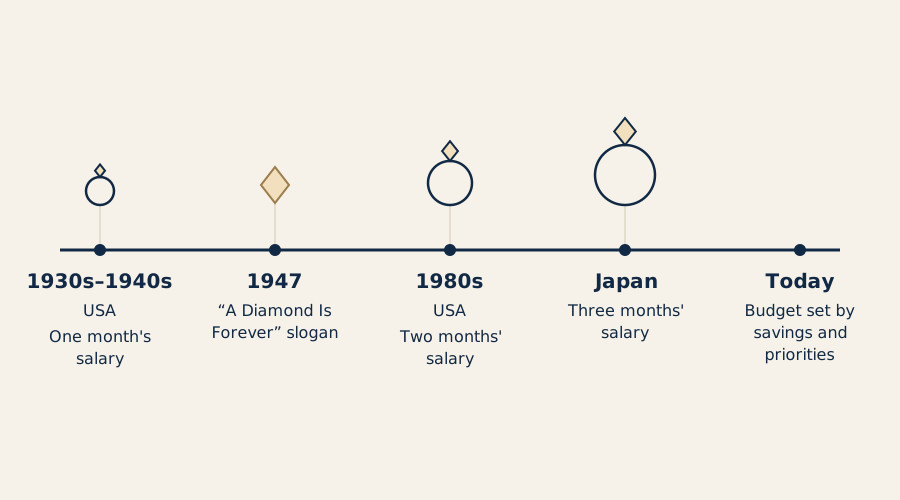
The salary rule is generally traced to De Beers, the company that controlled most of the world's rough diamond supply for much of the twentieth century, and its American advertising agency, N.W. Ayer. In the late 1930s, after the Depression had hit diamond sales hard, the agency set out to make a diamond engagement ring feel essential rather than optional. In 1947 one of its copywriters, Frances Gerety, wrote the line "A Diamond Is Forever", which is still in use.
The salary figure grew over the decades:
- 1930s–1940s, United States: advertising suggested spending about one month's salary.
- 1980s, United States: campaigns raised this to two months' salary, framed as a small price for something that lasts forever.
- Japan: De Beers marketing there is usually credited with the three months' figure, which later spread back to English-speaking countries.
The point is not that De Beers did anything unusual; all advertising tries to shape what people think is normal. The point is that the number was chosen to sell more diamonds, not to fit anyone's household budget. It also carried a quiet suggestion that diamonds hold their value, which is not how retail jewellery works. Our page on what diamonds are worth when you resell them explains why a ring is best thought of as something to wear and keep, not a financial asset, whether the diamond is natural or lab-grown.
What does the three month salary rule mean on an Australian wage?
Australia's average full-time adult earnings, as reported by the Australian Bureau of Statistics, are roughly AUD 1,900–2,000 a week, or about AUD 100,000 a year before tax. The median (the middle earner) is noticeably lower, because a smaller group of high earners pulls the average up. Here is what one and three months of pay look like at a few salary levels, using 2024–25 resident tax rates plus the 2% Medicare levy and ignoring offsets:
| Gross salary (AUD) | Three months before tax | Three months after tax (approx.) | One month after tax (approx.) |
|---|---|---|---|
| $60,000 | $15,000 | about $12,500 | about $4,200 |
| $80,000 | $20,000 | about $15,900 | about $5,300 |
| $100,000 | $25,000 | about $19,300 | about $6,400 |
| $150,000 | $37,500 | about $27,500 | about $9,200 |
Two things stand out. First, "three months" before tax and after tax can differ by AUD 5,000 or more, and the rule never says which it means. Second, even after tax, three months' pay is money you would normally spend on rent or a mortgage, groceries, fuel and bills. Unless you have saved it separately, following the rule literally means borrowing, often on a credit card or a pay-later instalment plan.
For a full walk through rings, stones and settings once you have a number in mind, start with our complete engagement ring buying guide.
Is the three month salary rule still relevant?
For most Australians, not really. The rule was written for a world with one main buyer, one kind of diamond and one traditional ring. Each of those has changed:
- Couples share the decision. Many couples now pick a ring together and treat it as one part of a joint budget that also covers a wedding, a deposit or travel. Our guide to choosing the ring as a couple looks at how that works in practice.
- Lab-grown diamonds changed the maths. A 1 carat lab-grown diamond can cost a fraction of a natural one with the same grades, so a fixed salary target buys wildly different rings depending on which you choose.
- Proposals and rings can be separated. Some people propose with a simple ring and design the permanent one together afterwards. See a simple proposal ring now, the real ring later.
- Tastes vary. Coloured gemstones, vintage-style designs and smaller, finely made rings are all common choices that rarely cost three months' pay.
What the rule gets right, almost by accident, is that a ring is worth planning for. Saving towards a clear number for a few months is sensible. Picking that number from an old advertisement is not.
| Approach | What it means | Strength | Weakness |
|---|---|---|---|
| Three months' salary | Spend 25% of a year's pay | Easy to remember | Marketing figure; often unaffordable |
| Two months' salary | Spend about 17% of a year's pay | Easy to remember | Same problems, smaller number |
| One month's salary | Spend about 8% of a year's pay | More realistic for many | Still ignores debts and goals |
| Savings-based budget | Spend what you can save without debt | Fits your real finances | Needs planning time |
| Priority-first budget | Decide what matters most, then price it | Matches the ring to the person | Takes research to price accurately |
Not sure which one is right?
Send us the stones you are looking at and our gemologist will tell you which to choose and why.
How much do Australians spend on an engagement ring?
There is no official Australian statistic on engagement ring spending. Figures quoted in the media usually come from retailer or wedding-industry surveys with small or self-selected samples, and they commonly land somewhere around AUD 5,000–10,000. That is well under three months of an average wage, and the spread around it is wide: plenty of couples spend AUD 2,000–3,000, and some spend AUD 30,000 or more.
Averages also hide a shift. As lab-grown diamonds have become widely available, many buyers now spend similar money to a few years ago but choose a larger lab-grown stone, while others choose a natural diamond and accept a smaller size. Retail prices for lab-grown diamonds have fallen steeply in recent years, so any figure older than a year or two can be well out of date. Our page on current lab-grown diamond prices in Australia tracks where they sit now.
Related guideHow Much Should You Spend on an Engagement Ring?What does an engagement ring budget actually buy?
This is the question the salary rule never answers. The table below gives broad, approximate AUD ranges for a complete solitaire ring (one centre diamond in a plain 18ct gold band), with a well-graded centre stone of about G–H colour and VS–SI1 clarity. Carat is the unit of diamond weight; one carat is 0.2 grams.
| Total ring budget (AUD) | Natural diamond centre (approx.) | Lab-grown diamond centre (approx.) |
|---|---|---|
| $3,000–$5,000 | about 0.30–0.50 ct | about 1.00–2.00 ct |
| $5,000–$10,000 | about 0.50–0.90 ct | about 2.00–3.00 ct, or 1–2 ct with a more detailed setting |
| $10,000–$20,000 | about 1.00–1.50 ct | 3 ct+, or a modest stone in platinum with side diamonds |
| $20,000+ | about 1.50–2.00 ct+ | Rarely needed for the stone; budget goes to design and metal |
These ranges move with the market and with the exact grades, cut and shape, so treat them as a starting point only. The four Cs (cut, colour, clarity and carat) shape price far more than any salary rule; our guide to how the four Cs affect price explains which grades you can relax on without seeing a difference.
Natural and lab-grown diamonds look identical to the eye and share the same hardness (10 on the Mohs scale) and refractive index (about 2.42). The differences are origin, rarity and price. Natural diamonds formed deep in the earth over a very long time and are rarer; lab-grown diamonds are grown in weeks and cost much less. In Australia a lab-grown diamond must be clearly described as lab-grown, laboratory-grown or similar, and our page on how lab-grown diamonds must be described under ACCC guidance sets out the wording you should see on a listing or report.
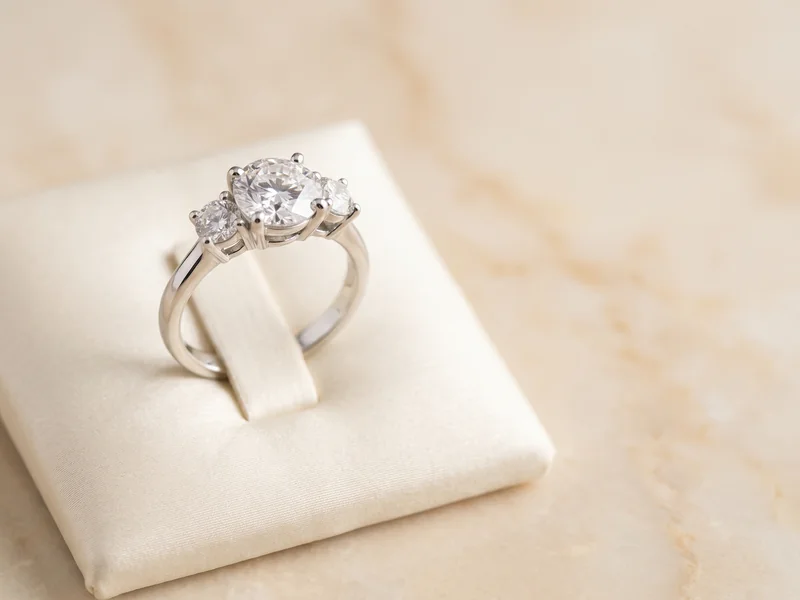
Shape and design move the numbers too. Ovals, pears and other fancy shapes usually cost less per carat than rounds, while three-stone designs spread the budget across a centre stone and two side stones.
Browse natural and lab-grown diamonds
Where does the money go in an engagement ring?
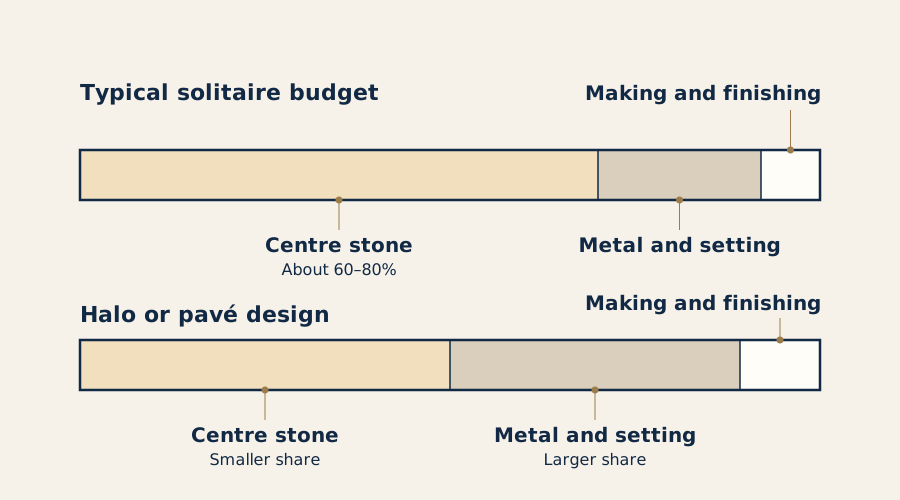
In a classic solitaire the centre stone usually takes about 60–80% of the total cost. The rest goes into the setting (the band and the claws or bezel that hold the stone), the metal, any small accent diamonds, and the craftsmanship. As the setting becomes more detailed, with a halo, a pavé band or hand engraving, its share rises.
- Metal: 18ct gold and platinum are the usual choices for engagement rings. Platinum is denser and harder to work, so the same design uses more metal by weight and usually costs more.
- Setting style: a plain four- or six-claw solitaire is the simplest; halos, hidden halos and pavé add small diamonds and many hours of setting work.
- Making method: rings can be designed on computer and cast, made by hand, or a mix of both. Our comparison of handmade and CAD-designed rings explains what each means for cost and finish.
- Grading report: an independent report from a lab such as GIA or IGI is standard for a centre diamond and is usually built into the stone's price.
Knowing the split helps you decide where to put the money. If size matters most, put more into the stone and keep the setting simple. If the design matters most, a slightly smaller stone in a finely made setting often looks more considered than a large stone in a basic one.
What other costs should you budget for besides the ring?
A sensible engagement ring budget includes a few costs the salary rule never mentions:
- GST: Australian retail jewellery prices include 10% GST. If you buy overseas, imported goods are generally subject to GST at the border and sometimes duty once they exceed the allowance (AUD 1,000 for posted goods, AUD 900 for goods an adult traveller carries home), so a lower overseas price can shrink. See buying a diamond overseas versus at home.
- Tourist Refund Scheme: if you are leaving Australia soon after buying, you may be able to claim the GST back when you depart, provided you meet the spend and timing conditions. Our guide to claiming GST back through the Tourist Refund Scheme covers the details.
- Insurance: standalone jewellery cover often costs in the region of 1–2% of the ring's value each year, and some home contents policies cover it with a specified-item listing. Read about insuring an engagement ring in Australia before you collect it.
- Resizing and servicing: if the size is a guess, allow for resizing later. Australia uses letter ring sizes (the same system as the UK), and checking the claws every year or two keeps the stone secure.
- The wedding band: many couples forget it, and a band shaped to sit beside the engagement ring costs more than a plain one.
Where you buy can also change what you get for the money. Online listings make price comparison easy, while seeing stones in person shows you sparkle and colour that photos miss. Our page on buying online or in a showroom weighs up both.
How do you set an engagement ring budget instead of using the three month salary rule? Step by step
At GemTrove, a Melbourne jeweller since 2008 and part of a family jewellery trade going back to 1984, this is the order we suggest people think it through:
- Start with savings, not salary. Work out what you can put aside without borrowing, and by when.
- List your other goals. Wedding, deposit, travel or debts all share the same money; agree with yourself, or your partner, how much goes to the ring.
- Pick your priorities. Rank size, diamond type (natural or lab-grown), shape, metal and design. Most people only need to be firm on one or two.
- Price a real example. Look up current listings for the stone and setting you have in mind so your number matches the market, not an old rule.
- Add the extras. Allow for insurance, resizing, a grading report if not included, and the wedding band.
- Check your ring size. Find the size in Australian letters, or plan a ring that can be resized easily.
- Allow time. Custom rings take weeks, not days; our guide to how long each stage of a ring takes helps you plan backwards from the proposal date.
Done this way, your budget might end up at half a month's pay or more than three. Either is fine, as long as it is a number you chose for reasons that are yours.
Free consultation
Talk to a gemologist
Compare stones in person or online with Raj Sood, Graduate Gemologist (GIA), AJP (GIA).
Book a consultationShop this shape
FAQ
Common questions
Is the three month salary rule before or after tax?
The rule never specified, which is part of the problem. On a AUD 100,000 salary the difference is about AUD 25,000 before tax versus roughly AUD 19,000 after tax.
Who invented the three month salary rule?
It is generally traced to De Beers diamond advertising. American campaigns suggested one month's salary in the 1930s and two months in the 1980s, and the three-month figure is usually credited to De Beers marketing in Japan.
How much should I spend on an engagement ring in Australia?
There is no correct figure. Spend what you can save without debt after allowing for your other goals, then match the stone and setting to your priorities.
What is the average engagement ring cost in Australia?
There is no official statistic. Industry surveys commonly suggest around AUD 5,000–10,000, but samples are small and the range of real spending is very wide.
Does a lab-grown diamond break the salary rule?
It makes the rule even less useful. A lab-grown diamond costs much less than a natural diamond of the same size and grade, so the same budget buys a very different ring depending on which you choose.
Will an expensive engagement ring hold its value?
Generally not at retail price. Jewellery usually resells for well below what you paid, so it is best chosen as something to wear rather than as a financial asset.

Ask a gemologist
Not sure which diamond to choose?
Raj Sood is a Graduate Gemologist (GIA) and master jeweller. Bring the stones you are considering, or send the reports, and he will tell you honestly which one is better and why.
Keep learning
Related guides
 Buying Knowledge & Custom ProcessHow Much Should You Spend on an Engagement Ring?Buying Knowledge & Custom ProcessEngagement Ring Buying Guide
 Buying Knowledge & Custom ProcessLab-Grown Diamond Price Guide AustraliaBuying Knowledge & Custom ProcessDiamond Resale Value Explained
 Engagement Rings & SettingsThree-Stone Engagement Rings
 Lab-Grown DiamondsLab-Grown Diamond Terms in Australia (ACCC Rules)
 Buying Knowledge & Custom ProcessHandmade vs CAD Engagement Rings
 Buying Knowledge & Custom ProcessProposal Ring vs Engagement Ring
Explore more
More guides on this topic
Education