
- Education
- Buying Knowledge & Custom Process
- Diamond Resale Value Explained: What a Diamond Is Really Worth When You Sell
Buying knowledge
Diamond Resale Value Explained: What a Diamond Is Really Worth When You Sell
Most people only think about diamond resale value when an engagement ends, an estate is settled or an upgrade is on the cards. Knowing the real numbers before you buy, or before you sell, saves a lot of disappointment.
 Reviewed by Raj Sood, Graduate Gemologist (GIA), AJP (GIA)Master jeweller and Graduate Gemologist (GIA) · reviewed 4 November 2026
Quick answer
Diamond resale value is what a buyer will actually pay you for a diamond you already own. In Australia a natural diamond usually resells for roughly 20–50% of its original retail price, depending on size, grades and paperwork, while lab-grown diamonds usually fetch very little. Diamonds are bought for wearing, not for selling at a profit.
What is diamond resale value?
Resale value is the amount someone will actually pay you, in cash or store credit, for a diamond you already own. It is not the price on your receipt, and it is not the figure on your insurance valuation. It is a wholesale number: what a jeweller, dealer or private buyer is willing to pay, knowing they have to test the stone, possibly reset or regrade it, and sell it again to someone else.
The value of the stone itself still comes from the same things that set the retail price: the 4Cs (carat, colour, clarity and cut), the shape, the grading report and the condition of the diamond. Our guide to the factors that set a diamond's price explains each one in depth, and any unfamiliar trade term on this page is defined in the GemTrove jewellery glossary. What changes when you sell is who is buying, and how much margin they need to make the purchase worthwhile.
The honest view from the trade side of the counter: a diamond is a lovely thing to own and wear for decades, but it is not a way to store or grow money. Plan on getting back a fraction of what you paid, treat a better result as a bonus, and you will not be caught out.
How much can you sell a diamond for?
There is no single percentage, because the secondhand market treats different diamonds very differently. A large, well-graded natural stone with an independent report is easy for a dealer to price and resell. A small stone with no paperwork, or any lab-grown diamond, is much harder. The table below is a rough guide to what Australian sellers typically see, expressed as a share of the original retail price.
| Diamond | Typical resale (share of original retail) | Why |
|---|---|---|
| Natural, 1 ct and above, GIA report, good grades | about 30–50% | Easiest to sell; dealers can price it straight from the report |
| Natural, 0.30–0.90 ct with a report | about 20–40% | Steady demand, but plenty of similar stones available |
| Natural, under 0.30 ct or no report | about 10–25% | Small stones are plentiful; testing and grading add cost |
| Natural, chipped or visibly included | often under 20% | May need recutting, which loses weight |
| Natural fancy colour, such as an Argyle pink | highly variable | Depends on colour intensity, report and origin documents |
| Lab-grown, any size | often 0–10% | New prices have fallen sharply; few trade buyers |
| Small accent diamonds (melee) | very little | Usually valued in bulk by weight, not one by one |
As a worked example, a natural 1 carat round, G colour, VS2 clarity (very slightly included) with a GIA report might have cost roughly AUD $9,000–$14,000 at retail. A fair dealer offer for the loose stone today could sit somewhere around AUD $3,000–$6,000, depending on the cut grade, fluorescence and where trade prices are at the time. A lab-grown 1 carat stone bought for AUD $2,000–$4,000 a few years ago may attract offers of only a few hundred dollars, and some buyers will not make an offer at all.
The setting is valued separately, mostly as metal. 18 carat gold is 75% pure gold, 9 carat is 37.5%, and platinum jewellery is commonly 95% platinum. A buyer pays for the weight of pure metal at the day's price, less a refining margin, so the design and hours of craftsmanship you paid for are largely lost. A typical 3–5 gram solitaire band in 18 carat gold is usually worth a few hundred dollars as metal, whatever it cost new.
Why is diamond resale value so much lower than the retail price?
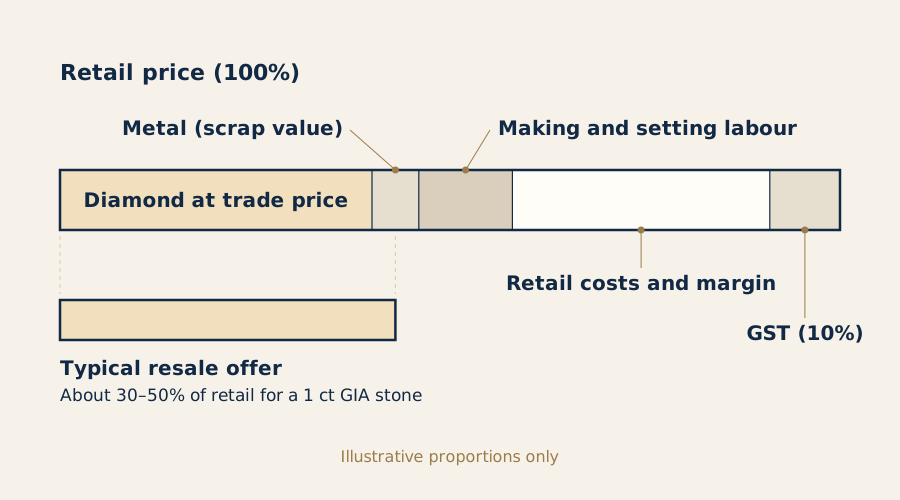
The retail price of a diamond ring covers far more than the stone. When you sell, the buyer only pays for the part they can sell again. These are the main reasons for the gap:
- GST: one-eleventh (about 9%) of an Australian GST-inclusive retail price is goods and services tax, charged at 10% on the pre-tax price. It goes to the ATO, and it does not come back to you when you sell privately or to a dealer. Travellers taking jewellery out of the country may be able to claim it through the Tourist Refund Scheme for jewellery, but only under its conditions at the time of purchase.
- Retail costs: rent, staff, design time, insurance, warranties and grading report fees are all built into the retail price.
- Labour in the setting: the hours spent making, setting and polishing a ring have no resale value once it is finished.
- Dealer risk and margin: a buyer has to test the stone, hold it as stock, perhaps send it for grading or a repolish, and still make a margin when it sells. So they buy at or below trade price.
- Plenty of supply: there are many secondhand diamonds in circulation and relatively few people buying them, which keeps offers modest.
- Price movement: trade prices for natural diamonds rise and fall with global demand, and lab-grown prices have dropped steeply as production has grown.
Buying abroad does not escape this maths. A stone bought overseas may have a lower sticker price, but jewellery brought home above the duty-free allowance must be declared and may attract GST, and an overseas purchase can be harder to resell or service in Australia. Our guide to buying a diamond overseas compared with buying at home sets out the trade-offs.
What affects how much you get back for a diamond?
The same qualities that set the retail price also set the resale price, but the secondhand market is less forgiving. Buyers pay most readily for stones they know they can sell quickly.
| Factor | Helps resale | Hurts resale |
|---|---|---|
| Grading report | GIA or another respected independent lab; laser inscription matches the report | No report, or a report from a lab known for generous grades |
| Carat weight | 0.50 ct and above, especially 1.00 ct and over | Very small stones under about 0.30 ct |
| Cut | Round brilliant with an Excellent cut grade | Deep or shallow stones that face up small or look dull |
| Colour and clarity | D–H colour, VS2 or better, eye-clean | Visible inclusions, or a strong brown or grey tint |
| Fluorescence | None to faint | Strong blue fluorescence in D–F colours can lower the trade price |
| Condition | Sharp facet edges, no chips | Chips, abrasions or a need for repolishing |
| Shape | Round, which has the widest trade demand | Less common fancy shapes can take longer to sell |
| Paperwork | Original invoice, report and valuations | No history, so the stone must be tested from scratch |
Natural and lab-grown diamonds look the same to the eye and have the same hardness (10 on the Mohs scale) and refractive index (about 2.42). A buyer who is handed an unknown stone with no report will screen it with testing equipment and may send it to a laboratory. That costs time and money, and it comes off your offer.
When you have two stones to choose between, whether buying or deciding which to sell, it helps to know how to compare two diamonds on paper and in person. Buyers also look at face-up size, the width you see from above, because a stone cut too deep hides weight underneath; the diamond size visualiser by shape shows how carat weight translates to millimetres across.
Not sure which one is right?
Send us the stones you are looking at and our gemologist will tell you which to choose and why.
What is lab-grown diamond resale value like?
Lab-grown diamonds are real diamond, grown in a laboratory rather than mined, with the same chemistry and physical properties as natural diamond. The difference at resale is the market. Production of laboratory-grown diamonds has expanded quickly, and new prices have fallen a long way over the past several years. That means a lab-grown stone bought a few years ago may now cost less to buy new, with a fresh report, than you paid for it.
Because a dealer can buy new lab-grown stones cheaply, few will pay much for a secondhand one. Some retailers offer trade-in or upgrade credit on lab-grown stones they sold, usually tied to spending more on a larger stone and subject to conditions. If resale matters to you, read our checklist of questions to ask about lab-grown resale before you buy and get any buyback or upgrade terms in writing.
None of this makes lab-grown a poor choice. It costs much less up front, so far less money is at stake. If you plan to keep and wear the ring, a low resale figure matters very little. If you think you may want to sell, a natural diamond with a strong report will usually return more in dollars, though still well below what you paid.
Resale value vs insurance valuation: why are they so different?
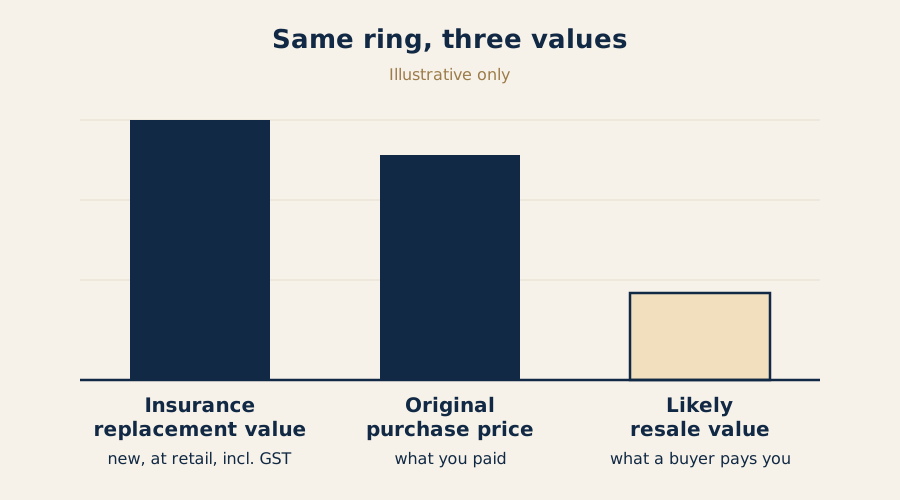
An insurance valuation states replacement value: what it would cost to replace your ring with one of like kind and quality, new, at retail, including GST. It is often higher than what you originally paid, because it assumes full retail and current prices. Resale value is what the secondhand market will pay, and it is commonly a third or less of the insurance figure. Neither number is wrong; they answer different questions. Our page on how replacement value differs from resale value goes through each type of valuation.
For estates, family law settlements and some tax matters you may need a market value valuation instead, which estimates what a willing buyer would pay a willing seller in the secondhand market. Always ask the valuer which type of valuation you are getting before you rely on the figure.
Related guideReplacement Value vs Resale Value in JewelleryWhere can you sell a diamond in Australia?
Each way of selling trades speed and convenience against price. Getting quotes from more than one type of buyer is the simplest way to see what your diamond is really worth.
| Where to sell | What to expect | Watch out for |
|---|---|---|
| Jeweller buyback or trade-in | Quick; often credit towards a new piece rather than cash | Credit may be tied to spending more; cash offers are lower |
| Diamond dealer or wholesaler | Offers based on trade prices; suits graded stones of 0.50 ct and above | Get more than one quote; offers vary widely |
| Auction house | Can reach collectors, useful for antique or signed pieces | Seller's commission and fees, often around 10–25% combined; low results without a reserve |
| Consignment with a jeweller | Possibly a higher price than an outright sale | Slow; commission applies; confirm insurance while it is held |
| Online marketplace or private sale | Potentially the highest net price | Scams and safety; buyers will want independent verification |
| Pawnbroker or cash-for-gold | Fast cash | Often priced on metal weight, with the diamond largely ignored |
Expect to show photo ID. Second-hand dealer and pawnbroker laws in each state require buyers to record who they buy from, which protects against the sale of stolen goods. A buyer who does not ask for ID is a warning sign.
On tax: the ATO treats jewellery as a collectable for capital gains tax. Jewellery bought for AUD $500 or less is generally exempt, and capital losses on collectables can only be used against capital gains on collectables. Most people sell at a loss, so tax rarely arises, but for a valuable inherited piece it is worth asking an accountant.
Should diamond resale value change what you buy?
For most couples, no. An engagement ring is bought to be worn every day, not to be sold, so the first question is what you can comfortably afford. Our guide to setting a sensible engagement ring budget is a better starting point than any resale calculation, and we also look at whether the old three-month salary rule still makes sense. The wider complete engagement ring buying guide covers the rest of the decision.
A few choices do keep your options open without costing more:
- Insist on an independent report from GIA or another respected lab, and keep it safe.
- Favour classic choices if resale matters: a round or popular shape in a common size will find a buyer faster.
- Do not rush. Some people propose with a simpler ring and choose the diamond together later; see how a proposal ring differs from the final engagement ring and how long each step of making a ring takes.
- Get the size right early. A ring resized several times, say from Australian size L to P, has extra metal added and joins that buyers notice. Check how Australian letter sizes compare with US, UK and EU sizes or use the ring size converter before ordering.
- Think about personalisation. Engraving and very individual designs mean a lot to you but narrow the pool of buyers.
If an engagement ends and the ring is being returned or sold, there are customs worth knowing; our page on engagement ring etiquette, including who keeps the ring covers them.
Because the setting returns so little, remodelling is often worth considering instead of selling. Resetting an inherited diamond into a new design keeps its full value to you, rather than accepting a trade price for the stone and scrap price for the gold.
Get a valuation, or browse natural and lab-grown diamonds
How do you sell a diamond in Australia? Step by step
- Gather the paperwork. Find the original invoice, the grading report and any previous valuations.
- Confirm what you have. Check the laser inscription against the report. If there is no report, have the stone tested and graded; this costs a fee and can take a few weeks.
- Decide: loose stone or whole ring. Ask buyers to price the diamond and the metal separately so you can see where the value sits.
- Get a market value estimate. Ask for a written secondhand market figure, not an insurance replacement value.
- Collect at least three offers. Try different types of buyer, such as a dealer, a jeweller and an auction house.
- Compare net amounts. Subtract commissions, fees and waiting time, and note whether an offer is cash or store credit.
- Sell safely. Meet in a shop or bank, bring photo ID, take payment by bank transfer and get a written receipt.
- Consider keeping it. If the offers are disappointing, remodelling or passing the piece down may serve you better.
Free consultation
Talk to a gemologist
Compare stones in person or online with Raj Sood, Graduate Gemologist (GIA), AJP (GIA).
Book a consultationFAQ
Common questions
Do diamonds hold their value?
Not in the sense of getting back what you paid. Natural diamonds typically resell for roughly 20–50% of their original retail price, and lab-grown diamonds for much less. They hold their beauty and durability, not their purchase price.
How much can I sell a 1 carat diamond for in Australia?
It depends heavily on the grades, report and whether it is natural or lab-grown. A natural 1 carat G VS2 round with a GIA report might attract offers of roughly AUD $3,000–$6,000, while a lab-grown 1 carat stone may only attract a few hundred dollars.
Can I sell a lab-grown diamond?
Yes, but the secondhand market is small and offers are usually low, because new lab-grown diamonds keep getting cheaper. Some retailers offer trade-in or upgrade credit on stones they sold, so check for written terms when you buy.
Why is my insurance valuation so much higher than the offers I'm getting?
An insurance valuation shows the cost to replace your ring new at full retail, including GST. A resale offer reflects what a dealer will pay for a secondhand stone they must resell, which is a much lower, wholesale figure.
Will a jeweller buy back a diamond they sold me?
Some do, and some offer upgrade credit instead of cash, usually with conditions such as spending more on a larger stone. Policies vary widely, so ask for the terms in writing at the time of purchase.
Do I pay tax when I sell a diamond ring?
The ATO treats jewellery as a collectable, so a capital gain on sale can be taxable, though items bought for AUD $500 or less are generally exempt. Most rings sell for less than they cost, so tax rarely applies; ask an accountant about valuable inherited pieces.

Ask a gemologist
Not sure which diamond to choose?
Raj Sood is a Graduate Gemologist (GIA) and master jeweller. Bring the stones you are considering, or send the reports, and he will tell you honestly which one is better and why.
Keep learning
Related guides
 Certificates & ValuationsReplacement Value vs Resale Value in Jewellery
 Lab-Grown DiamondsLab-Grown Diamond Resale Value: Questions to Ask Before Buying
 Diamond 4Cs & GradingWhat Determines a Diamond's ValueBuying Knowledge & Custom ProcessBuying a Diamond Overseas vs in AustraliaBuying Knowledge & Custom ProcessEngagement Ring Buying GuideBuying Knowledge & Custom ProcessEngagement Ring Timeline: How Long Each Step Takes
 Buying Knowledge & Custom ProcessHow to Compare Two Diamonds Side by Side
 Buying Knowledge & Custom ProcessTourist Refund Scheme on Jewellery Explained
Explore more
More guides on this topic
Education