
- Education
- Diamond 4Cs & Grading
- CT vs CTW vs TCW: Carat Weight Terms and Real Diamond Sizes
Diamond 4Cs & Grading
CT vs CTW vs TCW: Carat Weight Terms and Real Diamond Sizes
CT vs CTW vs TCW is the small print that decides how big a diamond really is. Read it wrong and a '1 carat' ring can hold a centre stone well under half that size.
 Reviewed by Raj Sood, Graduate Gemologist (GIA), AJP (GIA)Master jeweller and Graduate Gemologist (GIA) · reviewed 4 November 2026
Quick answer
CT (carat) is the weight of one diamond. CTW (carat total weight) and TCW (total carat weight) mean the same thing: the combined weight of every diamond in a piece. A 1 ctw ring might have a 0.70 ct centre and 0.30 ct of small stones, so it looks smaller and costs less than a 1 ct solitaire.
What does ct mean on a diamond?
Ct is short for carat, the unit used to weigh diamonds and gemstones. One metric carat is exactly 0.20 grams, or 200 milligrams, so five carats make a gram. The name comes from the carob seed, which traders once used as a counterweight on their scales. Carat is one of the four Cs of diamond grading, alongside cut, colour and clarity, and our full guide to how diamond carat weight works covers it in more depth.
Each carat is divided into 100 points. A 0.50 ct diamond is a 50-pointer, a 0.25 ct stone is a 25-pointer, and a 0.05 ct accent stone is a 5-pointer. Grading reports from labs such as GIA and IGI state the weight of a single stone to two decimal places, for example 1.02 ct, and that figure is measured on a precise electronic scale, not estimated.
One thing catches many Australians out. Gold purity here is also written with ct: 9ct gold is 37.5% pure gold, 14ct is 58.5% and 18ct is 75%. So a ring stamped 18ct inside the band is describing the metal, while 0.50 ct on the tag or report is describing the diamond. The two have nothing to do with each other. If any abbreviation in this article is new to you, our plain-English jewellery glossary explains it.
CT vs CTW vs TCW: what is the difference?
Ct on its own should describe one stone. Ctw (carat total weight) and tcw (total carat weight) describe the combined weight of all the diamonds in a piece of jewellery, added together. Ctw and tcw mean exactly the same thing; different retailers and countries simply prefer one or the other. You may also see cttw or dtw (diamond total weight), which mean the same again.
| Term | Stands for | What it measures | Where you see it |
|---|---|---|---|
| ct | carat | The weight of one stone | Loose diamonds, solitaire centre stones, grading reports |
| ctw | carat total weight | All diamonds in the piece added together | Halo rings, three-stone rings, studs, bands, bracelets |
| tcw | total carat weight | Same as ctw | Same as ctw; more common on some brands' tags |
| cttw / dtw | carat total weight / diamond total weight | Same as ctw | Older tags and some overseas listings |
| pt / pts | points | Hundredths of a carat | Small stones and melee, e.g. 10 pts = 0.10 ct |
| DEW | diamond equivalent weight | What a diamond simulant would weigh if it were diamond of the same size | Moissanite and other simulants |
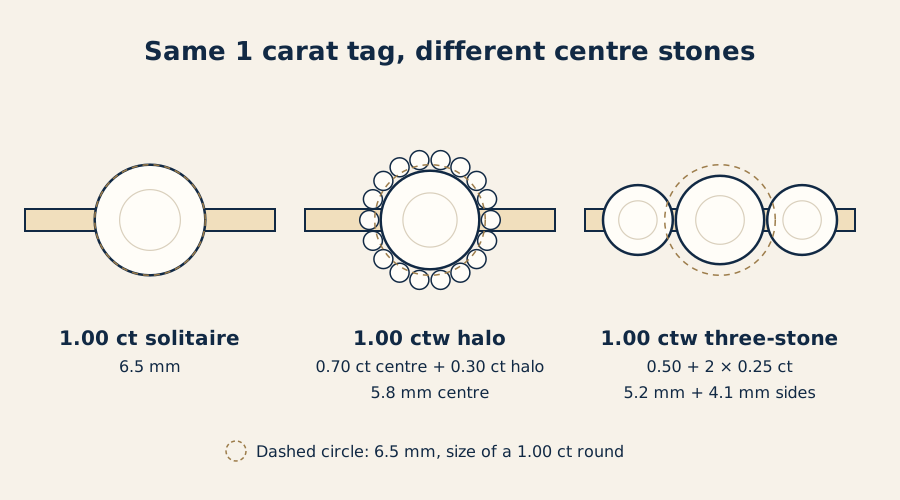
The practical rule is simple. If a single number covers several stones, it is a total weight, whatever the label says. Always ask what the centre stone weighs on its own, because that is the stone people notice and the one that drives most of the price.
What does ctw mean on rings, earrings and bracelets?
Carat total weight shows up anywhere there is more than one diamond. The same 1.00 ctw can be split in very different ways, and the split changes both how the piece looks and what it costs. Here is how a total of one carat is commonly divided:
| Piece | How 1.00 ctw is split | Largest stone looks about (round) |
|---|---|---|
| Solitaire ring | One 1.00 ct stone | 6.4–6.5 mm |
| Halo ring | 0.70 ct centre + 0.30 ct of small stones | 5.7–5.8 mm |
| Three-stone ring | 0.50 ct centre + two 0.25 ct sides | 5.1–5.2 mm |
| Stud earrings | Two 0.50 ct stones | 5.1–5.2 mm each |
| Cluster ring | Seven stones of about 0.14 ct | 3.3–3.4 mm each |
| Eternity band | About twenty 0.05 ct stones | 2.4–2.5 mm each |
Earrings deserve special care. 1 ctw studs are a pair of half-carat stones, not two one-carat stones, and each earring will look like a 0.50 ct diamond, about 5.1–5.2 mm across in a round. If you want each ear to show a full carat, you are looking for 2 ctw studs. Our page on what a half-carat diamond looks like shows that size in detail.
Bracelets and necklaces work the same way. A 5 ctw tennis bracelet might be around 50 diamonds of 0.10 ct each, roughly 3 mm across. The total sounds impressive, but each stone is small, and small diamonds (often called melee, meaning stones under about 0.20 ct) cost far less per carat than a single large one. That is why a 5 ctw bracelet can cost a fraction of a single 5 ct diamond.
When a ring is made to order, the centre stone, the halo and the band stones are chosen separately, so you can see each weight on its own rather than one combined figure.
Does CT vs CTW change the price of a diamond ring?
Yes, a great deal. Diamond prices rise faster than weight: a 1.00 ct stone costs much more than two 0.50 ct stones of the same colour and clarity, because large rough crystals are rarer. So a 1 ct solitaire and a 1 ctw halo ring are not comparable, even though both carry a '1 carat' label.
| 1 carat, G–H colour, VS clarity, round | Approximate price range (AUD) |
|---|---|
| Natural 1.00 ct solitaire centre stone | about $7,000–$14,000 |
| Natural 1.00 ctw halo (0.70 ct centre + 0.30 ct small stones) | about $4,000–$8,000 |
| Lab-grown 1.00 ct solitaire centre stone | about $700–$2,000 |
| Lab-grown 1.00 ctw halo | about $600–$1,800 |
These are broad ranges for the diamonds only, not the setting, and they move with the market. What matters is the pattern: in a ctw piece, much of the weight is in small stones that carry a lower price per carat.
Prices also jump at so-called magic sizes: 0.50, 0.70, 0.90, 1.00, 1.50 and 2.00 ct. A 0.95 ct diamond can cost noticeably less than a 1.00 ct stone yet measures only about 0.1 mm smaller across, a difference nobody can see on the hand. Our guides to three-quarter carat diamonds and the classic one carat diamond show where those price steps fall in practice.
Not sure which one is right?
Send us the stones you are looking at and our gemologist will tell you which to choose and why.
How big is each carat weight in millimetres?
Carat is weight, not size, but for a well-cut round brilliant the two track closely. Diamond has a density (specific gravity) of about 3.52, so every diamond of the same shape and proportions weighs roughly the same for its diameter. Because weight follows volume, doubling the carat weight only makes a round about 26% wider, though the face-up area grows by about 59%.
| Carat weight (round) | Typical diameter | Face-up area |
|---|---|---|
| 0.25 ct | about 4.1 mm | about 13 mm² |
| 0.50 ct | about 5.1–5.2 mm | about 21 mm² |
| 0.75 ct | about 5.8–5.9 mm | about 27 mm² |
| 1.00 ct | about 6.4–6.5 mm | about 33 mm² |
| 1.25 ct | about 6.9 mm | about 37 mm² |
| 1.50 ct | about 7.3–7.4 mm | about 43 mm² |
| 2.00 ct | about 8.1–8.2 mm | about 52 mm² |
| 2.50 ct | about 8.7–8.8 mm | about 60 mm² |
| 3.00 ct | about 9.3 mm | about 68 mm² |
| 4.00 ct | about 10.2 mm | about 82 mm² |
| 5.00 ct | about 11.0 mm | about 95 mm² |
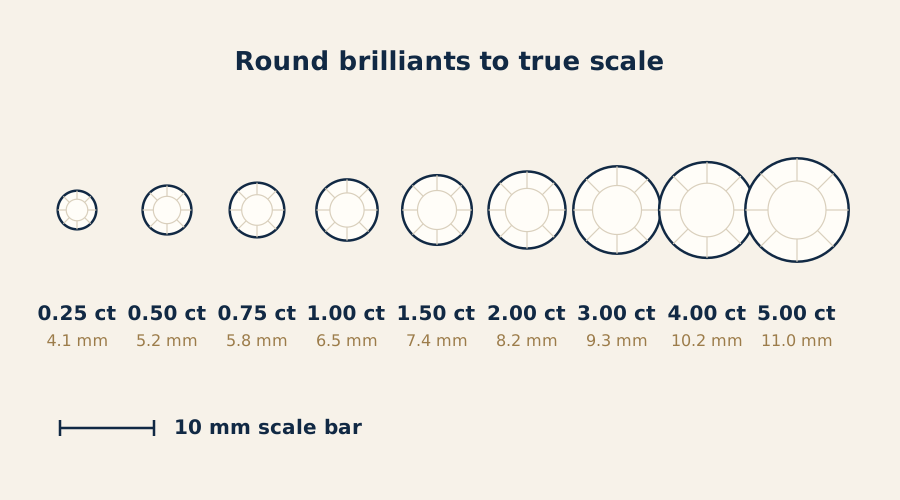
These figures assume a round cut to typical proportions, with a total depth of about 59–63%. A stone cut deeper hides weight underneath and looks smaller from above; one cut too shallow looks wider but leaks light. That is why two 1.00 ct rounds can differ by 0.2 mm or more across.
For a closer look at each weight, see the 1.25 carat size, a carat and a half on the hand, two carat diamonds and the 2.5 carat step. Larger stones are covered in our three carat diamond guide, 4 carat diamond sizes and prices, what a 5 carat diamond really looks like and, for the very top end, diamonds from six to ten carats.
How big is a 1 carat diamond in other shapes?
Shape changes how a carat is spread. Elongated shapes such as oval, pear and marquise put more of their weight into length and less into depth, so they usually look larger face-up than a round of the same weight. Square step cuts such as the Asscher carry more weight below the girdle and can look smaller.
| Shape, 1.00 ct | Typical measurements | Face-up compared with a round |
|---|---|---|
| Round | 6.4–6.5 mm | Reference |
| Oval | about 7.7 × 5.7 mm | Larger |
| Pear | about 8.0 × 5.3 mm | Larger |
| Marquise | about 10.0 × 5.0 mm | Noticeably larger |
| Emerald | about 7.0 × 5.0 mm | Similar to slightly larger |
| Radiant | about 6.5 × 5.5 mm | Similar to slightly smaller |
| Cushion | about 6.0 × 5.5 mm | Slightly smaller |
| Princess | about 5.5 × 5.5 mm | Slightly smaller across, but corners add reach |
| Asscher | about 5.5 × 5.5 mm | Smaller |
| Heart | about 6.8 × 6.3 mm | Similar |
Measurements for fancy shapes vary more than rounds, because each shape can be cut long or short. An oval at a 1.30 ratio and one at 1.50 can both weigh 1.00 ct yet look quite different. Always compare the millimetre measurements on the report, not just the weight.
Related guideDiamond MM to Carat Size Chart (All Shapes)How does carat weight look on the hand?
Most adult ring fingers are roughly 15–19 mm wide at the base. A 0.50 ct round at about 5.2 mm covers around a third of that width; a 1.00 ct at 6.5 mm covers a little over a third; a 2.00 ct at 8.2 mm covers close to half. On slimmer fingers the same diamond looks larger, which is why a carat on a size J finger reads very differently from a carat on a size R.
- Under 0.30 ct: delicate, suits stacking rings, small studs and side stones.
- 0.50–0.90 ct: a clear centre stone that sits comfortably for everyday wear.
- 1.00–1.50 ct: the size most people picture when they think 'engagement ring'.
- 2.00 ct and above: a strong presence; height and setting security matter more.
The setting changes the impression too. A halo can make a 0.70 ct centre read like a stone of about 1 ct from a distance, while thick claws or a heavy bezel can make a centre look smaller. White metal tends to blend with the diamond's edge, adding a little apparent size; yellow gold frames it more distinctly.
Is carat weight the same for lab-grown diamonds and gemstones?
Lab-grown diamonds are real diamond, grown in a laboratory rather than mined, with the same density as natural diamond. So a 1.00 ct lab-grown round measures the same 6.4–6.5 mm as a 1.00 ct natural round, and ct, ctw and tcw mean exactly the same thing. The difference is price: lab-grown costs much less, which is why many people choose a larger lab-grown centre stone. Our page on lab-grown sizes from one to five carats sets out what each step looks like.
Coloured gemstones are a different story, because they have different densities. Sapphire and ruby (specific gravity about 4.00) are heavier than diamond, so a 1 ct sapphire is smaller than a 1 ct diamond, typically around 5.8–6.0 mm in a round. Lab-created sapphire and ruby have the same density as natural ones. Emerald (about 2.72) is lighter, so a 1 ct emerald looks larger than a 1 ct diamond.
Simulants, which imitate diamond but are a different material, are often sold by diamond equivalent weight (DEW). Moissanite is lighter than diamond (specific gravity about 3.22), so a moissanite described as '1 ct DEW' is the size of a 1 ct diamond but actually weighs less, around 0.88 ct. Check whether a weight is actual or DEW before comparing.
Browse natural and lab-grown diamonds by carat weight
How do you check carat weight before you buy? Step by step
- Find the term. Note whether the tag says ct (one stone) or ctw / tcw (all stones combined).
- Ask for the split. For any ctw piece, ask the weight of the centre stone and the total weight of the smaller stones.
- Read the report. Confirm the centre stone's exact weight to two decimals and whether it is natural or lab-grown.
- Check the millimetres. Compare face-up measurements, not weight alone, especially across different shapes.
- Mind the magic sizes. Consider weights just below 0.50, 1.00 or 1.50 ct, which look almost identical for less.
- Confirm DEW or actual weight. For moissanite and other simulants, find out which figure is quoted.
- Try the size against your hand. Use the diameter with a ruler or a sample ring before deciding.
Free consultation
Talk to a gemologist
Compare stones in person or online with Raj Sood, Graduate Gemologist (GIA), AJP (GIA).
Book a consultationShop this shape
FAQ
Common questions
What does ctw mean on a diamond ring?
Ctw means carat total weight: the combined weight of every diamond in the ring. It does not tell you how big the centre stone is, so always ask for that weight separately.
Is 1 ctw the same as 1 carat?
Only if the piece has a single diamond. A 1 ctw ring with side or halo stones has a centre stone smaller than 1 carat, often 0.50–0.75 ct, and it costs less than a 1 ct solitaire of the same grades.
Is tcw different from ctw?
No. Tcw (total carat weight) and ctw (carat total weight) are two names for the same thing, the total weight of all diamonds in a piece.
Do 1 ctw earrings mean 1 carat in each ear?
No. 1 ctw studs are a pair of about 0.50 ct each, roughly 5.1–5.2 mm across in a round. For a full carat per ear, look for 2 ctw.
Does a lab-grown diamond weigh the same as a natural diamond of the same size?
Yes. Lab-grown diamond has the same density as natural diamond, so a 1.00 ct lab-grown round measures about the same 6.4–6.5 mm as a natural one.
Is 18ct the size of the diamond?
No. In Australia, 18ct stamped in a ring describes the gold purity (75% gold). Diamond weight is written with decimals, such as 0.50 ct or 1.00 ctw.

Ask a gemologist
Not sure which diamond to choose?
Raj Sood is a Graduate Gemologist (GIA) and master jeweller. Bring the stones you are considering, or send the reports, and he will tell you honestly which one is better and why.
Keep learning
Related guides
 Diamond 4Cs & GradingDiamond Carat Weight
 Diamond 4Cs & GradingDiamond MM to Carat Size Chart (All Shapes)
 Diamond 4Cs & Grading1 Carat Diamonds
 Lab-Grown DiamondsLab-Grown Diamond Carat Sizes: 1 to 5 CaratsDiamond 4Cs & GradingDiamond 4Cs
 Diamond 4Cs & Grading5 Carat DiamondsDiamond 4Cs & Grading4 Carat DiamondsDiamond 4Cs & Grading3 Carat Diamonds
Explore more
More guides on this topic
Education