
- Education
- Diamond 4Cs & Grading
- L and M Colour Diamonds (Faint Yellow): How They Look, What They Cost and When They Suit
Diamond 4Cs & Grading
L and M Colour Diamonds (Faint Yellow): How They Look, What They Cost and When They Suit
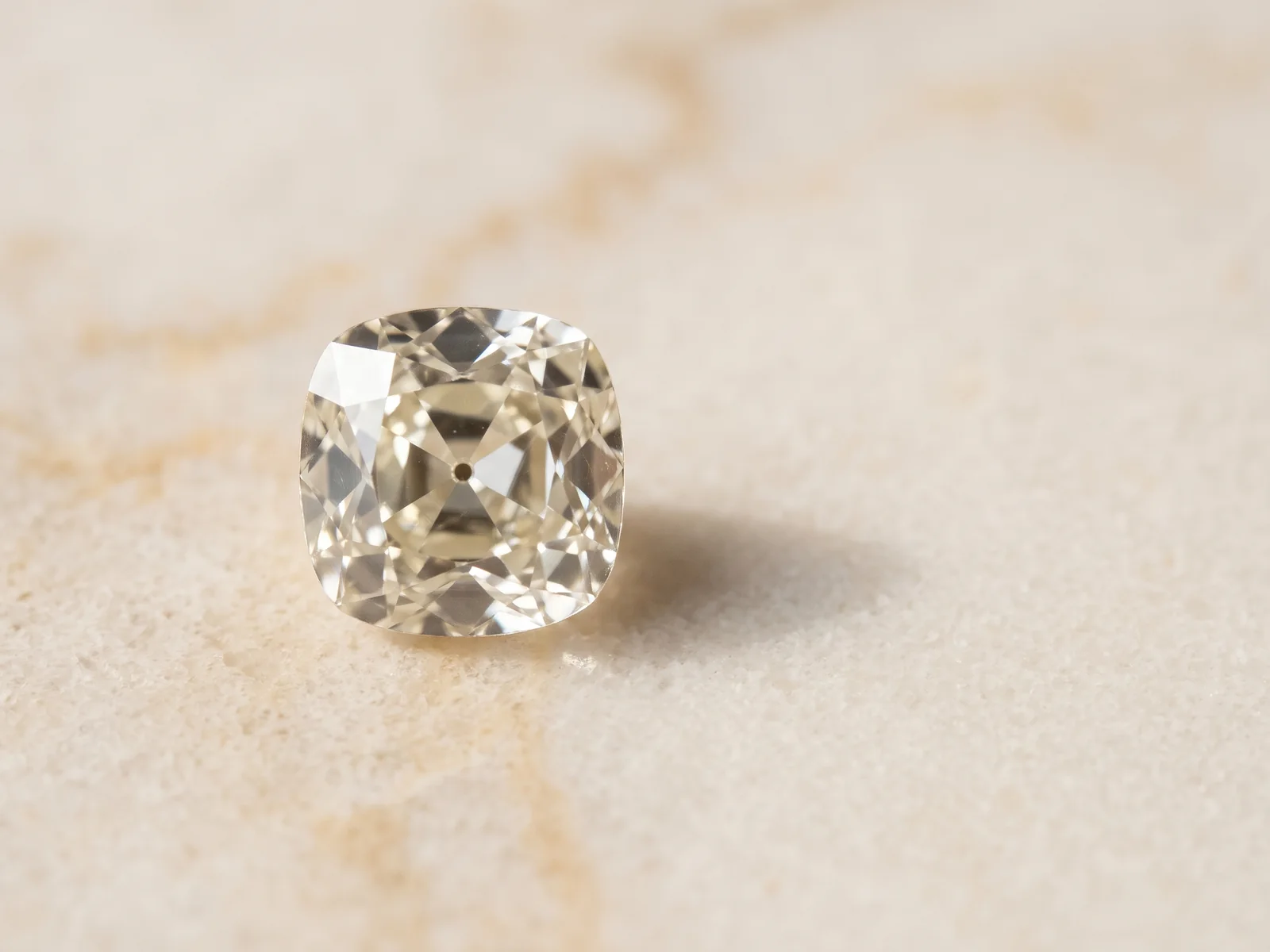
L and M colour diamonds show a visible warm tint, and they cost far less than the whiter grades. Whether that tint reads as a flaw or as a soft, warm glow depends on the shape, the size and, above all, the metal you set the diamond in.
 Reviewed by Raj Sood, Graduate Gemologist (GIA), AJP (GIA)Master jeweller and Graduate Gemologist (GIA) · reviewed 4 November 2026
Quick answer
L and M colour diamonds sit in the K–M 'faint' band of the GIA D-to-Z scale, so they show a soft, warm yellow tint face-up, especially in larger stones. Set in yellow or rose gold, in a round or old cut, they look warm rather than tinted and cost far less than near-colourless grades.
What do L and M colour diamonds mean?
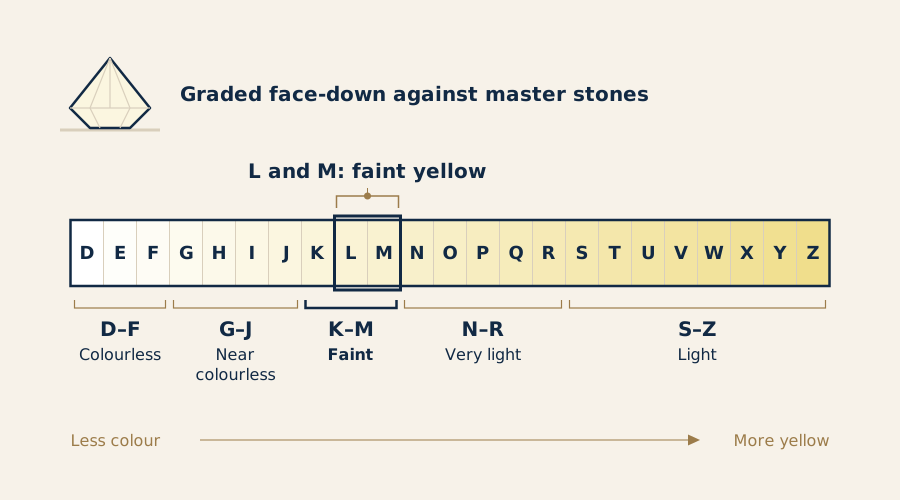
Colourless diamonds are graded on the GIA D-to-Z colour scale. D is completely colourless, and each letter after it shows slightly more yellow (or, less often, brown). L and M are the ninth and tenth grades. Together with K they make up the faint band, the first band where most people can see some colour without being shown a comparison stone. Our guide to how diamond colour is graded from D to Z explains the whole scale, and colour is one of the 4Cs that set a diamond's quality and price.
The yellow comes from nitrogen. Most natural diamonds trap some nitrogen atoms as they grow deep in the earth. When those atoms cluster in certain ways they absorb a little blue light, and the light that comes back to your eye looks faintly yellow. The trade calls these stones the cape series, after the Cape Province in South Africa, where many early yellowish diamonds were found. An L or M is simply a cape diamond with a little more nitrogen colour than a J or K.
Grading happens face-down. A grader places the diamond upside down on a white tray under a controlled daylight-equivalent lamp and compares it with master stones (a set of reference diamonds of known colour). Looking through the pavilion (the pointed underside) shows body colour most clearly, because there is no sparkle to distract the eye. Face-up, the same stone looks whiter, because its facets throw back white light and flashes of spectral colour. Any term here you have not met before is in our plain-English jewellery glossary.
What do L and M colour diamonds look like face-up?
An L colour diamond shows a soft, pale lemon or warm cream tint that most people notice face-up in a 1 carat round, particularly in white metal or next to a whiter stone. On its own on the hand, many people describe it as 'warm white' rather than yellow. An M colour diamond is one step further: the tint is clear to most eyes, and you can see it through the side of the stone as well as from above.
Three things change how much of that colour you actually see:
- Size: a bigger diamond has a longer light path, so it shows more body colour. Under about 0.50 carat, an L can be hard to tell from a J face-up; from 1.50 carat the tint is obvious.
- Lighting: warm indoor light and candlelight hide yellow; cool daylight and white LED light show it. Look at the stone near a window as well as under shop lights.
- Viewing angle: face-up, sparkle masks colour. From the side, or through the pavilion in a high setting, the tint is easier to see.
It also helps to know that colour grades are ranges, not exact points. A 'high' L that only just missed K can look almost the same as a low K, while a 'low' M close to N looks noticeably warmer. That is why photos or video of the actual stone matter more than the letter on the report.
How do L and M colour diamonds compare with K, J and N?
The table shows where L and M sit against the grades either side. Each single step is small, but two or three steps together are easy to see when the stones sit side by side in white metal.
| Grade | Band | Face-up in white gold or platinum | Face-up in yellow or rose gold |
|---|---|---|---|
| D–F | Colourless | Icy white | Can look slightly cool against the gold |
| G–H | Near colourless | White; tint only visible beside a D–F | White |
| I–J | Near colourless | Slight warmth in larger stones | White |
| K | Faint | Faint warmth visible to many people | Looks white to most people |
| L | Faint | Soft warm tint, noticeable in 1 ct+ | Warm white; tint blends with the metal |
| M | Faint | Clear pale yellow tint | Warm, gently yellow; often still pleasing |
| N–R | Very light | Distinctly yellow | Yellow; reads as a light yellow diamond |
At the top of the scale, the differences are almost invisible to most people; our comparison of D, E and F grades shows why. For context, D, the top colour grade, E colour stones and F colour diamonds cost a large premium for whiteness you mostly see only under grading conditions. Further down, G colour diamonds and H colour, a common white-metal choice are where many white gold and platinum rings sit, and our guide to choosing between G and H for an engagement ring compares them.
The closest neighbours matter most for an L or M buyer. I colour stones and J colour diamonds at the edge of near colourless look white in yellow gold and only slightly warm in white metal. The L vs K colour diamond question is the one most people face: K costs more, but in yellow gold the difference is often hard to pick.
Related guideK Colour DiamondsWhich diamond shapes hide faint yellow best?
Cut style changes colour more than many people expect. Brilliant cuts break light into many small flashes, which hides body colour. Step cuts, with their long, flat facets, act like windows into the stone and show colour clearly. Shapes with points or narrow ends also let colour collect where the stone is thin and the facets crowd together.
| Shape | How it shows L–M colour | Notes |
|---|---|---|
| Round brilliant | Hides it well | Strong sparkle masks tint; the most forgiving shape at L–M |
| Old European and old mine cuts | Hides it moderately; looks natural | Antique stones were often cut from warmer rough, so L–M suits a vintage look |
| Princess | Moderately well | Colour can gather in the four corners |
| Oval, pear, marquise | Shows more at the ends | Tint tends to pool at the points and tips |
| Cushion (crushed-ice style) | Shows more | The many small facets can concentrate colour |
| Radiant | Can intensify colour | Often cut deliberately to deepen fancy yellows |
| Emerald and Asscher | Shows the most | Step cuts reveal body colour; many people choose higher grades here |
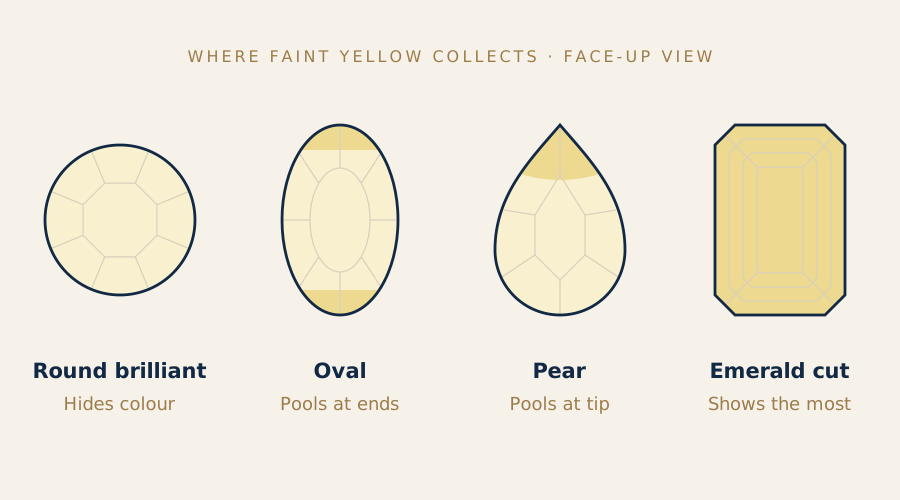
If you love an emerald cut or a long oval but your budget points to L or M, yellow or rose gold becomes almost essential. If you are set on white metal, a round brilliant gives the L grade its best chance of looking white.
Not sure which one is right?
Send us the stones you are looking at and our gemologist will tell you which to choose and why.
Does an L colour diamond look better in yellow gold?
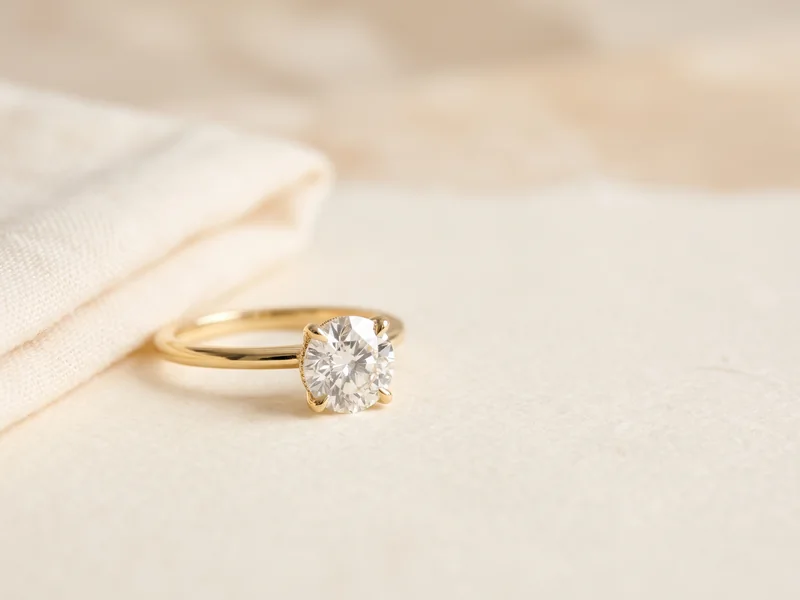
Usually, yes. Metal colour reflects into the diamond through its pavilion and sits right beside its edge, so your eye judges the stone against the metal. In white gold or platinum, the cool grey-white metal makes any yellow stand out by contrast. In 18 carat yellow gold the warm metal surrounds the stone with more yellow, so an L colour diamond looks warm white rather than tinted. Rose gold works the same way and gives an M a gentle, warm glow. Our guide to how the ring metal changes the colour you see shows the effect grade by grade.
- Yellow gold claws and band: the most forgiving for L and M.
- Rose gold: very forgiving; suits vintage and warm looks.
- Yellow band with white claws: common in white-diamond rings, but white claws can make an L look warmer by contrast. Yellow claws are kinder to faint yellow.
- White gold or platinum: workable for a small L in a round brilliant; an M usually looks noticeably yellow.
A halo of small white diamonds around an L or M also creates contrast and can make the centre look warmer. If you want a halo, consider yellow-gold settings for the halo stones, or a plain solitaire or bezel instead.
Does fluorescence make faint yellow diamonds look whiter?
Fluorescence is a glow some diamonds give off under ultraviolet (UV) light, most often blue. Daylight contains UV, so outdoors a fluorescent diamond glows faintly. Blue is the opposite of yellow on the colour wheel, so medium or strong blue fluorescence can cancel some of the yellow in an L or M and make it look a little whiter in daylight.
In the top grades (D to G), fluorescence is often seen as a drawback and can lower the price. In the faint band it is often neutral or even helpful, and many people actively look for it in an L or M. Very rarely, strong fluorescence makes a stone look slightly hazy or oily in sunlight; a video in daylight will show this. The report lists fluorescence as None, Faint, Medium, Strong or Very Strong.
How much do L and M colour diamonds cost in Australia?
Colour is one of the steepest price steps in diamonds. Each grade down saves a noticeable amount, and the faint band costs much less than near colourless for the same size, cut and clarity. The table gives broad AUD ranges for a natural 1 carat round brilliant with VS2 clarity and a very good to excellent cut.
| 1 ct natural round, VS2 | Approximate price range (AUD) |
|---|---|
| H colour | about $8,000–$13,000 |
| J colour | about $6,000–$10,000 |
| K colour | about $5,000–$8,000 |
| L colour | about $4,000–$7,000 |
| M colour | about $3,500–$6,000 |
| N colour | about $3,000–$5,000 |
These are guides only; prices move with the market and with each stone's exact grades, cut and fluorescence. The practical point is this: for the same budget, an L or M lets you choose a larger diamond, a better cut or a cleaner clarity. Our page on whether to put colour or clarity first helps you balance the trade-off. In the faint band, an eye-clean SI1 or SI2 (no inclusions you can see without magnification) keeps the price down further.
Lab-grown diamonds are real diamond grown in a laboratory rather than mined. Most are grown and treated to near-colourless grades, so L and M lab-grown stones are less common. Because lab-grown prices are already low, the saving from choosing L or M is small in dollar terms: a 1 ct lab-grown round in the faint band is typically about $500–$1,200, against roughly $700–$1,800 for a near-colourless one. Some grading labs now describe lab-grown colour in broader terms rather than single letters, so read the report carefully. A natural L or M carries its colour from nitrogen; a lab-grown stone's colour comes from its growth and any after-growth treatment, which the report should state.
Browse L and M colour diamonds: natural and lab-grown
Is an L or M colour diamond a good choice?
It depends on what you value and where the stone will be set. A faint yellow diamond engagement ring can look beautiful, or it can look like a compromise. These are the situations where L and M make the most sense:
- Yellow or rose gold settings: the tint blends into the metal, so the price saving is pure gain.
- Vintage and antique styles: Old European and old mine cuts were often cut from warmer rough, and L–M looks right in a period ring.
- Larger stones on a set budget: stepping down to L or M can fund a bigger carat weight or a better cut.
- People who like warmth: some simply prefer a soft, candlelit look to an icy white.
- Round brilliants with good light return: a strong cut hides more colour than a weak one in a higher grade.
They are a weaker choice for emerald or Asscher cuts in platinum, for halos of bright white melee (tiny diamonds), or for anyone who will compare the ring with a friend's G colour stone. If you want a properly yellow stone rather than a faint tint, look at a fancy yellow diamond or yellow sapphire as a deliberately yellow gem, which is 9 on the Mohs hardness scale and costs far less than a fancy yellow diamond.
How do you choose an L or M colour diamond? Step by step
- Decide the metal first. Yellow or rose gold makes L and M far more forgiving; white metal suits only smaller rounds.
- Pick a forgiving shape. A round brilliant or old cut hides faint yellow best; be cautious with emerald, Asscher and radiant cuts.
- Read the report. Confirm colour, clarity, cut, fluorescence and whether the diamond is natural or lab-grown, plus any treatment.
- Prioritise cut. A very good to excellent cut returns more white light and masks more colour.
- Check fluorescence. Medium or strong blue can help an L or M look whiter in daylight; confirm it does not look hazy on video.
- View the actual stone in daylight and warm light. Compare it beside a K or J if you can, and look from the side as well as face-up.
- Set the clarity to eye-clean. SI1 or SI2 is often enough, and keeps the saving from the colour grade.
Free consultation
Talk to a gemologist
Compare stones in person or online with Raj Sood, Graduate Gemologist (GIA), AJP (GIA).
Book a consultationShop this shape
FAQ
Common questions
Is an L colour diamond good?
It can be, especially in yellow or rose gold and in a well-cut round. In white metal most people can see a warm tint in an L of 1 carat or more.
What is the difference between L and M colour diamonds?
M is one grade warmer than L. An L reads as warm white in many settings, while an M shows a clear pale yellow tint to most eyes.
Does an M colour diamond look yellow?
Yes, face-up you can usually see a soft yellow tint, especially in larger stones and white metal. In yellow gold it reads as warm rather than obviously yellow.
How much cheaper is an L colour diamond than an H?
For a natural 1 carat round with VS2 clarity, an L is typically several thousand dollars less than an H. Broadly, H sits around AUD 8,000–13,000 and L around AUD 4,000–7,000, depending on cut and fluorescence.
Can you get lab-grown L and M colour diamonds?
Yes, but they are less common, because most lab-grown diamonds are produced in near-colourless grades. The dollar saving is small, since lab-grown diamonds already cost much less than natural ones.
Should I choose L or K colour for a yellow gold ring?
In 18 carat yellow gold the difference between K and L is hard to see face-up for most people. If budget matters, an L with a strong cut is a sensible choice.

Ask a gemologist
Not sure which diamond to choose?
Raj Sood is a Graduate Gemologist (GIA) and master jeweller. Bring the stones you are considering, or send the reports, and he will tell you honestly which one is better and why.
Keep learning
Related guides
 Diamond 4Cs & GradingK Colour Diamonds
 Diamond 4Cs & GradingDiamond Colour Grading
 Diamond 4Cs & GradingHow Ring Metal Changes the Way Diamond Colour Looks
 Diamond 4Cs & GradingJ Colour DiamondsDiamond 4Cs & GradingDiamond 4CsDiamond 4Cs & GradingI Colour DiamondsDiamond 4Cs & GradingH Colour DiamondsDiamond 4Cs & GradingF Colour Diamonds
Explore more
More guides on this topic
Education