
- Education
- Diamond 4Cs & Grading
- Twinning Wisp in Diamonds: What It Is, How It Forms and Should You Worry?
Diamond 4Cs & Grading
Twinning Wisp in Diamonds: What It Is, How It Forms and Should You Worry?
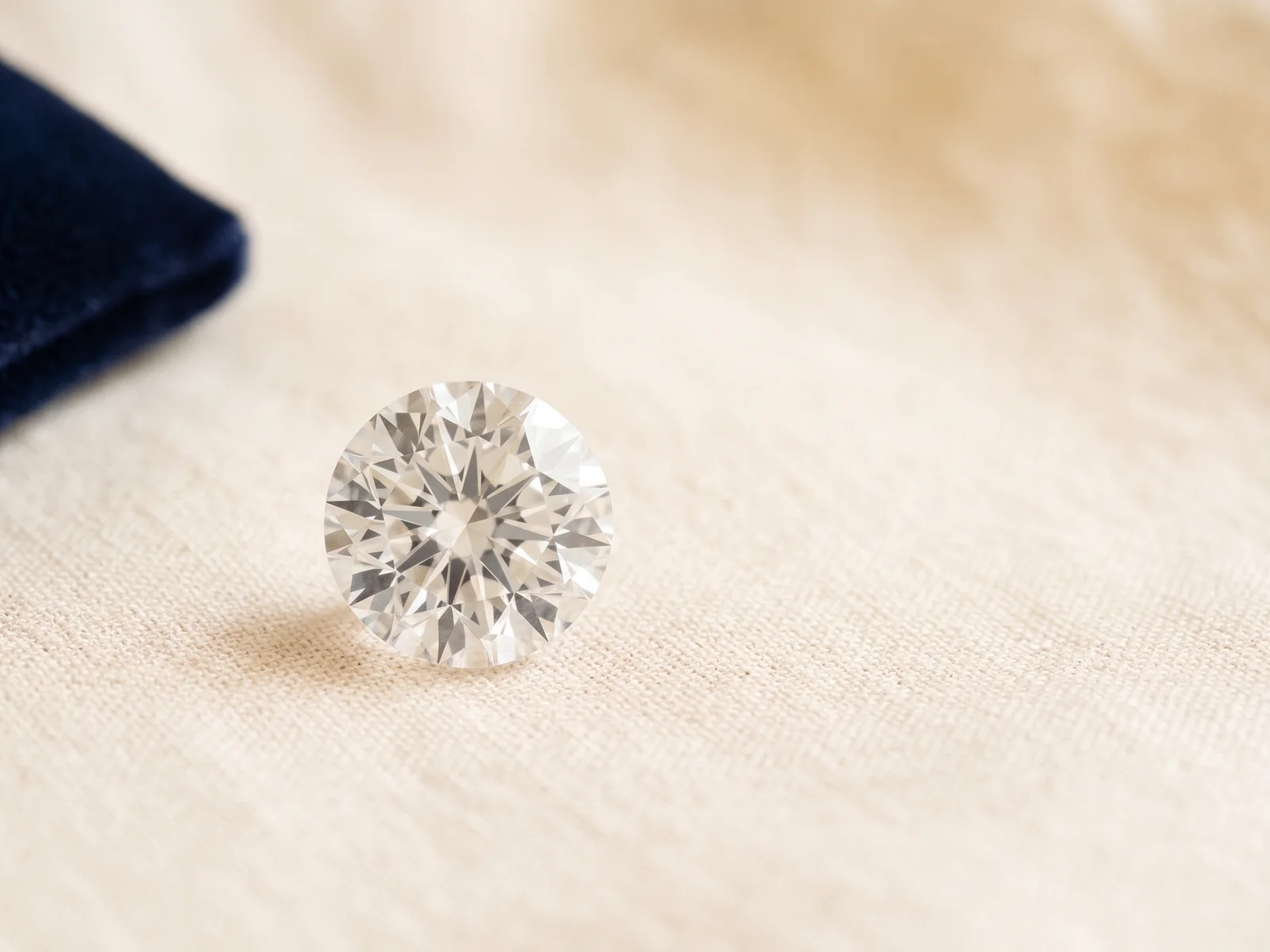
A twinning wisp is one of the most common reasons a natural diamond lands at VS or SI clarity, and one of the least understood. Here is what it is, how to read it on a report, and when it matters.
 Reviewed by Raj Sood, Graduate Gemologist (GIA), AJP (GIA)Master jeweller and Graduate Gemologist (GIA) · reviewed 4 November 2026
Quick answer
A twinning wisp is a ribbon-like band of pinpoints, clouds or crystals trapped along a twinning plane, where a natural diamond's crystal changed growth direction. It is plotted in red on a grading report. Most are low risk to durability and are often eye-clean at VS and SI1 grades, but larger wisps in SI2 or I stones may show.
What is a twinning wisp in a diamond?
A twinning wisp is an internal clarity characteristic, or inclusion. It looks like a thin, twisting ribbon or streak running through the diamond, often with a faint white or grey haze. Under magnification it turns out to be a line of tiny pinpoints (minute crystals that look like specks of dust), small clouds (clusters of pinpoints too close to see individually) and sometimes larger included crystals, all lying along the same internal plane.
That plane is called a twinning plane: a boundary inside the crystal where the arrangement of carbon atoms changes direction. Everything caught on that boundary as the diamond grew ends up lined up in a sheet, which is why a twinning wisp reads as one feature rather than scattered dots. If you are new to clarity, start with our explainer on the 4Cs of colour, clarity, cut and carat, then come back to the detail here.
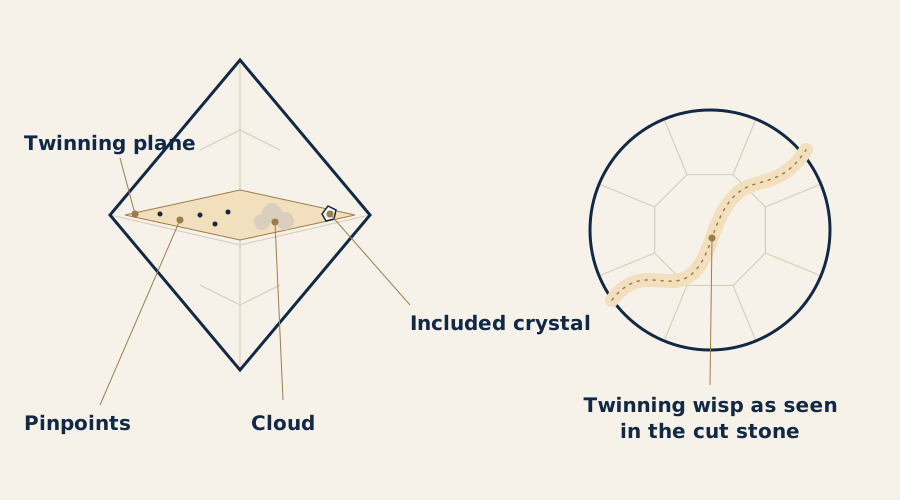
Twinning wisps are a well-known feature of natural diamonds and appear on grading reports from labs such as GIA under their own name. They are one of a family of growth-related features, alongside graining, that tell a gemmologist something about how the stone formed deep underground. Our diamond education hub covers the other inclusion types, and any unfamiliar term here is defined in our plain-English jewellery glossary.
How does a twinning wisp form?
Diamond normally grows as an octahedron, a shape like two four-sided pyramids joined at the base. Sometimes growth is disturbed by a change in pressure, temperature or the chemistry of the surrounding rock. Part of the crystal then carries on growing in a mirrored orientation, and the two halves meet along a twinning plane. Gemmologists call the result a twinned crystal; the flat, triangular twinned diamonds sometimes found in rough are known as macles.
At the moment of that disturbance, the growing surface is uneven. Tiny mineral grains, specks of other material and minute structural defects get trapped right on the boundary. Hundreds of millions of years later, when the rough is cut and polished, those trapped particles show up as the twinning wisp.
- Pinpoints: the most common ingredient, giving the wisp its speckled, dusty look.
- Clouds: dense patches of pinpoints that can make part of the wisp look hazy.
- Crystals: occasionally a larger included mineral grain sits along the plane.
- Graining: the distorted lattice along the plane often shows as faint lines, so wisps and graining frequently appear together.
Because the crystal structure is distorted along the twin, a twinning wisp is closely related to internal graining. Our page on internal graining and how it differs from a wisp explains the reflective lines and colour bands that sometimes travel with a twinning plane.
Where does a twinning wisp show on a GIA report plot?
A full grading report includes a plot: a diagram of the diamond face-up (crown view) and face-down (pavilion view) with each significant inclusion mapped in position. Internal features are drawn in red and external features, such as naturals or extra facets, in green. A twinning wisp is internal, so it is drawn in red along its path, and the words Twinning Wisp appear in the Key to Symbols beside the plot.
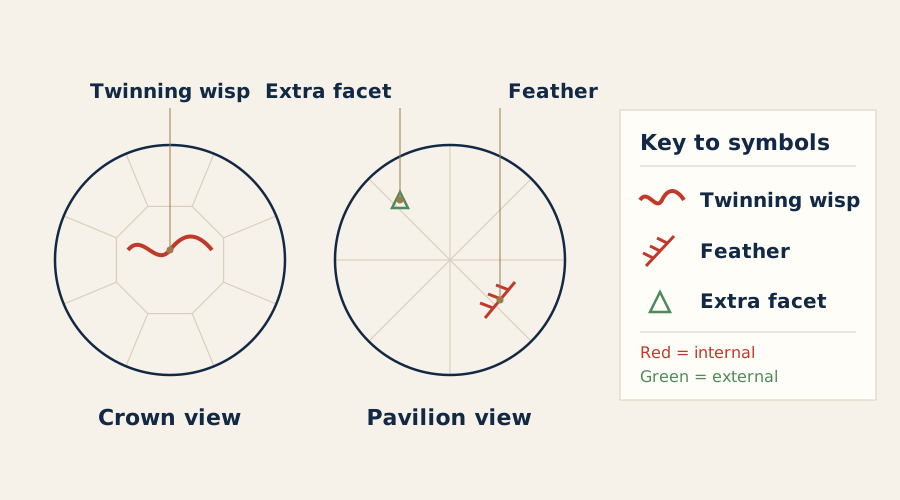
The order of the Key to Symbols also matters. Labs generally list features from most to least important to the clarity grade, so a twinning wisp listed first is usually the main reason the diamond received its grade. Listed third or fourth after a crystal or a feather, it is a minor player.
| Where to look on the report | What it tells you about the twinning wisp |
|---|---|
| Clarity grade | The overall result; a wisp alone commonly sits at VS1 to SI1 |
| Key to Symbols | Confirms a twinning wisp is present and its rank among the inclusions |
| Plot (crown view) | Whether the wisp crosses the table, where it is easiest to see |
| Plot (pavilion view) | Whether it sits low in the stone, where it is often hidden by reflections |
| Comments | May note clouds or pinpoints not shown on the plot, which can be part of the wisp |
| Polish grade | Twinned areas can be harder to polish, sometimes leaving faint polish lines |
That last row surprises people. Where the grain of the crystal changes direction, the polishing wheel meets diamond that is harder in one direction than another, so cutters can struggle to get a perfect finish. It rarely drops a stone far, but it is one reason to read the clarity and finish grades together. See how polish and symmetry are graded and what each polish grade means in practice.
How does a twinning wisp affect a diamond's clarity grade?
GIA's clarity scale has 11 grades, from Flawless (FL) down to Included (I3). A grader looks at five factors for each inclusion: size, number, position, nature and relief (how much it contrasts with the surrounding diamond). A twinning wisp is usually low in relief, since pinpoints are tiny and light in tone, so a modest wisp often earns a better grade than a dark crystal of the same length would.
| Clarity grade | What a twinning wisp typically looks like at this grade | Visible without magnification? |
|---|---|---|
| VVS1–VVS2 | Very faint, short wisp, hard to find even at 10× | No |
| VS1–VS2 | Fine wisp, seen at 10× with some effort | No |
| SI1 | Longer or more obvious wisp, often crossing part of the table | Usually not, worth checking in larger stones |
| SI2 | Prominent wisp or wisp with hazy clouds along it | Sometimes, from below or close up |
| I1–I3 | Large, hazy or crowded wisp that can dull brightness | Often |
These are typical patterns rather than rules. Position counts a great deal: a wisp running under the table (the large flat top facet) is graded more strictly than one tucked near the girdle, the thin outer edge where the crown meets the pavilion. A brilliant cut such as a round also hides a wisp better than a step cut such as an emerald or Asscher, whose open, mirror-like facets show what is inside.
Not sure which one is right?
Send us the stones you are looking at and our gemologist will tell you which to choose and why.
Is a twinning wisp bad for a diamond's durability?
In most diamonds, no. A twinning wisp is a line of trapped particles and lattice distortion, not a crack. That sets it apart from a feather, which is a genuine break inside the stone. Diamond is 10 on the Mohs hardness scale, and a typical wisp does not change that or make the stone noticeably easier to chip in everyday wear.
There are a few situations where a gemmologist looks more closely:
- The wisp reaches the surface, especially at the girdle or a corner. Any break in the surface is a point where a knock can concentrate.
- A feather runs along the wisp. The strain on a twinning plane can be where a small fracture forms, so check the plot for a feather symbol sharing the same path.
- The stone is a fancy shape with a thin point, such as a pear, marquise or heart, and the wisp ends near that point.
- The wisp is dense with clouds and noticeably hazy. This is mainly a beauty issue, as it can soften brightness, rather than a strength issue.
Other features deserve more caution. Our pages on etch channels that run in from the surface and bearding along the girdle cover two that can genuinely affect the edge, while pits and extra facets are surface marks that matter mostly for finish.
Twinning wisp vs feather, cloud and graining: what's the difference?
On a plot these features can sit close together, and the names are easy to confuse. This comparison sets them side by side.
| Twinning wisp | Feather | Cloud | Graining | |
|---|---|---|---|---|
| What it is | Pinpoints, clouds or crystals along a twinning plane | A break or fracture inside the stone | A cluster of tiny pinpoints | Lines from irregular crystal growth |
| Looks like | Ribbon or twisting streak | White or transparent crack, can look feathery | Hazy patch | Faint lines, reflective planes or colour bands |
| Plot colour | Red | Red | Red | Red if plotted (green if surface graining); often noted in comments instead |
| Durability risk | Low in most stones | Low to high, depends on size and position | Very low | Very low |
| Can affect brightness? | Only if large and hazy | Sometimes, if it reflects light | Yes, if large | Only if strong |
| Usual clarity range | VVS to SI, sometimes I | VS to I | VVS to I | VVS to SI |
The practical upshot: a twinning wisp and a cloud are mostly about appearance, while a feather is the one to judge for strength. When the report lists a twinning wisp and a feather together, check whether they overlap on the plot.
Is a diamond with a twinning wisp eye-clean?
Usually, at VS grades and in most SI1 stones. Eye-clean means you cannot see any inclusion without magnification at a normal viewing distance of about 25–30 cm, looking face-up. Pinpoint-based wisps are light in tone and low in relief, so they tend to blend into the sparkle of a brilliant cut. Our guide on how to tell if a diamond is eye-clean explains the viewing test in full.
Three things push a twinning wisp towards being visible:
- Size of the diamond. In a 2 carat round (about 8.1 mm across), an SI1 wisp is physically larger and easier to spot than in a 0.30 carat stone (about 4.3 mm). For diamonds between 0.25 and 0.4 carat, SI1 and even SI2 wisps are often invisible to the eye.
- Cut style. Step cuts such as emerald and Asscher show inclusions more than brilliant cuts such as round, oval and cushion.
- Position. A wisp crossing the table is the hardest to hide; one near the girdle can be covered by a claw.
Because a wisp is often invisible but still lowers the grade, an SI1 stone whose only real feature is a fine twinning wisp can be a sensible way to put more of your budget into size or cut. Weigh that trade-off with our page on whether to trade clarity for size.
Do lab-grown diamonds have twinning wisps?
Twinning wisps are mainly found in natural diamonds, because twinning comes from the disturbed growth conditions deep in the earth. Lab-grown diamonds are real diamond with the same hardness and a refractive index of about 2.42, but they grow differently. CVD (chemical vapour deposition) diamonds build up in layers on a flat seed plate, and HPHT (high pressure, high temperature) diamonds crystallise from a metal solution. Their typical inclusions are dark specks of non-diamond carbon in CVD stones and metallic flux inclusions in HPHT stones, rather than twinning wisps.
That does not make a twinning wisp proof that a diamond is natural. Only a lab test with specialised equipment can confirm origin, and the grading report will state clearly whether a stone is natural or laboratory-grown.
Some buyers also ask whether a wisp interacts with fluorescence, the glow some diamonds show under ultraviolet light. They are separate features, but in a stone with a hazy wisp, strong blue fluorescence can occasionally add to a slightly milky look in sunlight. Read up on what fluorescence is and why diamonds glow and on fluorescence strengths from None to Very Strong before you compare stones with both.
Browse natural and lab-grown diamonds
How do you judge a diamond with a twinning wisp? Step by step
- Read the Key to Symbols. Note whether the twinning wisp is listed first (the grade-setting feature) or further down.
- Find it on the plot. Check whether it crosses the table, sits low in the pavilion or reaches the girdle.
- Look for a feather on the same path. A wisp alone is low risk; a wisp with a feather needs a closer look.
- Check the finish grades. Confirm polish and symmetry are acceptable, since twinned areas can be harder to polish.
- View the stone or a 360° video face-up. At normal distance, ask whether you can see anything at all; if you cannot, the wisp is eye-clean for you.
- Plan the setting. If the wisp ends near the girdle, ask the jeweller to place a claw away from it or over it, as advised after inspection.
Cut quality still does more for how a diamond looks than a fine wisp ever will. Compare Excellent, Very Good and Good cut grades and see symmetry grades explained so you can balance all the grades on the report, not just clarity.
Free consultation
Talk to a gemologist
Compare stones in person or online with Raj Sood, Graduate Gemologist (GIA), AJP (GIA).
Book a consultationShop this shape
FAQ
Common questions
Is a twinning wisp bad in a diamond?
Usually not. A twinning wisp is a band of pinpoints and clouds along a growth plane, not a crack, so it rarely affects durability. It mainly lowers the clarity grade, often to VS or SI1, while staying invisible to the eye.
Can you see a twinning wisp with the naked eye?
In VS and most SI1 diamonds, no. Larger or hazier wisps in SI2 and I grade stones, or in big step-cut diamonds, can be visible face-up.
What is the difference between a twinning wisp and a feather?
A twinning wisp is a line of trapped particles along a twinning plane, while a feather is a fracture inside the stone. Feathers carry more durability risk, especially if they reach the surface.
Why does my GIA report list a twinning wisp?
The lab found one large enough to affect the clarity grade. If it is listed first in the Key to Symbols, it is usually the main reason for the grade.
Do lab-grown diamonds have twinning wisps?
They are uncommon in lab-grown diamonds, which tend to show dark carbon specks or metallic flux inclusions instead. A wisp alone does not prove a stone is natural; the grading report confirms origin.
Does a twinning wisp lower a diamond's price?
Indirectly. It lowers the clarity grade, and a lower clarity grade costs less, so an eye-clean SI1 with only a fine wisp can offer good appearance for the money.
Terms in this guide

Ask a gemologist
Not sure which diamond to choose?
Raj Sood is a Graduate Gemologist (GIA) and master jeweller. Bring the stones you are considering, or send the reports, and he will tell you honestly which one is better and why.
Keep learning
Related guides
 Diamond 4Cs & GradingEye Clean Diamonds
 Diamond 4Cs & GradingGraining in DiamondsDiamond 4Cs & GradingEtch Channels in DiamondsDiamond 4Cs & GradingDiamond 4Cs
 Diamond 4Cs & GradingPits and Extra Facets on Diamonds
 Diamond 4Cs & GradingDiamond EducationDiamond 4Cs & GradingFluorescenceDiamond 4Cs & GradingPolish and Symmetry
Explore more
More guides on this topic
Education